How to open a business bank account in Nigeria
What you need to open a business bank account in Nigeria, how banks and digital banks compare, the charges to ask about, and how to set the account up well from day one.


Photo: Natasha Hall / Unsplash
- To open a business bank account in Nigeria you first register the business with CAC, then give your chosen bank or licensed digital bank your registration documents, each signatory's ID, BVN and NIN, photos, proof of address and, at many banks, references. Compare charges and deposit insurance before you choose, and keep business and personal money apart from day one.
To open a business bank account in Nigeria, you first register your business with the Corporate Affairs Commission (CAC). Then you choose a bank or a licensed digital bank and give it your CAC registration documents, a valid ID plus the Bank Verification Number (BVN) and National Identification Number (NIN) of everyone who will sign on the account, passport photographs and proof of your business address. Many traditional banks also ask for two references. Limited companies usually add a board resolution and a Tax Identification Number.
That’s the short version. Below we cover why a separate business account matters, how the different kinds of banks compare, the documents for each type of business, the charges worth asking about, and how to set the account up so it works for you. It reflects what we could check as of 28 September 2026; requirements vary by bank and change over time, so always ask for your bank’s current checklist.
This is general information, not financial or legal advice. Confirm details with your bank and the Central Bank of Nigeria.
Why your business needs its own bank account
Plenty of small businesses in Nigeria start by running everything through the owner’s personal account. It works until it doesn’t. A separate business bank account gives you:
- Clear records. Every naira in and out is business, so you can see what you actually earn and spend.
- Trust. Customers and companies are more comfortable paying “Okafor Creative Studio” than a personal name they don’t recognise.
- Access to tools. Payment providers, POS terminals, loans and many corporate clients expect a business account in the registered name.
- Easier tax time. You won’t be picking business transactions out of a year of personal spending.
- A clean paper trail if you ever raise money, take a loan or sell the business.
If you haven’t registered your business yet, start with our guide on how to register a business name in Nigeria with CAC. Banks will ask for the certificate before they open an account in a business’s name.
Traditional bank, microfinance bank or digital bank?
You have two broad choices: a commercial bank, or a microfinance or digital bank (many app-based business accounts are run by licensed microfinance banks). The right one depends on how you get paid, how much cash you handle and whether you need to walk into a branch.
| Commercial bank | Microfinance or digital bank | |
|---|---|---|
| Opening | Often in branch or a mix of online and branch, with forms and references | Often fully in an app, with document uploads |
| Branches and cash | Branches for cash deposits, cheques and in-person help | Few or no branches; agents or partner banks for cash |
| Credibility with large clients | Widely accepted for contracts and tenders | Increasingly accepted; some organisations still prefer commercial banks |
| Foreign currency | Domiciliary (USD, GBP, EUR) accounts usually available | Varies |
| Deposit insurance limit | Up to ₦5 million per depositor (NDIC) | Up to ₦2 million per depositor for microfinance banks (NDIC) |
The deposit insurance figures come from the Nigeria Deposit Insurance Corporation, which raised its limits in 2024. If you regularly hold more than the insured amount, it’s reasonable to spread money across more than one institution.
Whatever you choose, check that the institution is licensed by the CBN. A slick app is not the same as a licence. The CBN publishes lists of the institutions it licenses on its website.
Documents you’ll need for a business bank account in Nigeria
Every bank publishes its own checklist, but the core requirements are similar across the industry. A law firm’s overview on Mondaq lists the usual set: a completed account opening form, the CAC registration documents, valid ID and passport photographs for signatories, BVN, a utility bill for the business address and two reference forms, plus a board resolution and TIN for companies and SCUML registration where it applies. Digital banks follow a similar pattern in the app. Moniepoint’s help centre, for example, asks for the registration type and number, the certificate and status report, and your TIN, SCUML and operating licence where applicable.
| Document | Business name (sole proprietor or partnership) | Limited company |
|---|---|---|
| CAC certificate and registration documents | Yes | Yes, plus the company’s registration documents and constitution |
| Completed account opening form and mandate | Yes | Yes |
| Valid ID for each signatory | Yes | Yes, for directors and signatories |
| BVN and NIN for each signatory | Yes | Yes |
| Passport photographs | Usually two per signatory | Usually two per signatory |
| Proof of business address (recent utility bill or similar) | Yes | Yes |
| References from existing account holders | Often two | Often two, sometimes from corporate account holders |
| Board resolution to open the account | No | Yes |
| Tax Identification Number (TIN) | Sometimes | Usually |
| SCUML certificate | If your business type requires it | If your business type requires it |
BVN and NIN are not optional
The BVN is the CBN’s unique identity for bank customers across the industry; the CBN’s BVN page explains how it works. In December 2023 the CBN told banks and fintechs to restrict accounts without the required BVN or NIN, as Premium Times reported. Make sure every signatory’s BVN and NIN details match their ID before you apply. A spelling difference is one of the most common reasons an application stalls.
Who needs SCUML?
The EFCC’s Special Control Unit against Money Laundering registers “designated non-financial businesses and professions”, a group that includes consultants, accountants, real estate businesses, hotels, car dealers and dealers in jewellery or luxury goods, among others. If your business is in that group, your bank may ask for the SCUML certificate. Check the SCUML site for the current list.
Which type of account to ask for
Banks name their products differently, but for a business there are really three to know about.
- Business current account. The everyday account for receiving payments, paying suppliers and staff, and connecting a payment provider. This is the one you need first.
- Domiciliary account. Holds foreign currency such as US dollars or pounds. Useful if you invoice clients abroad or pay for services in foreign currency.
- Savings or deposit account. Somewhere to park money you don’t need this month, such as your tax set-aside or an emergency buffer. Not every bank offers these to business names, so ask.
Start with the current account. Add the others when you actually need them; each extra account is another statement to check.
How to open the account, step by step
- Shortlist two or three banks. Ask where your biggest clients bank, whether you need a branch nearby, and whether you’ll need a domiciliary account for foreign payments.
- Ask for the current checklist and tariff. Get the list of documents and the charges in writing, or download them from the bank’s website.
- Prepare your documents. Clear colour scans, recent utility bill, photos, and references signed by account holders who know you.
- Decide who signs. For a sole proprietor that’s you. For partners or a company, decide who can approve payments and whether one or two signatures are needed. This goes on the mandate.
- Apply online, in the app or at a branch. Many banks let you start online and finish in a branch; digital banks usually handle it in the app.
- Complete verification. The bank checks your CAC records, IDs, BVN and NIN, and may visit or verify your business address.
- Activate the account. Set up internet banking, the mobile app, any hardware token and your debit card. Make a small test transfer in and out.
Charges and fees to ask about
Fees vary between banks, and the CBN sets limits on some of them in its Guide to Charges by Banks. The latest revision took effect in May 2026. Legit.ng’s summary of the revised guide reports that maintenance fees on naira debit and credit cards are no longer allowed, email alerts must be free, and the current account maintenance fee stays negotiable but is capped, falling to ₦0.50 per ₦1,000 of qualifying debits in 2026 and to zero in 2027. The CBN’s published guide is the document to check.
Also note the ₦50 stamp duty on electronic transfers of ₦10,000 or more. From 1 January 2026 it is charged to the sender rather than the receiver, as TheCable reported. For a business that pays many suppliers, it adds up.
Questions to ask before you sign
- Is there a minimum opening balance or minimum balance to keep?
- What do outgoing transfers cost, and are bulk payments cheaper?
- What do SMS alerts cost?
- Is there a fee for internet banking tokens or extra users?
- Can I open a domiciliary account alongside it, and what does it need?
- How long will account opening take once you have my documents?
Set the account up so it works for you
- Use it only for business. Pay yourself a set amount into your personal account, rather than paying personal bills from the business account.
- Turn on alerts for every transaction, so you notice mistakes and fraud quickly.
- Give staff the least access they need. Many internet banking platforms let one person prepare payments and another approve them.
- Put your account details on every invoice, in the registered business name, so customers pay the right account first time.
- Set aside money for tax in a separate account or sub-account each time you’re paid.
- Check your statement weekly against your invoices and expenses. Our guide to bookkeeping basics shows a simple routine.
A simple way to pay yourself
Once business and personal money are apart, decide how you’ll move money between them. A fixed “salary” transfer on the same day each month is easiest to track. Some owners also take a share of profit once a quarter, after checking that tax, the next month’s costs and a small buffer are covered. Label every transfer clearly (“owner’s pay, October”) so your records explain themselves a year later.
If your application stalls
Delays are common, and most have a simple cause. Ask the account officer, in writing, exactly what is outstanding. The usual culprits are a name mismatch between documents, a reference form that hasn’t come back, or an address the bank hasn’t been able to verify. Fix the specific item rather than resubmitting everything.
If a bank can’t open the account after you’ve supplied everything on its checklist, ask for the reason and whether another branch or its online channel would be quicker. If you believe you’ve been treated unfairly, the bank must have a complaints process, and the CBN’s consumer protection team handles complaints that banks don’t resolve.
Common mistakes that delay account opening
- Names on the CAC certificate, ID, BVN and NIN that don’t match exactly.
- A utility bill that’s too old or in a different name without an explanation.
- References from people who don’t bank with the institution or can’t be reached.
- Applying before the CAC registration is complete.
- Forgetting SCUML when your type of business needs it.
How startbuddi helps once your account is open
A business bank account is where money lands. Money Manager in startbuddi is where you see why it landed, who still owes you, and what’s going out.
In Money Manager’s settings you can connect Paystack by entering your business name, bank and 10-digit account number. Card, bank transfer and USSD payments from your customers then settle straight to that business account; startbuddi never holds your money. You can also add your bank transfer details once, and they appear on every invoice you send.
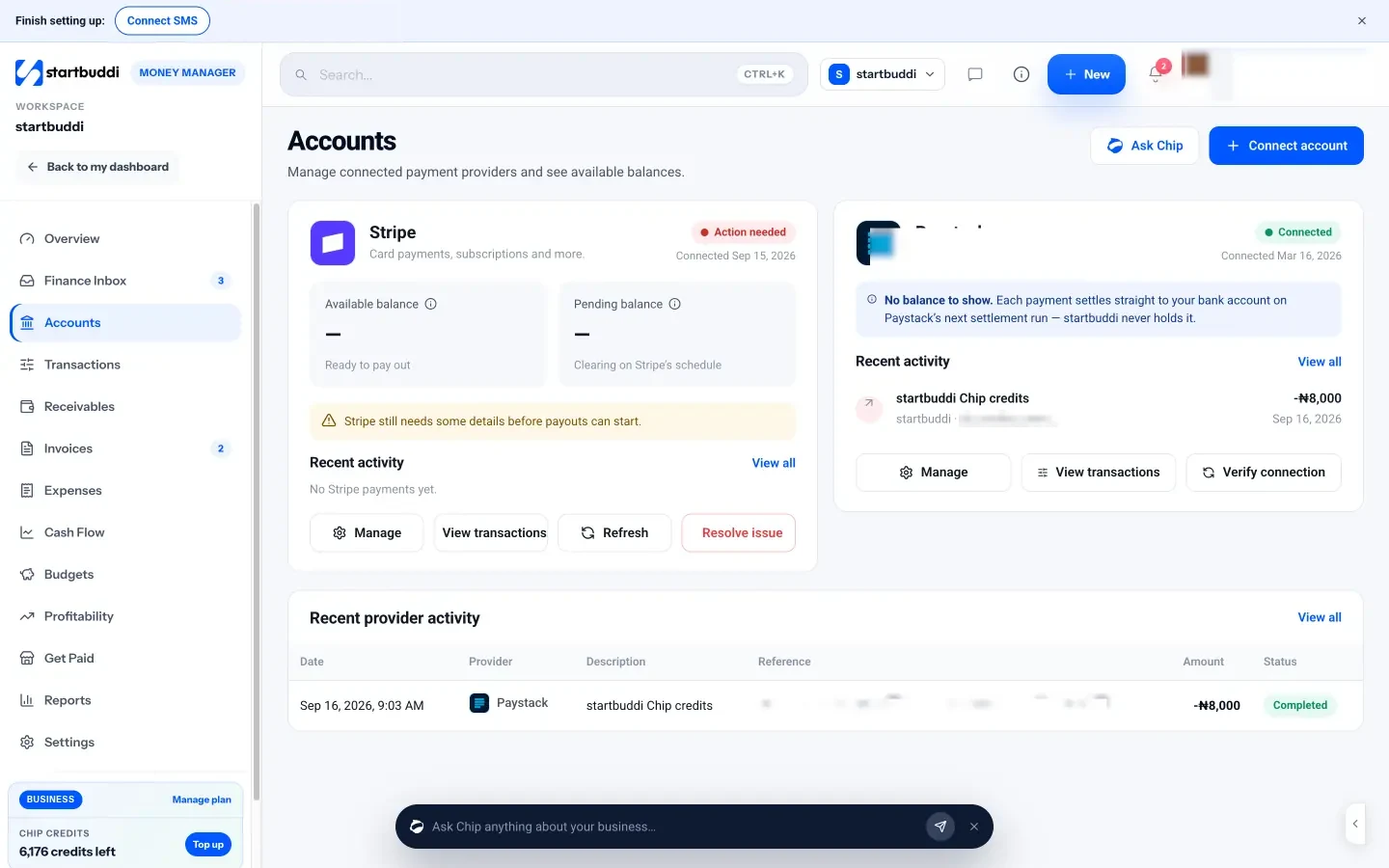
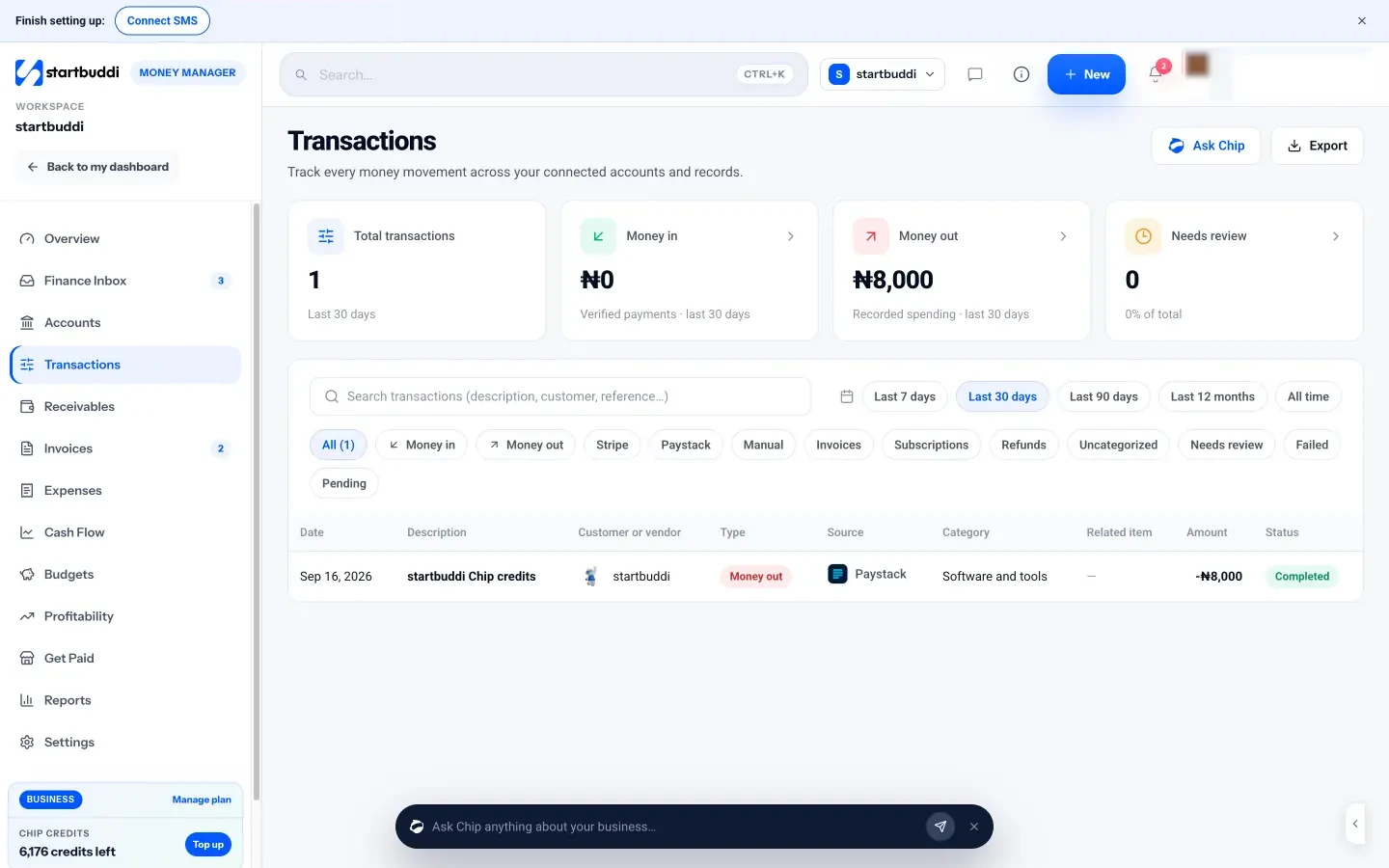
When a customer pays by transfer outside startbuddi, you record the payment against the invoice and the balance updates. Every payment and expense then shows up in one Transactions feed, filterable by money in, money out, provider and status, so checking your bank statement each week takes minutes. Note that startbuddi doesn’t connect directly to your bank’s feed; payments through Paystack or Stripe appear automatically, and others you record.
To start taking card and transfer payments into your new account, see Get Paid and our step-by-step help article on collecting payment via Paystack. Money Manager is available on every plan, including Free.
Your next step
Call or visit the websites of two banks you’re considering and ask for their business account checklist and tariff. While you wait, gather your CAC documents, a recent utility bill and your signatories’ IDs, and check everyone’s BVN and NIN details match. Once the account is open, read our guide on how to accept payments online in Nigeria and set up startbuddi free to start invoicing into it.
Sources
- Central Bank of Nigeria: Bank Verification Number
- Central Bank of Nigeria: Guide to Charges (April 2026)
- Legit.ng: CBN revised bank charges take effect
- Premium Times: CBN to restrict accounts without NIN and BVN
- NDIC: maximum deposit insurance coverage increased
- TheCable: senders to pay ₦50 stamp duty on transfers from January 2026
- Moniepoint help centre: registered business accounts
- Mondaq: requirements for opening a business bank account in Nigeria
- EFCC Special Control Unit against Money Laundering (SCUML)
Frequently asked questions
Can I open a business bank account in Nigeria without CAC registration?
Not in a business's name. Banks ask for your CAC certificate first. Some digital banks let unregistered traders open a basic account in their own name, which is useful until you register.
How long does it take to open a business account?
It depends on the bank and how complete your documents are. Digital banks are often quicker; traditional banks may need references and an address check first.
Do I need two references?
Many traditional banks ask for two references from existing account holders. Some digital banks don't. Ask your chosen bank before you apply.
Can I get paid in dollars into my business account?
You'll usually need a separate domiciliary account in the business name. Ask your bank what it requires; the documents are similar to the naira account.
Chinedu Kalu is the co-founder and chief operating officer of startbuddi, responsible for how the company runs day to day. Chinedu writes about the operational side of a small business: registering and running the company, money, hiring and the routines that keep a team on track.
Co-founded startbuddi and runs its operations