Bookkeeping basics for new business owners
Six steps to simple, reliable books: separate your money, pick categories, record every transaction with proof, and reconcile on a routine.


- Bookkeeping means recording every money movement with its date, amount, who, what, category and proof, then checking it against your bank. Separate business money, keep categories short, follow a weekly and monthly routine, and keep records for years.
Bookkeeping basics come down to one habit: write down every naira, dollar or pound that comes into or goes out of your business, with the date, who it was with, what it was for and proof, then check those records against your bank regularly. Do that, and you always know whether you are making money, who owes you, and what to hand your accountant at tax time.
This guide is for new business owners who have never kept books before. It covers the six steps to set up a simple system, a weekly and monthly routine that takes less than an hour, how long to keep your records, and the mistakes that cause the most pain later.
This is general information, not tax or legal advice. Rules differ by country; check with an accountant or your tax authority.
What bookkeeping is (and what it is not)
Bookkeeping is recording and organising your business’s money. Accounting is using those records to prepare accounts, work out tax and advise on decisions. You can do the bookkeeping yourself from day one; you will usually want an accountant for the accounting.
| Bookkeeping | Accounting | |
|---|---|---|
| What it is | Recording each transaction and keeping proof | Turning records into accounts, tax returns and advice |
| How often | Every week, ideally every day | Monthly, quarterly or yearly |
| Who does it | You, a team member or a bookkeeper | An accountant |
| What you get | A clean list of money in and out, with receipts | Profit and loss, balance sheet, tax filings |
Good bookkeeping makes accounting cheaper and faster. An accountant handed a shoebox of receipts charges for the hours it takes to sort them.
Step 1: separate business money from personal money
The single most useful thing you can do is keep business money in its own account. When your business and personal spending share one account, every transaction needs a decision: was that fuel for a delivery or for the weekend? Multiply that by a year and your records become guesswork.
- Open a business account, or at minimum a second personal account used only for the business. Our guide on opening a business bank account in Nigeria walks through the options.
- Pay yourself on purpose: transfer a set amount from the business account to your personal one and record it as owner’s drawings or salary.
- If you must pay a business cost from a personal card, keep the receipt and record it straight away so the business can pay you back.
The US Small Business Administration puts it simply in its guide to managing business finances: proper bookkeeping helps keep a business running smoothly, and you may be legally required to keep certain records.
Step 2: choose cash basis or accrual basis
There are two ways to decide when a transaction counts.
- Cash basis: you record income when the money arrives and expenses when you pay them. It is simple and matches your bank account.
- Accrual basis: you record income when you invoice and expenses when you are billed, even if no money has moved yet. It gives a truer picture for bigger businesses with lots of credit and stock.
In the UK, GOV.UK’s guidance on the cash basis describes it as recording income or expenses when you receive money or pay a bill, and notes that it needs fewer records. Many small service businesses start on a cash basis. Whichever you choose, ask your accountant what your tax authority expects, and keep a separate list of unpaid invoices so you do not forget money you are owed.
Step 3: set up a short list of categories
Categories let you see where money comes from and where it goes. Keep the list short. Ten well-used categories beat forty that nobody remembers.
Income categories might be: client work, product sales, subscriptions or retainers, and other income.
Expense categories that suit most small businesses:
- Software and tools
- Marketing and advertising
- Travel and transport
- Office and supplies
- Contractors and freelancers
- Rent and utilities
- Staff costs
- Taxes and fees
- Bank and payment fees
- Other
Use the same categories every month so you can compare. If your accountant uses different names, ask them to map theirs to yours once, at the start.
Step 4: record every transaction, with proof
For every money movement, record six things:
- Date
- Amount and currency
- Who: the customer or supplier
- What for: a short description, such as “Logo design, Ada’s Kitchen” or “Printer ink”
- Category
- Proof: an invoice number, receipt, transfer reference or photo
Proof matters. For money in, your invoice and the payment reference are the proof. For money out, snap a photo of the receipt the moment you get it; paper receipts fade and get lost. Not sure which document is which? See invoice vs receipt.
A simple record layout
| Date | Who | Description | Category | In | Out | Proof |
|---|---|---|---|---|---|---|
| 2 Oct | Ada’s Kitchen | Menu design, INV-014 | Client work | ₦180,000 | Transfer ref 00123 | |
| 3 Oct | Canva | Monthly subscription | Software and tools | ₦18,000 | Receipt photo | |
| 5 Oct | Bolt | Client meeting, Lekki | Travel and transport | ₦6,500 | App receipt |
For expense claims from staff, the expense report template gives everyone the same format.
Step 5: track who owes you and who you owe
Two short lists save a lot of money:
- Receivables: invoices you have sent that are not yet paid, with due dates. Check this list every week and follow up on anything overdue.
- Payables: bills you owe suppliers, with due dates. Paying on time protects relationships and avoids late fees.
Profit on paper means nothing if the cash has not arrived. Our guide to cash flow management for small businesses explains how these two lists drive your bank balance.
Step 6: reconcile on a routine
Reconciling means checking your records against your bank and payment statements, so every line in the bank has a matching record and nothing is missing or doubled. It is the step that turns a list into books you can trust.
| When | Task | Time |
|---|---|---|
| Every day or two | Photograph receipts and log any expense | 2 minutes |
| Weekly | Record income, check unpaid invoices, send reminders, categorise anything left over | 15 to 20 minutes |
| Monthly | Match records to bank and payment statements, review the profit and loss, check spending by category | 30 to 45 minutes |
| Quarterly | Review with your accountant, check tax you have collected, plan for tax payments | 1 hour |
| Yearly | Send records to your accountant, archive the year | Half a day |
Put the weekly slot in your calendar, same day and time. Friday afternoon works for many owners because the week’s transactions are fresh.
How long to keep your records
Keep your books and the proof behind them for years, not months. Two examples:
- Nigeria: section 31 of the Nigeria Tax Administration Act 2025 requires every person to keep books or records of accounts, in English, whether or not they are liable to pay tax, and to keep them for at least six years after the year of assessment the income relates to. The tax authority is the Nigeria Revenue Service.
- United Kingdom: GOV.UK says sole traders must keep records for at least 5 years after the 31 January submission deadline of the relevant tax year. See HMRC for other business types.
Digital copies are far easier to keep for six years than paper. Store them somewhere backed up, not only on one phone.
The three reports worth reading every month
- Profit and loss: income minus expenses for the period. It tells you whether the business made money. See how to track profit and loss.
- Cash flow: what came in and went out, and what is likely to happen next month.
- Receivables aging: unpaid invoices grouped by how late they are. Anything over 30 days needs attention now.
Read them together. A profitable month with a falling bank balance usually means clients are paying late.
Your first month: a starter checklist
If you are starting from nothing, do these in order over the next four weeks. Each one takes less than an hour.
- Week 1: open or choose a separate account for the business, and move any business subscriptions and supplier payments to it.
- Week 1: write down your income and expense categories and decide on cash or accrual basis with your accountant.
- Week 2: gather the last three months of bank statements and receipts, and record what you can. Do not chase perfection for old months; get the big items right.
- Week 3: list every unpaid invoice and every bill you owe, with due dates.
- Week 4: do your first monthly reconciliation and read your first profit and loss. Put the weekly slot in your calendar for the months ahead.
By the end of the month you will have clean books going forward and a rough picture of the past, which is enough to make better decisions straight away.
When to get a bookkeeper or accountant
Doing your own bookkeeping makes sense while the business is small and you have the time. It stops making sense when the hours you spend on it would earn more doing client work, or when the rules get complicated. Common signs it is time for help:
- You regularly have more than a few dozen transactions a week.
- You have staff to pay, or you need to register for and file VAT or sales tax.
- You hold stock, sell on credit to many customers, or trade in more than one currency.
- A bank, investor or large client asks for formal accounts.
- You keep falling behind, and the backlog is stressing you out.
Even then, keep reading your reports every month. A bookkeeper can record the numbers, but only you can decide what to do about them.
Common bookkeeping mistakes
- Mixing personal and business money. The root of most messy books.
- Waiting until tax time. Catching up on a year of receipts takes days and you will miss some.
- Not recording cash. Cash sales and cash expenses vanish unless you log them the same day.
- Forgetting fees. Payment provider and bank charges add up; record them as their own category.
- Too many categories. If you hesitate over where something goes, merge categories.
- Treating VAT or sales tax you collect as income. Tax you charge customers usually belongs to the tax authority. Our guide on VAT for small businesses in Nigeria explains more.
- No backups. A lost phone should not mean lost records.
How startbuddi helps with bookkeeping
Money Manager keeps your invoices, payments and expenses in one place, so most of your records build themselves as you work. It is not a full accounting system, and it does not file taxes, but it gives you clean records and reports to hand to an accountant.
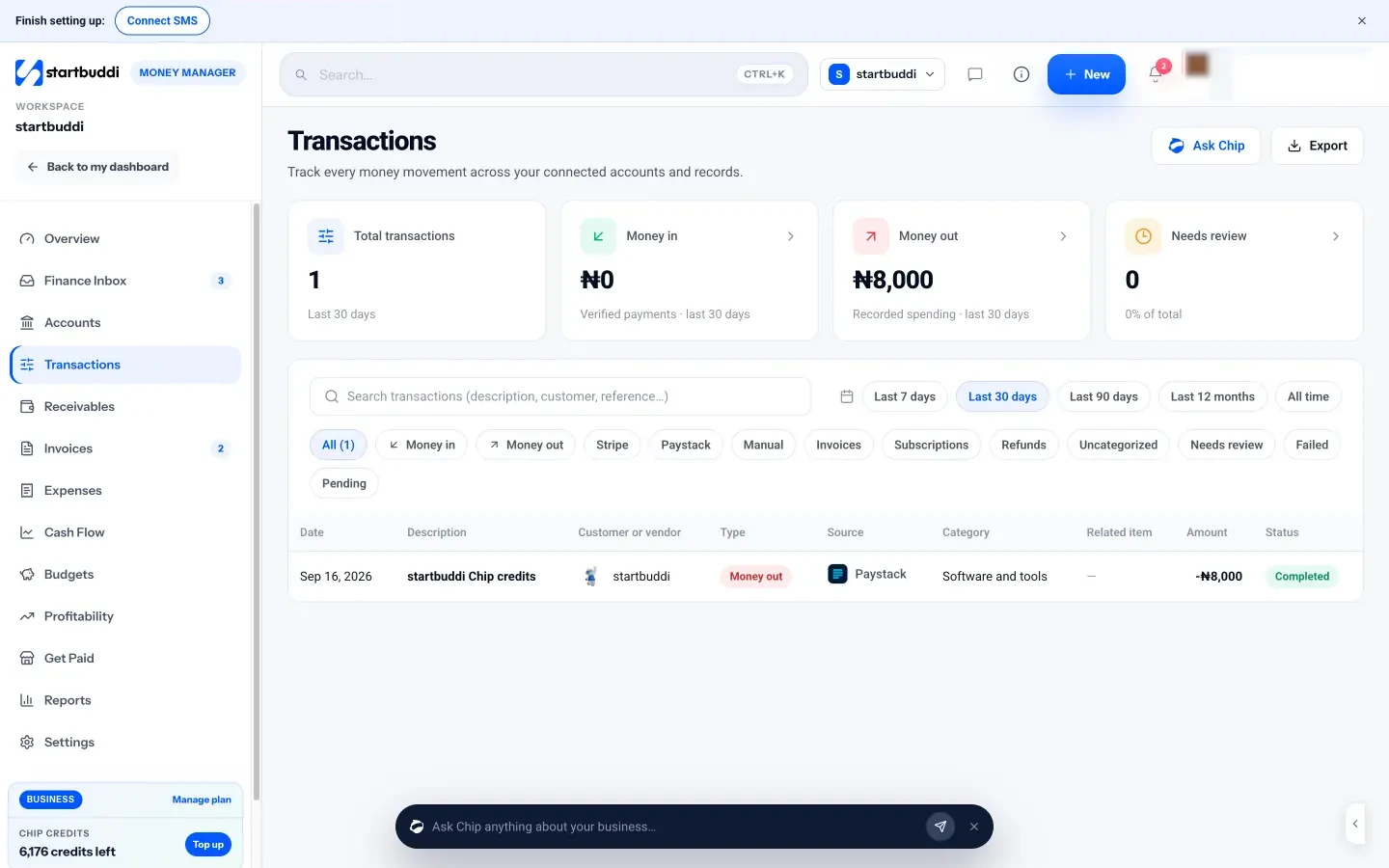
Money in is recorded for you. When a client pays an invoice, payment link or subscription through Paystack or Stripe, the payment lands in Transactions and is matched to what it was for. For bank transfers or cash, open the invoice and use Record payment to log the amount, method, date and a note such as the transfer reference.
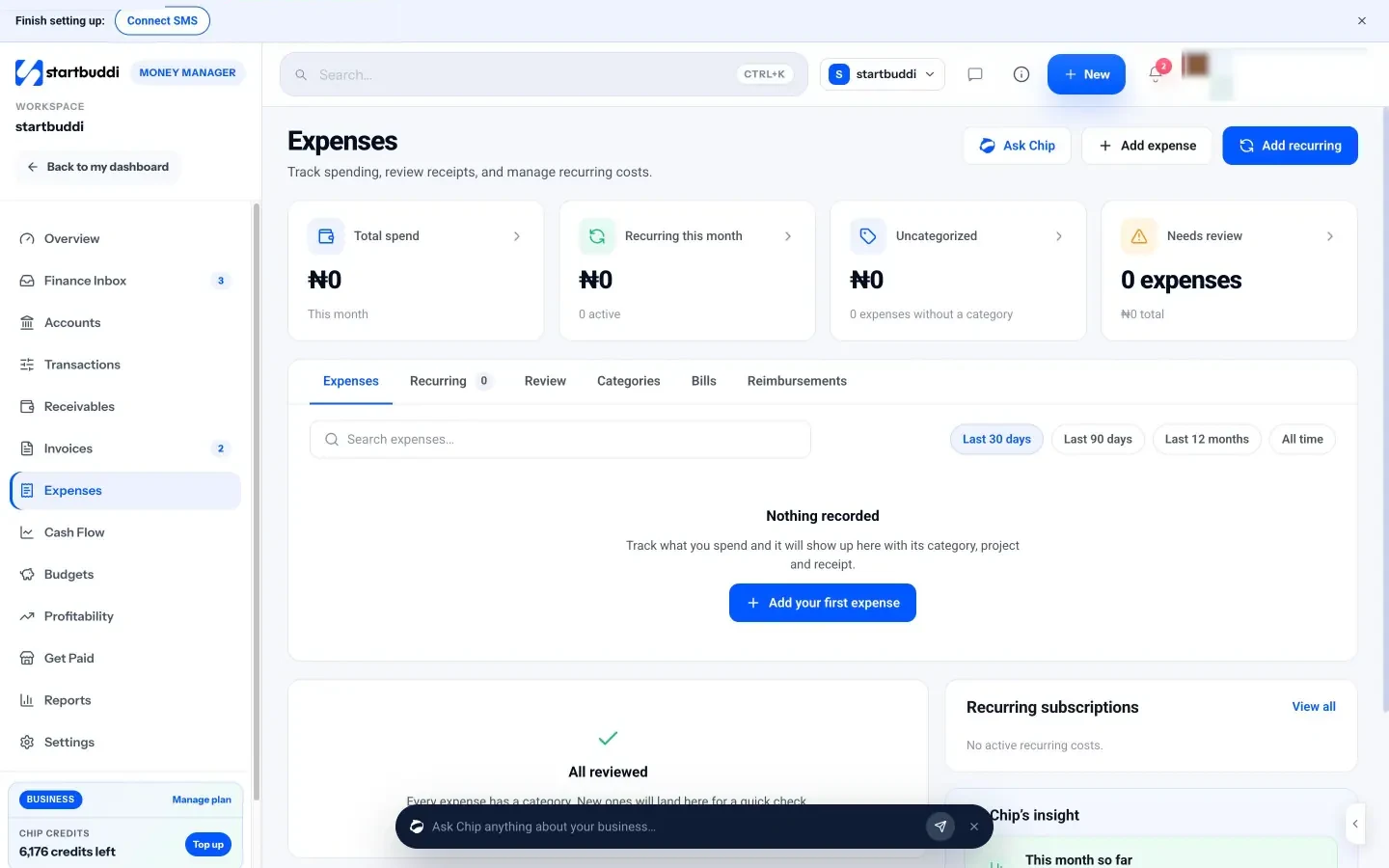
Expenses with receipts. Add an expense with the vendor, amount, category, date, how it was paid and a photo or PDF of the receipt. Recurring costs such as rent and subscriptions have their own tab, and a review queue suggests the category the vendor was last given, so uncategorised items do not pile up. There is no bank feed, so expenses are entered by you. See expenses, bills and reimbursements and what expense tracking is.
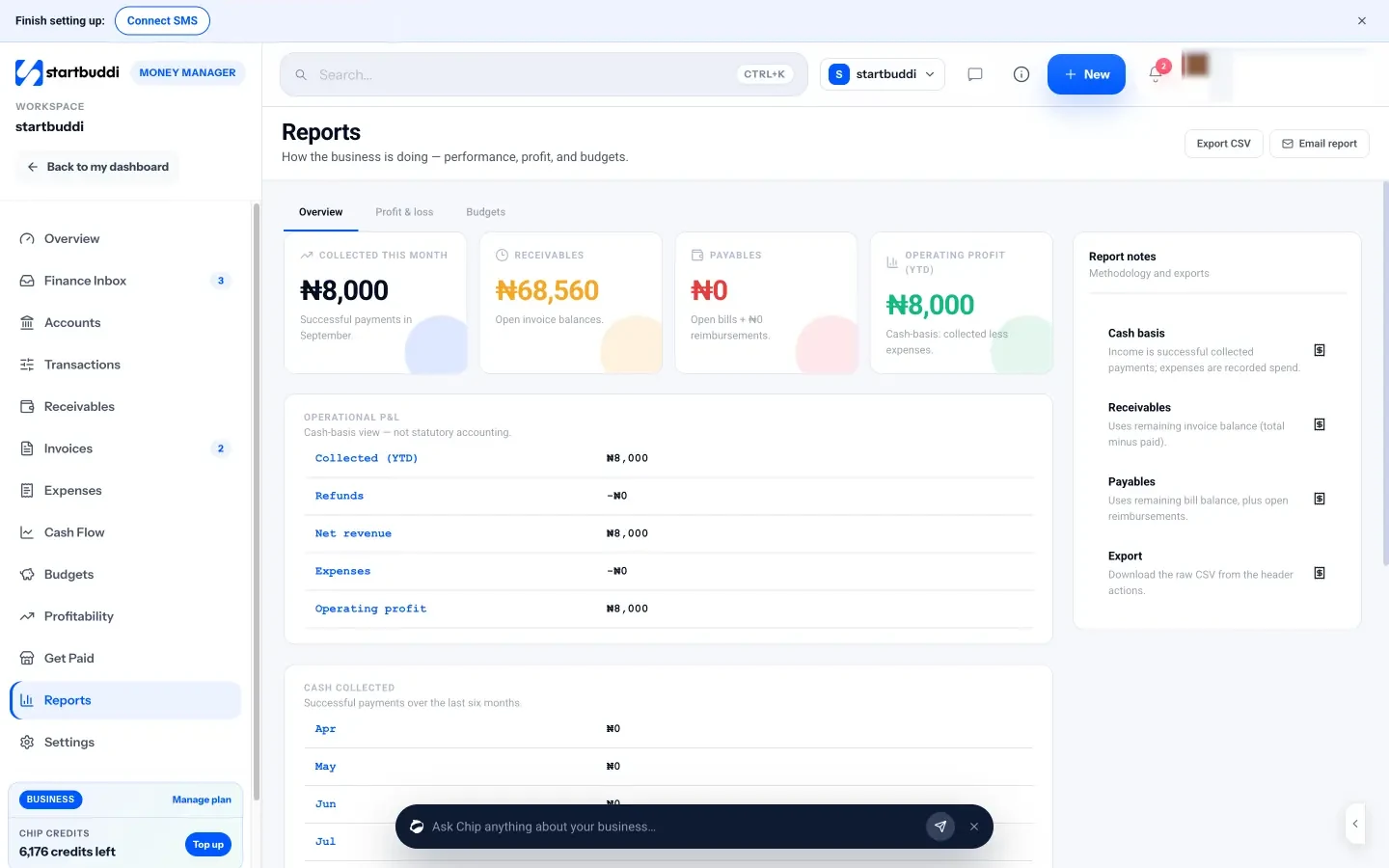
Reports for you and your accountant. Reports show a cash-basis profit and loss built from your real invoices and expenses, cash collected, receivables and payables aging, expenses by category and a running total of tax added to invoices. Export CSV to send the raw data to your accountant. See reports.
Money Manager is included on every plan, including Free, which allows 5 invoices a month. Starter and above include unlimited invoices.
Your next step
Block 20 minutes this Friday. Write down your categories, log last week’s income and expenses with proof, and list every unpaid invoice. If you would rather have most of that recorded as you go, set up Money Manager and connect Paystack or Stripe, or compare plans on the pricing page.
Sources
- Nigeria Tax Administration Act 2025, section 31 (Official Gazette, via Tax Appeal Tribunal)
- GOV.UK: How long to keep your records (self-employed)
- GOV.UK: Cash basis
- U.S. Small Business Administration: Manage your finances
Frequently asked questions
Do I need an accountant if I do my own bookkeeping?
Usually yes, for tax returns and year-end accounts. Doing your own bookkeeping makes the accountant's job quicker and cheaper.
Can I use a spreadsheet for bookkeeping?
Yes, to start. It works if you update it weekly and keep receipts. Most owners move to software once invoices and expenses grow.
How often should I do my bookkeeping?
Log receipts as they happen, record and review weekly, and reconcile against your bank monthly.
How long should I keep business records in Nigeria?
The Nigeria Tax Administration Act 2025 says at least six years after the year of assessment the income relates to.
Chinedu Kalu is the co-founder and chief operating officer of startbuddi, responsible for how the company runs day to day. Chinedu writes about the operational side of a small business: registering and running the company, money, hiring and the routines that keep a team on track.
Co-founded startbuddi and runs its operations