No-Show Policy Template (and How to Enforce It Kindly)
A free no show policy template for appointments: copy-ready wording, a filled example, fair deposits and fees, and kind ways to enforce it with clients.


A no-show policy template is ready-made wording that tells clients what happens if they miss a booked appointment without notice: the notice you need, any fee or lost deposit, and how many misses you allow. Copy the template below, set the numbers to fit your business, show it before clients book, and apply it the same way every time.
Key takeaways
- A good no-show policy covers four things: what counts as a no-show, the notice you need, what it costs, and what happens after repeat misses.
- A deposit taken at booking is far easier to enforce than a fee you try to collect afterwards.
- Keep any charge in line with what the missed slot really cost you. Consumer law in the UK and Nigeria both point that way.
- Enforce it kindly: waive the first miss for a genuine emergency, and always offer to rebook.
Why a written no-show policy matters
A no-show appointment costs more than the fee for that slot. You turned someone else away, you may have prepared materials or travelled, and the gap is usually too late to fill. Our no-show cost calculator shows what two or three misses a week add up to over a year.
Without written rules, every missed appointment becomes a negotiation. With them, you can point to something the client already agreed to, which takes the personal sting out of it for both of you. It also means your team applies the same rule, rather than one person waiving fees and another charging them.
This page is only about no-shows and very late arrivals. If you need a full policy that also covers cancellations, rescheduling and refunds, start from our cancellation policy template or build one in the booking policy writer.
The no-show policy template
Copy everything in this section, replace each item in square brackets, and delete any clause that doesn’t apply to you.
Missed appointment (no-show) policy
1. What counts as a no-show. If you don’t arrive, or don’t join the call, within [15] minutes of your appointment’s start time and haven’t told us, we treat the appointment as a no-show and release the slot.
2. How to let us know. If you can’t make it, tell us at least [24 hours] before your appointment by [replying to your confirmation email / messaging us on WhatsApp at number / using the cancel link in your booking email]. Changes made in time are free.
3. Deposit. We take a deposit of [amount or percentage] when you book. It counts towards the price of your appointment. If you miss the appointment without notice, we keep the deposit to cover the time we reserved for you.
4. No-show fee. [If no deposit was taken:] A missed appointment without notice may be charged at [amount], which reflects the time we set aside and couldn’t offer to anyone else. We’ll send you an invoice or payment link.
5. Arriving late. If you arrive late, we’ll do what we can in the time left, and the appointment will still finish at the booked time so the next client isn’t kept waiting. The full price applies.
6. Repeat no-shows. After [two] no-shows in [12 months], we’ll ask for [full payment] when you book future appointments.
7. Emergencies. We understand that emergencies, illness and bereavement happen. Tell us as soon as you can and we’ll waive the charge.
8. If we have to cancel. If we cancel or miss your appointment, we’ll rebook you at a time that suits you and refund any deposit if you’d rather not rebook.
By booking, you agree to this policy. Questions? Contact us at [email or phone].
How to fill in the no-show policy template
Choose your grace period
Fifteen minutes suits most 45 to 60 minute appointments. For a 20-minute call, ten minutes is plenty. For a three-hour job where you travel to the client, you might define a no-show as “not at the address, or not answering the door or phone, within 30 minutes of the arrival window”.
Set your notice period
Match the notice to how quickly you can refill a slot. A busy barber might refill a slot in two hours; an IT consultant who blocks half a day for an onsite audit needs 48 hours. Long notice periods that you can’t justify make clients wary of booking at all.
Pick a deposit or a fee, not both
A deposit is collected up front, so there’s nothing to chase. A no-show fee has to be invoiced after the event, and clients who didn’t turn up are often the slowest to pay. Use the deposit calculator to set an amount that covers the slot without putting people off. If you do charge a fee, treat it like a late payment fee: state it in advance, keep it proportionate, and invoice it promptly.
Keep the charge fair
In the UK, the government’s guide to writing a fair contract for customers (checked on 1 October 2026) says non-refundable deposits should reflect a genuine estimate of what you’ll lose, and that important terms must be made prominent. In Nigeria, the FCCPC’s consumer rights page (checked on 1 October 2026) explains that under section 120 of the Federal Competition and Consumer Protection Act, consumers can cancel advance bookings subject to reasonable cancellation charges. A deposit equal to part of the price is usually easier to defend than a fee bigger than the appointment itself. This isn’t legal advice; check the rules where you trade.
A filled example
Here is the policy filled in for a small IT support firm in Ikeja that books 60-minute onsite visits and 30-minute remote sessions. The figures are illustrative.
| Clause | What they chose | Why |
|---|---|---|
| Grace period | 15 minutes onsite, 10 minutes remote | A technician on the road can’t wait an hour |
| Notice | 24 hours for remote, 48 hours for onsite | Onsite visits are planned around Lagos traffic |
| Deposit | ₦10,000 on onsite visits priced at ₦35,000 | Covers transport and the blocked morning |
| No-show fee | None for remote sessions | Easy to refill, not worth chasing |
| Repeat rule | Full payment up front after 2 no-shows in 12 months | Protects the schedule from the same few clients |
With these settings, one missed onsite visit leaves the firm ₦25,000 short on the booking instead of ₦35,000, and the ₦10,000 deposit covers the transport it already spent. A London consultancy could use the same structure with a £50 deposit on a £150 session.
How to enforce a no-show policy kindly
The policy only works if you apply it, but how you apply it decides whether the client comes back.
Show the policy before they book
Put a short version on your booking page and in the confirmation email. “By booking, you agree to our no-show policy” with a link is enough. Clients are far less upset by a rule they saw before they paid.
Remind them, and make cancelling easy
Plenty of no-shows are people who forgot, not people who didn’t care. A reminder a day before and another a couple of hours before, each with a cancel or reschedule link, lets them tell you in time. Our guide to reducing no-show appointments has reminder wording you can copy.
Use a first-time waiver
For a client’s first miss, waive the fee once and say so: it buys goodwill and makes the rule feel fair when you do apply it. Record the waiver, so the second miss is handled by the policy, not by memory.
Send a calm follow-up the same day
Something like this works on WhatsApp or email:
Hi [Name], we missed you at your [time] appointment today. I hope everything’s okay. As mentioned in our booking policy, the [deposit] covers the reserved slot. Would you like to rebook? Here’s the link: [booking link].
Lead with concern, state the policy once, and end with a way to rebook.
Common mistakes with no-show policies
- Hiding the policy in small print, then charging people who never saw it.
- Charging more than the appointment was worth.
- Applying it to some clients and not others, which your regulars will notice.
- Charging a fee without first checking that your own reminder went out.
- Never revisiting it. If no-shows fall after you add deposits, you may be able to shorten the notice period.
How to run your no-show policy in startbuddi
startbuddi doesn’t charge a saved card after a no-show. It enforces the policy through deposits, reminders and follow-ups.
- Take a deposit when they book. In Bookings, open a service, go to Duration & pricing, turn on Require payment to book and choose a deposit. The client pays through Paystack (card, bank transfer, USSD or mobile money) or Stripe (card), and the slot is only confirmed once they pay.
- Show the policy on the booking page. Add a short version to the service description or the page’s intro text, and a required Single choice booking question such as “I’ve read the no-show policy”.
- Send reminder emails. Under Availability, choose when reminders go out, from 48 hours to 1 hour before. Clients can cancel from their booking page.
- Mark the no-show and follow up. In Appointments, click No-show. startbuddi sends the “After a no-show” email from your Settings template, which you can edit to match your policy and include a rebooking link.
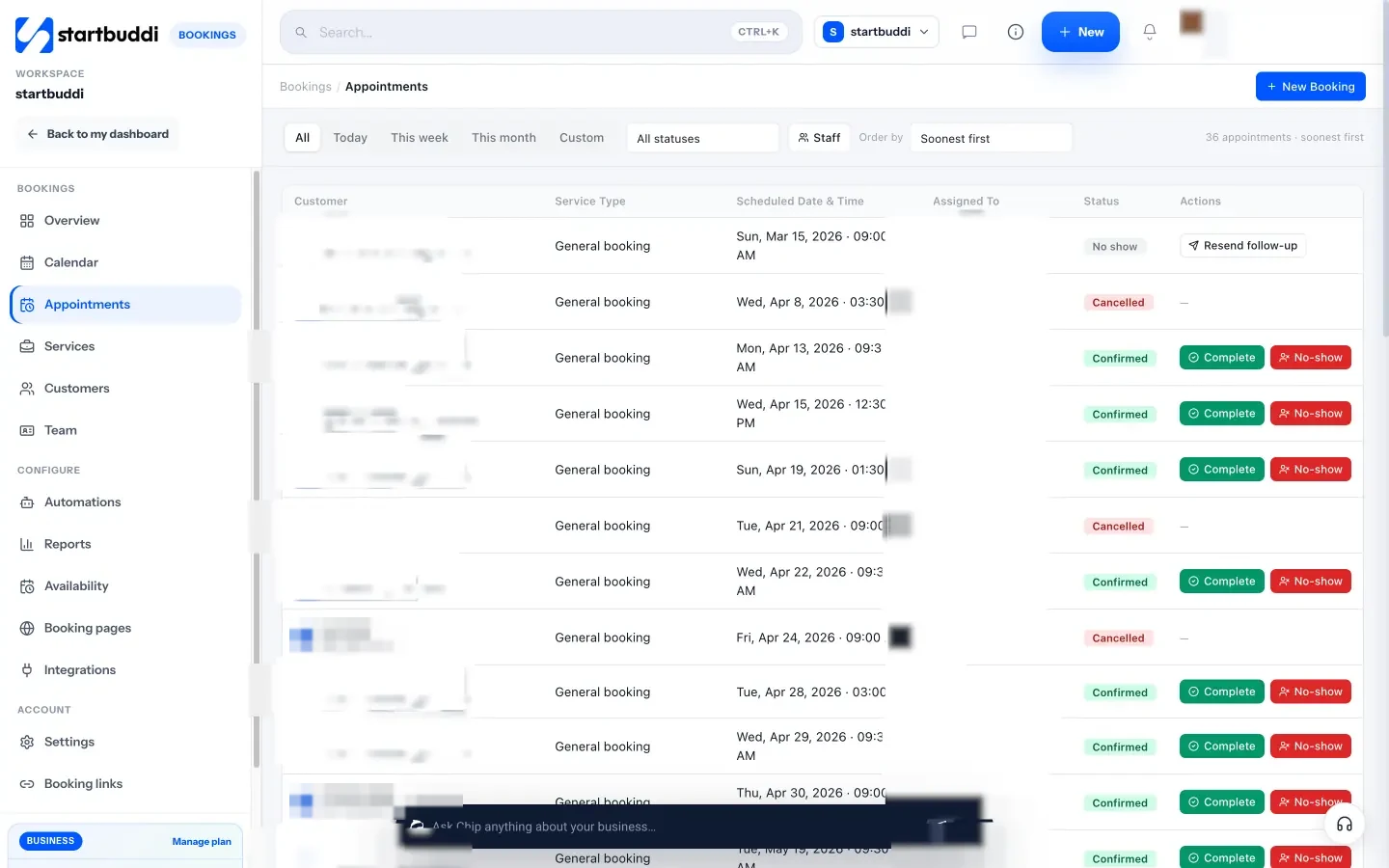
- Bill a fee if you charge one. From the booking detail, Generate Invoice creates an invoice you can send with a payment link.
The Bookings page shows the full feature set. A free plan is available; see pricing for what each plan includes, or read how appointment scheduling software in startbuddi works. If you’re still setting up the business itself, our guide to starting a service business covers bookings, pricing and getting paid.
Put your no-show policy to work
Copy the template, set your numbers, and add it to your booking page this week. Start startbuddi free to take deposits, send reminders and follow up on missed appointments automatically.
Frequently asked questions
What should a no-show policy include?
A no-show policy should say what counts as a no-show, how much notice clients must give, what a missed appointment costs (a kept deposit or a fee) and what happens after repeat misses. It should also cover emergencies and what you do if you cancel. Keep it short enough to read on a phone.
Is it legal to charge a no-show fee?
In most places you can charge a no-show fee if the client agreed to it before booking and the amount is reasonable. UK guidance says deposits and charges should reflect a genuine estimate of your loss, and Nigeria's FCCPA allows reasonable charges for cancelled advance bookings. Check the rules where you trade, as this isn't legal advice.
How much should a no-show fee be?
There's no standard amount: set it at what the missed slot really costs you, such as the reserved time, travel or materials, and never more than the appointment price. A fee that covers a real cost is easier to justify than a penalty. Taking it as a deposit at booking avoids chasing it later.
How do you tell a client about a no-show fee without upsetting them?
Mention it before they book, remind them before the appointment, and follow up after a miss with concern first and the policy second. Offer a rebooking link in the same message. Waiving the first miss for a genuine emergency keeps most relationships intact.
What is the difference between a no-show policy and a cancellation policy?
A cancellation policy covers clients who tell you they can't come, including how much notice they need to give and any late-cancellation charge. A no-show policy covers clients who simply don't turn up. Many businesses put both in one booking policy.
Tiwalade Joanna Okedara-Kalu is the founder, CEO and CTO of startbuddi, the business system that brings clients, bookings, invoices, projects, marketing and the Chip AI assistant into one place. Tiwalade builds software around how service businesses really work day to day, and writes about client management, getting paid on time and why small businesses outgrow the tools they start with.
Founded startbuddi and leads its product and engineering