Business Loan Checklist: Step-by-Step List + Free Template
A business loan checklist for small businesses: the documents, numbers and checks lenders want, plus a repayment example. Copy the free template and apply.


Photo: Wesley Tingey / Unsplash
A business loan checklist is the list of decisions, documents and numbers to prepare before you apply: how much you need and why, which lender fits, registration and tax papers, bank statements and accounts, a business plan with a cash flow forecast, any collateral, and proof you can afford the repayments.
Key takeaways
- Decide the purpose and the amount first. Lenders ask “what is it for?” before anything else.
- Most lenders want registration papers, a tax number, recent bank statements, accounts and a business plan with forecasts.
- For new businesses, your personal credit history often matters as much as the business’s.
- Work out the monthly repayment yourself and compare it with your real monthly profit before you sign.
- Development lenders and government-backed schemes exist in the US, UK and Nigeria, but each has its own eligibility rules.
This page is general information, not financial advice. Loan products, rates and rules change, so confirm the details with the lender and, if you can, an accountant or adviser before you borrow.
What lenders look for before they say yes
Every lender wants to know whether you’ll pay them back on time, and looks at three kinds of evidence.
- The business: what it does, how long it has traded, how much comes in and goes out each month, and what it already owes.
- The owner: identity, personal credit history and experience. The US Small Business Administration’s guide to funding your business (checked on 1 October 2026) notes that loan eligibility for a new business is usually based on the owner’s personal credit score, and that poor credit is one of the main reasons small business applications are declined.
- The plan: what the money will be spent on and how that spending will produce the cash to repay it. The same SBA guide suggests preparing a business plan, an expense sheet and financial projections before you approach a lender.
The British Business Bank’s guide Making business finance work for you (checked on 1 October 2026) adds a point many founders learn the hard way: lenders typically look for a trading history and a track record, so very young businesses can struggle to borrow from banks. It points those founders to the government-backed Start Up Loans programme, a personal loan of up to £25,000 at a fixed rate, with free mentoring for successful applicants. Check the current rate and eligibility on the programme’s own site before applying.
The complete business loan checklist
Copy this small business loan checklist into a document or a task list and tick items off as you gather them. Not every lender asks for everything, but having it ready means you won’t stall halfway through an application.
1. Decide what you need
2. Choose the right kind of lender
3. Business documents
4. Personal documents for each owner or director
5. Plan and numbers
6. Security and guarantees
7. Apply, then manage the loan
Business loan options in the US, UK and Nigeria
United States
The SBA doesn’t usually lend directly. It guarantees part of loans made by approved lenders, and your lender gives you the full document list for the product.
United Kingdom
Banks, specialist lenders and community development finance institutions all lend to small firms. The British Business Bank’s guide explains the main choices, from secured and unsecured loans to overdrafts and asset finance, and notes that unsecured working capital loans often need a personal guarantee and a good credit rating.
Nigeria
The Bank of Industry’s SME directorate (checked on 1 October 2026) says it offers SMEs loans with three to five year tenors at below-market rates, with a moratorium of 3 to 12 months, to duly registered businesses through 30 business offices. Its products lean towards production, processing and specific funds, so many service businesses will find commercial or microfinance bank loans a closer fit. If you plan to pledge equipment, vehicles or receivables, the CBN’s National Collateral Registry (checked on 1 October 2026) records security over movable assets; the borrower keeps using the asset, and it must be insured.
Worked example: can you afford the repayments?
These numbers are illustrative, not quotes from any lender. Repayments use a standard fixed-rate loan with equal monthly payments.
| Lagos cleaning company | Austin IT support firm | |
|---|---|---|
| Loan | ₦3,000,000 for a second van | $20,000 for laptops and a vehicle |
| Term and rate | 24 months at 24% a year | 36 months at 10% a year |
| Monthly repayment | ₦158,613 | $645.34 |
| Total repaid | ₦3,806,719 | $23,232.37 |
| Interest over the term | ₦806,719 | $3,232.37 |
| Average monthly profit (last 6 months) | ₦400,000 | $3,000 |
| Repayment as a share of profit | 40% | 22% |
The Lagos company would hand 40% of its current profit to the lender every month, which only works if the second van wins contracts quickly. The Austin firm’s 22% leaves more room. Use your real average profit, not your best month. Our guide to managing small business finances explains how to find your true monthly profit, and the difference between gross and net profit matters here: repayments come out of net profit.
Common mistakes on loan applications
- Applying with stale numbers. Bank statements and accounts more than a few months old raise questions. Update them first.
- Asking for a round number. “₦5 million” with no quotes behind it looks like a guess. Tie the amount to what you’re buying.
- Mixing personal and business money. It makes your income hard to verify. Run business money through a business account for at least a few months before applying.
- Forgetting tax. Unfiled returns stop many applications. Our small business tax checklist covers what to keep up to date.
No business plan yet? Start with the business plan checklist. A lender-ready plan can be short if the numbers are clear.
How to prepare a loan application in startbuddi
startbuddi isn’t accounting software and doesn’t replace accounts prepared by an accountant, which some lenders require. It does keep the day-to-day records that a loan application draws on, in one place.
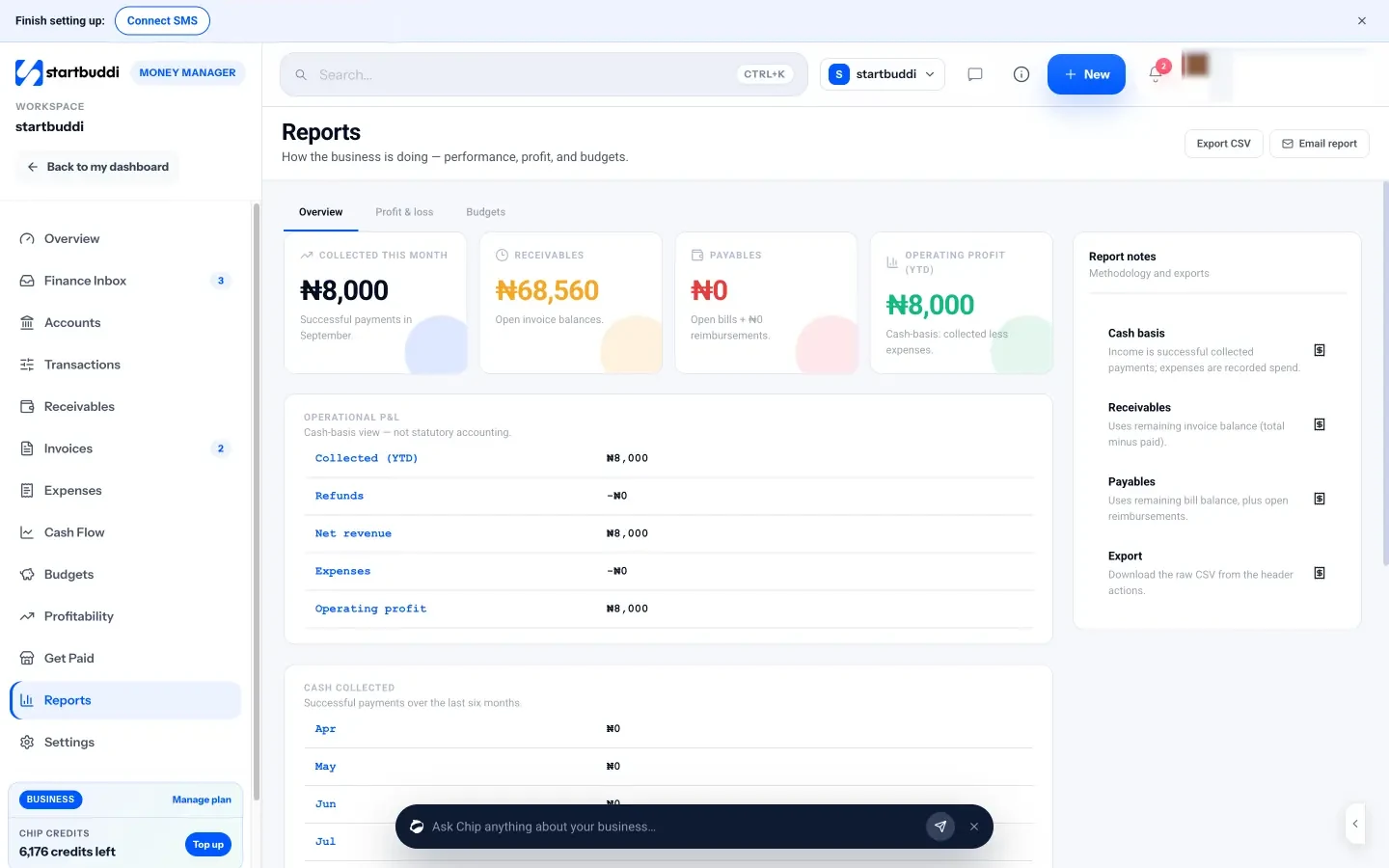
- Check your profit and loss. In Money Manager, open Reports and the Profit & loss tab, choose the period, and use Export CSV to send the figures to your accountant or attach them to an application. The report is a cash-basis view built from your invoices and expenses, and it says so on screen.
- Look at your cash flow forecast. Cash Flow shows a balance forecast built from open invoices, subscriptions, recurring expenses and bills, and lists which inputs are included. Use Run scenario to test what happens if revenue drops or overdue invoices are paid this week, then compare the result with the repayment from your own calculation. Read more about the cash flow forecast.
- Chase what you’re owed. Receivables lists open invoice balances. Collecting overdue invoices before you apply improves your bank statements and may reduce how much you need to borrow.
- Keep the paperwork together. In Documents, create a folder for the application and use Upload files for your registration papers, statements and quotes, so everything is in one place when the lender asks.
- Turn the checklist into tasks. In Work, add a task called “Loan application” with a subtask for each checklist item and a due date, so nothing is forgotten.
A free plan is available. See pricing for what each plan includes, or how startbuddi works as a business finance manager for service businesses.
Get your numbers loan-ready
Copy the checklist, work through it phase by phase, and keep your invoices, expenses and forecasts in one place. Start free with startbuddi to track your money and keep your paperwork together.
Frequently asked questions
What documents do I need for a small business loan?
Most lenders ask for registration papers, a tax number, 6 to 12 months of business bank statements, recent accounts or management accounts, a business plan with a cash flow forecast, and ID for each owner. Many also ask for a list of existing debts and details of any security. The lender gives you its full list for the specific product.
Can I get a business loan for a new business?
Yes, but it's harder, because most lenders look for a trading history. New businesses are usually judged on the owner's personal credit and the strength of the plan. Government-backed schemes, such as Start Up Loans in the UK and SBA-guaranteed loans in the US, exist partly to help newer businesses.
Do I need collateral for a business loan?
Not always. Unsecured loans need no assets pledged but often have higher rates and may need a personal guarantee. Secured loans use property, vehicles, equipment or receivables as security; in Nigeria, movable assets can be registered through the CBN's National Collateral Registry.
How much can my business afford to borrow?
Work out the monthly repayment for the amount, rate and term you're considering, then compare it with your average monthly net profit over the last six months. If the repayment would take a large share of profit, borrow less, choose a longer term or wait until the business earns more. An accountant or adviser can help you test the numbers.
What is the difference between a business loan and a personal loan for business?
A business loan is made to the business, which is responsible for repaying it. A personal loan is made to you, even if you spend it on the business, so you are personally liable. Some start-up schemes, such as the UK's Start Up Loans, are personal loans for business use.
Tiwalade Joanna Okedara-Kalu is the founder, CEO and CTO of startbuddi, the business system that brings clients, bookings, invoices, projects, marketing and the Chip AI assistant into one place. Tiwalade builds software around how service businesses really work day to day, and writes about client management, getting paid on time and why small businesses outgrow the tools they start with.
Founded startbuddi and leads its product and engineering