The best ways to follow up with customers, from first enquiry to repeat business
When and how to follow up with customers at every stage: new enquiries, quotes, after meetings, after a purchase, for reviews and to win them back, with message templates.


Chinonye wrote this while on the startbuddi team. The product has changed since, so the team updated it on .
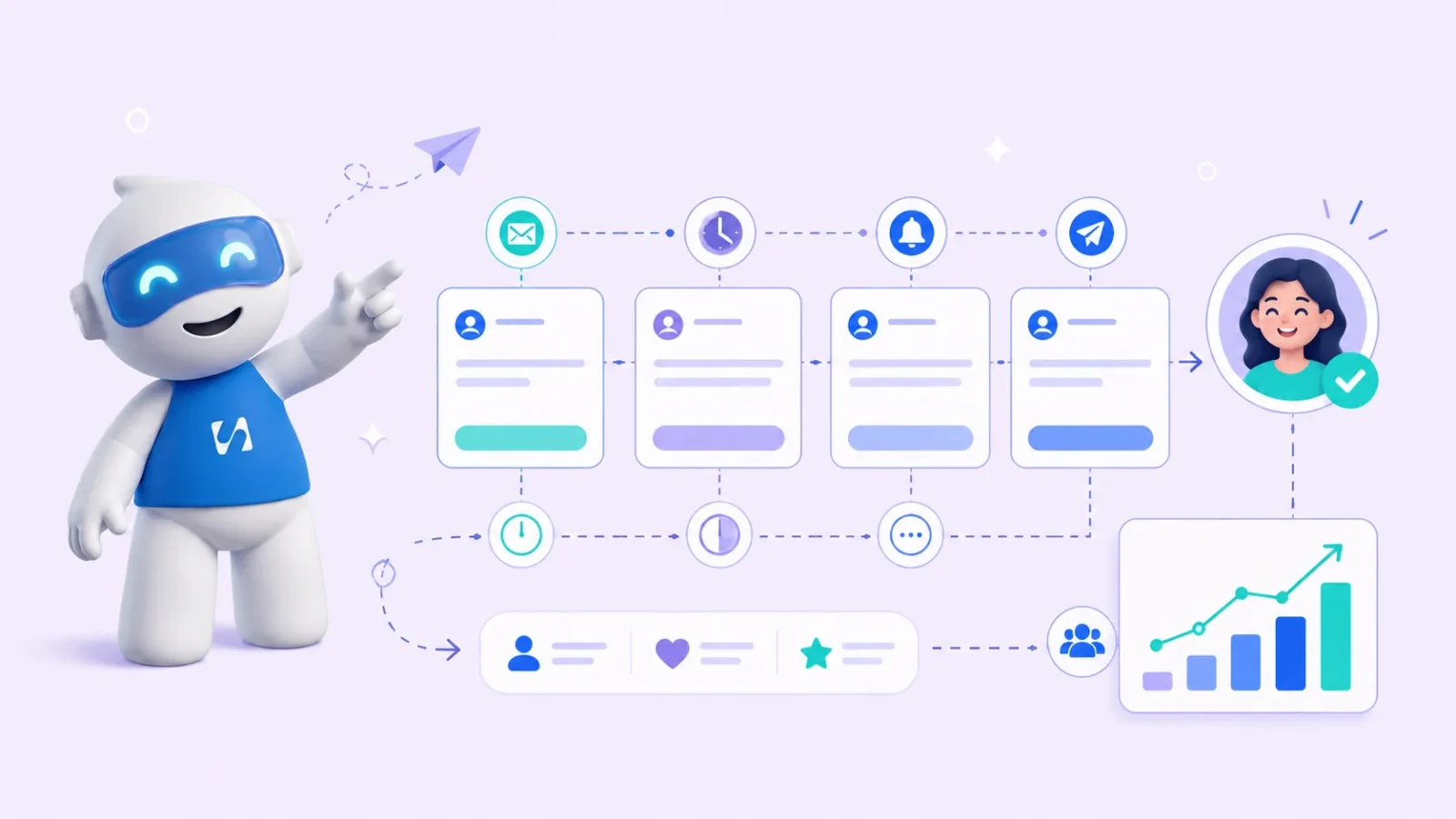
- Follow up fast after an enquiry, give every quote a dated follow-up, check in after every job, ask for reviews while the result is fresh, and remind past customers before they need you again. Plan these touchpoints once, use the channel each customer answers, and let simple automations handle the reminders.
The best way to follow up with customers is to plan it before you need it. Reply to new enquiries within the hour if you can, give every quote a follow-up date, check in after every job, ask for a review while the result is fresh, and get back in touch before a past customer needs you again. Use the channel each person actually answers, keep every message short and specific, and let a system remind you so nothing depends on memory.
Most follow-up advice stops at the sale. This guide covers the whole relationship, because a customer who comes back three times is worth far more than one who buys once. You’ll find timings, channels, templates you can copy and the mistakes that make follow-up feel pushy.
Why follow-up is where small businesses win or lose
Most lost customers aren’t lost to a better competitor. They are lost to silence. The enquiry that got a reply two days late, the quote nobody chased, the happy client who never heard from you again and quietly booked someone else next year.
Two pieces of research show why it matters:
- Speed at the start. A study of more than 2,000 US companies in Harvard Business Review found that firms contacting web leads within an hour were nearly seven times as likely to have a meaningful conversation with a decision maker as firms that waited longer.
- Loyalty after the sale. Research by Frederick Reichheld of Bain & Company, summarised in Harvard Business Review, found that increasing customer retention rates by 5% increases profits by 25% to 95%.
In other words, the first hour and the months after the sale are where follow-up pays most. Both are easy to neglect when you’re busy.
Map your follow-up touchpoints once
The biggest improvement is deciding in advance what happens at each stage, instead of improvising every time. Here is a map that fits most service businesses:
| Moment | When to follow up | Goal |
|---|---|---|
| New enquiry | Instantly, then a personal reply the same day | Start the conversation and book a next step |
| After a call or meeting | Within 24 hours | Confirm what was agreed and what happens next |
| Quote or proposal sent | After 2 to 3 days, then after a week | Answer questions and get a decision |
| After a purchase or booking | Straight away, and before the appointment | Reassure them and prevent no-shows |
| After the job is done | 1 to 3 days later | Check they’re happy and fix anything that isn’t |
| Review or referral | When they say they’re happy | Turn satisfaction into social proof |
| Repeat business | Just before they’d normally need you again | Book the next job |
| Gone quiet | After a set period, such as 90 days | Win them back or learn why they left |
Adjust the timings to your business. A hair salon’s “repeat” moment might be six weeks, an accountant’s might be a year. What matters is that each moment has a date and an owner.
How to follow up with new enquiries
This is where speed matters most. Two steps work well together:
- An instant acknowledgement that confirms you received the message, says when they’ll hear from a person, and offers a next step such as a booking link.
- A personal reply the same working day that answers their actual question.
If they don’t reply, follow up again after two or three days, then once more a week later. After that, move them to an occasional check-in rather than chasing. Our guide on how to follow up with leads goes deeper on this stage, and the idea of lead nurturing explains how to stay in touch with people who aren’t ready yet.
Template: first reply
Hi Grace, thanks for getting in touch about a deep clean for your flat. We have space next Tuesday or Thursday morning. Would either work? If you send a couple of photos of the kitchen and bathroom, I can confirm the price today.
How to follow up after a quote or proposal
Quotes go quiet for ordinary reasons: the client is busy, needs to check with someone, or has a question they haven’t asked. A good follow-up makes replying easy.
- Refer to something specific from your conversation, not just “checking in”.
- Offer help, not pressure: “Happy to walk through the options on a 10-minute call.”
- Give a reason to decide if there is a real one, such as limited availability in their preferred month.
- Close the loop politely after two or three attempts, so the door stays open.
Template: quote follow-up
Hi David, I wanted to check whether the proposal for your new website made sense. You mentioned launching before the spring trade show, so if you’d like to go ahead, the next start date I can offer is 3 March. Any questions, just reply here.
Template: closing the loop
Hi David, I haven’t heard back, so I’ll assume the timing isn’t right for now. I’ll close this quote on my side, but if anything changes, reply to this message and I’ll pick it straight back up.
How to follow up after a purchase
This is the stage most businesses skip, and where loyalty is built.
Before the appointment or delivery
Send a confirmation right away and a reminder before the appointment. Include the time, address or link, what to bring and how to reschedule. Clear reminders reduce no-shows and last-minute confusion.
After the job
A day or two after delivery, check in. Ask one simple question: “How did everything go?” If something isn’t right, you get a chance to fix it before it becomes a bad review. If it went well, you have the perfect moment to ask for a review or referral.
When something went wrong
If the check-in uncovers a problem, reply the same day, apologise without excuses and offer a specific fix with a date. Customers often remember how a problem was handled more than the problem itself. Once it’s sorted, a short note a week later to make sure they’re happy closes the loop properly.
Template: after the job
Hi Amaka, just checking the new brand guidelines are working well for your team. If anything needs a tweak, send it over. And if you’re happy with the result, a short Google review would really help us. Here’s the link.
How to follow up for repeat business and win-backs
Past customers already know and trust you. A well-timed message often brings them back faster than any advert.
- Service reminders: “It’s been six months since your boiler service. Want me to book the next one?”
- Seasonal prompts: “Your tax return deadline is coming up. Shall we get started?”
- Useful updates: a new service, a relevant tip or an early booking slot, sent only to the customers it suits.
- Win-backs: if someone hasn’t returned in a long while, ask honestly whether anything went wrong and invite them back.
Template: service reminder
Hi Priya, it’s been almost a year since we set up your accounts package, and the new tax year starts soon. Would you like to book a 30-minute planning call next week? Here are three times that work for me.
Template: win-back
Hi James, we haven’t seen you since your last garden tidy in spring. If something wasn’t quite right, I’d genuinely like to know. If you’d like us back before winter, we have a few slots left in November.
See our guides on how to retain clients and how to win back lost customers for more ideas.
Choosing the right follow-up channel
Use the channel each customer actually answers, and keep a record of it. As a rough guide:
- WhatsApp is quick and personal, and in many markets it is where customers expect to hear from you. On the WhatsApp Business Platform, you can send free-form replies within a 24-hour window after the customer messages you. Outside that window, only approved template messages can be sent.
- Email suits quotes, documents and anything the customer may want to find later.
- SMS is good for short, time-sensitive reminders.
- Phone calls work best for high-value quotes and anything sensitive. A short call often settles in two minutes what would take a day of back-and-forth messages.
- Social media DMs are fine for a first reply, but move the conversation to a channel you track once the customer is serious.
For marketing messages, such as offers sent to many customers at once, make sure people have agreed to hear from you and can opt out easily. Rules vary by country, so check what applies where your customers live.
A simple daily and weekly follow-up routine
Good follow-up is a habit, not a campaign. A routine that takes 15 minutes a day and 30 minutes a week covers almost everything:
- Every morning: reply to anything new from the last 24 hours, and send the follow-ups that are due today.
- Every afternoon: check that every conversation from the day ends with a clear next step and a date.
- Every week: review open quotes, check in with customers whose jobs finished that week, and pick five past customers to contact with something useful.
- Every month: look at which follow-ups got replies and which didn’t, and rewrite the weakest template.
If several people deal with customers, give each customer one owner, and keep notes where the whole team can see them. That way a follow-up never depends on who happens to be in the office. For a full system with stages and owners, read how to build a client follow-up system.
Mistakes that make follow-up feel pushy
- “Just checking in” with nothing to say. Every message should add something: an answer, an option, a date.
- Too many messages, too close together. Space them out and stop after a clear closing message.
- Automated messages that sound automated. Use the customer’s name and the details they gave you. Read each template aloud before you use it.
- Different people, different stories. If two team members follow up with different prices or dates, trust drops. Keep conversations and notes where everyone can see them.
- Only following up when you want something. Mix in genuinely useful messages, such as a tip or a check-in, so your name isn’t always attached to a sales pitch.
How startbuddi helps you follow up with customers
In startbuddi, customers, conversations and follow-up rules live in one place, so the touchpoint map above can mostly run itself.
- One inbox. WhatsApp, email, SMS, website chat, Instagram and Facebook messages land in one shared Inbox. You can use quick replies, schedule a message to send later, or ask Chip to draft a reply for you to edit.
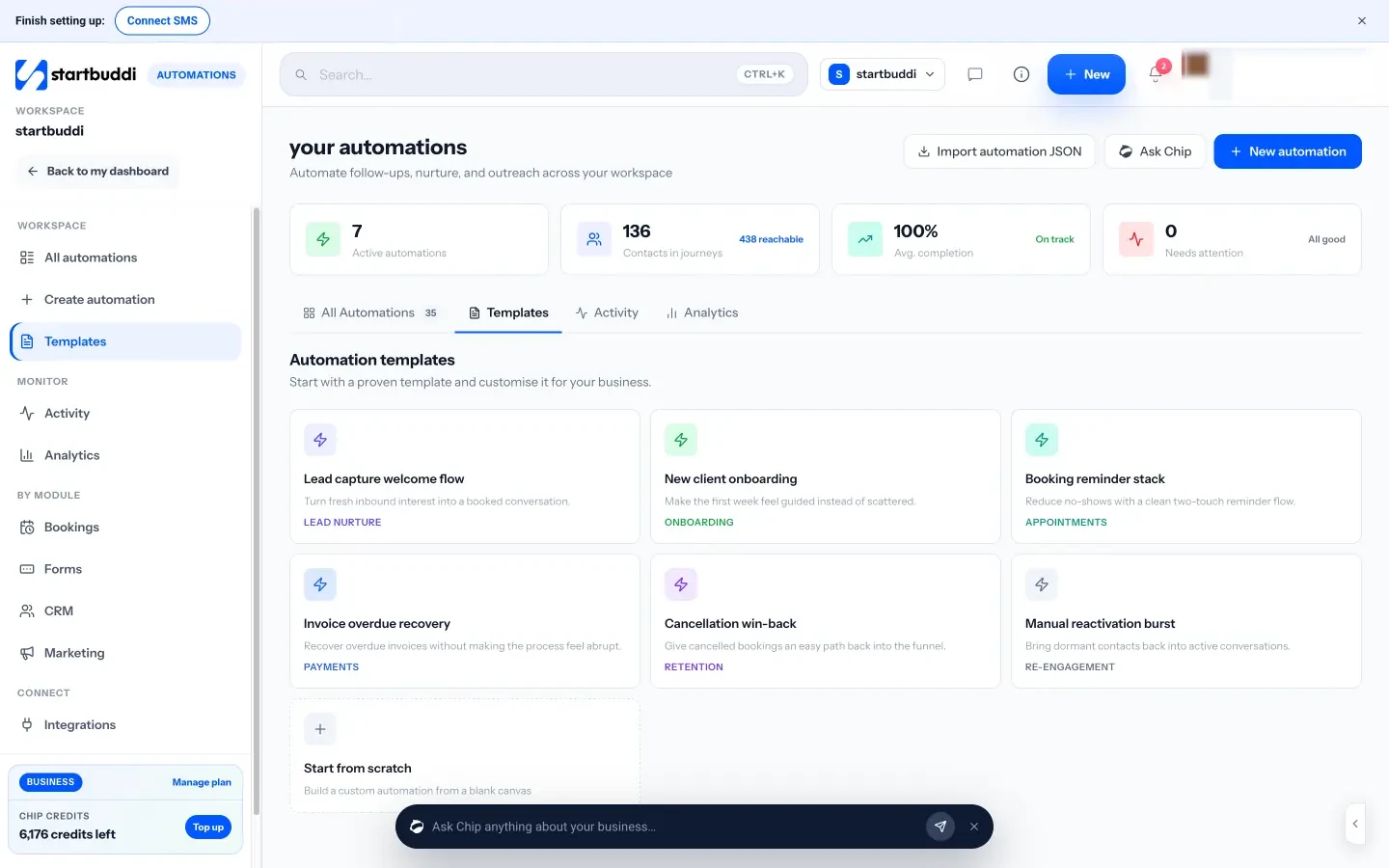
- Ready-made automations. The Automations hub has templates including a lead capture welcome flow, new client onboarding, a booking reminder stack, invoice overdue recovery, cancellation win-back and a manual reactivation burst. Free includes 2 active automations, and Starter allows 10.
- Booking follow-ups. Bookings sends reminder emails at the lead time you choose, and follow-up emails after a no-show or a completed booking.
- Payment follow-ups. Receivables lists who owes you and what is overdue, with a one-click Remind button on each open invoice.
- Chip’s to-do list. On the Customers home, Chip answers “Who needs a reply?” and “Who haven’t I contacted in 14 days?”, and can draft a nurture sequence for a contact from their real history.
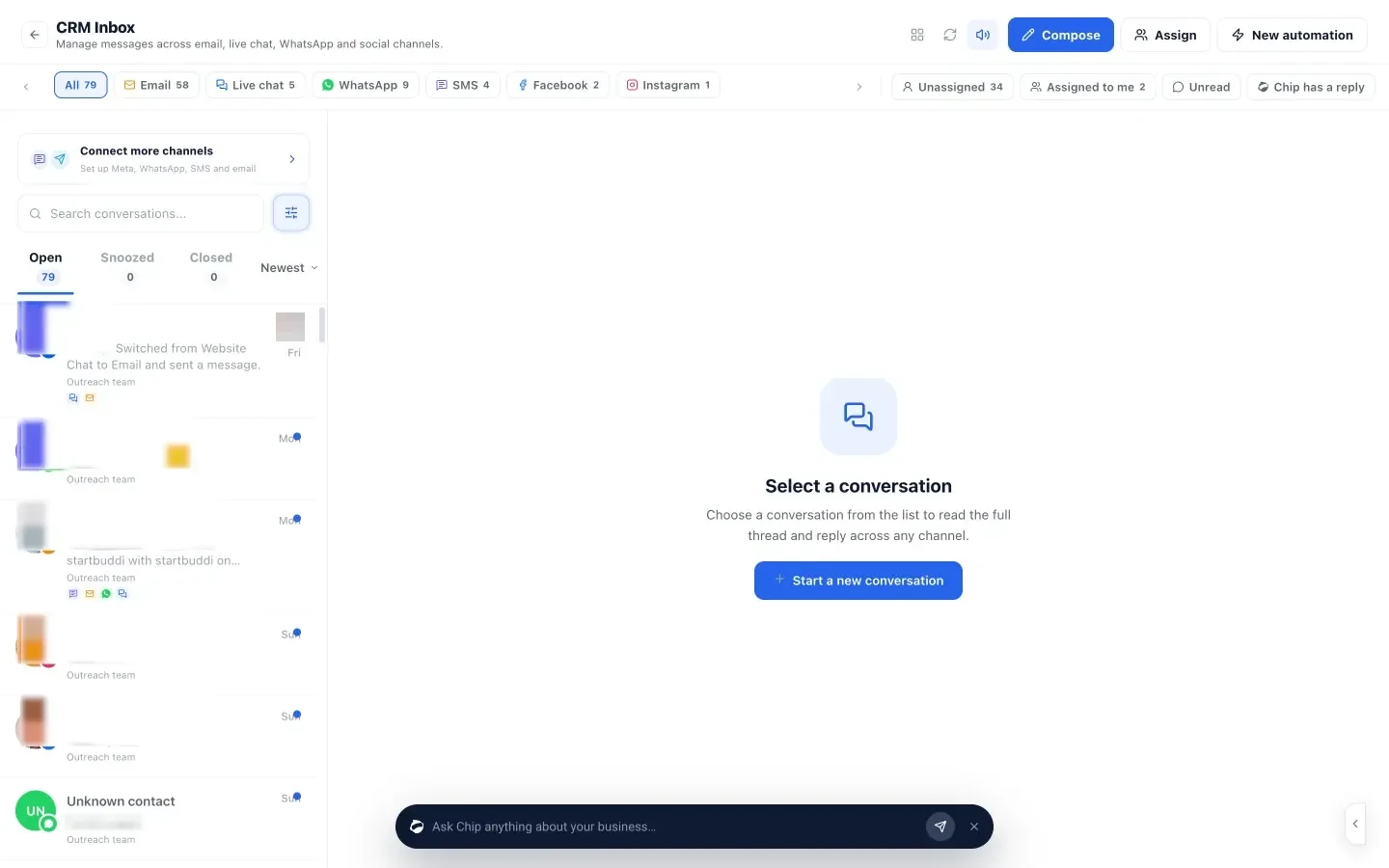
On the Growth plan and above, Chip can also reply to customers on the channels you switch on and send due follow-ups for you, with rules for when it should step back and let your team answer.
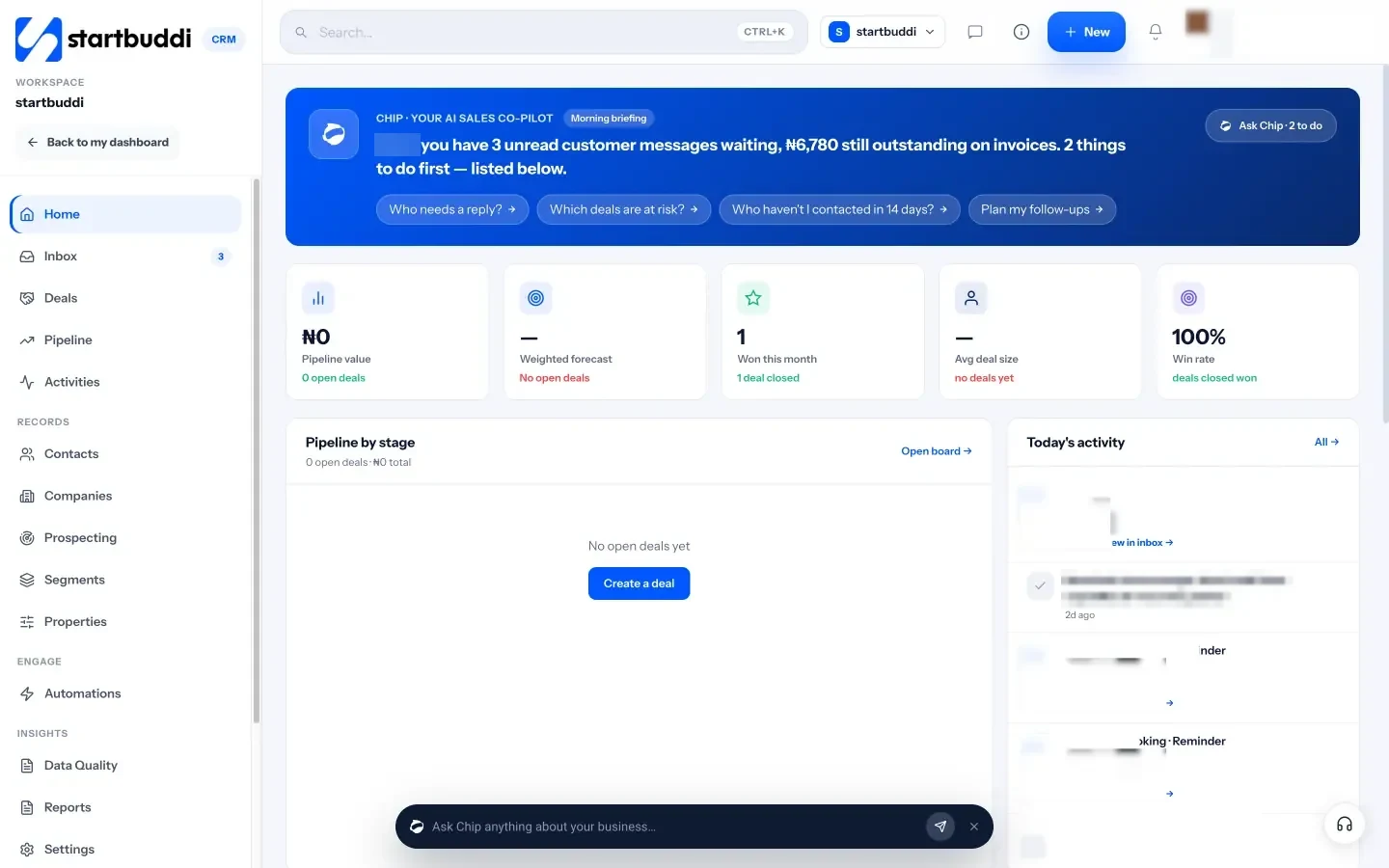
WhatsApp and SMS need the Starter plan or above (see pricing), and every paid plan comes with a 30-day trial.
Your next step
Copy the touchpoint table into a note and fill in your own timings. Then pick the one moment you handle worst today, usually quotes or after-the-job check-ins, and write the template for it. When you want the reminders to run on their own, compare plans on our pricing page.
Sources
- Oldroyd, McElheran and Elkington, “The Short Life of Online Sales Leads”, Harvard Business Review, March 2011
- Amy Gallo, “The Value of Keeping the Right Customers”, Harvard Business Review, October 2014
- Meta for Developers: WhatsApp template messages
Frequently asked questions
How many times should you follow up with a customer?
For a new enquiry or quote, two or three follow-ups spaced a few days apart, then a polite closing message. After that, switch to occasional useful check-ins rather than chasing.
How soon should I follow up after an enquiry?
As fast as you can. An instant acknowledgement plus a personal reply the same working day is a good standard for a small business.
What is the difference between follow-up and lead nurturing?
Follow-up is the direct next step after a specific moment, such as an enquiry or quote. Lead nurturing is the longer, lighter contact that keeps you in mind until someone is ready to buy.
Should I follow up by WhatsApp or email?
Use the channel the customer uses with you. WhatsApp is quick for short messages; email is better for quotes and documents. Keep a note of each customer's preference.
SEO Copywriter| Email growth Specialist| I help businesses increase revenue with strategic SEO content & high-converting email funnels.