Talent Acquisition vs Recruitment: Key Differences Explained
Talent acquisition vs recruitment for a small business: scope, timing, cost, metrics and who does the work, with a worked example and when to use each one.



The difference in talent acquisition vs recruitment is scope and timing. Recruitment fills one open role now: advertise, screen, interview, offer. Talent acquisition is the longer-term system around it: planning the skills you’ll need, building a pool of people before roles open, shaping how candidates see you, and making sure hires stay. Small businesses need recruitment first, then a light version of talent acquisition.
Key takeaways
- Recruitment is a project with an end date: one role, filled. Talent acquisition is ongoing and covers the whole team you’re building.
- Recruitment is part of talent acquisition, not an alternative to it.
- A founder hiring once a year can run good recruitment and skip most of the talent acquisition machinery.
- Once you’re hiring two or more people a year, a few talent acquisition habits (a skills plan, a candidate pool, a referral routine) pay back in time and fees.
- The two are measured differently: recruitment by whether the role was filled, talent acquisition by quality of hire and whether people stay.
Talent acquisition vs recruitment at a glance
| Recruitment | Talent acquisition | |
|---|---|---|
| What it is | Filling a specific vacancy | A continuous approach to finding, attracting and keeping the right people |
| Time horizon | Weeks | Months to years |
| Trigger | A resignation, a new contract, a gap | Your business plan and growth goals |
| Main activities | Job advert, screening, interviews, offer | Workforce planning, talent pool, employer brand, referrals, recruitment, onboarding |
| Candidates | People actively applying now | Active applicants plus people not looking yet |
| Measured by | Role filled, time to hire, cost of the hire | Quality of hire, new hire retention, offer acceptance, source of hire |
| Who owns it in a small business | The hiring manager or founder | The founder, with help from managers |
| Best for | Occasional hires, urgent gaps | Regular hiring, hard-to-find skills, growing teams |
If you want the term itself first, our glossary entry on talent acquisition has a short definition and a cost-per-hire example.
What is the difference between talent acquisition and recruitment?
Think of recruitment as buying something when you need it and talent acquisition as keeping a well-stocked supply. Recruitment answers “who can do this job by next month?” Talent acquisition answers “what people will this business need over the next year or two, and how do we make sure good ones want to join?”
The UK’s professional body for HR, the CIPD, makes a similar point in its recruitment factsheet (checked on 1 October 2026): effective resourcing “is not just about filling an immediate vacancy” but about the long-term success of the business. That longer view is what people usually mean by talent acquisition.
Neither is a legal category. Acas, the UK employment advice service, notes in its recruitment guidance (checked on 1 October 2026) that there’s no set hiring process required by law, but employers must follow a fair one. The same fairness rules apply whichever label you use.
Scope: one role vs the whole team
Recruitment starts with a vacancy and ends with a signed offer. The work is concrete: write the job description, post the advert, read the applications, run interviews, check references and make an offer.
Talent acquisition wraps around that. Before the vacancy, it asks which skills the business will need. During the hire, it treats candidates as people who might be right for a different role later. After the hire, it includes onboarding, because a hire who leaves in month three is a failed hire, whatever the recruitment metrics said.
Verdict: recruitment is a subset. If you only do recruitment, you’ll fill roles. If you add talent acquisition, you’ll fill them with less panic and lose fewer people afterwards.
Time horizon: weeks vs years
Recruitment runs on a deadline. A Nairobi digital agency wins a contract on Friday and needs a second developer in four weeks. That’s a recruitment problem, and it’s solved with a good advert, fast screening and quick decisions.
Talent acquisition runs on the business plan. If the same agency knows it will add a developer, a designer and an account manager over the next 12 months, it can start talking to good people now, ask its team for referrals early and keep a short list of past applicants who nearly made it.
Verdict: a short time horizon favours recruitment. Anything you can see coming six months out is a talent acquisition opportunity.
Who does the work in a small business
In large companies, talent acquisition is often a team with its own head, separate from the recruiters who fill individual roles. In a business of five or fifteen people, it’s usually the founder, plus whichever manager the new person will report to.
That changes the comparison. For a small team, talent acquisition doesn’t mean buying software or hiring a talent partner. It means a founder spending an hour a month on three things: the skills plan, the candidate pool and how the business looks to people who might want to work there. Our guide to building your first team covers the order to hire in.
Verdict: both fall to the founder at first. Recruitment takes concentrated bursts of time; talent acquisition takes small, regular slots.
Candidates: active applicants vs a talent pool
Recruitment mainly reaches people who are job hunting right now and see your advert. That’s a narrow slice of the people who could do the job well.
Talent acquisition also reaches people who aren’t looking yet: a freelancer you’ve worked with, a strong runner-up from last year’s hire, a friend of a current employee, someone who follows your work online. When a role opens, you message them first.
Be careful that a talent pool built only from your own network doesn’t end up excluding people. In the US, the EEOC warns that relying on word-of-mouth recruitment (checked on 1 October 2026) can be unlawful if it means nearly all new hires come from one group. Mix referrals with open adverts.
Verdict: recruitment gets you applicants. Talent acquisition gets you people you already know something about.
Metrics: filled vs well filled
Recruitment metrics are about the process of one hire: time to fill, time to hire, cost per hire and the number of applicants. Talent acquisition metrics ask whether the hiring worked: quality of hire, new hire retention at 90 days and a year, offer acceptance rate and which sources produce people who stay.
For a small team, four numbers are plenty: time to hire, cost per hire, offer acceptance rate and whether each hire is still with you after a year. Our article on talent acquisition metrics explains how to calculate each one in a spreadsheet.
Verdict: recruitment metrics tell you if the process was efficient. Talent acquisition metrics tell you if it was worth it.
Cost: fees per hire vs time up front
Recruitment costs show up per hire: job board fees, agency fees, the time spent interviewing and the cost of the gap while the seat is empty. Talent acquisition costs show up earlier and smaller: time spent on planning, referral rewards, keeping in touch with good people and investing in how you onboard.
A worked example: two ways to hire three people
These figures are illustrative. A 12-person IT services firm in Lagos plans to hire three engineers in the next year, each on ₦6,000,000 a year. The founder compares two approaches.
Approach A: recruitment only. Each time someone is needed, the firm uses a recruitment agency at an illustrative fee of 15% of first-year salary.
| Per hire | Three hires | |
|---|---|---|
| Agency fee (15% of ₦6,000,000) | ₦900,000 | ₦2,700,000 |
| Weeks the seat is empty | 8 | 24 |
| Founder hours on interviews | 10 | 30 |
Approach B: light talent acquisition. The founder spends two hours a month on a skills plan and candidate pool, offers a ₦300,000 referral reward to staff, and uses the agency only once, for the hardest role.
| Cost or time | |
|---|---|
| Referral rewards (2 hires x ₦300,000) | ₦600,000 |
| Agency fee for one hire | ₦900,000 |
| Total fees | ₦1,500,000 |
| Founder hours on planning (12 months x 2) | 24 |
| Founder hours on interviews (3 x 10) | 30 |
| Weeks seats are empty (estimate: 4 + 4 + 8) | 16 |
Approach B saves ₦2,700,000 minus ₦1,500,000, which is ₦1,200,000 in fees, and 8 fewer weeks with an empty seat. It costs 24 extra founder hours across the year. Whether that’s a good trade depends on what an hour of the founder’s time and a week of missing engineering capacity are worth to this firm. The point isn’t the exact numbers; it’s that you can put both approaches into a table and decide.
Verdict: recruitment is cheaper in time when you hire rarely. Talent acquisition usually becomes cheaper in money once you hire regularly.
Employer brand and candidate experience
Recruitment treats the advert as the first impression. Talent acquisition recognises that candidates have already formed a view from your website, your social posts, what current staff say and how past applicants were treated.
For a small business, this isn’t about a glossy careers site. It’s about replying to every applicant, telling people where they stand, paying for work samples that take real effort, and having current employees who’d recommend you. Our post on talent acquisition best practices covers these habits.
Verdict: recruitment can ignore employer brand for a single urgent hire. Talent acquisition can’t, because next year’s candidates hear about this year’s process.
Choose recruitment if, choose talent acquisition if
Focus on recruitment if:
- you hire once a year or less;
- the role is common and easy to fill locally;
- you need someone within weeks and have no time for anything else;
- you’re testing whether the business needs the role at all.
Add talent acquisition if:
- you expect to hire two or more people in the next 12 months;
- the skills are scarce (senior engineers, specialist clinicians, experienced sales people);
- you’ve lost new hires in their first few months;
- you’re spending heavily on agency fees or job boards for every role.
Most small businesses sit in between. Run proper recruitment for each role, and add the three cheapest talent acquisition habits: a written skills plan, a list of people you’d hire again, and a referral routine.
How to move from recruitment to talent acquisition in 90 days
- Write a 12-month hiring plan. List the roles you expect to add, the month you’ll need each and the skills that matter most.
- Create a hiring scorecard for each role. Outcomes in the first year, must-have skills, deal-breakers.
- Start a candidate list. Add runners-up from past hires, freelancers you rate and people who’ve asked about working with you, with their permission to stay in touch.
- Set up referrals. Tell your team which roles are coming and what you’ll pay for a successful referral.
- Fix the candidate experience. Reply to every applicant, set a timeline and stick to it.
- Plan onboarding before the offer. Decide the first week, who the new hire shadows and what success at 90 days looks like.
Our step-by-step guide to the talent acquisition process goes deeper on each stage.
Where startbuddi fits
startbuddi is our product. It doesn’t include an applicant tracking system, so it won’t post jobs, collect applications or rank candidates; use a job board or a dedicated hiring tool for that. Where it helps is around the hire:
- Plans and scorecards: ask Chip in a normal chat to draft a hiring plan, a scorecard or interview questions, then edit them.
- Interviews: run video interviews in startbuddi Live, with the candidate joining as a guest by link. From the Starter plan, meetings can be recorded with Chip notes; ask the candidate first.
- Offers: write the offer in Documents and send it for e-signature, or start from our free offer letter template.
- Onboarding: in People, start an onboarding checklist so the new hire’s first weeks are planned. See our definition of employee onboarding.
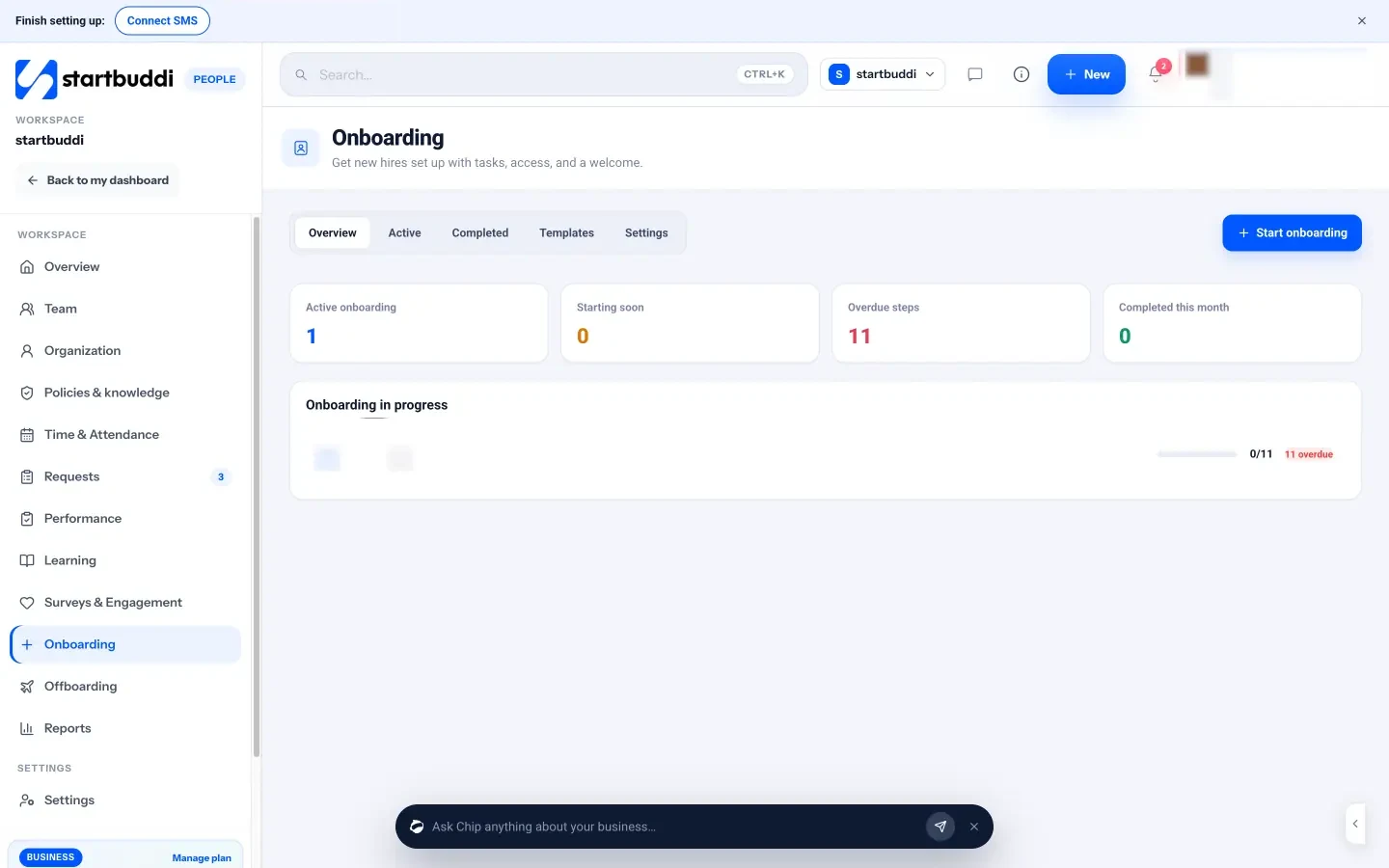
A free plan is available, with no card needed to start; inviting a new hire as a team member needs a paid plan with seats. See pricing or how startbuddi works for startups.
Hire for this role, and the next three
Copy the comparison table into your hiring plan, decide where your next hire sits, and start free with startbuddi to run interviews, offers and onboarding in one place. No card needed.
Frequently asked questions
Is talent acquisition the same as recruitment?
No. Recruitment fills a specific open role. Talent acquisition is the broader, ongoing approach that includes workforce planning, building a pool of candidates, employer brand, recruitment itself and onboarding. Recruitment is one part of talent acquisition.
Which comes first, recruitment or talent acquisition?
For most new businesses, recruitment comes first, because the first hires are urgent. Talent acquisition habits become worth it once you're hiring regularly or struggling to find the right skills. You can start small with a hiring plan and a list of good candidates.
Do small businesses need a talent acquisition strategy?
They need a simple one once they hire more than one person a year. A one-page plan of upcoming roles, a scorecard per role and a referral routine is enough. There's no need for special software at that stage.
What does a talent acquisition specialist do that a recruiter doesn't?
A recruiter mainly fills current vacancies. A talent acquisition specialist also plans future hiring needs, builds relationships with people before roles open, works on employer brand and tracks whether hires succeed. In small companies, the founder often plays both parts.
Is talent acquisition more expensive than recruitment?
Not necessarily. Talent acquisition costs time up front, but it can reduce agency fees, empty-seat time and early leavers. For a business that rarely hires, plain recruitment is usually cheaper.
How do you measure recruitment vs talent acquisition?
Recruitment is measured by whether the role was filled, how long it took and what it cost. Talent acquisition adds quality of hire, retention after 90 days and a year, offer acceptance and which sources produce people who stay.
Omolola Akiyode is the operations and project manager at startbuddi, leading cross-functional projects and the content that helps founders get set up. Omolola writes about projects, websites and getting found online, and turns complex ideas into clear, practical steps.
Runs operations and projects at startbuddi