Talent Acquisition Best Practices: 12 Practical Ideas That Work
Talent acquisition best practices for founders hiring a first team: scorecards, fair job ads, paid work samples, structured interviews and onboarding.



The talent acquisition best practices that matter most for a small business are simple: define what the hire must achieve before you advertise, write a fair job ad with a pay range, test real work instead of trusting CVs, ask every candidate the same questions, move quickly, check references and the right to work, and plan onboarding before day one.
Key takeaways
- Hiring goes wrong at the start, not the end. A one-page scorecard of outcomes prevents most bad hires.
- Fair, specific job ads widen your pool and keep you on the right side of discrimination law.
- A short, paid work sample tells you more than a long interview.
- Structured interviews (same questions, same scoring) make comparisons honest.
- The process isn’t finished at the signed offer. The first 90 days decide whether the hire stays.
Why talent acquisition best practices matter for a first team
When you have five people, one wrong hire is 20% of your team. It costs you the salary, the time you spent hiring, the work that didn’t get done and often a client or two. Big companies can absorb that. You can’t.
Talent acquisition is the full cycle of finding, choosing and keeping the right people, not just filling a vacancy. The practices below are the ones a founder can actually run alongside the day job, without an HR department.
1. Define the outcome before the job title
Write down what this person must achieve in their first 6 to 12 months, then decide the role.
“We need a marketing person” leads to vague ads and vague interviews. “We need someone to answer every enquiry within an hour and book 20 discovery calls a month” tells you exactly who to look for.
Example: a Lagos IT support firm thought it needed a “senior engineer”. Writing out the outcomes showed that most of the work was first-line support and client updates, so it hired a support technician and kept senior work with the founder.
2. Use a hiring scorecard
Turn those outcomes into a scorecard you’ll use at every stage.
Here’s a template you can copy:
| Section | What to write | Example: support technician |
|---|---|---|
| Mission | One sentence on why the role exists | Keep clients’ systems running and clients informed |
| Outcomes (3 to 5) | Measurable results for the first year | Resolve 80% of tickets within one working day |
| Must-have skills | Skills you’ll test, not assume | Windows and Microsoft 365 admin, clear written English |
| Nice-to-have | Useful but not decisive | Networking certificate |
| Behaviours | How they work | Tells the client before they have to ask |
| Deal-breakers | Things that end the process | Can’t work on-site in Lekki two days a week |
Score each candidate 1 to 4 against every line. It makes the final decision far less about who you liked most.
3. Write the job advert around the work, with a pay range
Describe a real week in the job and say what it pays.
Candidates want to know what they’ll do, who they’ll work with, where and for how much. Leaving pay out wastes everyone’s time when the first call reveals you’re ₦200,000 apart. Keep the advert short: the outcomes, the must-haves, the pay, the location and how to apply.
4. Keep the advert and process fair
Hire on ability to do the job, and check your wording for bias.
In the US, the EEOC’s guidance on prohibited employment practices (checked on 1 October 2026) says job adverts must not show a preference based on protected characteristics such as race, sex, religion, disability or age 40 and over; an ad asking for “recent college graduates” may discourage older applicants. In the UK, Acas’s recruitment guidance (checked on 1 October 2026) covers following discrimination law when advertising a job. Elsewhere, local rules differ, but the practical test is the same: does every requirement relate to the work?
5. Look where your candidates already are
Don’t rely on one channel, and be careful with referrals alone.
Referrals are fast and often good, but hiring only friends of your current team tends to produce a team that all looks the same. The EEOC gives the example that relying on word-of-mouth recruitment can be discriminatory if it results in almost all hires coming from one group. Mix referrals with job boards popular in your market (Jobberman in Nigeria, BrighterMonday in Kenya, LinkedIn or Indeed in the UK and Canada), community groups and your own social accounts.
6. Replace long tests with a short, paid work sample
Ask finalists to do a small piece of the real job, and pay for it if it takes more than an hour.
A designer can redesign one screen. A support technician can reply to three sample tickets. A sales hire can write a follow-up to a lost deal. You learn more in 90 minutes of real work than in an hour of “tell me about yourself”, and paying for longer tasks shows respect for the candidate’s time.
7. Run structured interviews
Ask every candidate the same questions, in the same order, and score them against the scorecard.
Mix past-behaviour questions (“Tell me about a time a client was angry about downtime. What did you do?”) with role questions linked to your outcomes. Have two people score separately before they compare notes, so the loudest opinion doesn’t win.
8. Move fast and keep candidates informed
Set a timeline at the start and tell every candidate where they stand.
Good candidates have options. A process that takes six weeks with silent gaps loses them to the business that decided in ten days. Tell people the steps and dates up front, and send a short, kind reply to everyone you turn down. It’s free and it protects your reputation in a small market.
9. Check references and the right to work
Verify before the offer becomes final, not after the start date.
Ask referees specific questions tied to your scorecard: “How quickly did they resolve client issues?” In the UK, employers must check a job applicant’s right to work before employing them, using an online share code or original documents, as GOV.UK’s right to work guidance explains (checked on 1 October 2026). Other countries have their own rules for work permits and identity checks, so confirm what applies where the person will work.
10. Put the offer in writing
Send a clear written offer with pay, start date, role, probation and key terms.
A verbal “you’re hired” leads to misunderstandings about pay dates, notice and leave. Use an offer letter template and have it signed. Give the candidate a reasonable deadline to reply.
11. Plan onboarding before day one
Have the laptop, accounts, first tasks and a 30-day plan ready before they arrive.
Employee onboarding is part of talent acquisition, because the first weeks decide whether the hire stays. A new hire who spends day one waiting for a login starts to wonder if they made a mistake. Book a short check-in at the end of week one and week four.
12. Track a few numbers and keep a talent pool
Measure time to hire, offer acceptance and who’s still with you after 90 days.
You don’t need an analytics team. Keep a simple sheet per role:
| Measure | How to work it out | Illustrative figure |
|---|---|---|
| Time to hire | Days from advert to signed offer | 24 days |
| Applicants per hire | Applications ÷ hires | 60 |
| Offer acceptance | Offers accepted ÷ offers made | 1 of 2 = 50% |
| 90-day retention | Hires still here at 90 days ÷ hires | 1 of 1 = 100% |
Keep a list of strong runners-up with their permission. Next time you hire, you start with warm candidates instead of an empty inbox.
Common mistakes to avoid
- Hiring for an urgent gap instead of the outcome you need in a year.
- Inventing interview questions on the spot, so every candidate gets a different test.
- Letting unpaid “tests” grow into free consulting.
- Making an offer before checking references or the right to work.
- Treating the signed offer as the finish line and leaving onboarding to chance.
For more on using AI tools in this process, read our guide to AI in talent acquisition, and for the bigger picture, our guide on building your first team.
How startbuddi helps with hiring and onboarding
startbuddi doesn’t include an applicant tracking system, so it won’t post jobs or screen applicants. Use a job board or a hiring tool for that part. startbuddi helps around it:
- Drafting with Chip. In a normal chat, ask Chip to draft a scorecard, a job advert or interview questions, then edit them yourself.
- Interviews on video. In startbuddi Live, hold a video meeting with a candidate who joins by link. From the Starter plan, meetings can be recorded with Chip notes; ask the candidate’s permission before you record.
- Offers for signature. Write the offer in Documents and send it for e-signature.
- Onboarding checklists. In People, start onboarding with a checklist template; each step owner is notified, and the new hire sees their own open steps.
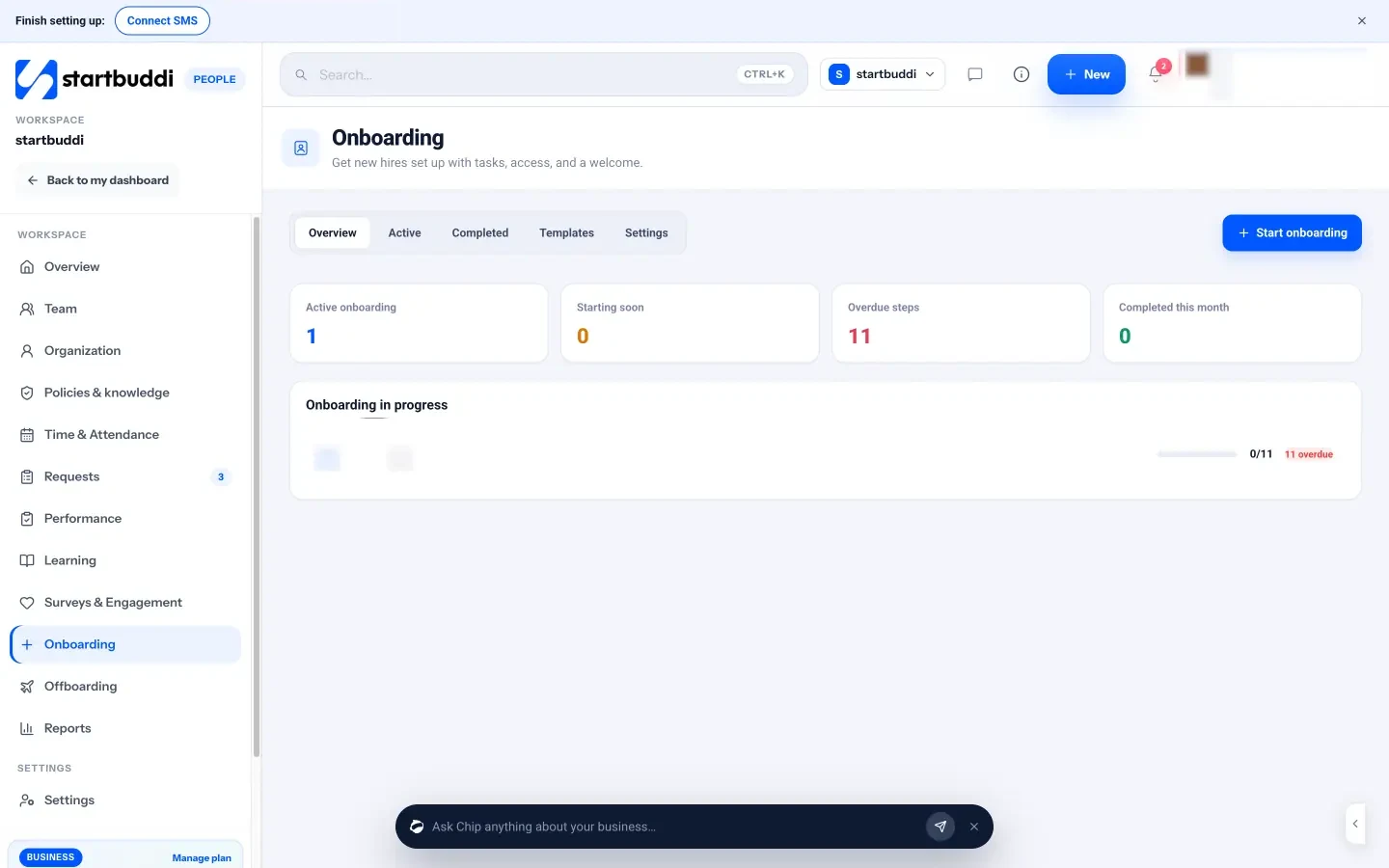
A free plan is available; inviting a new hire as a team member needs a paid plan with seats. See pricing, or how startbuddi works for startups.
Hire well, then help them settle in
Copy the scorecard into your next role before you write the advert. When the offer is signed, start free with startbuddi to send it for signature and run onboarding from a checklist.
Frequently asked questions
What are the best practices in talent acquisition?
The core practices are defining outcomes before advertising, writing fair job adverts with pay ranges, testing real work, running structured interviews, moving quickly, checking references and the right to work, and planning onboarding. Together they reduce bad hires and lost candidates. Small teams can run all of them without special software.
How can a small business compete for talent with bigger companies?
Small businesses win on speed, clarity and ownership. Decide quickly, say what the role pays, and show candidates the real impact they'll have. Flexibility and a direct line to the founder often matter as much as salary.
How long should the hiring process take?
For most small-business roles, two to four weeks from advert to offer is realistic. Longer processes lose good candidates to faster employers. Set the timeline at the start and share it with candidates.
What is a hiring scorecard?
A hiring scorecard is a one-page description of what a role must achieve, the skills and behaviours needed, and the deal-breakers. Every interviewer scores candidates against it. It keeps decisions consistent and based on the job, not gut feeling.
Should I pay candidates for work samples?
Pay for any task that takes more than about an hour, or that you could use in your business. It shows respect for candidates' time and avoids the impression of getting free work. Short tasks under an hour are generally accepted as part of the process.
What metrics should a small business track in talent acquisition?
Track time to hire, applicants per hire, offer acceptance rate and 90-day retention. They show whether your adverts attract the right people and whether hires stay. A simple spreadsheet per role is enough.
Tiwalade Joanna Okedara-Kalu is the founder, CEO and CTO of startbuddi, the business system that brings clients, bookings, invoices, projects, marketing and the Chip AI assistant into one place. Tiwalade builds software around how service businesses really work day to day, and writes about client management, getting paid on time and why small businesses outgrow the tools they start with.
Founded startbuddi and leads its product and engineering