Talent Acquisition Outsourcing: A Practical Guide for Small Business Owners
Talent acquisition outsourcing explained for small businesses: the models, what they cost, when outsourcing hiring makes sense and the mistakes to avoid.


Photo: Tyler Franta / Unsplash
Talent acquisition outsourcing means paying an outside firm to run some or all of your hiring: writing the advert, sourcing and screening candidates, arranging interviews and sometimes making the offer. For a small business it usually makes sense for hard-to-fill roles or a burst of hiring, not for every hire. You still make the final decision and stay responsible for it.
Key takeaways
- Outsourcing talent acquisition comes in four main forms: contingency recruiters, retained search, project-based recruitment process outsourcing (RPO) and on-demand recruiters paid by the hour or month.
- Contingency fees are paid only when someone starts, so they’re the lowest-risk way for a small business to try outsourcing.
- Outsourcing the work doesn’t outsource the responsibility. Discrimination, data protection and right-to-work rules still apply to you.
- Write a one-page hiring brief before you call any firm. Most failed outsourced searches fail because the brief was vague.
- Keep the final interview and the offer in-house. Nobody outside your business can judge fit with your clients and team as well as you can.
What is talent acquisition outsourcing?
Talent acquisition is the whole job of finding and hiring people: planning the role, attracting candidates, assessing them and bringing them on board. Talent acquisition outsourcing hands part of that job to a specialist. Large companies often outsource the whole function under a multi-year RPO contract. A small business usually outsources one stage (sourcing and screening is the most common) for one role or one hiring push.
It isn’t the same as outsourcing the work itself. If you pay an agency to place a bookkeeper on your payroll, that’s outsourced hiring. If you pay a bookkeeping firm to do your books, that’s outsourced work, and no hiring happens at all. It’s also different from an employer of record, where another company legally employs your hire for you, usually in another country.
The four models of outsourcing talent acquisition
| Model | How you pay | What they do | Best for |
|---|---|---|---|
| Contingency recruiter | A fee when the hire starts, usually a share of first-year salary | Send you CVs of screened candidates | One-off roles with a clear market, such as sales, admin or technicians |
| Retained search | Part of the fee upfront, the rest in stages | A dedicated, exclusive search, often with a market map | Senior or rare roles, such as a finance lead or head of operations |
| Project RPO | A fixed fee for a set period or set number of hires | Run the whole hiring process for a batch of roles, often under your brand | Opening a new branch or winning a contract that needs several hires at once |
| On-demand recruiter | Hourly, daily or monthly rate | A recruiter works inside your process for a few weeks | Teams that want control but lack time |
Fee levels vary by country, sector and seniority, so ask at least two firms for written terms. The model matters more than the headline number: a contingency fee you pay only on success is a very different risk from a retainer you pay whether or not anyone is hired.
When does outsourcing hiring make sense for a small business?
Outsourcing tends to pay off in four situations:
- The role is hard to fill. Specialist engineers, experienced nurses, licensed technicians. A recruiter with an existing network reaches people who never read job boards.
- You need several people quickly. A cleaning company that wins a contract for three new office sites may need ten cleaners and two supervisors in a month. A project RPO can run that volume while you keep the business going.
- You’re hiring outside your expertise. A design studio owner hiring a first accountant can’t easily judge the CVs. A specialist recruiter can.
- Your time is worth more than the fee. If screening 200 applications takes a founder two weeks of evenings, the fee may be cheaper than the lost sales.
It rarely pays off for entry-level roles with plenty of applicants, roles you’ll hire again and again (build your own process instead), or your first one or two hires, where getting the culture right matters more than speed. Our talent acquisition process guide sets out how to run hiring yourself.
How talent acquisition outsourcing works, step by step
- Write the hiring brief. One page: the job, the outcomes expected in the first 90 days, must-have and nice-to-have skills, salary range, location and working pattern, and how you’ll assess candidates.
- Choose the model and the firm. Ask for recent placements in your sector and city, how they source, and who exactly will work on your role.
- Agree terms in writing. Fee, when it’s due, the replacement guarantee if a hire leaves early, exclusivity, and who owns the candidate data. Our recruitment placement agreement template shows the clauses to look for.
- Calibrate early. Review the first three to five CVs together and say clearly what’s right and wrong about each. This one conversation saves weeks.
- Interview the shortlist yourself. Let the firm handle scheduling and first screens, but keep the final interview and any practical test.
- Make the offer. Many firms will present the offer and handle negotiation; the contract still comes from you.
- Onboard and review. Run employee onboarding yourself, and check in with the firm at the end of the guarantee period.
A hiring brief you can copy
Give this to any recruiter before the first call.
ROLE: [title]                      REPORTS TO: [name]
LOCATION / PATTERN: [office, hybrid, remote; hours]
SALARY RANGE: [min to max, plus any allowances]
START BY: [date]

WHY THIS ROLE EXISTS
[Two sentences: the problem this person solves.]

IN THE FIRST 90 DAYS THEY WILL
1. [Outcome]
2. [Outcome]
3. [Outcome]

MUST HAVE                          NICE TO HAVE
- [skill or licence]               - [skill]
- [experience]                     - [experience]

HOW WE WILL ASSESS
- Screening call (recruiter), 20 minutes
- Practical task (us), [describe]
- Final interview (owner + one teammate)

DEAL-BREAKERS
- [e.g. no weekend availability]

WHAT WE OFFER CANDIDATES
- [growth, training, flexibility, the honest pitch]
What does talent acquisition outsourcing cost? A worked example
The figures below are illustrative, not market rates. Use them to set up your own comparison.
A Lagos IT services firm needs two support engineers on ₦400,000 a month each (₦4,800,000 a year). It compares three routes:
| Route | Assumption | Cost for two hires |
|---|---|---|
| In-house | 40 hours of the founder’s time per hire, valued at ₦10,000 an hour, plus ₦100,000 of job adverts in total | ₦900,000 |
| Contingency recruiter | 15% of first-year salary per hire (₦720,000 each) | ₦1,440,000 |
| Project RPO | ₦600,000 a month for 2 months, up to 4 hires | ₦1,200,000 |
In-house looks cheapest, but only if the founder really has 80 spare hours and gets the hires right. If the firm also needs two more engineers next quarter, the RPO route covers four hires for ₦1,200,000, or ₦300,000 each, while contingency would cost ₦2,880,000 for four. The right answer depends on volume and on what the founder’s time is actually worth.
The rules still apply to you
Outsourcing hiring moves the work, not your legal duties. A few examples from different countries (general information, not legal advice):
- United States. The EEOC’s guidance on staffing firms and their clients (checked on 1 October 2026) says both the firm and the client can be liable for discrimination, including where one knew or should have known of the other’s discrimination and didn’t act.
- United Kingdom. If you take on an agency temp permanently, the agency may charge a transfer fee. Under the GOV.UK rules on fees to hiring companies (checked on 1 October 2026), you can instead choose to extend the temp’s assignment, and the fee only applies within set periods, so read those terms before you sign.
- Nigeria. A company that employs workers to make them available to a third party needs a recruiter’s licence from the Federal Ministry of Labour and Employment under the Labour Act, as the NELEX recruiter’s licence page (checked on 1 October 2026) explains. Ask any agency supplying staff to show theirs.
Candidate CVs are personal data too. Agree in writing how the firm stores and deletes the data it collects for you, under the data protection law where you operate, such as the Nigeria Data Protection Act 2023 or the UK GDPR.
Common mistakes when outsourcing talent acquisition
- Briefing by phone only. A five-minute call produces five weeks of wrong CVs. Send the written brief.
- Giving the same role to four agencies. You’ll get the same candidates from several firms, disputes over who introduced whom, and less effort from everyone. Use one or two.
- Skipping the calibration review. If the first CVs are off, say why straight away.
- Hiding the salary range. Recruiters can’t sell a role they can’t price.
- Letting the firm run the final interview. Fit with your clients and team is your call.
- Not tracking results. Measure time to hire, offer acceptance and how many hires pass probation. Our talent acquisition metrics article explains each one.
- Forgetting onboarding. A recruiter’s guarantee doesn’t help if a good hire leaves in month two because nobody showed them how things work.
How to get started
Start small. Pick one role that’s hard to fill, write the brief, and approach two firms that place people in that role in your city. Agree a contingency fee with a replacement guarantee, calibrate on the first CVs and keep the final interview yourself. After the hire has passed probation, decide whether outsourcing earned its fee or whether you’d rather build the process in-house. If you’re planning several hires over the next year, our guide to building your first team helps you decide the order.
Where startbuddi fits
startbuddi isn’t an applicant tracking system or a recruitment agency, and it won’t source candidates for you. It helps with the parts of hiring that sit around an outsourced search:
- Keep the agency in your CRM. Add the recruitment firm as a company in Customers, with its contacts, your notes and every email and WhatsApp message in one history.
- Sign the terms. Send the agency agreement and, later, the offer letter for e-signature from Documents.
- Interview by video. Hold final interviews in startbuddi Live, with candidates joining by link.
- Onboard the hire. Once they accept, start an onboarding checklist in People with steps for the new hire, their manager and whoever sets up their access.
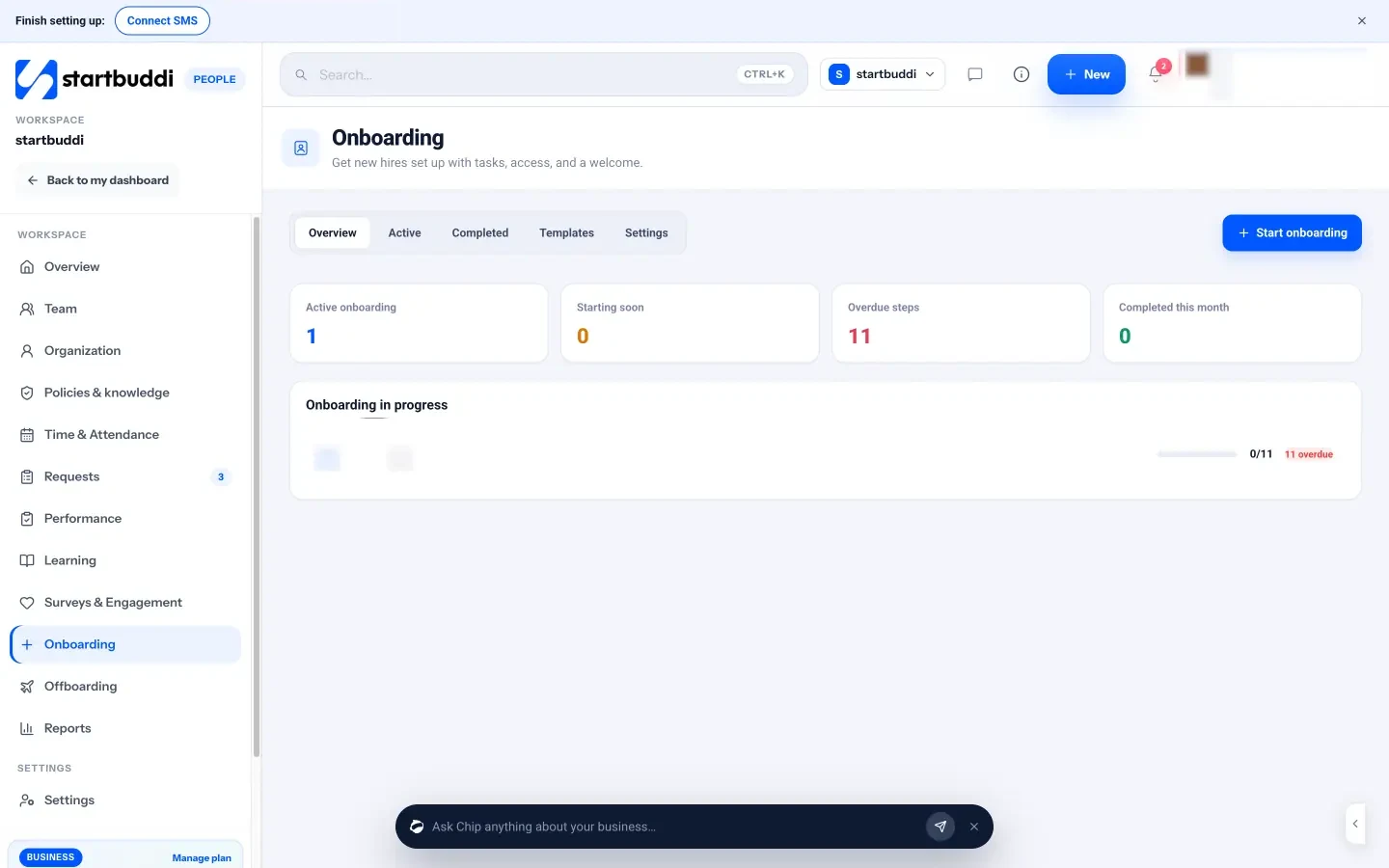
A free plan is available; adding a new hire as a team member needs a paid plan with seats. See pricing. If you run a recruitment business yourself, see how startbuddi works for recruitment agencies.
Hire with a brief, then onboard with a plan
Write the brief before you call a recruiter, and have the onboarding checklist ready before the offer is signed. Start free with startbuddi to keep the agency, the paperwork and the new hire’s first weeks in one place.
Frequently asked questions
What is talent acquisition outsourcing?
Talent acquisition outsourcing is paying an outside firm to run some or all of your hiring, from sourcing and screening candidates to arranging interviews and offers. Small businesses usually outsource one stage for one role or a batch of roles. You still make the final hiring decision.
What is the difference between RPO and a recruitment agency?
A recruitment agency usually fills individual roles and is paid per hire. Recruitment process outsourcing (RPO) runs your hiring process itself, often for a set period or number of hires and often under your brand. For a small business, project RPO for a batch of hires is the closest fit.
Is outsourcing talent acquisition worth it for a small business?
It's worth it for hard-to-fill roles, sudden hiring pushes and roles outside your own expertise. It's rarely worth it for entry-level roles with lots of applicants or roles you hire repeatedly. Compare the fee with the real value of the time you'd otherwise spend.
How much does it cost to outsource hiring?
Costs depend on the model, the country and the role. Contingency recruiters charge a fee when the hire starts, usually set as a share of first-year salary; retained search and RPO charge fees in stages or per month. Get written terms from at least two firms and compare them on the same roles.
Am I still responsible if an agency discriminates?
Often, yes. In the US, EEOC guidance says a client can be liable for a staffing firm's discrimination if it knew or should have known and didn't act. Similar principles apply in other countries, so set clear, fair criteria in your brief and check how the firm screens.
Can I outsource onboarding as well as hiring?
Some RPO firms offer onboarding help, but most small businesses are better keeping it in-house. Onboarding is where a new hire learns how your business serves clients, and that's knowledge only you and your team have.
Olabimpe Salami is the email and outreach specialist at startbuddi. Olabimpe writes about the messages that bring customers in and back: email, WhatsApp and SMS campaigns, follow-ups, and turning enquiries into paying clients.
Runs email and outreach at startbuddi