How to scope a client project so it doesn’t creep
Scope creep quietly eats your profit. Learn how to scope client projects properly, handle change requests without saying no, and spot creep early.



- Scope creep is extra work that slips in without extra time or money. Prevent it by asking the right questions before you quote, writing a scope that lists what is not included and what counts as a revision, and treating every new request as a priced decision with options.
Scope creep is when a project slowly grows beyond what was agreed, without the time, budget or price growing with it. You prevent it in two places: before the work starts, by writing down exactly what is and is not included, and during the work, by treating every new request as a small decision with a price and a date, not a favour. You do not have to say no to clients. You have to say “yes, and here is what it changes”.
This guide shows you how to scope a client project so it holds: the questions to ask, what to put in a statement of work, how to handle change requests with a simple template, and how to spot creep early.
What scope creep is, and why it happens
The Project Management Institute describes scope creep as the uncontrolled expansion of a project’s scope without adjustments to time, cost and resources. In its Pulse of the Profession 2018 survey, 52% of projects completed in the previous 12 months had experienced scope creep or uncontrolled changes, up from 43% five years earlier. That survey covers large organisations, but anyone who has built a website, run a campaign or designed a brand for a small client will recognise the pattern.
For freelancers and small agencies, it usually starts innocently:
- Vague scope. “A new website” can mean five pages or fifty.
- “While you are at it” requests. Small asks that each seem too minor to price.
- Unlimited revisions. Nobody said how many rounds of changes were included.
- New decision-makers. The client’s partner or boss sees the work late and wants changes.
- Your own gold-plating. Adding extras nobody asked for, then feeling you cannot charge for them.
The Association for Project Management points to the same tools professional project managers use: a clear scope definition and a change control process. For a small business, both can be one page each.
The real cost of scope creep for a small business
On a large project, scope creep hurts a budget. On a freelance project, it hurts you directly.
- Your hourly rate drops. A ₦600,000 project planned for 40 hours pays ₦15,000 an hour. If it quietly becomes 60 hours, you earn ₦10,000 an hour.
- Other clients wait. The extra hours come from someone else’s deadline.
- The relationship sours. You feel taken for granted; the client feels you are slow.
- The project never ends. Without a clear finish line, the final invoice keeps slipping.
Our free hourly rate calculator is a quick way to see what your real rate is once the extra hours are counted.
Step 1: ask the right questions before you quote
Most creep is baked in at the start, because the quote was based on a guess. Before you price anything, ask:
- What problem is this project solving? The goal helps you judge later requests: does this change serve the goal, or is it a new project?
- What does “done” look like? Ask them to describe the finished result in one or two sentences.
- Who approves the work? Get the names of everyone who can say yes or no, and ask to include them early.
- What content, access or materials will you provide, and when? Late content is one of the most common causes of delays.
- What is the deadline, and what is it tied to? A launch, an event or just a preference?
- What is the budget range? This lets you shape the scope to fit, rather than cut it later.
A short client intake form collects most of this before your first call.
Step 2: write a scope that says what is out, too
The single most useful line in any scope is the one that lists what is not included. Clients rarely argue with a list they agreed to; they argue with silence.
What to include in your statement of work
| Section | What to write | Example |
|---|---|---|
| Goal | One sentence on why the project exists | Get more enquiries from the website |
| Deliverables | Each thing you will hand over, with numbers | A 5-page website: Home, About, Services, Blog, Contact |
| Not included | Things clients often assume are included | Copywriting, stock photos, logo design, ongoing updates |
| Revisions | How many rounds, and what counts as one | Two rounds of changes per page, sent as one list |
| Client responsibilities | What they provide and by when | All text and photos by 10 March |
| Timeline and milestones | Key dates, each linked to a deliverable | Design approved 20 March; site live 15 April |
| Price and payment | Total, deposit and when the rest is due | 50% to start, 50% before launch |
| Changes | How new requests are handled | Changes outside this scope are quoted separately before work starts |
You can start from our statement of work template, and if you are still winning the job, our guide on how to write a business proposal shows how scope fits into the pitch.
Define a revision properly
“Two revisions” means nothing if a revision can be a one-word change or a complete redesign. Write it down: “A round of revisions is one consolidated list of changes to the existing design. New pages, new features or a new direction are not revisions.” This one sentence prevents a lot of arguments.
Step 3: get agreement in writing before you start
An emailed “sounds good” is better than nothing, but a signed agreement with the scope attached is much stronger. It does not need to be long or written by a lawyer for every project, but for bigger jobs it is worth having a template reviewed once. A freelance or consulting agreement template is a good starting point; treat any template as general information, not legal advice.
Then run a short kickoff call where you walk through the scope line by line, especially the “not included” list. Our guide on how to run a project kickoff meeting has an agenda you can use. Saying it out loud at the start is far easier than saying it for the first time in week six.
Step 4: handle change requests with a simple process
Changes are not the enemy. Clients learn as the project goes, and some changes make the work better. The problem is changes that slip in without anyone deciding. A change process turns each request into a decision.
The four-step change process
- Acknowledge it. “Great idea, thanks. That is outside what we agreed, so let me work out what it involves.”
- Estimate it. Hours, cost and effect on the deadline.
- Offer options. Add it for an extra fee, swap it for something of similar size, or save it for a phase two.
- Get a yes in writing before you start the extra work, then update the plan and the invoice.
Change request reply template
Hi {{first_name}}, thanks for this, adding a booking page makes sense. It is not in our current scope, so here are the options:
1. Add it now for ₦120,000. It adds about a week, so launch moves from 15 April to 22 April.
2. Swap it for the blog page, which we have not started yet. No change to price or date.
3. Launch as planned and add it as a small phase two in May.
Let me know which you prefer and I will send the updated quote.
This reply is friendly, shows you listened, and puts the decision where it belongs: with the client. Most clients choose sensibly once they see the trade-off.
When to absorb a small change
You do not have to price every five-minute tweak. Many freelancers keep a small allowance of goodwill changes, but they still mention it: “Happy to do this one at no charge.” Naming the favour stops it from becoming the new normal.
Step 5: watch for early warning signs
Scope creep is easiest to fix in week one, not week ten. Look out for:
- Hours logged running ahead of progress. If you are 50% through the budget but only 30% through the tasks, something has grown.
- Tasks being added to the project that are not linked to any agreed deliverable.
- Feedback rounds that keep reopening work already approved.
- A new person on the client side giving feedback for the first time.
- Phrases like “just one more thing”, “quick change” or “while you are in there”.
Track time against each project, even if you charge a fixed price. It is the only way to see creep in numbers rather than feelings. Our guide on tracking billable hours without a spreadsheet explains a simple routine.
Common scope creep examples and how to answer them
The same requests come up again and again. Having an answer ready makes them much easier to handle in the moment.
| The request | Why it is creep | A good answer |
|---|---|---|
| “Can you also write the text for the pages?” | Copywriting was listed as not included | Offer it as an add-on with a price per page, or suggest they send drafts you can tidy within the current revisions |
| “My partner saw it and wants a different style.” | A new decision-maker is reopening approved work | Treat it as a new direction: quote it, or agree which approved parts stay as they are |
| “Can we add a shop?” | A new feature, not a revision | Quote it as phase two, with its own timeline |
| “Just a few small tweaks” (for the fourth time) | Revisions beyond the agreed rounds | Remind them how many rounds were included and offer extra rounds at an hourly or fixed rate |
| “Can you post it on our social media too?” | Ongoing work after a one-off project | Offer a monthly retainer for ongoing support |
Notice that none of these answers is “no”. Each one turns the request into a choice, and many of them turn into extra revenue. Some of your best repeat work will start as a request you nearly did for free.
Scope creep on retainers
Monthly retainers creep differently: the work grows a little each month while the fee stays the same. Write down what the retainer covers each month (for example “8 social posts and one report”), track hours against it, and review it together every quarter. If the work has grown for three months in a row, that is the moment to adjust the fee or the scope, with the numbers in front of you.
Step 6: close the project cleanly
A project without an ending invites endless small requests. When the last deliverable is approved, send a short handover message: what was delivered, where the files are, what support is included (for example “two weeks of bug fixes”), and how to request new work. Then send the final invoice. New requests after that point are a new project, which is often good news: it is repeat business.
How startbuddi helps
startbuddi keeps the scope, the work and the money for a project connected, so creep shows up before it costs you.
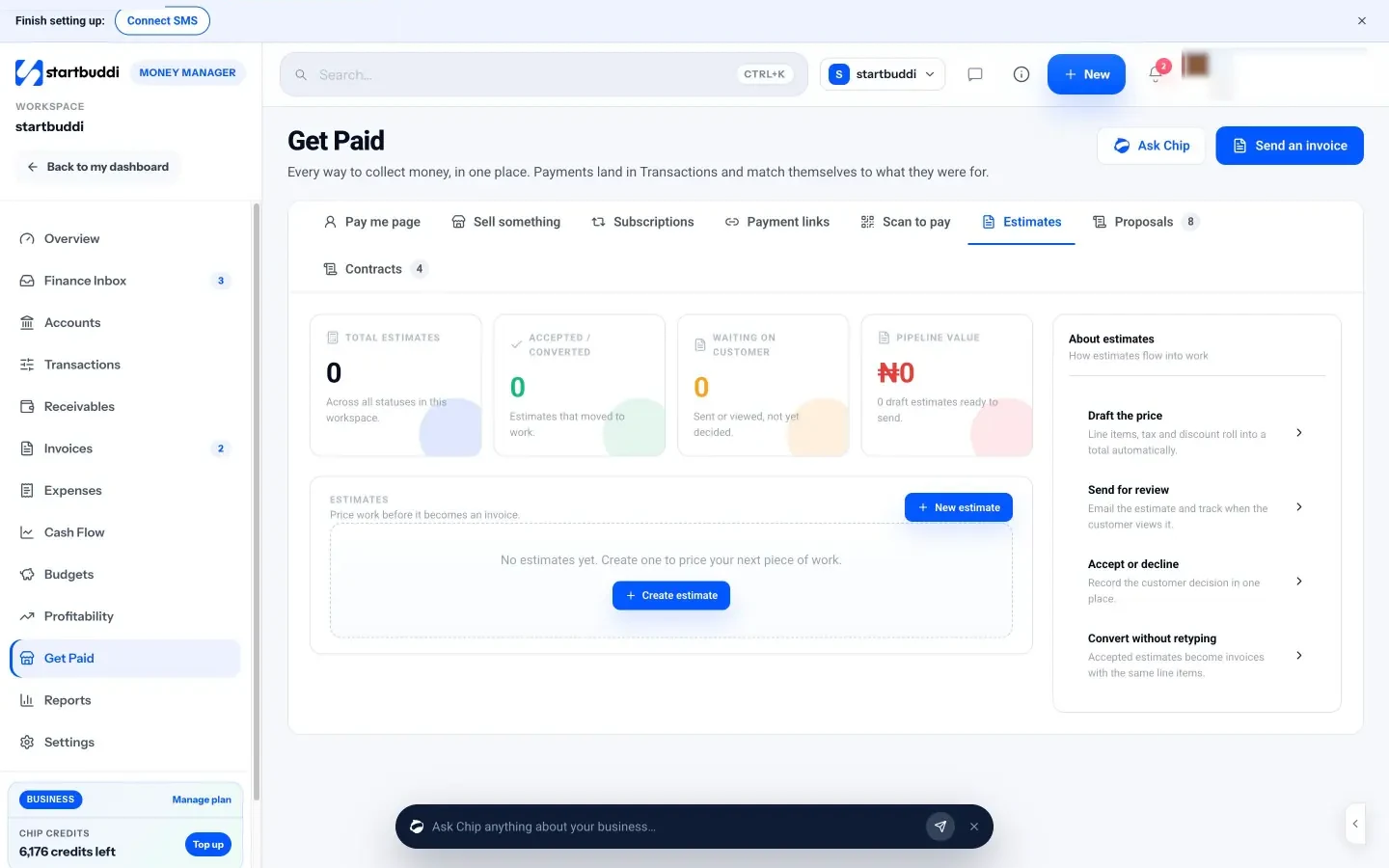
In Money Manager, you can create an estimate with line items and notes and terms (such as “Valid for 30 days. 50% deposit to begin.”), send it by email, and when the client replies to accept, mark it accepted and convert it into an invoice without retyping. For a signed agreement, create a contract from a template such as the Website Development or Brand Design contract, edit the wording to add your scope and “not included” list, add signers and send it for e-signature. A change request can simply be a new estimate for the extra work.
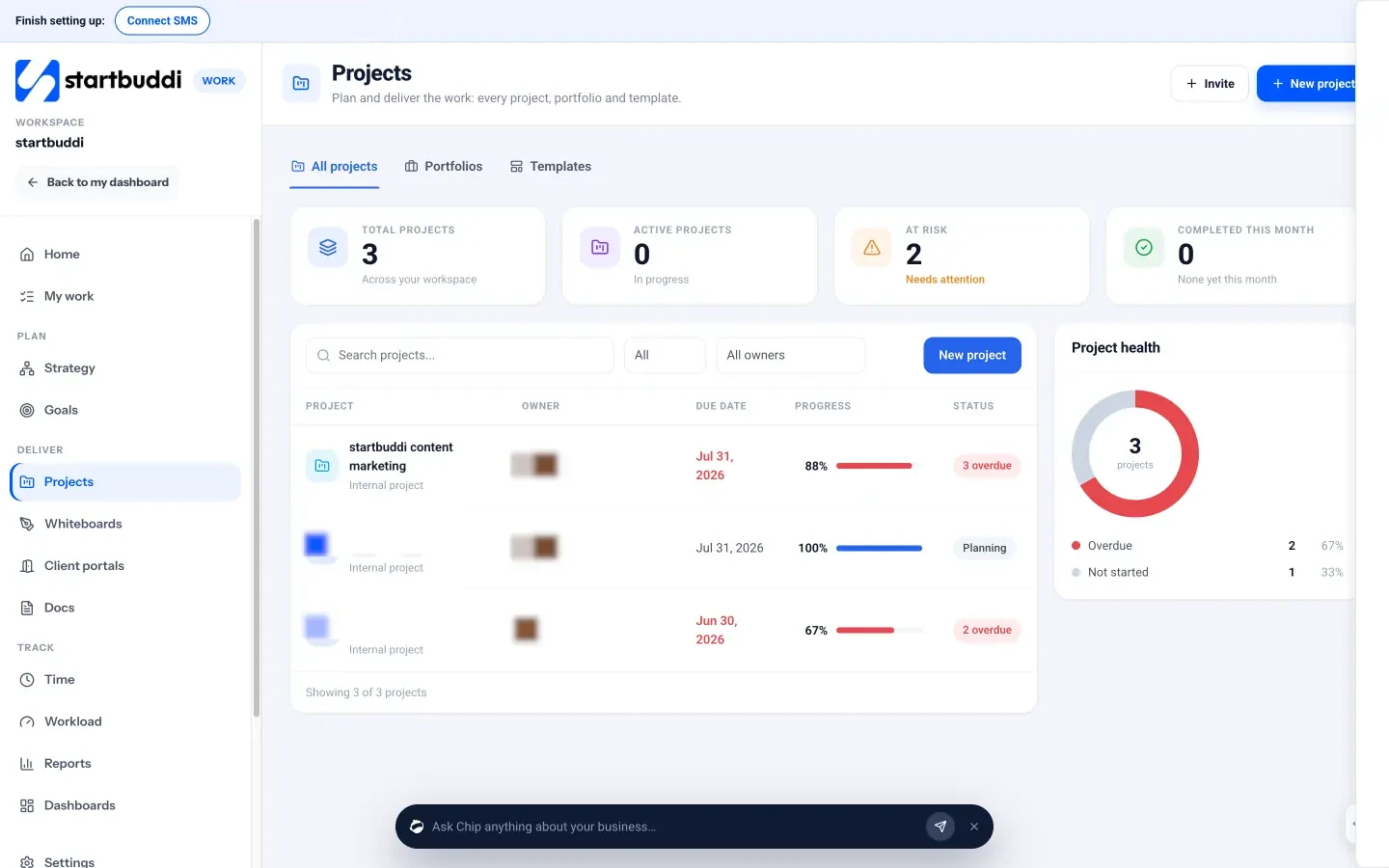
In Projects, you can start from a template such as Client delivery or Website project, set milestones with due dates and owners, and link tasks to each milestone, so anything that does not belong to an agreed milestone stands out. The Budget tab shows a money budget and an hours budget alongside time logged and cost to complete, with an hours burn-down chart. Time logged in time tracking feeds straight into it.
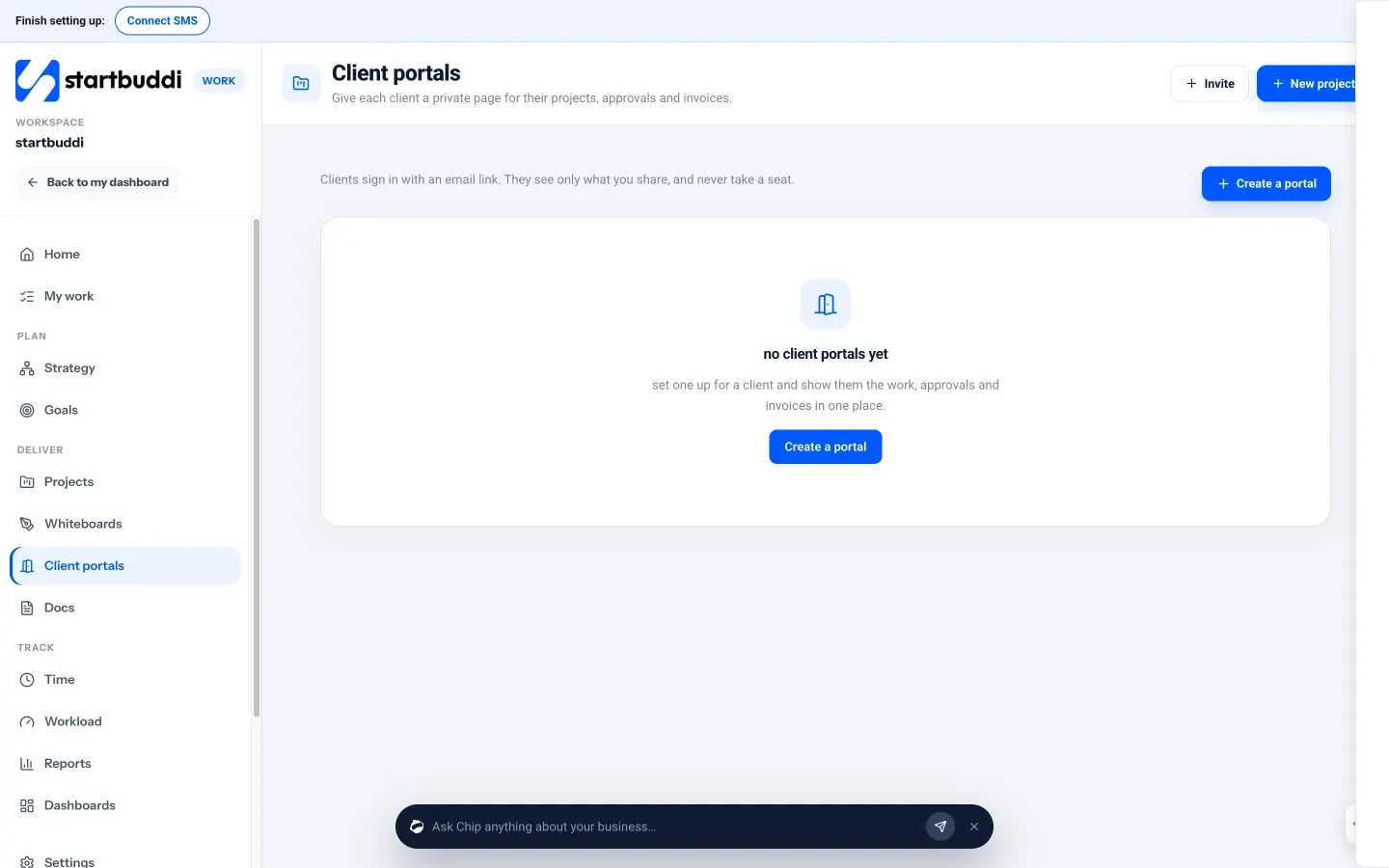
With client portals, each client gets a private page to follow the work and approve deliverables. When approvals are on, a shared deliverable cannot be marked done until the client approves it, which gives you a clear written record of what was signed off. Clients sign in with an email link and never take a seat. You can build and preview a portal on the Free plan; inviting clients needs the Starter plan or above.
Your next step
Take the project you are quoting next and write its “not included” list before you send the price. Then decide, in one sentence, what counts as a revision. If you want the estimate, project plan and client approvals in one place, see startbuddi’s plans and start on Free.
Sources
- Project Management Institute, Pulse of the Profession 2018
- Association for Project Management, What is scope creep and how can we mitigate it?
Frequently asked questions
Is scope creep always the client's fault?
No. It often comes from a vague scope, unlimited revisions or extras the freelancer adds without being asked. A clear written scope protects both sides.
How do I tell a client something is out of scope without upsetting them?
Thank them for the idea, explain that it is outside what you agreed, and offer options: add it for a fee, swap it for something not yet started, or move it to a later phase.
Should fixed-price projects include a contingency?
Many freelancers add a small buffer to fixed prices for unknowns. It is still worth tracking hours, so you can see when a project is growing beyond that buffer.
What is the difference between a change request and scope creep?
A change request is a new ask that is priced and agreed before work starts. Scope creep is the same ask done without that decision, so time and cost grow without anyone agreeing.
Olabimpe Salami is the email and outreach specialist at startbuddi. Olabimpe writes about the messages that bring customers in and back: email, WhatsApp and SMS campaigns, follow-ups, and turning enquiries into paying clients.
Runs email and outreach at startbuddi