Email subject lines that get opened: rules and examples
Seven rules and eight formulas for email subject lines that get opened, with examples for small businesses, preview text tips and how to test on a small list.


- Good email subject lines are short, specific and honest, with the key words first. Use preview text to add new information, avoid clickbait and shouting, and A/B test one change at a time, judging winners by clicks rather than opens.
Email subject lines that get opened are short, specific and honest about what’s inside. They put the most important words first, sound like a person rather than a brand, and give the reader a reason to open now. Pair every subject line with preview text that adds something new, and test one change at a time to learn what your own readers respond to.
This guide covers the rules that matter, eight subject line formulas with examples for small businesses, the mistakes that send emails to spam or get them ignored, and how to test subject lines properly on a small list.
Why email subject lines matter more than the email
Your reader sees three things before deciding whether to open: who it’s from, the subject line and the preview text. That’s all. If those don’t earn the open, the email you spent an hour on is never read.
Subject lines also shape how people feel about your future emails. A misleading subject might win one open, but readers remember. Next time they skip you, unsubscribe or mark you as spam, and mailbox providers notice. If you’re new to the basics, our glossary entry on email marketing is a good starting point.
The sender name matters too
Before the subject line, people check who the email is from. “Tolu at Bloom Studio” feels more personal than “Bloom Studio Marketing” or “noreply”. Pick a sender name people recognise and keep it the same, so your emails become familiar.
Seven rules for subject lines that get opened
1. Keep it short and put the key words first
Mailchimp’s subject line best practices suggest no more than nine words and 60 characters. On phones, even fewer characters show before the line is cut off, so front-load the part that matters. “Friday slots open: book before they go” works even if only “Friday slots open” is visible.
2. Be specific
Vague subject lines (“Our latest news”, “October update”) give no reason to open. Specific ones do: “3 new colours in the linen range”, “Your quote for the kitchen fit-out”, “We’re closed Monday, open late Tuesday”.
3. Say what’s in it for them
Readers ask one question: what do I get? Lead with the benefit or the useful thing, not your company. “How to keep your inverter running during outages” beats “Tips from SunPower Solar”.
4. Sound like a person
Write the way you’d text a customer. Lowercase, plain words and a natural tone often stand out in an inbox full of shouting brands. Avoid ALL CAPS and stacks of exclamation marks. Mailchimp suggests no more than three punctuation marks in a subject line.
5. Use personalisation carefully
A first name (“Amaka, your order is ready”) can help, especially for transactional or personal-feeling emails. But it has become common, so it isn’t magic. Location or recent behaviour (“New slots in Lekki this week”) is often more useful than a name, and it comes from segmenting your list. Always set a fallback so a missing name doesn’t produce “Hi ,”.
6. One emoji, at most
An emoji can help your email stand out, but Mailchimp recommends using no more than one, and using it to support words rather than replace them. Check it displays properly on the phones your customers use.
7. Never mislead
Fake “Re:” or “Fwd:” prefixes, false urgency and promises the email doesn’t keep damage trust. In the US, the FTC’s CAN-SPAM guidance says a subject line must accurately reflect the content of the message. That’s a good rule wherever you are.
Preview text: the second subject line
Preview text is the line of grey text that appears after the subject in most inboxes. If you don’t set it, the inbox grabs the first words of your email, which is often “View in browser” or “Hi there”.
Use it to add information, not repeat it:
| Subject line | Weak preview text | Better preview text |
|---|---|---|
| Friday slots are open | Friday slots are now open for booking | Only six left, and Saturday is already full |
| Your invoice from Bloom Studio | View your invoice | ₦85,000 for the September retainer, due 15 October |
| The mistake most new landlords make | Read our latest blog | It costs about a month’s rent. Here’s how to avoid it |
Think of the subject and preview text as one sentence split in two. The subject gets attention, the preview gives the reason to click.
Eight subject line formulas, with examples
Formulas aren’t a replacement for knowing your customers, but they’re a quick way to get past a blank page. Each works for a different kind of email.
1. The straight announcement
Best for news people want. Say exactly what happened.
- New: weekend appointments from October
- The linen range is back in stock
- We’ve moved to 14 Admiralty Way
2. The useful how-to
Best for newsletters and tips.
- How to make your braids last six weeks
- How to price a small catering job
- The 5-minute check before you file your returns
3. The number
Numbers promise something concrete and scannable.
- 3 things to ask before hiring a builder
- 7 lunch ideas under ₦3,000
- 2 slots left this month
4. The honest deadline
Urgency works when it’s real. Only use it for real deadlines.
- Last day for 20% off the starter pack
- Registration closes Friday at midnight
- Book by Wednesday for delivery before the holiday
5. The question
A question can pull readers in when it touches a real problem.
- Still paying for three tools that do one job?
- Is your generator ready for December?
- What would you do with an extra free afternoon?
6. The curiosity gap
Hint at something interesting without tricking people. The email must deliver.
- The client who paid us twice (and what we did)
- Why we stopped offering discounts
- This small change doubled our repeat bookings
Only use a line like the last one if it’s true for your business and you explain it inside.
7. The personal note
Great for founder emails, follow-ups and win-backs.
- A quick thank you from me
- Can I ask your opinion?
- Amaka, we saved your spot
8. The transactional clear-as-day
For invoices, receipts and bookings, clarity beats cleverness every time.
- Your booking is confirmed: Tue 14 Oct, 10am
- Invoice INV-013 from Bloom Studio
- Payment received, thank you
Subject lines for common small business emails
Here are ready-to-adapt lines for the emails small businesses send most. Use them as a starting point and rewrite them in your own voice.
| Subject line ideas | |
|---|---|
| Welcome | Welcome in, here’s your guide / You’re on the list (and here’s what’s next) |
| Newsletter | This month: new slots, a tip and a small change / What we learned in September |
| Sale or offer | 20% off everything until Sunday / Your early access starts now |
| Event or webinar | Join us live on Thursday: pricing for freelancers / Starting in one hour |
| Win-back | We miss you, here’s what’s new / Still interested in a quote? |
| Review request | How did we do? (one question) / Would you recommend us? |
| Payment reminder | Friendly reminder: invoice INV-013 due Friday / Invoice INV-013 is now overdue |
If you’re planning a promotion across several channels, our guide to running a sale across email, WhatsApp and SMS shows how the email subject lines fit with the rest.
Seasonal subject lines without the clichés
Holidays and big shopping days fill inboxes with near-identical subject lines. “Happy holidays from all of us” disappears in the crowd. What stands out is something only your business could say, tied to what your customer needs at that moment.
- Independence Day (1 October in Nigeria): “Made in Lagos: our 5 bestsellers” beats “Happy Independence Day!”.
- Black Friday: “Our only sale this year starts Friday” is clearer than another “BLACK FRIDAY DEALS”.
- Christmas deliveries: “Order by 18 December for delivery before Christmas” answers the question people actually have.
- New Year: “3 appointments to book before January gets busy” gives a reason to act.
- Back to school: “Uniform alterations: 48-hour turnaround this month” is specific and useful.
- Ramadan or Eid: “Our opening hours during Ramadan” is simple and genuinely helpful.
A useful habit: write your seasonal subject lines a month ahead, when you have time to think, rather than the night before. Plan them next to your social posts so the message is the same on every channel.
Subject line mistakes that hurt your emails
- Clickbait. “You won’t believe this” might get an open, but readers who feel tricked unsubscribe or report spam.
- Shouting. ALL CAPS, “!!!” and “FREE FREE FREE” look like spam to people and filters alike.
- Fake replies. Adding “Re:” to a first email is misleading and breaks trust quickly.
- Same subject every time. “Bloom Studio Newsletter #14” gives no reason to open issue 14.
- Too clever. Puns and in-jokes can fall flat. If a stranger wouldn’t understand it, rewrite it.
- Ignoring the list. A great subject line can’t fix sending to people who never asked. Build your list with consent first: see how to grow an email list from zero.
Deliverability depends far more on permission and complaints than on individual words. Google’s sender guidelines tell senders to keep spam complaint rates low and to avoid ever reaching 0.3%. An honest subject line sent to people who want your emails is the best protection there is.
How to test subject lines on a small list
An A/B test sends two versions to a small part of your list and the better one to everyone else. Done well, it’s the fastest way to learn what your readers like.
Test one thing at a time
If version B is shorter, more personal and has an emoji, you won’t know which change made the difference. Change one thing: length, a question versus a statement, with or without a name.
Judge by clicks, not just opens
Open rates have become less reliable. Apple’s Mail Privacy Protection downloads remote content in the background, which hides whether someone really opened an email and can inflate open counts. Clicks and replies come from a real person, so use them as the tiebreaker.
Be patient with small lists
With a few hundred subscribers, one test can be down to chance. Keep a simple note of every test and its result, and look for patterns over several sends. After five or six tests you’ll know whether your readers prefer questions, numbers or plain announcements.
A simple testing log
| Date | Version A | Version B | What changed | Winner (clicks) |
|---|---|---|---|---|
| 6 Oct | New weekend slots | Weekend slots are finally here | Tone | B |
| 20 Oct | 3 tips for dry season skin | Is dry season wrecking your skin? | Number vs question | A |
The results above are an example of how to fill in the log, not real data.
How startbuddi helps
The email marketing tools in startbuddi are built so you can write a good subject line, check it and learn from it without extra tools.
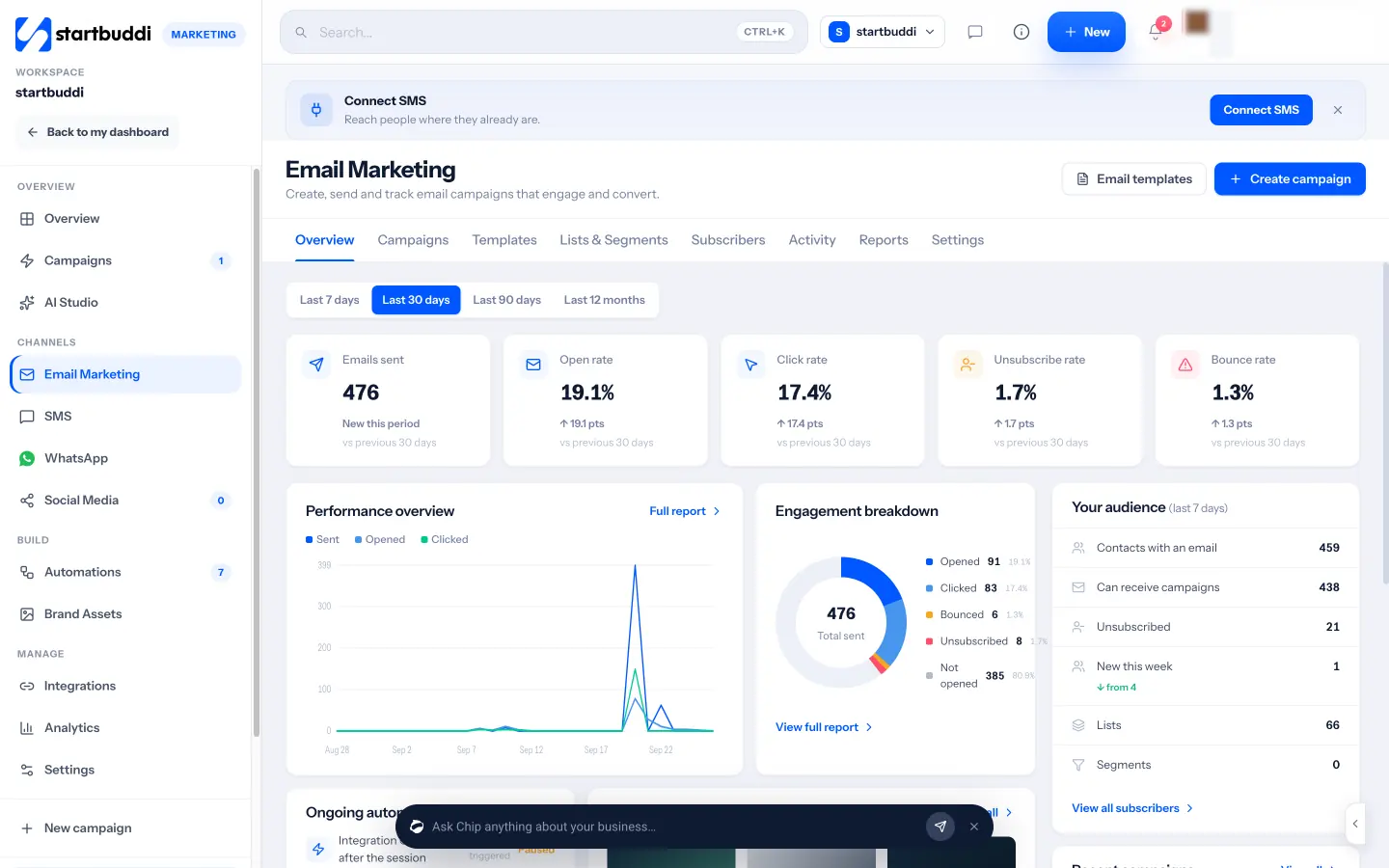
- Subject and preview text together. The Message step asks for both, so you never send an email with “View in browser” as its preview.
- Checks before you send. The Review step flags a missing subject, a subject that will be cut off on phones and missing preview text, and Chip gives a short read of the whole email with suggested fixes.
- Personalisation with a fallback. Merge tags such as {{first_name}} are available, and a missing first name reads as “there” instead of a blank.
- A/B testing. Test the subject line, the content or the sender name. Chip can write version B from angles such as More curiosity, Shorter, Benefit-led or Honest urgency. You set the test size and duration and pick the winner by click rate or open rate.
- A second chance. After a campaign, Resend to non-openers sends the same email with a new subject, once, only to people who haven’t opened it.
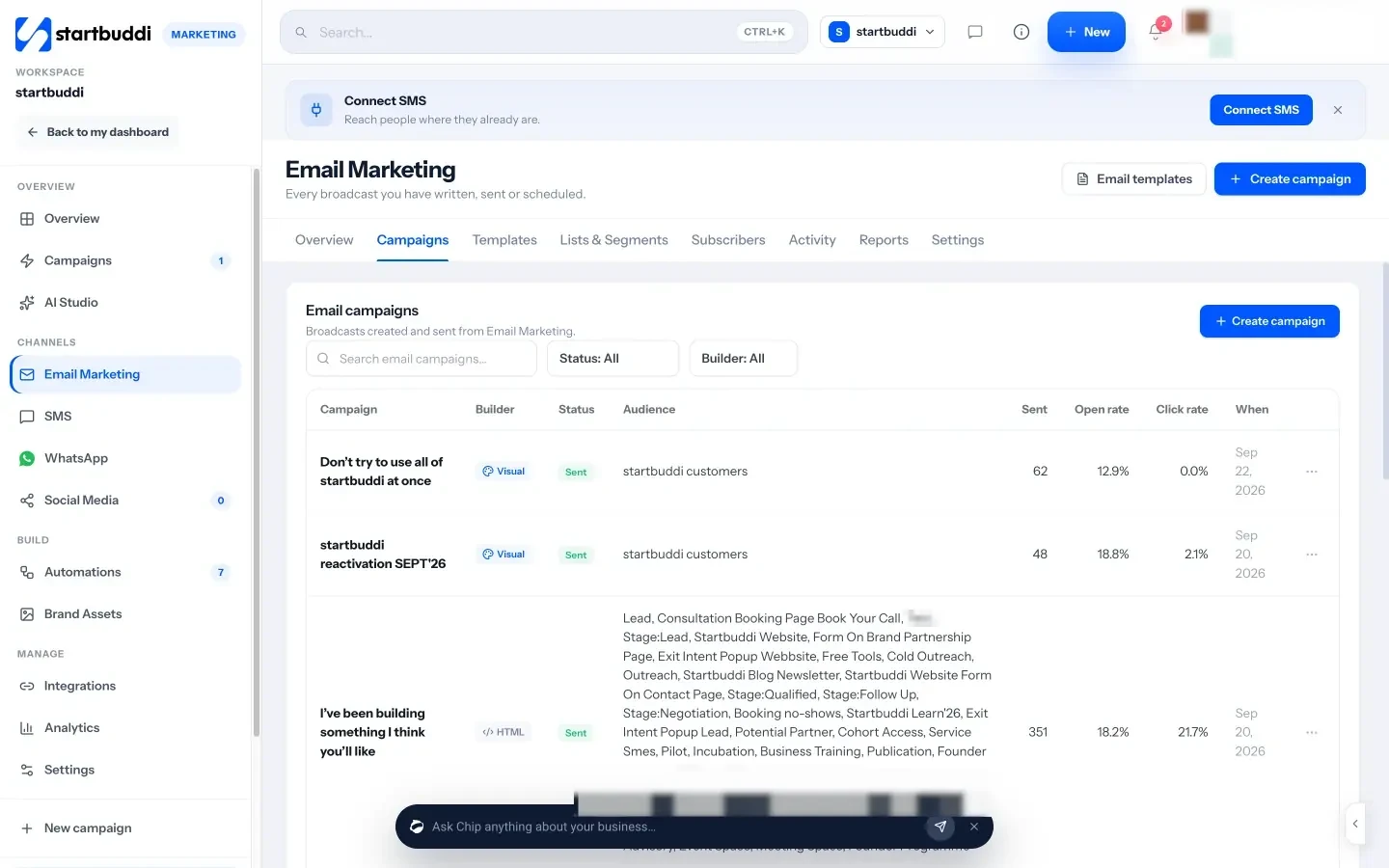
The help article on building an email campaign walks through each step. Email campaigns are part of the Marketing module, available on the Starter plan and above.
Your next step
Take your next email and write five subject lines for it using five different formulas from this guide. Pick the two you like most and test them against each other, judging by clicks. Do this for your next three sends and you’ll have your own evidence of what works. To run the test and see the results in one place, start a 30-day trial on any paid plan.
Sources
- Mailchimp: Best practices for email subject lines
- FTC: CAN-SPAM Act compliance guide for business
- Google Workspace: Email sender guidelines
- Apple Support: Use Mail Privacy Protection on iPhone
Frequently asked questions
How long should an email subject line be?
Aim for under nine words and about 60 characters, with the most important words first, because phones cut long subject lines short.
Do emojis in subject lines help?
Sometimes. One relevant emoji can help an email stand out, but more than one tends to look like spam. Test it with your own readers.
Should I put the customer's name in the subject line?
It can help for personal or transactional emails, but it's common now. Something specific, like their area or a recent booking, is often stronger.
Why are my open rates so high but clicks low?
Privacy features such as Apple Mail Privacy Protection can count emails as opened when they weren't. Clicks are a more reliable signal of real interest.
Olabimpe Salami is the email and outreach specialist at startbuddi. Olabimpe writes about the messages that bring customers in and back: email, WhatsApp and SMS campaigns, follow-ups, and turning enquiries into paying clients.
Runs email and outreach at startbuddi