Receipt: Definition, Examples and How It Works

A receipt is a document a seller gives a customer to confirm that a payment has been received. It shows who was paid, by whom, how much, when, how and what for, and it is the customer's proof of payment and part of both sides' business records.
So what is receipt paperwork for, if the money has already moved? It closes the loop on a sale: the customer can prove they paid, and you have a record that matches the money in your account.
Key takeaways
- A receipt confirms money received. An invoice asks for money. They are different documents.
- Every receipt needs a number, a date, both parties, the amount, the payment method and what the payment was for.
- Issue a receipt for every payment, including deposits and part payments, not only the final one.
- Tax authorities expect you to keep receipts for years, both the ones you issue and the ones you’re given for expenses.
- A digital receipt sent by email is as valid as a paper one in most places.
Why receipts matter for a small business
For an IT services firm, receipts do three jobs. They give clients proof they’ve paid, which their own finance team will ask for. They stop arguments about whether a payment arrived, especially with bank transfers that take a day to clear. And they keep your books honest: every receipt should match a payment in your bank or payment account.
Receipts you’re given matter just as much. The receipt for the laptop, the software subscription or the taxi to a client site is your evidence for that expense. The US tax authority’s guide to what records to keep (checked on 1 October 2026) lists receipt books, cash register tapes, credit card receipts and invoices among the documents that support income and expenses. If you lose them, you may struggle to prove the cost later.
How a receipt works
- The customer pays, by card, bank transfer, mobile money, USSD or cash.
- You confirm the money has arrived. For transfers, check your account rather than a screenshot.
- You issue the receipt, on paper or by email, with a unique number.
- You record it against the invoice or sale, so the invoice shows as paid or part-paid.
- Both sides keep a copy for their records.
What goes on a receipt
| Field | Example |
|---|---|
| Receipt number | RCT-0218 |
| Date of payment | 10 November 2026 |
| Your business name and contact details | Your trading name, address, email |
| Customer name | The client or company that paid |
| Amount received and currency | KSh 90,000 |
| Payment method and reference | Bank transfer, ref. 4471 |
| What it was for | Deposit on invoice INV-0153, server migration |
| Balance still due, if any | KSh 210,000 |
If you’re registered for VAT or sales tax, your country may require extra details, and sometimes a tax invoice rather than a plain receipt. Check your tax authority’s rules.
Types of receipt
- Full payment receipt: the whole amount is paid at once.
- Deposit or part payment receipt: shows what’s been paid and what’s still owed.
- Cash receipt: especially important, because there’s no bank record to fall back on.
- Refund receipt: confirms money returned to the customer. For a reduced or cancelled invoice, a credit note is often used alongside it.
An example with numbers
These figures are illustrative.
Wambui runs a small IT firm in Nairobi. A school asks her to move its files to a new server for KSh 300,000. Her invoice asks for a 30% deposit up front and the balance on completion.
| Payment | Date | Amount | Receipt | Balance after |
|---|---|---|---|---|
| Deposit (30%) | 10 November | KSh 90,000 | RCT-0218 | KSh 210,000 |
| Balance | 24 November | KSh 210,000 | RCT-0231 | KSh 0 |
| Total paid | KSh 300,000 |
Each receipt names the invoice it relates to and shows the balance left. When the school’s bursar asks in March whether the server work was fully paid, Wambui can send both receipts in a minute.
What is receipt retention, and how long should you keep receipts?
It depends on where you’re taxed. In the UK, sole traders must keep records for at least five years after the 31 January filing deadline of the tax year they relate to, and limited companies for six years from the end of the financial year (both checked on 1 October 2026). Other countries set their own periods, so ask your tax authority or accountant, and keep digital copies so a faded thermal receipt doesn’t become a gap in your records.
Common mistakes with receipts
- Sending a receipt before the money clears. Confirm the payment in your account first.
- No receipt for deposits. Clients then struggle to show what they’ve already paid.
- Reusing numbers. Each receipt needs its own sequential number.
- Mixing up receipts and invoices. Our guide to invoice vs receipt explains when you need each.
- Losing expense receipts. Photograph or upload them on the day you get them.
Related terms
- Invoice vs receipt: the difference between asking for payment and confirming it.
- Invoice: the request for payment a receipt usually follows.
- Expense tracking: recording what you spend, with receipts as evidence.
How startbuddi handles receipts
In startbuddi’s Money Manager, receipts sit with the invoices and payments they belong to. When a client pays an invoice online through Paystack or Stripe, or you use Record payment for money that arrived another way (bank transfer, cash or card outside startbuddi), startbuddi records the payment against the invoice and creates a receipt. Part payments are supported, so the invoice shows what’s still due. Online store orders get a receipt automatically when they’re paid.
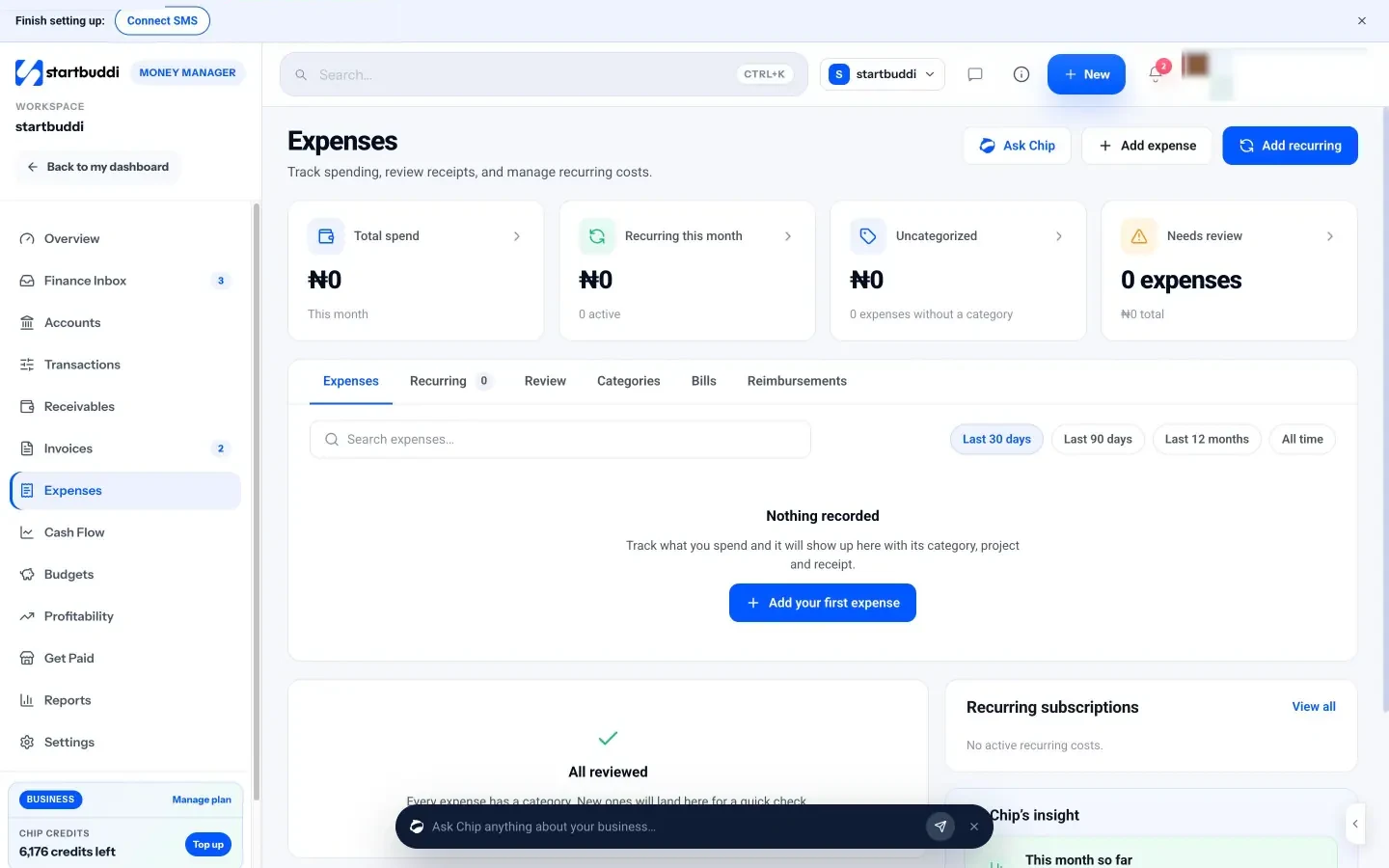
For receipts you’re given, Expenses lets you attach a photo or PDF of the receipt to each expense, and a Receipt review queue helps you check categories.
Need a single receipt without an account? Use the free receipt generator. For a full system, read our guide on how to track business expenses, see invoices and expenses in Money Manager, or how it works for IT teams.
Get paid and send receipts from one place
Invoice clients, take payment by card, transfer or USSD, and keep every receipt with the invoice it belongs to. Start free with startbuddi, no card needed.
Receipt is part of Money Manager in startbuddi.
See Money ManagerRelated terms
FAQ
What is a receipt in business?
A receipt is a document confirming that a business has received a payment. It shows the amount, date, payment method, who paid and what it was for. It is the customer's proof of payment and part of the seller's records.
What is the difference between a receipt and an invoice?
An invoice is sent before payment to ask the customer to pay. A receipt is issued after payment to confirm the money arrived. One invoice can have several receipts if it's paid in parts.
Is a digital receipt valid?
In most countries, yes. An emailed or PDF receipt with the right details serves the same purpose as a paper one. Keep copies in a safe, backed-up place, and check any special rules your tax authority has for VAT or sales tax receipts.
Should I give a receipt for a deposit?
Yes. A deposit is a payment, so issue a receipt that names the invoice or job and shows the balance still due. It protects you and the client if there's later a question about what was paid.
How long should a small business keep receipts?
Usually several years. In the UK, sole traders keep records for at least five years after the 31 January filing deadline, and limited companies for six years from the end of the financial year. Check the rule where you pay tax.
Tiwalade Joanna Okedara-Kalu is the founder, CEO and CTO of startbuddi, the business system that brings clients, bookings, invoices, projects, marketing and the Chip AI assistant into one place. Tiwalade builds software around how service businesses really work day to day, and writes about client management, getting paid on time and why small businesses outgrow the tools they start with.
Founded startbuddi and leads its product and engineering