Project Management: Definition, Examples and How It Works

Project management is the work of planning, running and finishing a project, a one-off piece of work with a clear goal, a deadline and a budget, so that it delivers what was agreed on time and within cost. It covers scope, tasks, people, progress and the handover.
So what is project management for a small business? It’s how a website build, an office move or a client’s server replacement gets finished without anyone guessing what’s next.
Key takeaways
- A project is temporary and has an end; routine work repeats. Project management is for the first kind.
- Every project balances scope (what you deliver), time and cost. Change one and the others move.
- Most projects run through five stages: start, plan, do, check and close.
- Project management is the discipline. Project management software is the tool that helps you do it.
What is project management, and why does it matter?
The UK’s Association for Project Management defines it as “the application of processes, methods, skills, knowledge and experience to achieve specific project objectives according to the project acceptance criteria within agreed parameters” (APM: What is project management?, checked on 1 October 2026). In plain words: agree what “done” looks like, then organise the work to get there within the time and money you have.
APM also points out that projects are separate from business as usual. That distinction matters in a small business. Answering today’s support tickets is routine. Moving a client’s whole team to a new email system is a project, and it needs a plan, an owner and an end date, or it drifts for months. For an IT services firm, typical projects are migrations, office network installs and new client set-ups. Each one ties up technicians who would otherwise be answering support requests, so a late project quietly costs you support time as well.
Big organisations write this down formally. The UK government, for example, publishes a project delivery functional standard (GovS 002, version 2.1, checked on 1 October 2026) for its own projects. A small business needs the same habits on one page, not a manual.
How project management works: the five stages
| Stage | What happens | Output |
|---|---|---|
| Start | Agree the goal, who it’s for and what “done” means | A one-page brief |
| Plan | Break the work into tasks, estimate them, set dates and milestones | A task list and a timeline |
| Do | People work through the tasks; the project lead clears blockers | Finished tasks and deliverables |
| Check | Compare progress with the plan each week and adjust | A status update and decisions |
| Close | Hand over, get sign-off, invoice and note what you learned | A closed project and lessons for next time |
A Gantt chart is the usual way to show the plan over time. Teams that deliver in short cycles, such as software teams, often use agile project management instead of one fixed plan.
Scope, time and cost
Every project trades off three things. If a client adds pages to a website (more scope), you need more time, more cost, or both. If the deadline moves forward (less time), you cut scope or add people.
Writing the scope down at the start, in a short brief, is the cheapest protection against this. Our project brief template shows what to include. When the scope does change, write a short change note with the extra time and cost, and get it agreed before the extra work starts.
Example: an email migration at an IT firm in Nairobi
An illustrative IT services firm agrees to move a 25-person client from an old email system to a new one. The brief sets the scope (25 mailboxes, shared calendars, staff training), a three-week deadline and an estimate of 40 hours of technician time.
At the end of week two, the project lead checks progress: 30 hours used and the work is about 60% done. At that rate the whole job will take 30 ÷ 0.6 = 50 hours, which is 10 hours, or 25%, over the estimate.
Because it’s caught in week two, the lead has options: agree the extra hours with the client, move the training session to a recorded video to save time, or accept the overrun as a lesson for pricing the next migration. Without the weekly check, the firm would find out after the invoice went out.
Related terms
- Project management software: the app you use to plan tasks, dates and progress.
- Project milestone: a checkpoint that shows a stage is complete.
- Gantt chart: a timeline of tasks and how they depend on each other.
For the full beginner’s walkthrough, from brief to close, read our guide to project management for beginners.
How startbuddi handles project management
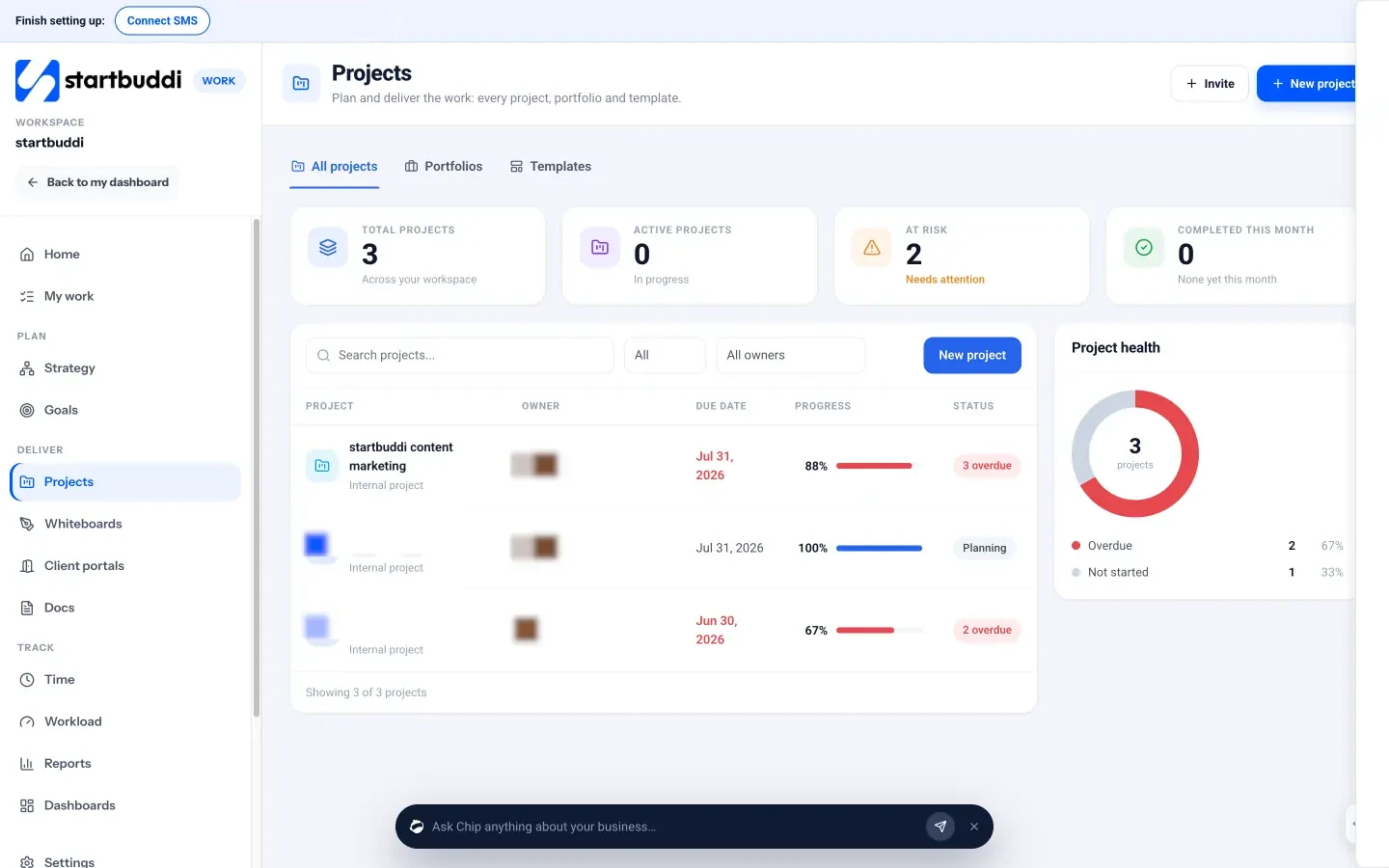
In startbuddi, projects live in Work → Projects. Each project has tasks with owners, priorities and due dates, a Timeline (a Gantt chart with dependencies and milestones), Milestones, a Budget tab with an hours budget and time logged, and an optional client portal so the client can follow along. You can start from a template that sets up milestones and tasks for you. See how it works for IT teams or on the Projects page.
Run your next project in one place
Write the brief, set the tasks and dates, and check progress weekly in startbuddi Work. Start free.
Project Management is part of Work in startbuddi.
See WorkRelated terms
FAQ
What is project management in simple terms?
Project management is organising a one-off piece of work so it gets finished on time, within budget and to the agreed standard. You agree the goal, plan the tasks and dates, track progress each week and close the project with a handover.
What are the five stages of project management?
The five stages are start, plan, do, check and close, often called initiation, planning, execution, monitoring and closing. You agree the goal, break it into tasks and dates, carry out the work, compare progress with the plan, and then hand over and review what you learned.
What is the difference between project management and project management software?
Project management is the discipline: the planning, tracking and decisions. Project management software is the tool that holds the tasks, dates and updates. Good software helps, but it won't fix a project with no clear goal or owner.
Do small businesses need project management?
Yes, whenever they take on work with a deadline that isn't routine, such as a client build, an office move or a new service launch. A one-page brief, a task list with owners and a weekly check is enough for most small projects.
Tiwalade Joanna Okedara-Kalu is the founder, CEO and CTO of startbuddi, the business system that brings clients, bookings, invoices, projects, marketing and the Chip AI assistant into one place. Tiwalade builds software around how service businesses really work day to day, and writes about client management, getting paid on time and why small businesses outgrow the tools they start with.
Founded startbuddi and leads its product and engineering