No-Show Fee: Definition, Examples and How It Works

A no-show fee is a charge a business makes when a client misses a booked appointment without cancelling in time. It covers the time the business held back and couldn't sell to anyone else. In short, what is no-show fee money for?
A no-show fee is a charge a business makes when a client misses a booked appointment without cancelling in time. It covers the time the business held back and couldn’t sell to anyone else. In short, what is no-show fee money for? It pays for an empty slot, and it only works if the client agreed to it before booking.
Key takeaways
- A no-show fee is charged after a missed appointment; a deposit is taken before it. Deposits are far easier to collect.
- The client must know about the fee before they book, in writing, with the amount and the notice they need to give.
- Keep it in line with what the missed slot really cost you. UK and Nigerian consumer rules both point that way.
- A sensible starting point is a flat amount close to your direct cost, or a quarter to a half of the price. Waiving a first miss keeps goodwill.
Why a no-show fee matters for a small business
For a small IT services firm, time is the stock. When a client misses a two-hour on-site visit, the engineer has already planned the day around it, may have travelled, and can’t fill the gap at short notice. A no-show appointment is money that’s gone for good.
A no-show fee does two jobs. It recovers some of that loss, and, more usefully, it makes clients take the booking seriously. Most people who would shrug off a free slot will message you to reschedule when they know a charge applies.
What is no-show fee policy, and how does it work?
A no-show fee sits inside your booking terms or payment terms. It usually works like this:
- You set the rule. For example: “Cancel or reschedule at least 24 hours before. If you don’t turn up and haven’t told us, we charge ₦15,000.”
- The client sees it before booking, on the booking page, in the confirmation email and in reminders.
- The client misses the appointment without notice, past a short grace period such as 15 minutes.
- You mark it as a no-show and send a calm message with the fee and a link to rebook.
- You collect it, by invoice or payment link, or by keeping a deposit taken at booking.
Collecting after the event is the weak point. A client who didn’t show up is often slow to pay a bill for it. That’s why many businesses take a deposit at booking instead and treat it as the no-show fee. Our no-show policy template has wording for both approaches.
An example with numbers
These figures are illustrative.
Tunde runs a five-person IT support firm in Ikeja, Lagos. An on-site setup visit costs ₦45,000 for up to two hours. His no-show fee is ₦15,000, a third of the price, which covers the engineer’s time that morning and the transport already paid.
| Without a fee | With a ₦15,000 fee | |
|---|---|---|
| Missed visits a month | 4 | 4 |
| Income lost from those slots | ₦180,000 | ₦180,000 |
| Fees collected (3 of 4 clients pay) | ₦0 | ₦45,000 |
| Net loss from no-shows | ₦180,000 | ₦135,000 |
The fee recovers a quarter of the loss here. The bigger gain is usually fewer no-shows in the first place, because clients who know about the fee tend to reschedule rather than ghost. To estimate what missed slots cost you over a year, try the free no-show cost calculator.
The same logic works for a remote consultation in London. If a one-hour call costs £90 and the fee is £30, three missed calls a month means £270 of lost time and up to £90 back.
Rules to know
No-show fees are allowed in most places, but they have to be fair and agreed in advance. This is general information, not legal advice.
- UK: the government’s guidance on writing a fair contract for customers says deposits and cancellation charges should reflect “a genuine estimate of what you will lose directly” because the customer cancelled (checked on 1 October 2026). A fee that covers your full profit as well is likely to be unfair to consumers.
- Nigeria: the FCCPC explains that, under section 120 of the Federal Competition and Consumer Protection Act, consumers can cancel advance bookings and get a refund “subject to reasonable charges” (FCCPC consumer rights, checked on 1 October 2026).
- US healthcare: Medicare lets doctors and suppliers charge patients for missed appointments, as long as they charge non-Medicare patients the same amount and don’t bill Medicare for it (CMS MLN Matters MM5613, checked on 1 October 2026).
Business clients usually have less legal protection than consumers, but the same fairness test keeps relationships intact.
No-show fee vs related charges
| Charge | When it applies | Paid when |
|---|---|---|
| No-show fee | Client misses the appointment without notice | After the missed appointment |
| Late cancellation fee | Client cancels inside your notice period | After the late cancellation |
| Booking deposit | Taken to secure the slot, kept if they don’t show | At booking |
| Late payment fee | An invoice is paid after its due date | After the due date |
Related terms
- No-show appointment: the missed booking the fee responds to.
- Late payment fee: a similar charge for invoices paid late.
- Payment terms: where your fee rules belong in writing.
How startbuddi handles no-show fees
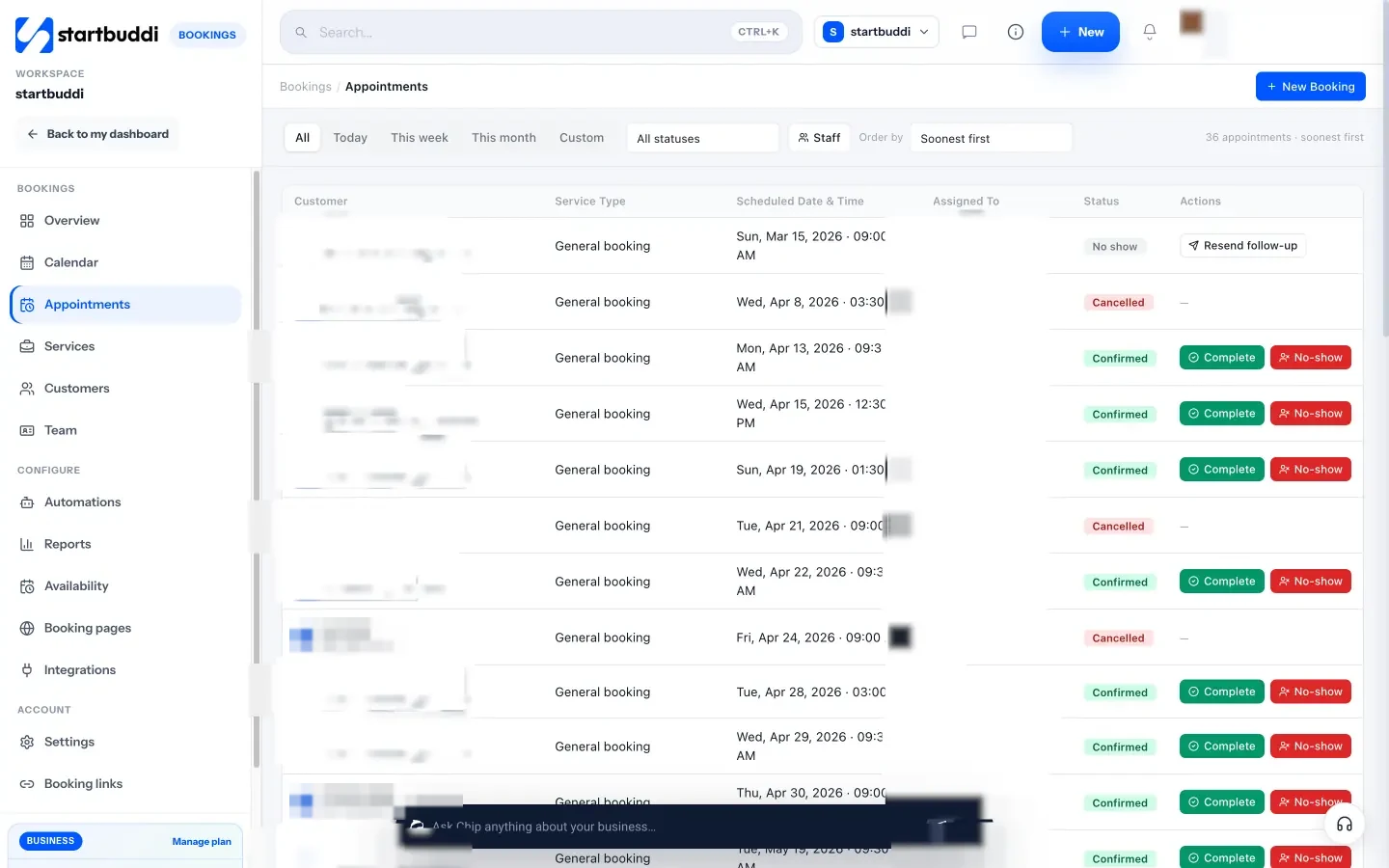
startbuddi doesn’t charge a saved card automatically after a no-show. You have two practical options in Bookings:
- Take a deposit up front. Turn on Require payment to book for a service and choose a deposit. Clients pay through Paystack or Stripe before the booking is confirmed.
- Charge after the event. Click No-show on the booking to mark it and send your “After a no-show” follow-up, then use Generate Invoice or a payment link for the fee.
Need wording for clients? Start with the cancellation policy template, and see our guide to reducing no-show appointments for reminders that stop most misses before a fee is needed. IT firms can see the wider setup on startbuddi for IT teams.
Stop chasing missed appointments
Take deposits when clients book, send reminders automatically and follow up on no-shows from one place. Start free with startbuddi, no card needed.
Related terms
FAQ
What is a no-show fee?
A no-show fee is a charge for missing a booked appointment without cancelling in time. It covers the time the business reserved and couldn't sell. It only holds up if the client agreed to it before booking.
How much should a no-show fee be?
A sensible starting point is a quarter to a half of the appointment price, or a flat amount close to the direct cost of the slot. Keep it in proportion to what you actually lose. A fee that's out of proportion is harder to collect and may be unfair under consumer law.
Is it legal to charge a no-show fee?
In most places, yes, if the client agreed to it before booking and the amount is reasonable. UK guidance links fair charges to a genuine estimate of your loss, and Nigeria's FCCPA allows reasonable charges for cancelled advance bookings. Check the rules where you trade.
Is a no-show fee the same as a deposit?
No. A deposit is paid when the client books and can be kept if they don't turn up, while a no-show fee is billed afterwards. Deposits are easier to enforce because the money is already with you.
Should I waive a no-show fee?
Waiving a first miss for a genuine emergency usually costs little and keeps a good client. Apply the same rule to everyone and note each waiver, so repeat no-shows are easy to spot.
Tiwalade Joanna Okedara-Kalu is the founder, CEO and CTO of startbuddi, the business system that brings clients, bookings, invoices, projects, marketing and the Chip AI assistant into one place. Tiwalade builds software around how service businesses really work day to day, and writes about client management, getting paid on time and why small businesses outgrow the tools they start with.
Founded startbuddi and leads its product and engineering