Monthly Recurring Revenue (MRR): Definition, Examples and How It Works

Monthly recurring revenue (MRR) is the amount a business can expect to bill every month from customers on ongoing plans, such as subscriptions, retainers and support contracts, with annual and quarterly plans converted to a monthly figure. It leaves out one-off sales, setup fees and taxes.
So what is monthly recurring revenue good for? It tells you the floor under next month: the money that arrives if you win nothing new, which is the number you plan hiring, rent and cash around.
Key takeaways
- MRR = the monthly value of every active recurring plan. Divide yearly plans by 12 and quarterly plans by 3.
- Leave out one-off projects, setup fees, taxes, free plans and trials.
- MRR moves five ways: new, expansion, contraction, churn and reactivation. Track each one, not just the total.
- MRR is a planning number, not your accounting revenue or the cash in the bank.
What is monthly recurring revenue, and why does it matter?
For a small service business, most months start at zero: you have to sell again before you earn again. Recurring revenue changes that, and MRR is how you measure it.
Take an IT support company. Project work (a server move, a new office network) pays well but stops when the job ends. Monthly support plans keep paying. If MRR covers your fixed costs, every project becomes profit rather than survival money.
How to calculate MRR
The formula is simple:
MRR = sum of (each active recurring plan’s price ÷ number of months it covers)
A monthly plan counts in full. A yearly plan counts as one twelfth. A quarterly plan counts as one third.
The judgement is in what you include. Stripe’s billing analytics, for example, counts active and past-due subscriptions, excludes taxes, free plans and usage-based charges, and stops counting a subscription once it is cancelled or marked unpaid (Stripe Billing analytics docs, checked on 1 October 2026). Those are sensible rules for a small business too:
| Include in MRR | Leave out of MRR |
|---|---|
| Monthly retainers and support plans | One-off projects and call-outs |
| Yearly and quarterly plans, converted to monthly | Setup or onboarding fees |
| Memberships and subscriptions | VAT and other taxes |
| Recurring discounts (subtract them) | Free plans and free trials |
| Plans that are paid but a few days late | Cancelled plans, even if the last payment is still due |
Pick your rules once, write them down and keep them. MRR is most useful as a trend, and a trend means nothing if the rules change every month.
The five ways MRR moves
Your total MRR changes for five reasons:
- New MRR: new customers starting a plan.
- Expansion MRR: existing customers moving to a bigger plan or adding seats.
- Contraction MRR: customers moving to a smaller plan.
- Churned MRR: customers cancelling. Your churn rate is the share of customers or MRR you lose.
- Reactivation MRR: past customers coming back.
Net new MRR = new + expansion + reactivation − contraction − churned.
Watching the parts matters more than the total. A business adding plenty of new MRR while losing almost as much to churn has a retention problem that the total hides.
Example: an IT support company in Nairobi
These numbers are illustrative. At the start of March, the company has:
| Plan | Sum | MRR |
|---|---|---|
| 8 clients on a KES 25,000 monthly support plan | 8 × 25,000 | KES 200,000 |
| 3 clients on a KES 240,000 yearly plan | 3 × (240,000 ÷ 12) | KES 60,000 |
| 1 client on a KES 90,000 quarterly plan | 90,000 ÷ 3 | KES 30,000 |
| Starting MRR | KES 290,000 |
During March:
| Movement | What happened | Change |
|---|---|---|
| New | 2 new clients on the monthly plan | + KES 50,000 |
| Expansion | 1 monthly client moves up to a KES 40,000 plan | + KES 15,000 |
| Contraction | 1 yearly client renews at KES 180,000 instead of 240,000 | − KES 5,000 |
| Churn | 1 monthly client cancels | − KES 25,000 |
| Not counted | A KES 150,000 office network project | 0 |
Net new MRR is 50,000 + 15,000 − 5,000 − 25,000 = KES 35,000, so the company ends March on KES 325,000 MRR.
MRR vs ARR, revenue and cash
ARR (annual recurring revenue) is MRR × 12. In the example, KES 325,000 MRR is KES 3,900,000 ARR.
MRR is not accounting revenue. Your accounts follow revenue recognition rules, such as IFRS 15 where it applies, which set when income counts in the books. MRR is a management number for planning.
MRR is not cash, either. A client who pays KES 240,000 up front for a year adds KES 240,000 to your bank in one go but only KES 20,000 to MRR. A late payer counts in MRR but not yet in your account.
Related terms
- Retainer: the most common way service businesses earn MRR.
- Recurring invoicing: billing the same client on a schedule.
- Customer lifetime value: what a customer is worth over the whole relationship, which MRR and churn feed into.
For the full picture, from designing a plan to keeping customers on it, read our guide to recurring revenue for service businesses.
How startbuddi handles MRR
In startbuddi, Money Manager → Get Paid → Subscriptions lets you create plans for your own customers (a membership, a retainer or a paid service) billed monthly or yearly through your connected Paystack or Stripe account. Renewals are charged automatically by the provider. The tab shows your active subscribers and your monthly recurring revenue, with yearly plans normalised to a monthly value.
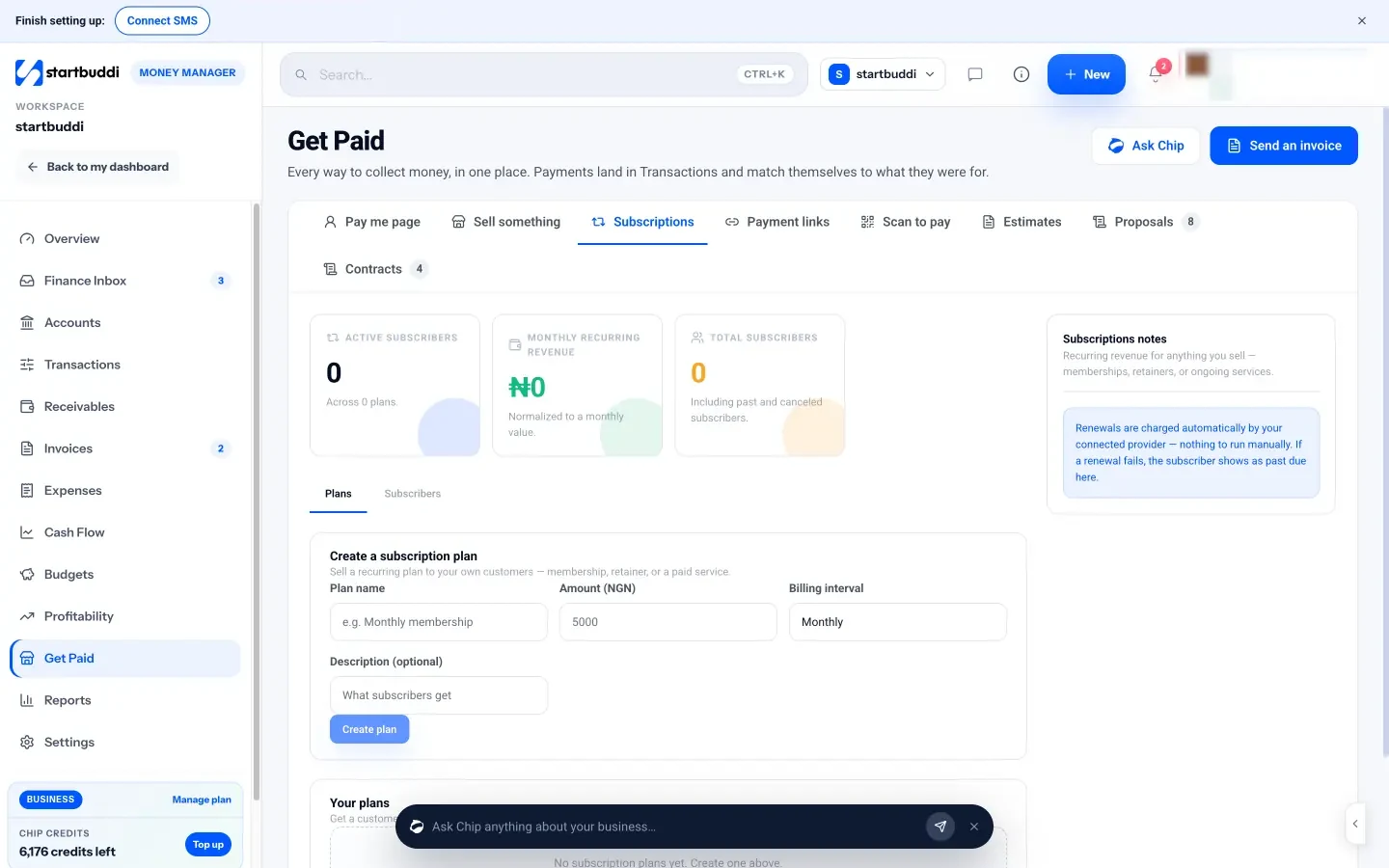
If you’d rather invoice each month, recurring invoices create the drafts for you on schedule. See subscriptions for how it works.
Track your recurring income in one place
Set up subscription plans, bill retainers and see your MRR next to your invoices and payments. Start free with startbuddi.
Related terms
FAQ
What is MRR in simple terms?
MRR is the money your customers on ongoing plans will pay you each month. You add up every monthly plan, plus yearly and quarterly plans converted to a monthly amount. One-off work and taxes are left out.
How do you calculate monthly recurring revenue?
Add the monthly value of every active recurring plan. A monthly plan counts in full, a yearly plan is divided by 12 and a quarterly plan by 3. Subtract recurring discounts and leave out setup fees, one-off projects, taxes and free trials.
Do one-time fees count towards MRR?
No. Setup fees, one-off projects and call-outs don't repeat, so they stay out of MRR. Track them as separate revenue so you can see how much of your income is recurring.
What is the difference between MRR and ARR?
ARR is annual recurring revenue, which is MRR multiplied by 12. Both measure the same thing over different periods. Monthly-plan businesses usually report MRR, and businesses with yearly contracts often use ARR.
Is MRR the same as monthly revenue?
No. Monthly revenue includes everything you earned that month, including one-off work. MRR counts only the recurring part, so it shows what you can rely on next month.
Tiwalade Joanna Okedara-Kalu is the founder, CEO and CTO of startbuddi, the business system that brings clients, bookings, invoices, projects, marketing and the Chip AI assistant into one place. Tiwalade builds software around how service businesses really work day to day, and writes about client management, getting paid on time and why small businesses outgrow the tools they start with.
Founded startbuddi and leads its product and engineering