Retainer: Definition, Examples and How It Works

A retainer is money a client pays a professional in advance to secure their time or services over a period, usually monthly. It can reserve availability, prepay a block of hours that are used up as work is done, or buy a fixed monthly package. So what is retainer work in practice?
A retainer is money a client pays a professional in advance to secure their time or services over a period, usually monthly. It can reserve availability, prepay a block of hours that are used up as work is done, or buy a fixed monthly package. So what is retainer work in practice? Ongoing work, paid before it’s done.
Key takeaways
- A retainer is paid up front. That’s what separates it from billing hours at the end of the month.
- There are three common shapes: availability, prepaid hours that are drawn down, and a fixed monthly service.
- Money paid in advance for work you haven’t done yet isn’t fully yours until you’ve earned it. Track what’s used.
- The agreement must say what’s included, what happens to unused hours and how either side ends it.
- For IT support, design, bookkeeping and marketing, retainers turn one-off jobs into recurring revenue.
Why a retainer matters for a small business
An IT support firm with ten clients who each call “when something breaks” has a lumpy month: three emergencies one week, nothing the next, and invoices chased for small jobs. A retainer smooths that out. The client pays a known amount each month, and you plan staff and cash around it.
It also changes the relationship. A client on a retainer calls early, before a small problem becomes an outage, because the call is already paid for. And you spend less time quoting, approving and invoicing small jobs.
The catch is scope. Without clear limits, “you’re on retainer” turns into “you’ll fix anything, any time, for the same fee”. The agreement does most of the work here.
What is retainer billing, and how does it work?
The word comes from law. Cornell’s Legal Information Institute defines retainers (checked on 1 October 2026) as payments either for reserving a lawyer’s employment or as compensation for future services. Service businesses use the same ideas.
| Type | What the client pays for | How it’s used | Common in |
|---|---|---|---|
| Availability retainer | Your priority time and response, e.g. “reply within 4 working hours” | Extra work is billed on top | Legal, advisory, IT on-call |
| Prepaid hours (drawdown) | A block of hours paid in advance | Hours are deducted as you work; the client tops up | IT support, development, bookkeeping |
| Fixed monthly service | A set list of deliverables each month | Billed the same every month | Managed IT, marketing, content |
How it runs, in four steps:
- Agree the scope and price in writing: hours or deliverables, response times, rollover rules and notice period.
- Invoice at the start of the period, before the work, usually on the same day each month.
- Track work against the retainer as billable hours or completed deliverables, and share a short report.
- Top up or renew. For prepaid hours, send a top-up invoice when the balance runs low. For monthly retainers, a recurring invoice goes out on schedule.
Earned and unearned money
When a client prepays, part of that money pays for work you haven’t done yet. Many accountants treat it as unearned until the work is delivered. That matters if a client leaves mid-block and expects a refund for unused hours, so your agreement should say what happens.
Tax can apply when the money arrives, not when you do the work. In the UK, the tax point for an advance payment is the date you receive it or invoice it, whichever is first (GOV.UK, checked on 1 October 2026). Rules differ by country, so check with your accountant. This is general information, not tax or legal advice.
An example with numbers
An IT support firm in Lagos sells a law office a block of 24 hours at ₦25,000 an hour, paid in advance. The figures are illustrative.
| Hours used | Value earned | Hours left | Prepaid balance | |
|---|---|---|---|---|
| Start | 0 | ₦0 | 24 | ₦600,000 |
| Month 1 | 9 | ₦225,000 | 15 | ₦375,000 |
| Month 2 | 11 | ₦275,000 | 4 | ₦100,000 |
The agreement says a top-up invoice goes out when 5 hours or fewer remain, so after month 2 the firm sends one for another 24-hour block. The client never runs out mid-emergency, and the firm is never working on credit.
The same firm also offers a fixed monthly retainer for a 15-person office at ₦450,000 a month, covering helpdesk, backups and one site visit. Anything outside that list, such as a new server installation, is quoted separately.
Retainer vs deposit vs subscription
- A booking deposit secures one job and comes off its final bill.
- A retainer pays in advance for ongoing work over a period.
- A subscription is a fixed recurring charge for the same thing each period, renewed automatically. Many fixed monthly retainers are billed as subscriptions.
Related terms
- Recurring revenue: the predictable income retainers create.
- Recurring invoicing: sending the same invoice on a schedule.
- Billable hours: the time you track against a prepaid block.
For pricing, pitching and the clauses to include, read our guide to selling and billing retainers, or start from the free agency retainer agreement template.
How startbuddi handles retainers
In Money Manager, open Invoices and use the Recurring billing card. Pick the client, choose Monthly or Quarterly, the issue day, currency, line item and amount, and save the schedule. A draft invoice is created automatically on each due date, ready for you to check and send.
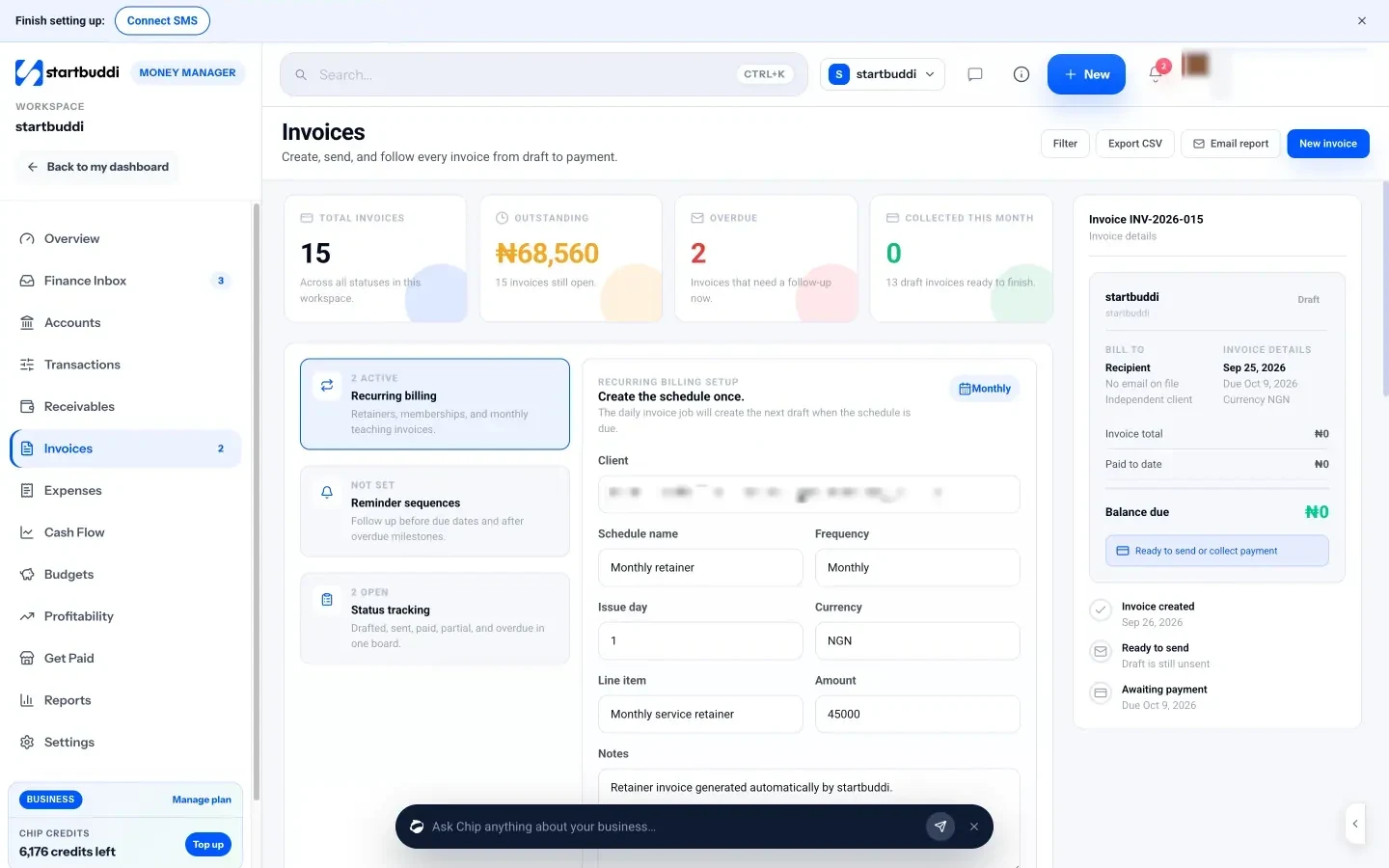
For fixed monthly retainers that should charge automatically, create a plan in Get Paid under Subscriptions and send the client a subscribe link. Renewals are charged by Paystack or Stripe. To track prepaid hours, log time on the client’s tasks in Work and tick Billable, then check the week’s billable total. IT firms can see how it fits together on startbuddi for IT teams.
Bill your retainers on time
Set up the schedule once and let the drafts arrive on the right day each month. Start free with startbuddi, no card needed.
Related terms
FAQ
What is a retainer?
A retainer is an advance payment a client makes to secure a professional's time or services, usually for a month or a block of hours. It can reserve availability, prepay hours that are used up as work is done, or buy a fixed monthly package.
What does it mean to be on retainer?
Being on retainer means a client pays you regularly in advance so you're available for their work. What that covers depends on the agreement: a number of hours, a list of deliverables or a promised response time. Work outside it is usually billed separately.
Is a retainer fee refundable?
It depends on the agreement and the type. Prepaid hours that haven't been used are often refundable or carried over, while a fee purely for reserving availability usually isn't. Write the rule into the agreement before the client pays.
What happens to unused retainer hours?
Your agreement decides. Common options are letting a limited number roll over to the next month, letting them expire at the end of each month, or refunding them when the retainer ends. Capping rollover stops unused hours from building into a debt you owe.
How is a retainer different from a deposit?
A deposit secures one specific job and is taken off that job's final bill. A retainer pays for ongoing work over a period, such as a month of support or a block of hours. Both are paid in advance.
Tiwalade Joanna Okedara-Kalu is the founder, CEO and CTO of startbuddi, the business system that brings clients, bookings, invoices, projects, marketing and the Chip AI assistant into one place. Tiwalade builds software around how service businesses really work day to day, and writes about client management, getting paid on time and why small businesses outgrow the tools they start with.
Founded startbuddi and leads its product and engineering