Estimate vs quote: what is the difference?
Also called: Quotation vs estimate, price quote, cost estimate, fixed quote, ballpark figure
An estimate is an approximate price based on what you know so far, and the final bill may differ. A quote is a firm price for a clearly defined job, and once the customer accepts it you are normally expected to stick to it.
An estimate is your best guess at what a job will cost. A quote (or quotation) is a fixed price for a clearly described job. That is the heart of estimate vs quote: an estimate can move as you learn more, while a quote is a promise the customer can hold you to once they accept it.
The two words are used loosely in everyday speech, and some businesses call every price document an “estimate”. What matters is what the document says: is the price firm, or is it a guide?
Estimate vs quote at a glance
| Estimate | Quote | |
|---|---|---|
| Price | Approximate, may change | Fixed for the work described |
| Detail needed | Rough scope is enough | Clear, detailed scope |
| Binding? | Usually not a firm promise | Usually binding once accepted |
| Best for | Early conversations, uncertain jobs | Well-defined work |
| If the job grows | Revise the estimate and explain | Agree a change in writing first |
When to give an estimate
Use an estimate when you genuinely cannot know the final cost yet:
- A plumber who has not seen behind the wall.
- A developer asked to “fix the website” before looking at the code.
- A caterer who does not yet know final guest numbers.
Good estimates give a range or say what could change the price: “Estimated $1,800 to $2,400, depending on whether the old pipes need replacing.” Tell the customer you will contact them before going over the top of the range.
When to give a quote
Use a quote when the work is clear enough to price with confidence:
- A logo with three concepts and two rounds of changes: $900.
- Cleaning a three-bedroom flat, once, including ovens: £180.
- Catering for 80 guests from a set menu: ₦1,600,000.
Customers often prefer quotes because they know exactly what they will pay. You carry the risk if the job takes longer, so describe the scope carefully.
A worked example: from estimate to quote
Kwame, an electrician in Accra, is asked to rewire part of a shop. On the phone he gives an estimate: “Roughly GH₵6,000 to GH₵8,000, depending on the state of the old wiring.” After a site visit he knows the exact scope, so he sends a quote: GH₵7,200 for the listed work, valid for 21 days, with 40% up front. The customer accepts. When the owner later asks for two extra sockets, Kwame sends a short written change for GH₵450 before doing them. The customer is never surprised, and Kwame is paid for every hour.
What to include in either one
- Your business name and contact details, and the customer’s.
- A reference number and date.
- A clear description of the work, line by line, with quantities and prices.
- What is not included.
- Tax, discounts and the total, with the currency.
- Whether it is an estimate or a quote, in so many words.
- How long the price is valid (for example “valid for 30 days”).
- Deposit and payment terms.
You can start from our free quote and estimate template.
Common mistakes
- Quoting a job you have not scoped. If you are guessing, call it an estimate.
- Vague descriptions. “Website design” invites arguments. “Five-page website, two rounds of changes, content supplied by client” does not.
- Doing extra work without a new price. Agree changes in writing before you start them. Our guide on how to prevent scope creep covers this.
- Letting estimates drift far above the figure given. If the price will rise a lot, stop and talk to the customer first.
- No follow-up. Many quotes are simply forgotten. A friendly check-in a few days later wins work.
Related terms
A proforma invoice looks like an invoice but, like a quote, is sent before the sale is final. A purchase order is how some business customers accept your quote. Once the work is done, the invoice asks for payment.
Estimates and quotes in startbuddi
In startbuddi, the word “estimate” covers both. In Money Manager, open Get Paid and the Estimates tab, then create an estimate for an existing client or a one-off recipient with line items, tax, discount, notes and terms (the placeholder suggests “Valid for 30 days. 50% deposit to begin.”). Write “fixed quote” or “estimate” in the notes so the customer knows which it is.
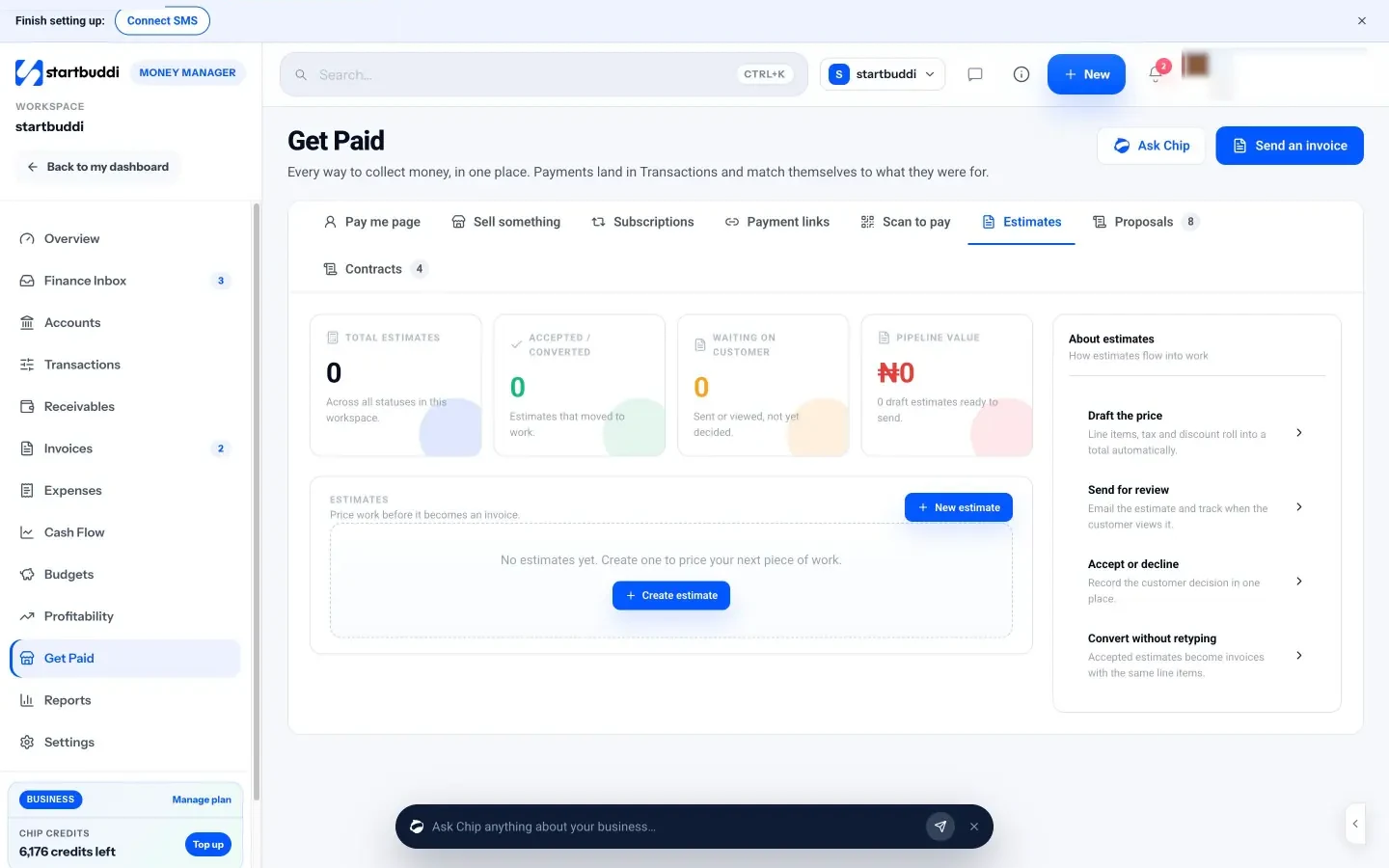
Click Send estimate to email it. There is no online accept button yet: the customer replies to the email, and you click Mark accepted or Mark declined. An accepted estimate converts to an invoice with the same line items, so nothing is retyped. The estimates, proposals and contracts page shows the full flow, including e-signed contracts. Your next step: take your most common job, write down exactly what is included and not included, and turn it into a fixed quote you can reuse.
Related terms
FAQ
Is a quote legally binding?
In many countries a quote becomes binding once the customer accepts it, while an estimate is treated as a guide. The details depend on local law and your terms, so this is general information, not legal advice.
Can the final price be higher than an estimate?
Yes, because an estimate is approximate. Good practice is to explain why and agree it with the customer before you go much above the figure you gave.
Which is better for a small business, an estimate or a quote?
Use a quote when you can define the work clearly, and an estimate when there are unknowns. Many businesses give an estimate first and a firm quote after a site visit or discovery call.
How long should a quote be valid?
Commonly 14 to 30 days. Choose a period that matches how quickly your costs change, and write it on the quote.
Tiwalade Joanna Okedara-Kalu is the founder, CEO and CTO of startbuddi, the business system that brings clients, bookings, invoices, projects, marketing and the Chip AI assistant into one place. Tiwalade builds software around how service businesses really work day to day, and writes about client management, getting paid on time and why small businesses outgrow the tools they start with.
Founded startbuddi and leads its product and engineering