Utilisation Rate: Definition, Examples and How It Works

Utilisation rate is the share of a person's available working hours that they spend on billable or productive work, shown as a percentage. So what is utilisation rate in practice? An engineer with 40 available hours who bills 28 of them has a utilisation rate of 70%.
Utilisation rate is the share of a person’s available working hours that they spend on billable or productive work, shown as a percentage. So what is utilisation rate in practice? An engineer with 40 available hours who bills 28 of them has a utilisation rate of 70%. The rest went on admin, sales, training or waiting for work.
Key takeaways
- The basic formula is billable hours ÷ available hours × 100. Decide once what counts as “available” and stick to it.
- Billable utilisation counts only client-chargeable time. Total (or productive) utilisation also counts internal work such as training and sales.
- No one should be at 100%. Admin, learning and breaks are real work, and a team with no slack can’t absorb an urgent job.
- Track it per person and per month. One week is noise; three months is a trend.
Why utilisation rate matters for a small business
In a service business you sell hours, directly or hidden inside a fixed fee. If your prices assume each engineer bills 30 hours a week and they actually bill 20, a third of the revenue you planned for never arrives, even though everyone was busy.
Utilisation rate makes that gap visible. It also shows the opposite problem: a person billing 45 hours a week for months is not a success story. It usually means unlogged admin, late nights and someone close to leaving. The UK’s Health and Safety Executive says employers should set demands that are “adequate and achievable” for the agreed hours (checked on 1 October 2026), and utilisation is one of the simplest ways to check that.
What is utilisation rate, and how does it work?
You need two numbers per person for the same period.
- Available hours: contracted hours minus leave and public holidays. A 40-hour week with one public holiday gives 32 available hours.
- Billable hours: time spent on work a client pays for, either by the hour or inside a fixed-fee job. These come from timesheets. Our billable hours definition explains what to count.
| Measure | Formula | What it tells you |
|---|---|---|
| Billable utilisation | Billable hours ÷ available hours × 100 | How much paid work each person delivers |
| Total utilisation | (Billable + internal project hours) ÷ available hours × 100 | How much time goes on planned work of any kind |
| Team utilisation | Sum of billable hours ÷ sum of available hours × 100 | Whether the business as a whole is busy enough |
Some firms divide by hours actually worked instead. That flatters anyone who works late, so available hours is the fairer base.
There’s no single “good” rate. Someone who only delivers client work can sit higher than an owner who also sells and hires, so set targets per role from your own history.
An example with numbers
An IT managed services company in Lagos has four people. Each works a 40-hour week, so in a four-week month with no leave they have 160 available hours each. These figures are illustrative.
| Person | Role | Available hours | Billable hours | Billable utilisation |
|---|---|---|---|---|
| Tunde | Field engineer | 160 | 128 | 80% |
| Ada | Field engineer | 160 | 120 | 75% |
| Kemi | Service desk lead | 160 | 96 | 60% |
| Owner | Sales and delivery | 160 | 48 | 30% |
| Team | 640 | 392 | 61% |
The firm bills ₦25,000 an hour, so 392 hours is worth ₦9,800,000. Is 61% a problem? Look at the people before the total. Kemi’s 60% may be fine if she spends a day a week on internal security checks the firm has chosen not to charge for. The real question is the owner’s 30%: is that time selling, or is it fixing things the engineers should handle?
Now suppose the firm wants the team to reach 65%. That’s 416 billable hours (640 × 65%), or 24 more hours a month. At ₦25,000 an hour, that’s ₦600,000 more revenue from the same team, with no hire. To set a price that already allows for non-billable time, try our hourly rate calculator.
Common mistakes with utilisation rate
- Pushing everyone towards 100%. Long weeks have limits. In the UK, for example, workers can’t work more than 48 hours a week on average unless they opt out (checked on 1 October 2026).
- Forgetting leave in available hours. Someone on holiday for a week isn’t “under-utilised” that week.
- Counting what was logged, not what was done. If engineers don’t record time, the rate falls and you learn nothing.
- Confusing busy with paid. Billed hours that clients dispute or you write off still count as utilised. Check what was actually invoiced too, as our guide to tracking billable hours without a spreadsheet explains.
Related terms
- Billable hours: the hours on top of the utilisation formula.
- Timesheet software: where the hours come from.
- Resource scheduling: assigning people to specific jobs and times.
- Workforce analytics: the wider set of numbers about your team, of which utilisation is one.
How startbuddi helps you track utilisation rate
startbuddi doesn’t print a billable utilisation percentage for you, but it collects both halves of the sum. In Work, the Time page shows each week’s Total, Billable and Billable value for you, and managers can switch to Team time. Divide billable hours by each person’s available hours to get the rate.
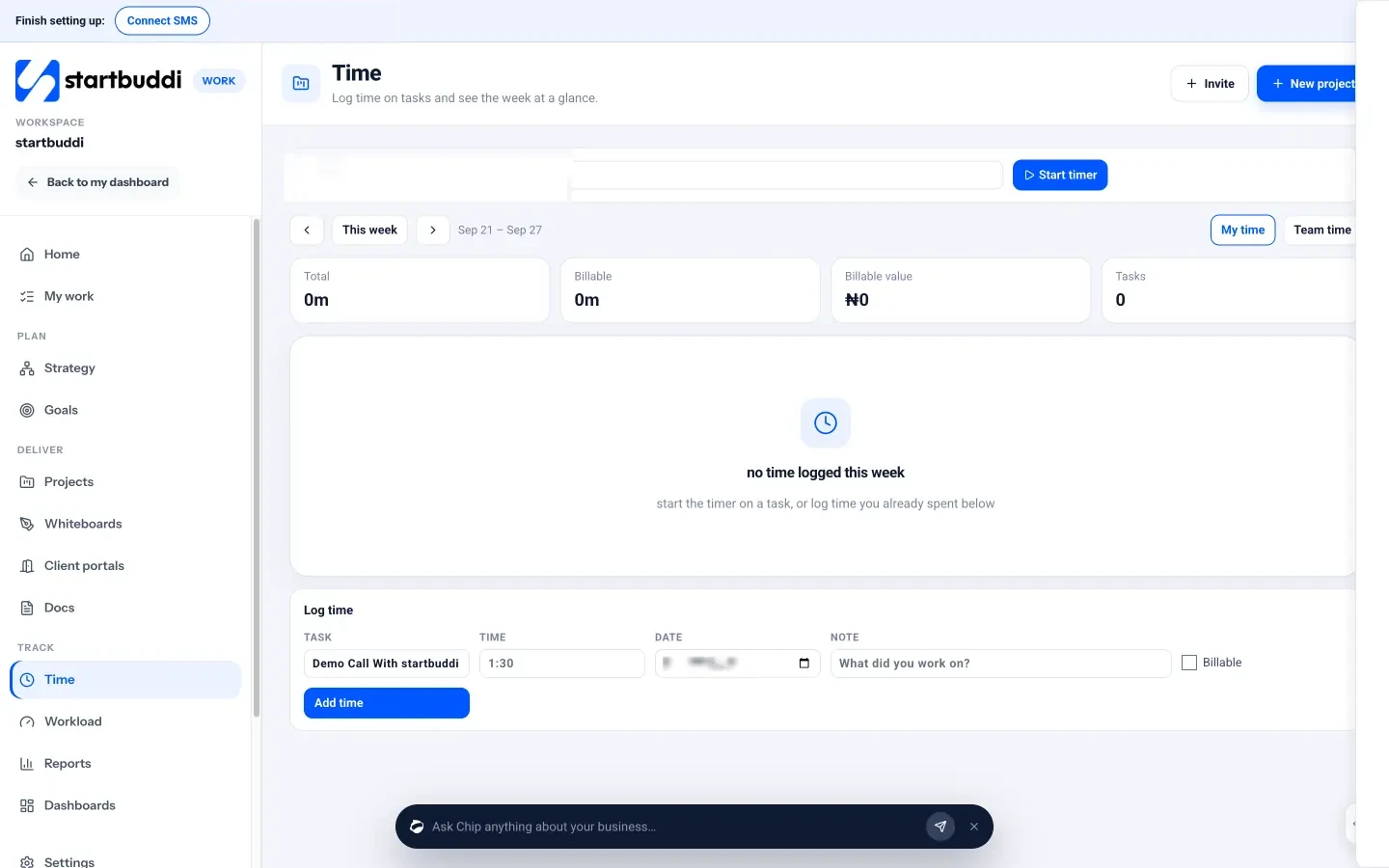
The Workload page shows a different percentage: planned hours from task estimates against each person’s weekly capacity, so you can see next week’s load before it lands. IT firms can see how projects, time and invoices connect on startbuddi for IT teams.
See where the hours go
Log time against tasks, mark what’s billable and see the week for you or your team. Start free with startbuddi, no card needed.
Related terms
FAQ
What is utilisation rate in simple terms?
Utilisation rate is the percentage of someone's working time spent on billable or productive work. If a consultant has 40 available hours and bills 30, their utilisation rate is 75%. It shows how much of the time you pay for turns into paid work.
How do you calculate utilisation rate?
Divide billable hours by available hours for the same period and multiply by 100. Available hours are contracted hours minus leave and public holidays. For example, 120 billable hours out of 150 available hours is an 80% utilisation rate.
What is the difference between utilisation and capacity?
Capacity is how many hours a person or team has available. Utilisation is the share of that capacity that went on billable or productive work. Capacity is the size of the container; utilisation is how full it was.
Is a higher utilisation rate always better?
No. A rate that stays close to 100% leaves no time for admin, training, sales or emergencies, and often leads to burnout. Most service businesses set different targets by role and watch for people who are consistently far above or below theirs.
Is utilisation rate the same as productivity?
Not quite. Utilisation measures how much time went on billable work, not how much was achieved in that time. An engineer can log 35 billable hours and still finish less than a colleague who logs 30, so read utilisation alongside results.
Tiwalade Joanna Okedara-Kalu is the founder, CEO and CTO of startbuddi, the business system that brings clients, bookings, invoices, projects, marketing and the Chip AI assistant into one place. Tiwalade builds software around how service businesses really work day to day, and writes about client management, getting paid on time and why small businesses outgrow the tools they start with.
Founded startbuddi and leads its product and engineering