What is round robin scheduling?
Also called: Booking rotation, team scheduling, round robin assignment, round robin booking
Round robin scheduling is a way of sharing bookings or leads across a team in turn, so each new appointment goes to an available team member and the workload stays balanced, while customers see more open times.
Round robin scheduling is a way of sharing incoming bookings or leads across a team in turn, so no single person gets all the work and every customer is matched with someone who is free. When a client books “a consultation”, the system picks the next available team member for them, rather than the client choosing a person.
The name comes from the old idea of taking turns in a circle. In booking tools it is also called a booking rotation, team scheduling or round robin assignment.
Why round robin scheduling matters for a small business
Once two or more people take appointments, a single shared calendar gets messy fast. Without a fair system, one of two things usually happens: the owner ends up with most of the bookings, or the busiest team member burns out while someone else sits idle.
Round robin scheduling fixes both. It helps you:
- Offer more times. The booking page shows a slot if any team member is free, so customers see more options.
- Share the workload fairly. Bookings are spread across the team instead of piling up on one person.
- Respond faster. New leads are picked up by whoever is available, not whoever happens to check the inbox first.
- Grow without chaos. Adding a new hire means adding them to the rotation, not rebuilding your booking process.
How round robin scheduling works
You create one bookable service and choose which team members can host it. Each person sets their own working hours. When a customer opens the booking page, the system combines everyone’s availability and shows every slot where at least one host is free. When the customer picks a time, the booking is given to one of the hosts free at that moment.
Here is an example. A small accounting firm offers a free 30-minute “tax health check”. Three advisers are in the rotation. Ada works mornings, Tunde works afternoons, and Grace works all day on Tuesdays and Thursdays. A client books Tuesday at 10am, when Ada and Grace are both free, and the system assigns one of them. Another client books Wednesday at 3pm, and only Tunde is free, so it goes to him. The client never has to know whose diary is whose.
Types of round robin scheduling
Tools decide “who is next” in different ways. The most common approaches are:
- Availability first: the booking goes to whoever is free at the chosen time. This shows customers the most slots.
- Equal distribution: the tool keeps counts so bookings even out over time, sometimes hiding a person’s slots until others catch up. Calendly’s round robin overview explains this trade-off: fairer shares can mean fewer slots on offer.
- Priority based: some hosts are preferred, for example senior staff for high-value services.
- Lead round robin: the same idea applied to new enquiries in a CRM, where each new lead is assigned to the next salesperson.
Round robin is different from a collective booking, where several people must all attend the same meeting, and from a personal booking page, where the client books one named person.
Best practices and common mistakes
- Only pool people who deliver the same service. If only one person can do colour treatments, they shouldn’t be in the rotation for colour with someone who can’t.
- Keep everyone’s hours up to date. The rotation only works if availability is real. Block holidays and training days.
- Let people pause. Someone on leave or overloaded should be able to step out of the rotation for a while.
- Check the numbers monthly. Look at bookings and completed appointments per person to spot imbalance.
- Keep the customer experience consistent. Use shared booking questions, confirmations and reminders so the client gets the same service whoever hosts.
- Give returning clients a way to rebook the same person. A personal booking page for each teammate works well alongside the rotation.
Related terms
An online booking system is where round robin scheduling usually lives. Booking software is the wider tool that manages staff, calendars and reports. In sales, the same idea is used to share leads across a sales pipeline. For a longer walk-through, read how round robin scheduling works on our blog.
Round robin scheduling in startbuddi
In startbuddi Bookings, open the Team tab to see the Booking rotation. Everyone on the team shares incoming bookings, and each member has an “In the booking rotation” switch and an “Accepting right now” switch to pause new bookings. Each person uses Set my hours to add their working hours, and anyone with no hours set is always eligible.
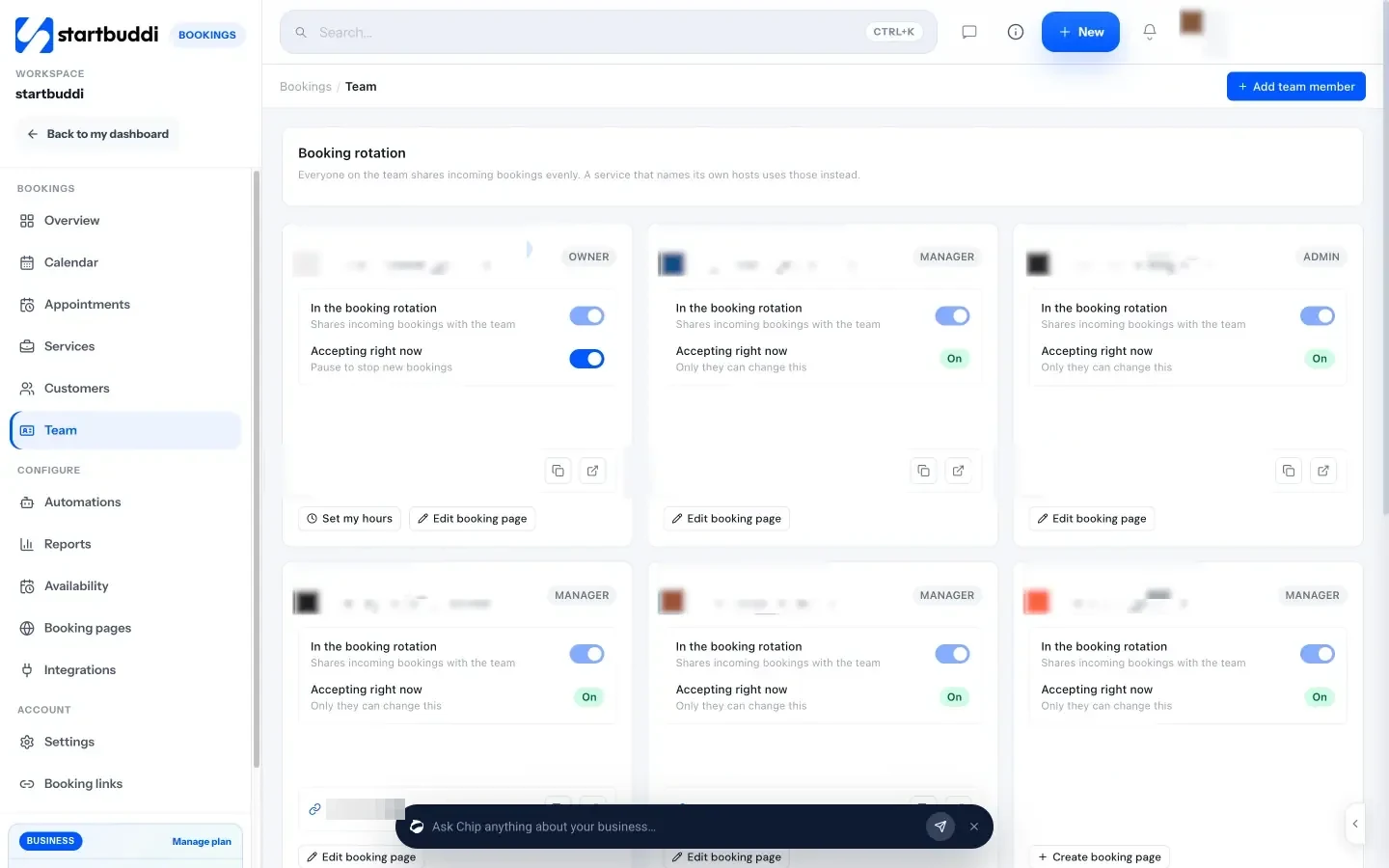
In a service’s Staff assignment you choose which hosts take that service. A service that names its own hosts uses those instead of the whole team. Customers see a Next available host option when they book. You can also create a personal booking page for each teammate, filter the Calendar and Appointments by staff, and compare staff performance in Reports. Team members are limited by your plan’s seats. See pricing.
Next step: pick one service that more than one person on your team can deliver, add those people as hosts, and share a single booking link for it.
Related terms
FAQ
Can the customer choose a specific person in round robin scheduling?
Not in the rotation itself, because the system picks the host. If returning clients want the same person, give each team member a personal booking page too.
Is round robin scheduling fair if some people work fewer hours?
An availability-first rotation gives more bookings to people who are free more often, which is usually fair. If you want strictly equal numbers, use a tool that balances counts over time.
Do I need round robin scheduling if I work alone?
No. It only helps once two or more people can deliver the same service. Until then, a single booking page is enough.
Tiwalade Joanna Okedara-Kalu is the founder, CEO and CTO of startbuddi, the business system that brings clients, bookings, invoices, projects, marketing and the Chip AI assistant into one place. Tiwalade builds software around how service businesses really work day to day, and writes about client management, getting paid on time and why small businesses outgrow the tools they start with.
Founded startbuddi and leads its product and engineering