Quote: Definition, Examples and How It Works

A quote (or quotation) is a document a business sends before doing work that sets out exactly what it will supply and the fixed price it will charge, usually for a limited time. Once the customer accepts it, both sides are normally expected to stick to that price for that work.
So what is quote paperwork actually for? It turns “how much would that cost?” into a clear, written offer the customer can say yes to, and gives both of you a record to point to if the job is later disputed.
Key takeaways
- A quote is a firm price for a defined job. An estimate is a guide that can change.
- A quote should say how long the price is valid for, so an old price can’t come back to bite you.
- Acceptance usually turns the quote into an agreement, so the scope matters as much as the price.
- Anything the customer asks for that isn’t in the quote should be priced and agreed in writing before you do it.
- An accepted quote becomes the basis of your invoice.
Why a quote matters for a small business
For an IT services firm, a vague price is where most disputes start. “Set up the office network” can mean four access points or forty, with or without cabling, with or without a firewall. A written quote forces you to decide the scope before you start, which protects your margin as much as it reassures the customer.
It also helps you win work. Businesses comparing three suppliers find it easier to choose the one whose quote lists exactly what they get. And it keeps your records straight: when the quote is accepted, you already have the line items for the invoice.
How a quote works, step by step
- The customer asks for a price. Often after a call or a site visit.
- You define the scope. What’s included, what isn’t, quantities, and any assumptions (for example “existing cabling is usable”).
- You send the quote. It shows each line item, the total, any tax, your payment terms, any deposit and how long the price is valid.
- The customer accepts, declines or asks for changes. Get acceptance in writing: a signature, an email or a reply on the quote.
- You do the work and invoice it. The invoice should match the accepted quote, plus any extras the customer agreed in writing.
For larger or longer jobs, the quote often sits alongside a statement of work that describes deliverables and timelines in more detail.
What is quote acceptance, and when is a quote binding?
In many countries, a quote is treated as an offer, and the customer’s acceptance creates a contract on those terms. Consumer rules often reinforce this. UK guidance from Citizens Advice (checked on 1 October 2026) describes a quote as “a promise to do work at an agreed price”, and says a trader can’t charge more just because their own costs have gone up since quoting. Section 50 of the UK Consumer Rights Act 2015 (checked on 1 October 2026) goes further: what a trader tells a consumer about a service can become a term of the contract if the consumer relies on it.
The rules differ by country and between business and consumer customers, so treat this as general information, not legal advice. The practical lessons are the same everywhere: put an expiry date on every quote, describe the scope precisely, and agree changes in writing before doing extra work.
If you’re unsure whether to give a firm price or a guide, our page on estimate vs quote explains when each fits.
An example with numbers
These figures are illustrative.
Chidi runs a small IT services firm in Lagos. A law office in Yaba asks him to set up its network and email. After a site visit, he sends this quote, valid for 30 days, with 50% payable before he orders the hardware.
| Item | Qty | Unit price | Total |
|---|---|---|---|
| Business router and firewall, supplied and configured | 1 | ₦450,000 | ₦450,000 |
| Wireless access points, supplied and mounted | 4 | ₦95,000 | ₦380,000 |
| Business email set-up and migration, per user | 12 | ₦15,000 | ₦180,000 |
| On-site staff training (half day) | 1 | ₦120,000 | ₦120,000 |
| Total | ₦1,130,000 | ||
| Deposit due on acceptance (50%) | ₦565,000 | ||
| Balance due on completion | ₦565,000 |
The quote also says what it doesn’t cover: new cabling, laptops, and any work outside the office’s current floor. Two weeks later the client asks for a fifth access point in the meeting room. Chidi sends a short written change for ₦95,000 before fitting it, and the final invoice comes to ₦1,225,000, with no argument.
Common mistakes with quotes
- No expiry date. Hardware prices move. A quote with no end date can be accepted months later at a price that no longer covers your costs.
- Vague scope. “Network set-up” invites the customer to assume everything is included.
- Doing extras on a handshake. Small additions add up. Price them and get a yes in writing first.
- Not following up. Many quotes go unanswered simply because the customer got busy. Our guide on following up after sending a quote covers when and how to chase.
Related terms
- Estimate vs quote: when to give a firm price and when to give a guide.
- Invoice: the request for payment that follows an accepted quote.
- Statement of work: the detailed scope that often goes with a quote on larger projects.
How startbuddi handles quotes
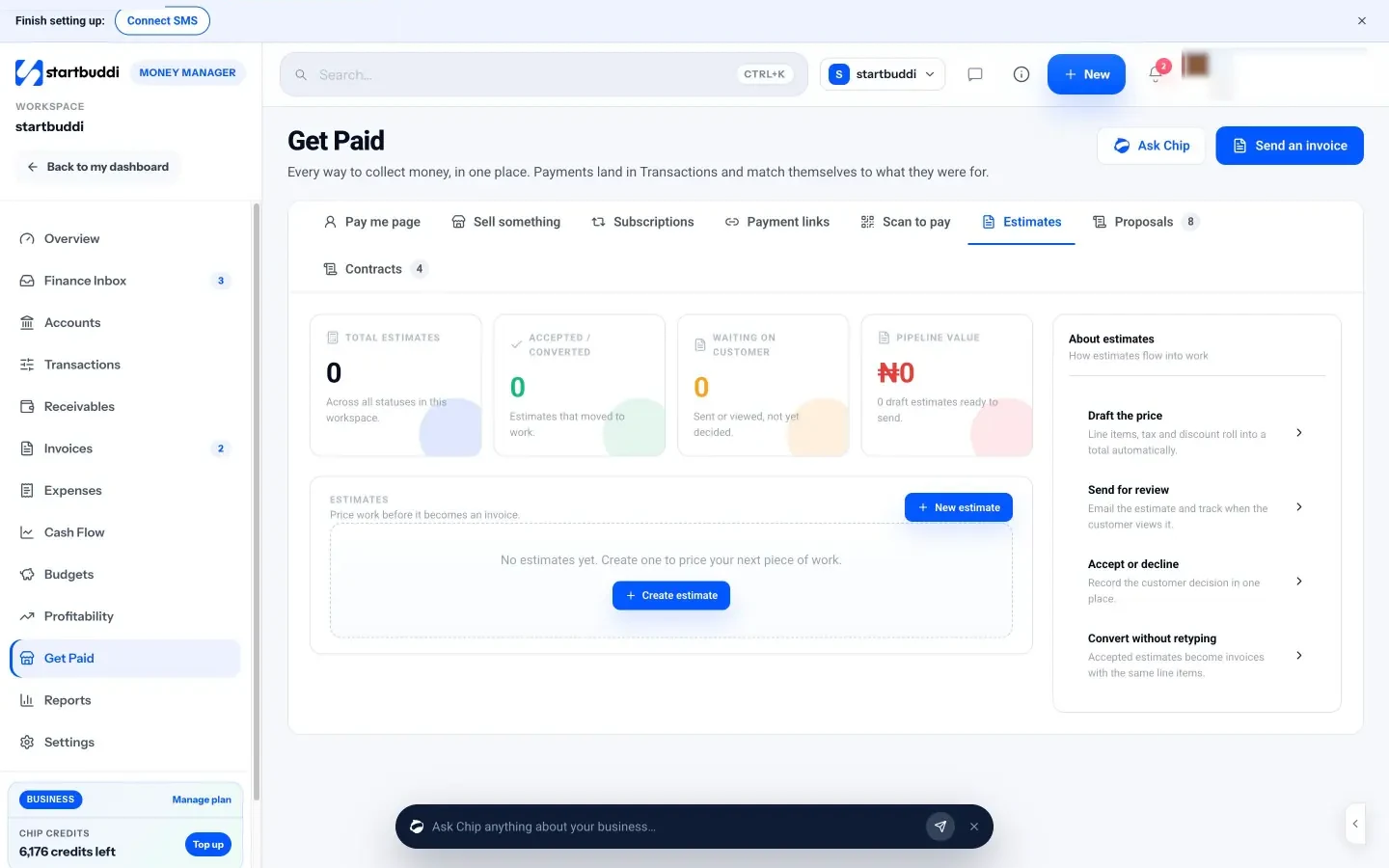
In startbuddi, quotes are created as estimates in Money Manager, under Get Paid. Choose an existing client or a one-off recipient, add line items, tax and any discount, write your terms (for example “Valid for 30 days. 50% deposit to begin.”) and send it by email. The customer replies to accept or ask for changes, and you click Mark accepted. Then Convert to invoice turns it into an invoice with the same line items, so nothing is retyped.
Need a one-off quote without an account? Try the free quote generator. IT firms can see how quotes, projects and invoices connect on startbuddi for IT teams, or read about estimates in Money Manager.
Send your next quote in minutes
Price the job, send it, and turn it into an invoice when the client says yes. Start free with startbuddi, no card needed.
Quote is part of Money Manager in startbuddi.
See Money ManagerRelated terms
FAQ
What is a quote in business?
A quote is a written offer to supply defined goods or services at a fixed price, usually valid for a set period. It lists what's included and the total cost. Once the customer accepts, it normally binds both sides to that price for that work.
Is a quote legally binding?
Often, yes, once the customer accepts it, because acceptance of an offer usually forms a contract. Consumer protection rules in many countries also stop a trader charging more than an accepted quote without agreement. Rules vary, so check the law where you trade.
How long should a quote be valid?
Thirty days is a common choice for service work. Use a shorter period if your costs change quickly, such as hardware or imported materials. Always print the expiry date on the quote itself.
What is the difference between a quote and an invoice?
A quote comes before the work and states what you will do and what it will cost. An invoice comes after the work, or at a milestone, and asks the customer to pay. An accepted quote usually becomes the basis of the invoice.
Can I change a quote after it has been accepted?
Only by agreement with the customer. If they ask for extra work, send a written change with the extra cost and get their yes before doing it. Changing the price because your own costs went up is usually not allowed once a quote is accepted.
Tiwalade Joanna Okedara-Kalu is the founder, CEO and CTO of startbuddi, the business system that brings clients, bookings, invoices, projects, marketing and the Chip AI assistant into one place. Tiwalade builds software around how service businesses really work day to day, and writes about client management, getting paid on time and why small businesses outgrow the tools they start with.
Founded startbuddi and leads its product and engineering