Break-Even Point: Definition, Examples and How It Works

The break-even point is the level of sales at which your total revenue exactly covers your total costs, so you make neither a profit nor a loss. Below it you lose money; every sale above it adds profit. So what is break-even point for a service business?
The break-even point is the level of sales at which your total revenue exactly covers your total costs, so you make neither a profit nor a loss. Below it you lose money; every sale above it adds profit. So what is break-even point for a service business? The number of clients, hours or jobs you need each month before you earn anything.
Key takeaways
- Break-even depends on three numbers: your fixed costs, your price and the variable cost of each sale.
- The core formula is fixed costs ÷ (price minus variable cost per unit). The bit in brackets is the contribution each sale makes.
- Service businesses can work it out in clients, jobs or billable hours, whichever they actually sell.
- Small changes in price move break-even more than most owners expect.
- It’s a planning number, not a target. Aim well above it, because a month at break-even pays the bills and nothing else.
Why the break-even point matters for a small business
Before you sign a lease, hire an engineer or drop your prices to win a contract, the break-even point tells you what the decision really commits you to. An IT firm that adds ₦400,000 a month in salary needs to know how many more support contracts that takes, not just whether it “feels” affordable.
It also answers the question every new owner asks in the first year: how much work do I need just to survive? Knowing that figure makes quiet months less frightening, because you can see how far you are from it.
What is break-even point, and how does it work?
The US Small Business Administration defines the break-even point as the point where total cost and total revenue are equal, and gives the formula fixed costs ÷ (price minus variable costs) for break-even in units. Canada’s business bank, BDC, describes it as the level of sales where total revenue equals total expenses (both checked on 1 October 2026).
You need three numbers:
- Fixed costs: what you pay each month whatever you sell, mostly your overhead: rent, salaries, software, insurance.
- Price per unit: what one client, job or hour brings in.
- Variable cost per unit: what each extra sale costs you, such as licences, a contractor’s time, travel or payment fees.
Price minus variable cost is the contribution each sale makes towards fixed costs. Divide it by the price and you get the contribution margin as a percentage.
| What you want | Formula |
|---|---|
| Break-even in units (clients, jobs, devices) | Fixed costs ÷ (price − variable cost per unit) |
| Break-even in revenue | Fixed costs ÷ contribution margin % |
| Break-even in billable hours | Fixed costs ÷ (hourly rate − variable cost per hour) |
An example with numbers
An IT managed services company in Nairobi supports small offices for a monthly fee per device. These figures are illustrative.
- Fixed costs: KSh 600,000 a month (office, two engineers’ salaries, software, insurance).
- Price: KSh 4,000 per device a month.
- Variable cost: KSh 1,500 per device a month (security licence, remote support tool and backup storage).
Contribution per device: KSh 4,000 − KSh 1,500 = KSh 2,500. Contribution margin: 2,500 ÷ 4,000 = 62.5%.
- Break-even in devices: KSh 600,000 ÷ KSh 2,500 = 240 devices.
- Break-even in revenue: KSh 600,000 ÷ 62.5% = KSh 960,000 a month (240 × KSh 4,000).
Now see how the levers move it:
| Change | New contribution | Break-even |
|---|---|---|
| None | KSh 2,500 | 240 devices |
| Price up to KSh 4,500 | KSh 3,000 | 200 devices |
| Fixed costs up to KSh 750,000 (a third engineer) | KSh 2,500 | 300 devices |
| Variable cost up to KSh 2,000 | KSh 2,000 | 300 devices |
A 12.5% price rise cuts the devices needed by 40. Hiring the third engineer means signing 60 more devices before the hire pays for itself.
The same idea in billable hours
A consultancy in Lagos with ₦900,000 of monthly fixed costs bills ₦25,000 an hour, and each hour costs ₦7,000 in a contractor’s share and tools. Contribution per hour is ₦18,000, so break-even is ₦900,000 ÷ ₦18,000 = 50 billable hours a month. Anything above 50 hours is profit.
To run your own numbers, use our free break-even calculator.
Common mistakes with the break-even point
- Leaving out your own pay. If the owner’s salary isn’t in fixed costs, “break-even” still means working for free.
- Calling a cost fixed when it grows with sales. Payment fees, licences per user and contractor hours are variable.
- Using your best month. Base it on a normal or slow month.
- Treating break-even as the goal. It’s the floor. Your profit margin is made above it.
Related terms
- Overhead: the fixed running costs that break-even has to cover.
- Profit margin: what’s left once you’re past break-even, as a share of revenue.
- Gross vs net profit: contribution is close to gross profit; net profit is what remains after fixed costs.
For how break-even shapes your prices, read our guide to pricing strategy for small business.
How startbuddi helps you track break-even
startbuddi doesn’t calculate break-even for you, but it keeps the numbers you need in one place. In Money Manager, recurring expenses (your fixed costs) and open invoices feed the Cash Flow forecast. Run a scenario to see what happens to your balance if revenue drops by a set percentage or overdue invoices are paid this week, and Profitability shows revenue minus attributed costs for each customer or project.
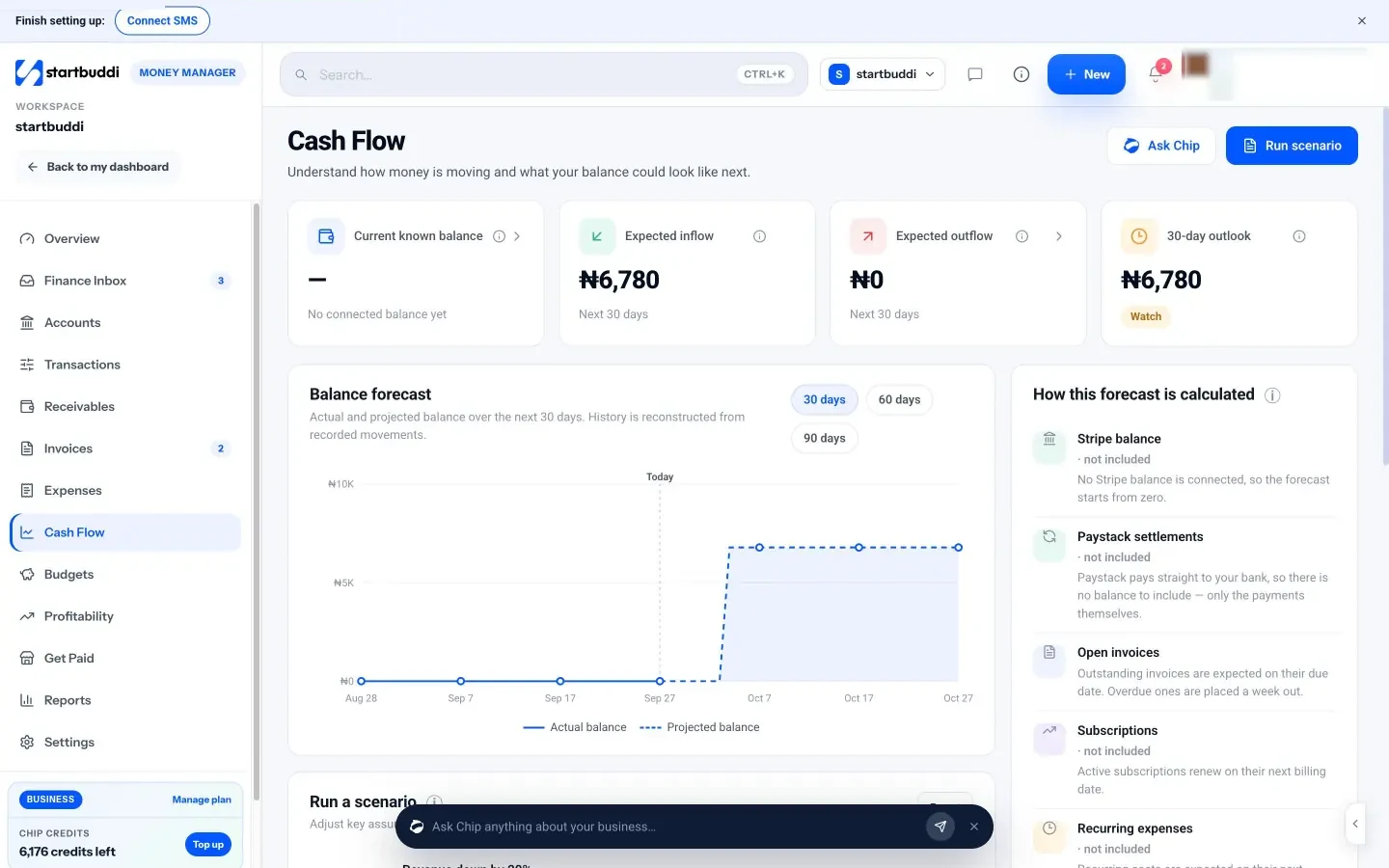
IT firms can see how contracts, projects and invoices connect on startbuddi for IT teams.
Know your numbers before the month starts
Track recurring costs and expected income in one place, and check your forecast before you commit to a new cost. Start free with startbuddi, no card needed.
Related terms
FAQ
What is the break-even point in simple terms?
The break-even point is the amount you need to sell for your income to equal your costs. At that point you make no profit and no loss. Every sale after it adds profit.
How do you calculate the break-even point?
Divide your fixed costs by the contribution of each sale, which is the price minus the variable cost of that sale. For example, KSh 600,000 of fixed costs and KSh 2,500 contribution per client gives a break-even of 240 clients. To get it in revenue, divide fixed costs by the contribution margin percentage.
What is the difference between break-even point and profit?
Break-even is where profit is exactly zero. Profit is what you earn on sales above the break-even point. A business at break-even covers its bills but has nothing left to save or reinvest.
How can a service business lower its break-even point?
Raise prices, cut the variable cost of each job, or reduce fixed costs. Raising prices usually has the biggest effect, because the whole increase goes to contribution. Billing more of your team's time also helps, as fixed costs are spread over more hours.
Is break-even point the same as payback period?
No. The break-even point is a level of sales in a period, such as clients or revenue per month. A payback period is how long it takes to earn back a one-off investment, such as new equipment. You can use break-even thinking to estimate payback, but they answer different questions.
Tiwalade Joanna Okedara-Kalu is the founder, CEO and CTO of startbuddi, the business system that brings clients, bookings, invoices, projects, marketing and the Chip AI assistant into one place. Tiwalade builds software around how service businesses really work day to day, and writes about client management, getting paid on time and why small businesses outgrow the tools they start with.
Founded startbuddi and leads its product and engineering