Overhead: Definition, Examples and How It Works

Overhead is the cost of running your business that isn't tied to any one job, client or product: rent, internet, software, insurance, admin salaries and the accountant. You pay it whether you finish ten jobs this month or none. So what is overhead in practice? The cost of keeping the lights on.
Key takeaways
- Overhead is every running cost you can’t charge to a specific job. Costs you can trace to a job, such as a contractor or a part, are direct costs.
- Most overhead is fixed from month to month, but some moves with activity, such as electricity or fuel for a generator.
- Your prices have to cover overhead as well as direct costs, or every job looks profitable while the business loses money.
- The simplest way to price it in is an overhead rate: overhead divided by the hours you can bill.
- Review overhead every few months. It creeps up through small subscriptions nobody cancels.
Why overhead matters for a small business
An IT support firm can earn a healthy margin on every job and still run short at the end of the month. The usual reason is overhead: the office, the connection, the generator, the software licences and the person answering the phone. None of it shows up on a single job, so it’s easy to price without it.
Overhead also decides how much work you need just to stand still. If overhead is ₦1,600,000 a month, that money has to come from somewhere before you make a kobo of profit. Knowing the number helps you set prices, decide whether to take a bigger office and see what a quiet month really costs.
What is overhead, and how does it work?
The US Small Business Administration describes fixed costs (checked on 1 October 2026) as costs that don’t change with the amount you produce or sell, such as rent, salaries, insurance and interest. Most overhead falls into that group.
| Type | What it means | IT services examples |
|---|---|---|
| Fixed overhead | The same each month whatever the workload | Office rent, insurance, admin salary, accounting fees |
| Variable overhead | Rises and falls with activity, but not tied to one job | Electricity, generator diesel, data top-ups |
| Semi-variable overhead | A fixed base plus a usage part | A phone plan with a base fee and extra minutes |
Overhead is different from direct costs:
- Direct costs belong to a job: the network switch you install, the freelance engineer you hire for one project, travel to a client’s site.
- Overhead supports all jobs at once: the office, the help desk software, the business bank fees.
Most tax systems let you deduct genuine business running costs. The UK government’s guide to allowable expenses (checked on 1 October 2026) lists office costs, premises, insurance, bank charges and professional subscriptions, and says you can only claim the business part of a cost you also use personally. That’s a useful test for overhead too: only count the business share.
The overhead rate
To price overhead into your work, spread it over something you can measure. Service businesses usually use billable hours:
Overhead rate per hour = monthly overhead ÷ billable hours a month
You can also express it as a share of revenue: monthly overhead ÷ monthly revenue × 100.
An example with numbers
An IT support company in Lagos has three engineers and one administrator. These monthly figures are illustrative.
| Overhead item | Monthly cost |
|---|---|
| Office rent | ₦600,000 |
| Internet | ₦120,000 |
| Generator diesel | ₦250,000 |
| Software and tools | ₦180,000 |
| Accountant | ₦100,000 |
| Administrator’s salary | ₦350,000 |
| Total overhead | ₦1,600,000 |
Each engineer bills about 120 hours a month, so the team bills 360 hours.
- Overhead per billable hour: ₦1,600,000 ÷ 360 = about ₦4,444.
- If revenue is ₦8,000,000 a month, overhead is ₦1,600,000 ÷ ₦8,000,000 × 100 = 20% of revenue.
So if an engineer’s pay and direct costs come to ₦9,000 per billable hour, the firm needs to charge at least ₦13,444 an hour before it makes any profit. Pricing at ₦12,000 an hour would feel profitable on each job and lose about ₦1,444 on every hour billed. Our hourly rate calculator does this sum for you.
How to keep overhead under control
- List every recurring cost once a quarter, including small software subscriptions, and cancel the ones nobody opened.
- Track utilisation. Overhead per hour falls when engineers bill more of their time, so idle hours are an overhead problem as much as a sales one.
- Separate business and personal costs. Only the business share is overhead.
- Check before committing. A bigger office or a second generator raises overhead for years; work out the new rate per hour first.
Related terms
- Profit margin: what’s left after direct costs and overhead, as a share of revenue.
- Billable hours: the hours you spread overhead across.
- Expense tracking: recording costs so you know what your overhead really is.
For how overhead feeds into what you charge, read our guide to pricing strategy for small business.
How startbuddi handles overhead
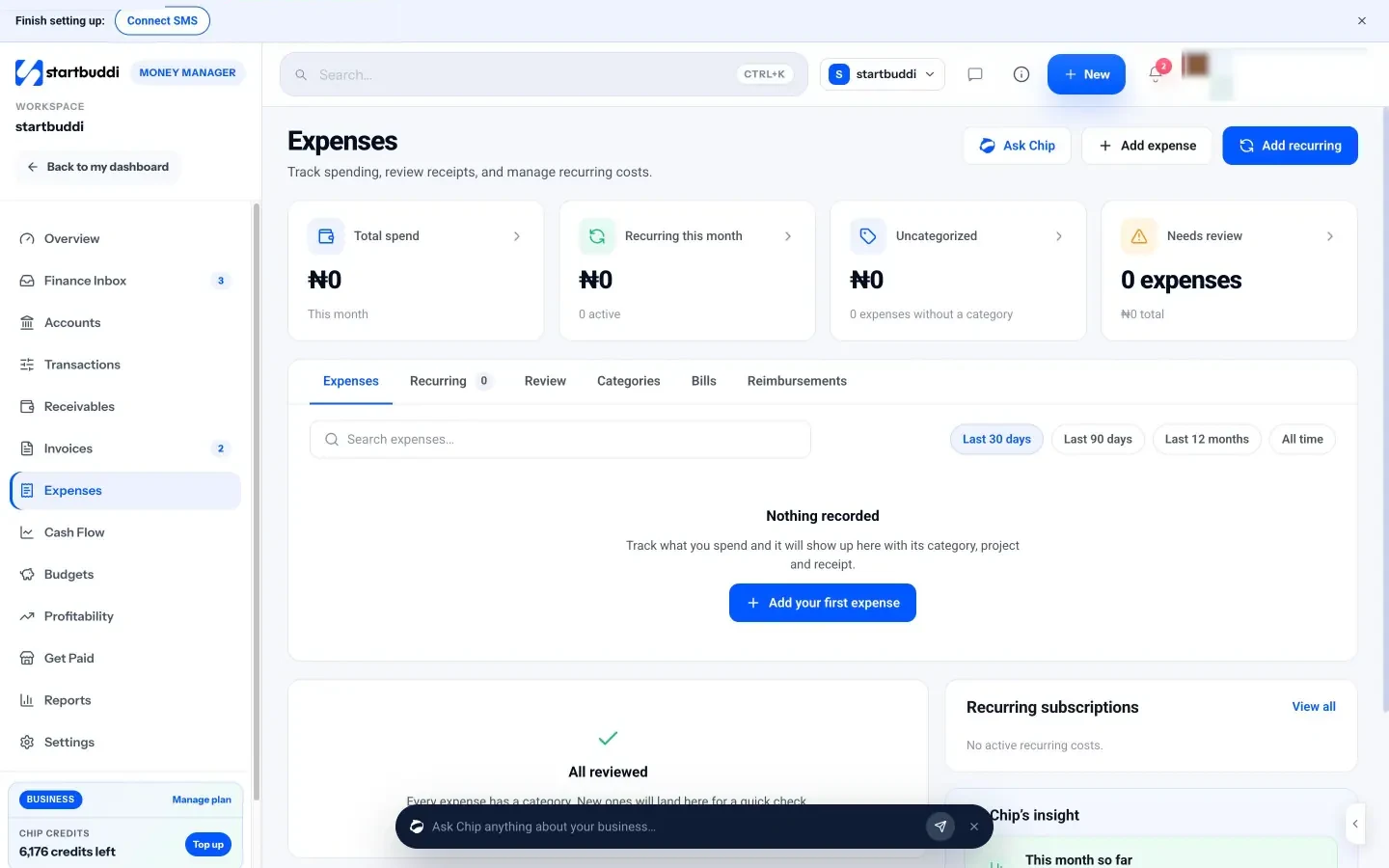
In Money Manager, add running costs under Expenses. Rent, software and other regular payments go in the Recurring tab with Add recurring, so they appear in the cash forecast and budgets. Link job costs to a project or customer and leave overhead unlinked; Profitability then shows each project’s or client’s revenue minus the costs attributed to it, and your overhead stays visible as the running cost of the whole business.
Profitability doesn’t include team labour costs, so add salaries to your own overhead sum. IT firms can see how the rest fits together on startbuddi for IT teams.
See what running the business really costs
Log your running costs once, set the regular ones to repeat, and see where the money goes. Start free with startbuddi, no card needed.
Related terms
FAQ
What is overhead in simple terms?
Overhead is the cost of running your business that isn't linked to a particular job or product. Rent, internet, software, insurance and admin salaries are typical examples. You pay it whether or not you're busy.
What is the difference between overhead and direct costs?
Direct costs can be traced to a specific job, such as parts, materials or a contractor hired for one project. Overhead supports the whole business and can't be charged to one job, such as office rent or accounting fees. Prices need to cover both.
Is salary an overhead cost?
It depends on the role. An administrator's or manager's salary is usually overhead, because it isn't tied to one job. The pay for time an engineer spends on client work is often treated as a direct cost, especially in businesses that bill by the hour.
How do you calculate the overhead rate?
Divide your monthly overhead by your billable hours for the month to get an overhead cost per hour. For example, ₦1,600,000 of overhead over 360 billable hours is about ₦4,444 an hour. You can also divide overhead by revenue to see it as a percentage.
What is a good overhead percentage for a small business?
There's no single good figure, because it depends on the industry and how the business is set up. What matters is that your prices cover overhead and still leave a profit. Track the percentage over time: if it rises while revenue stays flat, look for costs to cut.
Tiwalade Joanna Okedara-Kalu is the founder, CEO and CTO of startbuddi, the business system that brings clients, bookings, invoices, projects, marketing and the Chip AI assistant into one place. Tiwalade builds software around how service businesses really work day to day, and writes about client management, getting paid on time and why small businesses outgrow the tools they start with.
Founded startbuddi and leads its product and engineering