The best booking software for coaches and service businesses in Nigeria: how to choose
What coaches and service businesses in Nigeria need from booking software: naira deposits, WhatsApp-friendly links, reminders, and the published plans of popular tools.



Photo: Andile Mnothoza / Unsplash
- Choose booking software in Nigeria by how clients will pay first: many tools only take Stripe or PayPal. Then check deposits, reminders, buffers and team scheduling, and compare the real yearly cost including payment fees.
The best booking software in Nigeria does four things well: it lets clients pick a time from a link you can share on WhatsApp, it takes a deposit in naira before the slot is confirmed, it sends reminders so people actually turn up, and it keeps every client’s history in one place. For a coach, therapist, consultant, photographer or salon, those four things matter more than a long feature list. Many international tools handle the scheduling part well but take payments only through processors that don’t serve Nigerian businesses directly, so check the payment side first.
This guide explains what to look for, compares the published plans of well-known tools, and gives you five questions to decide. The advice works wherever you are, with notes on what is specific to Nigeria.
What booking software does for a service business
Booking software replaces the back-and-forth of “are you free Tuesday?” with a page where clients see your real availability and book themselves. A good one also:
- lists your services with a length and price for each, such as a 60-minute coaching session or a 30-minute discovery call;
- blocks time around bookings so you aren’t booked back to back;
- collects the details you need before the session, such as goals, budget or hair type;
- sends a confirmation, a calendar invite and a reminder;
- takes full payment or a deposit at the time of booking;
- keeps a record of who booked, who came and who didn’t.
If you are new to the idea, our plain-English definition of booking software covers the basics.
Booking software or WhatsApp messages?
Plenty of Nigerian coaches and service businesses run bookings entirely through WhatsApp chats, and it works while you are small. The cost shows up in three places. First, time: each booking can take five or six messages to agree a slot, share account details and confirm the transfer. Second, mistakes: two clients offered the same Saturday slot, or a transfer that never arrives but nobody notices until the client turns up. Third, memory: when a client books again three months later, their history is scattered across chats.
Booking software doesn’t replace WhatsApp. It gives WhatsApp a link to send. The client picks a time, pays the deposit and gets a confirmation, and you get a clean record. You still chat, but about the session, not the logistics.
What different service businesses need
- Life and business coaches: discovery calls that are free, paid sessions with a deposit, and packages of four or six sessions. Intake questions about goals are worth adding. Clients abroad make time zone display important.
- Therapists and wellness practitioners: privacy first. Ask only for what you need on the booking form, and keep detailed notes somewhere access-controlled.
- Salons, barbers and beauty studios: several services of different lengths, more than one stylist, and a strong need for deposits on long appointments such as braids or lash sets.
- Consultants and tutors: fewer, longer sessions, video links, and often an invoice afterwards rather than payment at booking.
- Photographers and event services: larger deposits, dates booked months ahead and a clear cancellation policy.
Write down which of these sounds like you before you look at tools. It tells you which features you can ignore.
What matters for booking software in Nigeria
Taking payment in naira
This is the deciding factor for most Nigerian businesses. Many popular scheduling tools collect payments only through Stripe or PayPal. Stripe lists Nigeria as part of its “extended network” rather than as a country where businesses sign up directly (Stripe). In practice, most Nigerian businesses take card, bank transfer and USSD payments through a local processor such as Paystack.
Know the fees before you set prices. Paystack’s published rate for local payments is 1.5% plus ₦100, with the ₦100 waived on payments under ₦2,500 and fees capped at ₦2,000 per transaction (Paystack). On a ₦30,000 coaching session that is ₦550.
Mobile first, WhatsApp always
DataReportal counted 109 million internet users in Nigeria in late 2025, alongside 165 million mobile connections (DataReportal). Most of your clients will open your booking link on a phone, often straight from a WhatsApp chat or an Instagram bio. Test the booking page on an older Android phone with a slow connection before you share it. If it takes more than a few taps, people drop off.
Time zones for clients abroad
Coaches and consultants often serve clients in the UK, US or elsewhere in Africa. Your booking page should show times in the client’s time zone or clearly state yours (West Africa Time), so a London client doesn’t turn up an hour late.
Data protection
A booking form collects names, phone numbers and sometimes sensitive details, such as health information for a therapist. The Nigeria Data Protection Act 2023 sets rules for collecting and using personal data, overseen by the Nigeria Data Protection Commission. Only ask for what you need, and say why. This is general information, not legal advice.
Paying for the software itself
Most international tools bill in US dollars or euros. That means a card that works for foreign payments, and a monthly cost that moves with the exchange rate. A tool billed in naira gives you a predictable cost.
Features checklist: what to ask before you choose
| Feature | Why it matters | Question to ask |
|---|---|---|
| Naira payments at booking | Deposits cut no-shows and protect your time | Which processor, and can clients pay by transfer or USSD? |
| Deposits, not just full payment | Some clients won’t prepay in full for a first session | Can I take a fixed deposit or a percentage? |
| Reminders | People forget, especially bookings made weeks ahead | Email, SMS or WhatsApp? Included or paid extra? |
| Buffers and notice | Travel time in Lagos traffic is real | Can I add time after sessions and a minimum notice period? |
| Intake questions | Better sessions when you know the goal in advance | Can answers save to the client’s record? |
| Team scheduling | Needed once you have a second coach or stylist | Round robin, or a separate page per person? |
| Calendar sync | Stops clashes with personal events | Does it read my busy times, or only add bookings? |
| No-show handling | You need a record and a polite follow-up | Can I mark a no-show and send a rebooking message? |
Deposits, reminders and no-shows
For coaches and service businesses, a missed session is lost income you can’t get back. Two things reduce it. The first is a reminder: a Cochrane review of text-message reminders for health appointments found they increased attendance compared with no reminder (Cochrane). The second is a deposit, because people are far less likely to skip something they have already paid for.
A common starting point is a deposit of 20% to 50% for first-time clients, with full payment upfront for packages. Put your rules in writing: how much notice a client must give to reschedule, and whether the deposit is refundable. Our booking policy writer drafts one for you. Then add up last month’s missed sessions: that is what no-shows are costing you now.
Popular booking tools and their published plans
These are well-known booking tools, with free plans and starting prices as published on their own pricing pages when we checked in September 2026. Prices change, so confirm on the linked page. We haven’t ranked them: the right one depends on how you take payment and how many people take bookings.
| Tool | Free plan | Published paid pricing | Payments |
|---|---|---|---|
| Calendly | Yes: one event type, one calendar connection | Standard $10 per seat a month billed yearly | Stripe and PayPal on paid plans |
| Zoho Bookings | Yes: one user, with reminders | Per user; see pricing page for your region | See Zoho’s integrations |
| Setmore | Yes: up to 4 users, unlimited appointments | Pro $5 per user a month billed annually, $12 monthly | Square, Stripe, PayPal |
| SimplyBook.me | Yes: 50 bookings a month, 1 provider | Basic €11.90 a month billed annually | Stripe, PayPal, Square and others |
| Acuity Scheduling | No, 7-day trial | Starter $16 a month billed annually, $20 monthly | See Acuity’s payment options |
If you already use one of these, our comparisons of startbuddi and Calendly and startbuddi and Acuity set out the differences, and our list of booking software for service businesses goes wider.
How to choose: five questions
- How will clients pay? If most pay by card, transfer or USSD in naira, rule out any tool that can’t connect to a processor you can actually use.
- Do you need deposits? If no-shows cost you, a tool that can only take full payment, or none, isn’t enough.
- How many people take bookings? Solo coaches can use a simple tool. A studio with three coaches needs round robin or separate pages.
- What happens after the booking? If you also send invoices, run email follow-ups or track clients, a booking tool that connects to those saves retyping.
- What will it really cost in a year? Add the subscription (converted to naira), payment fees and any paid add-ons such as SMS reminders.
Set up your booking page in an afternoon
- List your services, each with a name, length and price. Keep it to three or four to start.
- Set your working hours, a buffer after each session and how far ahead people can book.
- Decide your deposit rule and write a one-paragraph booking policy.
- Add two or three intake questions per service.
- Make a test booking on your phone and pay the deposit yourself.
- Share the link in your WhatsApp status, Instagram bio and email signature. A QR code for your booking link works well on printed cards and in a physical studio.
Mistakes to avoid
- Too many services on day one. Twelve options confuse people. Start with three and add more when clients ask.
- No buffer. Back-to-back sessions leave no time to write notes, travel or take a breath.
- Hidden prices. Show the price or deposit on the booking page. Surprises at checkout lose bookings.
- A policy nobody reads. Put the cancellation rule in one sentence on the page and again in the confirmation.
For more on reminders, see our guide to automating client bookings with reminders.
How startbuddi helps coaches and service businesses
The Bookings module in startbuddi was built with naira payments and WhatsApp sharing in mind, and it connects to your client list, invoices and marketing in the same account.
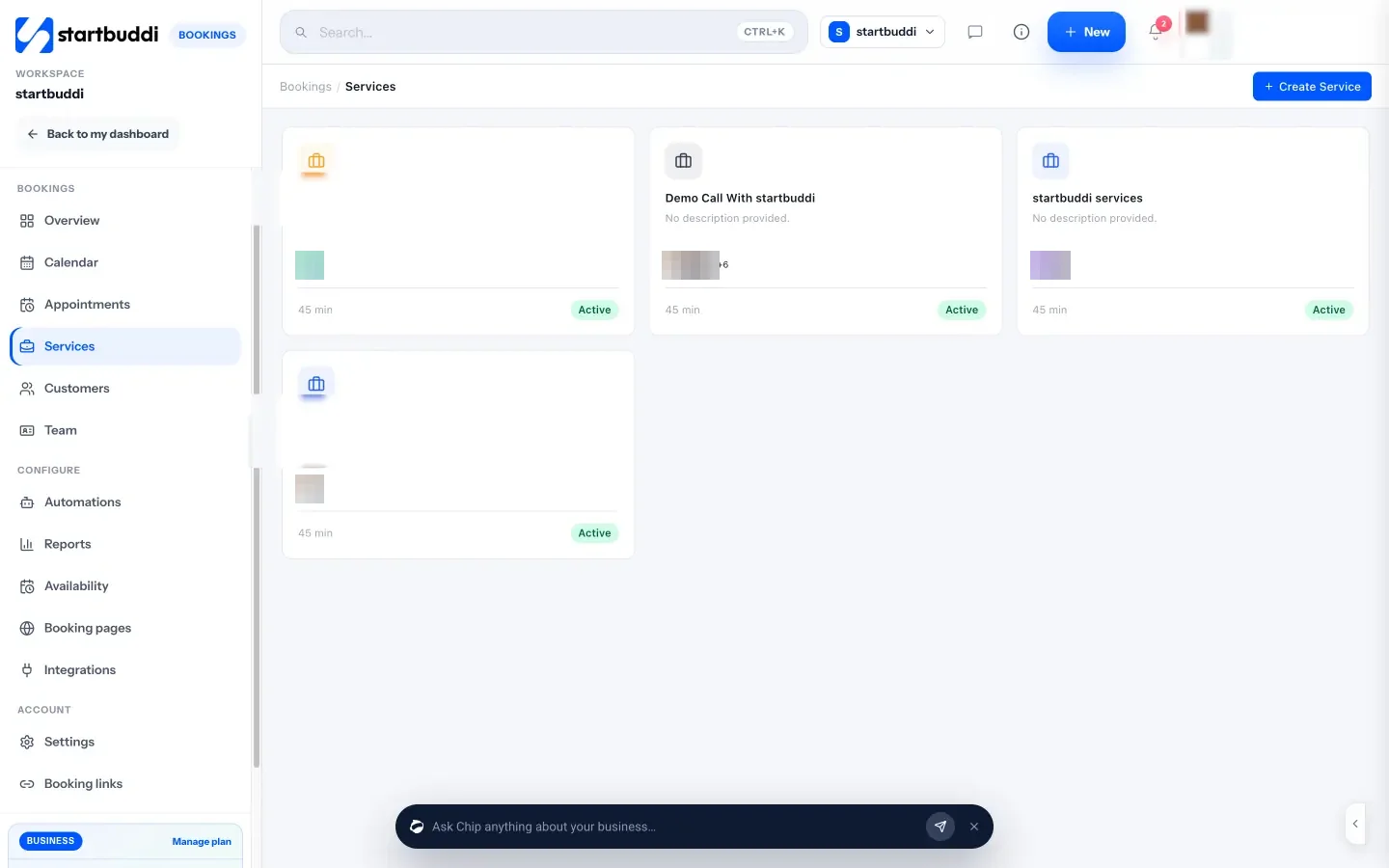
Services with deposits. Each service has a price in NGN, USD, GBP, EUR, KES, ZAR or GHS. Turn on “Require payment to book” and choose the full amount or a deposit. The client pays through Paystack or Stripe checkout, and the slot is held for 30 minutes while they pay.
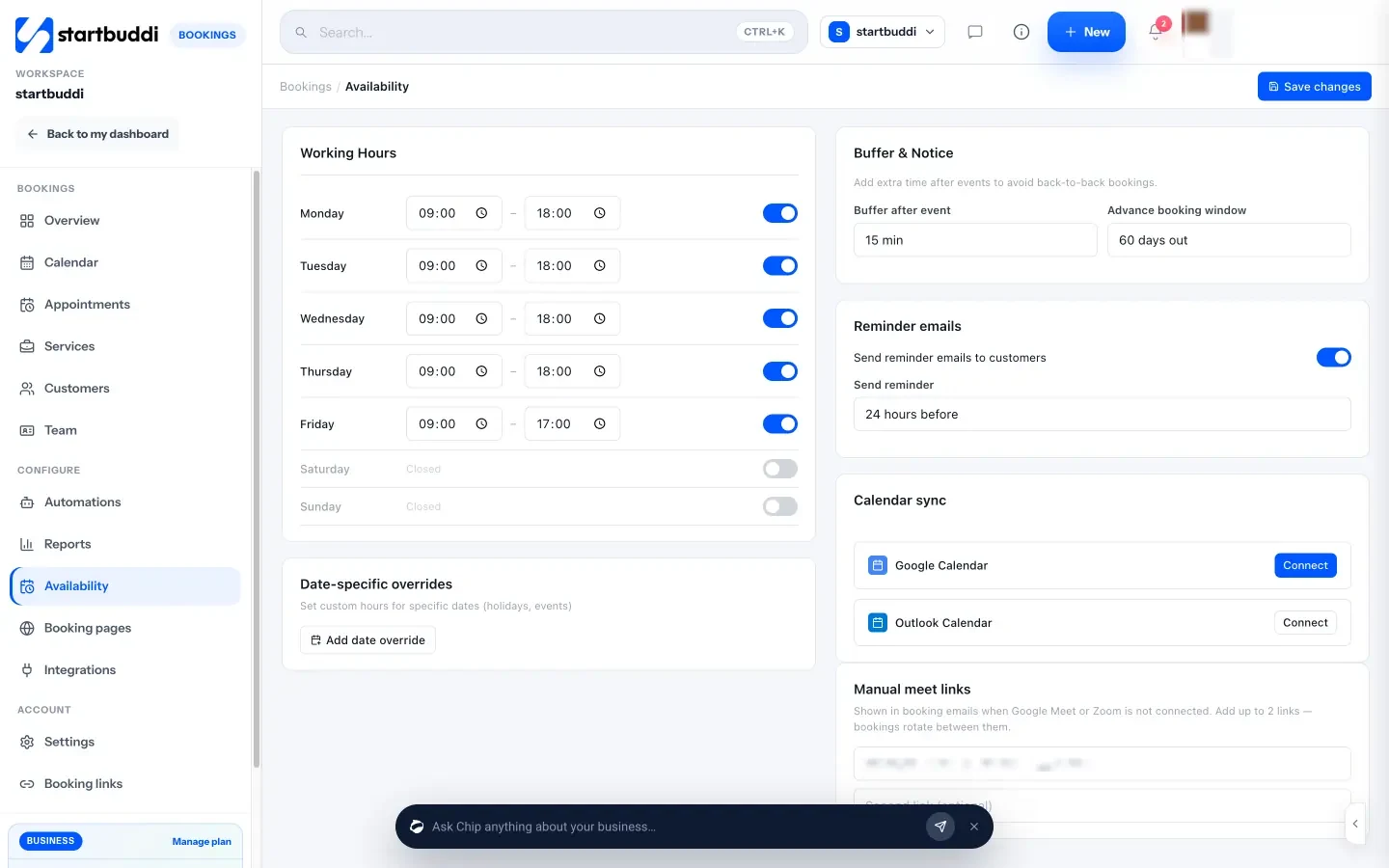
Availability and reminders. Set working hours per day, a buffer after each event and an advance booking window, and block time for holidays. An automatic reminder goes out by email, WhatsApp or SMS at the lead time you choose, such as 24 hours before.
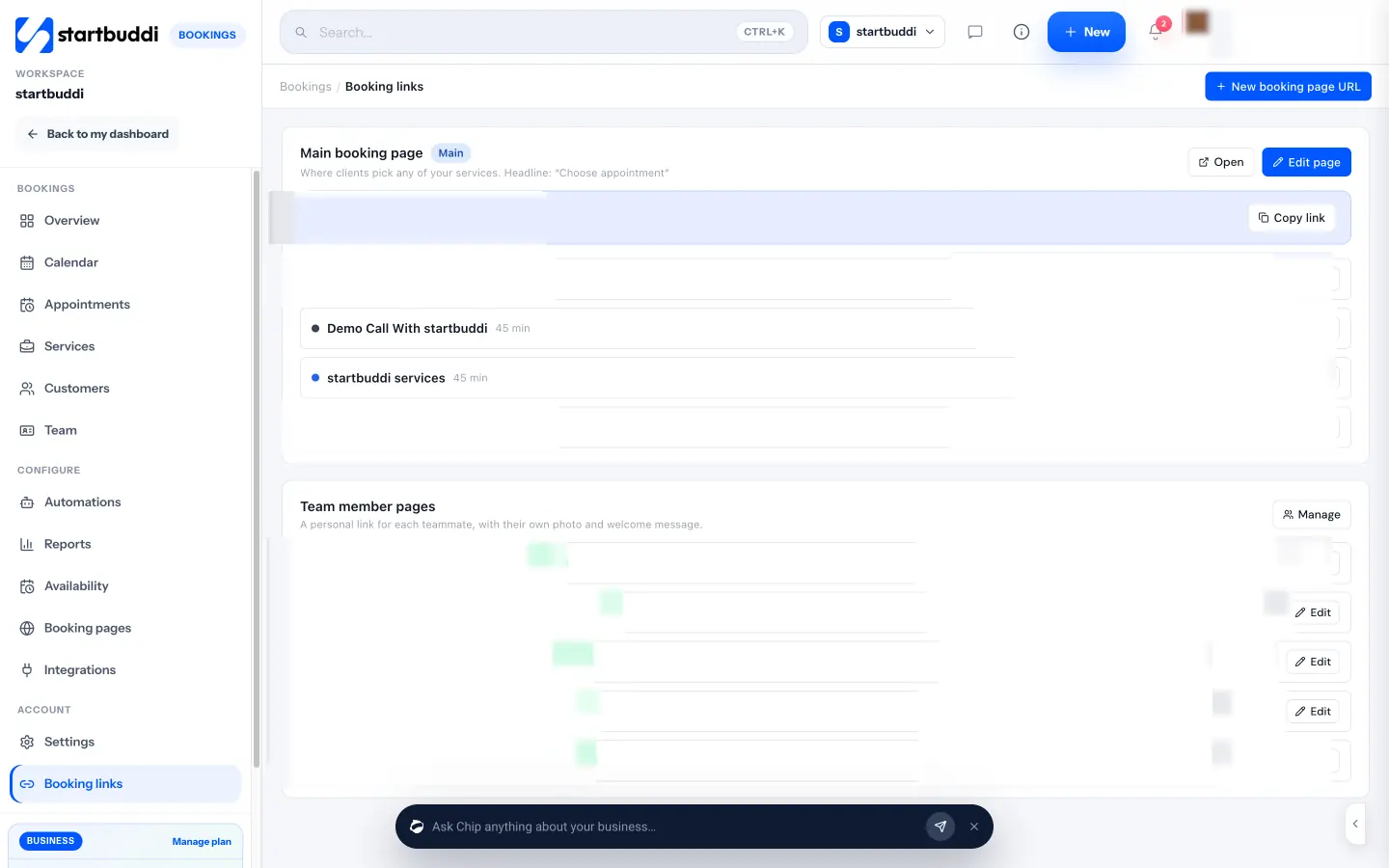
Sharing. Copy your booking link, share it on WhatsApp or by email, embed it on your site, or download a QR code. You can run extra booking page URLs for different offers, plus a personal page for each teammate.
Running your day. The Overview shows today’s appointments and a Needs attention list where you mark Came or No-show. Marking a no-show sends your follow-up email. From any booking you can generate an invoice in Money Manager. Everyone who books is added to your contacts.
Teams. Round robin shares bookings across the team, and each member sets their own hours.
Honest limits. Calendar sync pushes bookings into Google Calendar (and Outlook where it is set up), but it doesn’t read your personal busy times, so block time manually for other commitments. WhatsApp reminders need a connected WhatsApp number, and SMS reminders need an SMS connection and a plan that includes SMS. Zoom isn’t connected yet, so paste your own meeting link. On Free you get one live service; Starter includes 10 and Growth 25.
Your next step
Write down your three most-booked services with a length, price and deposit rule. Then set up one booking page, test it on your phone, and share it in your WhatsApp status this week. See how startbuddi works for coaches, or start free from the pricing page.
Sources
- Stripe: global availability
- Paystack Support: transaction fees in Nigeria
- DataReportal: Digital 2026 Nigeria
- Nigeria Data Protection Commission: Nigeria Data Protection Act 2023
- Cochrane: mobile phone messaging reminders for attendance at healthcare appointments
- Calendly pricing, Zoho Bookings pricing, Setmore pricing, SimplyBook.me pricing, Acuity Scheduling plans
Frequently asked questions
Is there free booking software in Nigeria?
Yes. Several tools have free plans, including Calendly, Setmore, SimplyBook.me and startbuddi. Check whether the free plan lets clients pay a deposit in naira, because that is often where free plans stop.
Can clients pay in naira when they book?
Only if the tool connects to a processor that serves Nigerian businesses, such as Paystack. Many international booking tools take payments only through Stripe or PayPal.
How much deposit should a coach charge?
Many coaches ask 20% to 50% for a first session and full payment for packages. Write the rule into a short booking policy so clients know what happens if they cancel.
Do booking apps send WhatsApp reminders?
Some do, often on paid plans or with extra credits. Others send email only. Check which channels are included and whether reminders cost extra before you commit.
Tiwalade Joanna Okedara-Kalu is the founder, CEO and CTO of startbuddi, the business system that brings clients, bookings, invoices, projects, marketing and the Chip AI assistant into one place. Tiwalade builds software around how service businesses really work day to day, and writes about client management, getting paid on time and why small businesses outgrow the tools they start with.
Founded startbuddi and leads its product and engineering