How to revive cold leads six months old using your CRM data
How to revive cold leads six months old: pull the list from your CRM, group leads by where they stopped, check consent, and send short, specific messages that get replies.


Chinonye wrote this while on the startbuddi team. The product has changed since, so the team updated it on .

- Filter leads last contacted three to nine months ago, group them by where they stopped, check you may still contact them, and send one specific, useful message per group plus two gentle follow-ups. Move replies straight back into the pipeline and fix the gaps that let them go cold.
To revive cold leads that are six months old, don’t blast everyone with “just checking in”. Pull the list from your CRM, sort it by where each lead stopped and why, check you’re still allowed to contact them, and send a short, useful, personal message per group, then two gentle follow-ups at most. Put anyone who replies straight back into your pipeline with a next step, and close the rest politely. Done well, it’s one of the cheapest sources of new work a service business has, because these people already know who you are.
This guide walks through that process step by step: finding the leads worth reviving, grouping them using the data you already hold, the consent and deliverability checks people skip, message templates for each group, and how to stop the next batch going cold.
Why six-month-old leads are worth reviving
A lead that went quiet six months ago wasn’t necessarily a “no”. Most go cold for ordinary reasons: the timing was wrong, the budget wasn’t approved yet, they got busy, or you stopped following up. Six months later, some of those reasons have changed. A new budget year has started, the project is back on, or the supplier they chose didn’t work out.
Old leads also have advantages new ones don’t. You know what they asked for, how they found you and what you quoted. That history lets you send a message that’s specific rather than generic, which is the single biggest factor in whether anyone replies.
The flip side: timing still matters. Research published in Harvard Business Review, The Short Life of Online Sales Leads, found firms that contacted new leads within an hour were nearly seven times as likely to qualify them as those that waited longer. Reviving cold leads is a good second chance, but it’s no substitute for fast first replies. We’ll come back to that at the end.
Step 1: pull your cold list from the CRM
Start by defining “cold” in a way your CRM can filter. A practical definition:
- Last contact between 90 and 270 days ago.
- Never became a customer (or bought once and never again, if you’re reviving past clients too).
- Not marked as “do not contact”, unsubscribed or clearly not a fit.
Export or save this as its own list or segment so you can work through it without mixing it with active conversations. If your leads live in a spreadsheet, sort by “last contacted” and copy the rows into a new tab.
Then clean it. Remove duplicates, obvious test entries and people who told you no for a reason that hasn’t changed (for example, “we’ve hired in-house”).
Step 2: sort leads by where they stopped
This is where your CRM data earns its keep. A lead who stopped after receiving a quote needs a different message from one who never replied to your first email. Group your list by the last stage each lead reached:
| Group | What happened | What they probably need |
|---|---|---|
| A. Quoted, then silent | They saw your price and went quiet | A reason to revisit: new option, new timing, a question about their plans |
| B. Had a call, no quote | Interested, but something stalled | A reminder of what they wanted and an easy next step |
| C. Enquired, never replied | Asked a question, then vanished | A short, helpful message that restarts the conversation |
| D. Said “not now” | Told you the timing was wrong | A check-in pegged to the timing they gave you |
| E. Lost to price or a competitor | Chose someone else or said too expensive | Something genuinely new, or leave them for longer |
If you recorded a lost reason or notes, read them. “Wanted to start after the new financial year” is a gift: it tells you exactly when and how to get back in touch.
Step 3: decide who to contact first
With a long list, prioritise. Signals that a cold lead is worth your personal time:
- They reached the quote or call stage (groups A, B and D).
- The job was a good size or a good fit for the work you want more of.
- They engaged more than once: several emails, a booked call, a visit to your pricing page.
- They gave you a timing that has now arrived.
Some CRMs rank contacts with a lead score based on activity and recency, which is a useful first sort. But read the notes too: a score can’t tell you that someone said “call me in March”. Our post on lead scoring for small business explains how to use scores without over-trusting them.
Top-priority leads get a personal message or call from you. The rest can receive a short automated sequence.
Step 4: check consent and your sender reputation
This is the step most guides skip, and it’s the one that can hurt your business if you ignore it.
Are you allowed to contact them?
General information, not legal advice. Rules on marketing messages vary by country. In the UK, for example, the ICO explains that the “soft opt-in” for marketing emails and texts only covers people whose details you got during a sale or negotiation for similar services, who were given a chance to opt out, and who get a chance to opt out in every message. Someone who asked you for a quote may fit that; someone on a list you bought does not. The EU GDPR, the US CAN-SPAM Act (which, among other things, requires you to honour opt-out requests within 10 business days) and Nigeria’s data protection law set their own rules, so check what applies where you and your leads are. Whatever the law, respect anyone who has already said no.
Will your emails reach the inbox?
Old lists contain dead addresses, and emailing lots of them at once can harm your sender reputation. Google’s email sender guidelines ask senders to keep spam rates reported in Postmaster Tools below 0.10% and never to reach 0.30%. To stay safe:
- Send in small batches rather than all at once.
- Remove addresses that have bounced before.
- Make every message easy to unsubscribe from.
- Write like a person, from a person, not like a newsletter.
Step 5: write a message for each group
The first message should give value or relevance and ask one easy question. No pitch, no guilt (“I haven’t heard back from you”), no fake urgency.
Group A: quoted, then silent
Hi Funmi, back in March I quoted for the new menu design for your second branch. I don’t know whether that went ahead, but we now do a smaller “menu refresh” package that might suit if the full version was more than you needed. Is the second branch still on the cards?
Put this into practiceEverything in this article works inside startbuddi, free to start.Start free
Group B: had a call, no quote
Hi Mark, we spoke in spring about getting your bookkeeping set up before year end. Year end is now eight weeks away. Would it help if I sent a short checklist of what to gather, whether or not you work with us?
Group C: enquired, never replied
Hi Aisha, you asked about deep cleaning for your office a while ago and I don’t think we ever connected properly. Are you still looking for help with that, or is it sorted?
Group D: “not now”
Hi Raj, when we last spoke you said to get back in touch after the new financial year. Is the website project back on the agenda? Happy to update the plan for your new timeline.
Group E: lost to price or a competitor
Hi Chloe, I know you went with another studio for the brand refresh earlier this year, and I hope it went well. If you ever need extra hands for the launch materials, we now offer a fixed-price design sprint. No pressure either way.
Short, specific and easy to answer. “Is it sorted?” gives people permission to say no, which makes them more likely to reply at all.
Step 6: follow up twice, then close the loop
For leads who don’t reply, send at most two more messages, spaced about a week apart:
- Follow-up one (about 5 to 7 days later): something useful with no ask, such as a relevant tip, an example of recent work or an answer to a question people in their situation often ask.
- Follow-up two (about 7 days after that): a polite close. “I’ll assume the timing isn’t right and won’t keep emailing. If anything changes, just reply and we’ll pick it up.”
Use the channel that suits the relationship. For top-priority leads, a phone call or WhatsApp message (where they’ve shared their number with you for this purpose) often works better than a third email. For more on email-only re-engagement, see our guide on re-engaging cold leads with email.
Step 7: move replies straight back into the pipeline
A reply is a warm lead again. Treat it that way within hours, not days:
- Move them back into an active stage (for example “Contacted”).
- Stop any automated messages to them.
- Set a dated next step: a call, an updated quote or a booking link.
- Note what brought them back, so you can reuse what works.
For those who said no or didn’t reply, record the outcome and a reason. Some may be worth another check-in in a year; others should be removed from marketing lists.
How to measure your revival campaign
Track four numbers for each batch:
| Measure | What it tells you |
|---|---|
| Reply rate by group | Which messages and groups are worth repeating |
| Meetings or quotes created | Whether replies turn into real opportunities |
| Jobs won and value | The actual return on the effort |
| Bounces and unsubscribes | List health and whether your tone is right |
Run the process again every quarter with the next batch of leads that have gone quiet. It gets quicker each time.
Stop the next batch going cold
Reviving old leads fixes the past. To stop it happening again, fix the gaps that let leads cool in the first place:
- Reply to new enquiries the same working day, with an automatic acknowledgement in the meantime.
- Give every open lead a next step with a date.
- Follow up every quote at least twice.
- Record a reason for every lost lead.
- Set a reminder to check in with “not now” leads at the time they gave you.
Our guide to building a client follow-up system covers these habits in detail.
How to revive cold leads in startbuddi
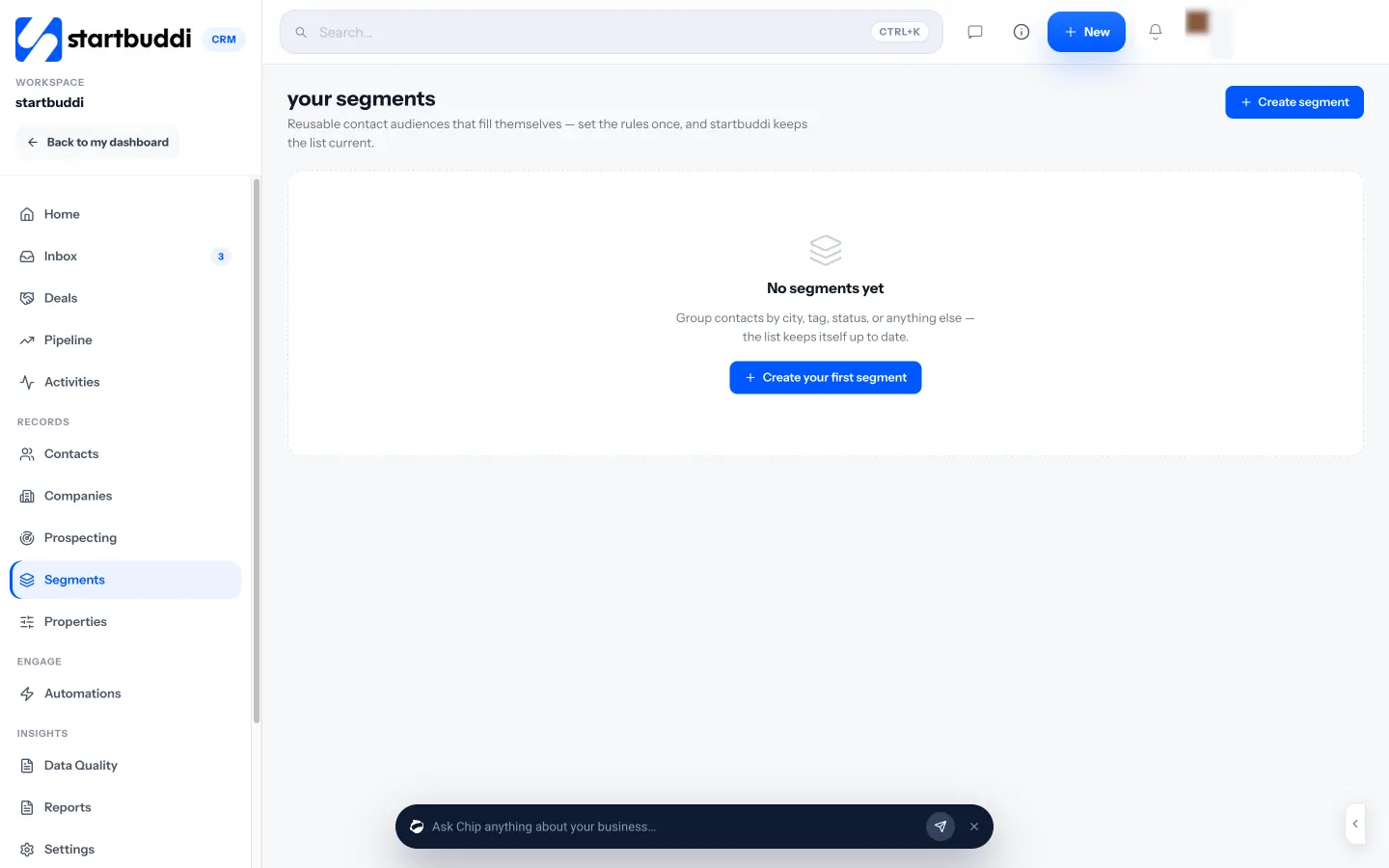
Find them. In Contacts, filter by “last contacted” (for example more than 90 days) and by lead status, then save the result as a segment so the list keeps itself up to date. Each contact also has a lead score from 0 to 100 based on activity, spend, recency and deals, which you can filter on.
Read the history. Each contact page shows notes, messages, deals and invoices on one timeline, so you can see where the lead stopped before you write.
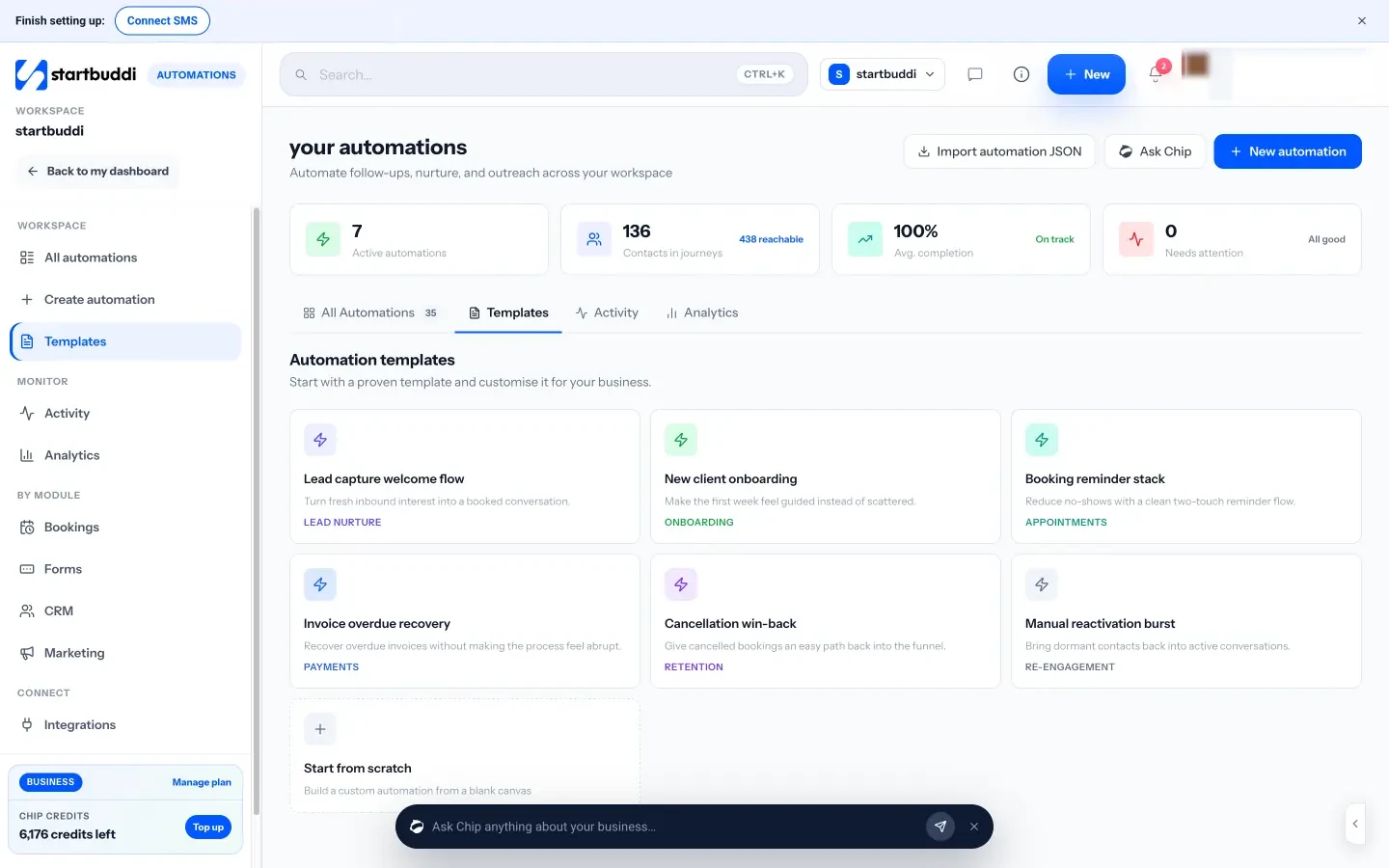
Automate the sequence. Automations include a “Manual reactivation burst” template for bringing dormant contacts back into conversation, a step that waits for the person to reply, and triggers for email opens and clicks. Before an automation goes live, startbuddi checks consent and reachability and shows how many contacts are suppressed. Email marketing needs the Starter plan or above, and Free includes 2 active automations against 10 on Starter.
Draft the messages. On a contact, “Nurture with Chip” drafts a short follow-up sequence from that person’s real history for you to edit before anything is sent.
Put replies back in the pipeline. Replies land in the shared inbox, and a reply moves the contact’s deal out of the first stage of the pipeline.
See pricing for what each plan includes. Every paid plan has a 30-day trial.
Your next step
Today, filter your CRM or spreadsheet for leads you last spoke to three to nine months ago. Pick the ten most promising, read their notes, and send each one a personal message using the templates above. Count the replies next week. Then decide whether to automate the rest.
Sources
- Oldroyd, McElheran and Elkington, “The Short Life of Online Sales Leads”, Harvard Business Review, March 2011
- ICO, Electronic mail marketing
- Google, Email sender guidelines
- FTC, CAN-SPAM Act: A Compliance Guide for Business
Frequently asked questions
Is it worth contacting leads after six months?
Often, yes. Many leads go quiet because of timing or budget, not because they said no. A specific, useful message about what they originally asked for can restart the conversation.
How many messages should a cold lead reactivation sequence have?
Usually three: a specific first message, one useful follow-up about a week later and a polite close a week after that. More than that starts to feel like spam.
Can I email old leads who never bought from me?
It depends on the law where you and they are and how you got their details. People who asked you for a quote may be covered; bought lists usually are not. Always include an easy opt-out.
What should I say to a cold lead?
Refer to what they originally asked for, offer something relevant or new, and ask one easy question such as whether the project is still on. Avoid guilt and generic check-ins.
SEO Copywriter| Email growth Specialist| I help businesses increase revenue with strategic SEO content & high-converting email funnels.