How to hire your first employee: a checklist
A step-by-step checklist to hire your first employee: know the true cost, define the role, get the legal basics right, choose well and onboard properly.


- Before you hire your first employee, check you can cover the full cost for six months and can describe the role clearly. Set up the legal basics for your country (contract, tax, pension, insurance), use a consistent interview and a short task, then give your hire a planned first two weeks and a proper probation review.
To hire your first employee, work through seven steps in order: confirm you can afford it, define the role, set up the legal and tax basics for your country, find the right person, make a written offer, plan their first weeks, and review their probation. The checklist below covers each step, with templates and the official places to check your obligations.
Your first hire is a big moment. It’s the point where your business stops being only you. Getting it right saves money, protects you legally, and sets the tone for every hire after. This guide is written for small business owners in Nigeria, the UK and elsewhere, so the legal section points you to the right official bodies rather than pretending one set of rules fits everyone.
This is general information, not legal or tax advice. Employment law changes, so check the official sources linked below or speak to a local adviser before you hire.
Are you ready to hire your first employee?
Hiring too early strains your cash. Hiring too late burns you out and loses you work. These signs suggest it’s time:
- You regularly turn down work or delay it because you don’t have the hours.
- You spend a big share of your week on tasks someone else could do well, such as admin, deliveries or customer replies.
- Customers are waiting longer for replies or services than they used to.
- You have steady income that could cover a salary for at least six months, even in a slow month.
- You can clearly describe what the person would do every day.
If you tick the first three but not the fourth, consider a freelancer or part-time help first. It’s a lower-risk way to test whether the work is really there.
Employee or freelancer?
The difference matters legally and financially. An employee usually works set hours under your direction, uses your equipment and is paid a regular salary. A freelancer or contractor runs their own business, controls how the work is done and invoices you. Calling someone a contractor when they work like an employee can leave you liable for tax and benefits you didn’t pay. The UK government’s guide to employing staff for the first time starts with exactly this check, and it’s a good question to ask wherever you are.
If freelance help is the right first step, our free freelance agreement template helps you set clear terms.
Hire first employee checklist: the whole process at a glance
| Stage | What to do | Done when |
|---|---|---|
| 1. Ready | Check workload, cash and the true cost of the role | You can pay the salary for six months |
| 2. Role | Write a job description and the first 90 days of work | Someone else could read it and understand the job |
| 3. Legal setup | Register as an employer, set up tax, pension and insurance | You know your monthly obligations and deadlines |
| 4. Find | Advertise, shortlist, interview and test | You have a preferred candidate and a backup |
| 5. Offer | Check references, send an offer letter and contract | Signed contract and start date |
| 6. Onboard | Prepare the first day and first two weeks | A checklist with owners and dates |
| 7. Review | Hold check-ins and a probation review | A clear decision at the end of probation |
Step 1: Work out the true cost of the role
Salary is only part of what an employee costs. Before you advertise, add up:
- Salary, plus any allowances you plan to pay, such as transport or housing.
- Employer contributions required where you are, such as pension and social insurance (see Step 3).
- Equipment: a laptop, phone, uniform or tools.
- Software and accounts: email, the tools they’ll use every day, and any extra seats.
- Recruitment costs: job adverts or agency fees.
- Your time: expect to spend hours each week training them in the first month.
Then check the minimum wage. In Nigeria, the National Minimum Wage (Amendment) Act 2024 raised the national minimum wage to ₦70,000 a month, though establishments with fewer than 25 employees are among those exempt. Even if you’re exempt, paying well below the market rate makes it hard to hire and keep good people. In the UK, check the current National Minimum Wage and National Living Wage rates.
Step 2: Define the role clearly
A vague role attracts vague candidates. Write a one-page job description that covers:
- Job title that people actually search for, such as “Office administrator” rather than “Operations ninja”.
- Why the role exists in one or two sentences.
- Main responsibilities, five to eight bullet points.
- Must-have skills and nice-to-haves, kept separate.
- Hours, location and whether remote work is possible.
- Pay range. Including it saves everyone time.
- How to apply and the closing date.
Then sketch what the person will do in their first 90 days. If you can’t fill that list, the role may not be ready yet.
Step 3: Get the legal and tax basics in place
It’s tempting to skip this step, and it’s the one that causes the most expensive problems later. The rules depend on your country. Here are the main points for Nigeria and the UK, with links to the official sources.
If you’re hiring in Nigeria
- Written terms: under section 7 of the Labour Act, workers covered by the Act must receive a written statement of their terms within three months of starting. It includes the nature of the job, pay and how it’s calculated, hours and notice periods. Giving a full written contract on day one is simpler and clearer.
- Pension: the Pension Reform Act 2014, regulated by PenCom, requires private employers with three or more employees to run the Contributory Pension Scheme. The minimum is 10% of monthly pay from the employer and 8% from the employee, paid into the employee’s retirement savings account. Rates have been under review, so confirm the current figures with PenCom.
- Employees’ compensation: under the Employee’s Compensation Act 2010, employers contribute at least 1% of their total monthly payroll to the fund managed by the Nigeria Social Insurance Trust Fund (NSITF). This is paid by the employer, not deducted from salaries.
- PAYE income tax: you deduct income tax from salaries and pay it to the tax authority of the state where the employee lives, for example the Lagos State Internal Revenue Service. Register as an employer with them before your first payday.
- Business registration: make sure your business itself is registered. See how to register a business name in Nigeria with CAC.
If you’re hiring in the UK
The government’s employing staff for the first time guide sets out the steps: check the person is an employee, check you can pay at least the minimum wage and your National Insurance and pension costs, make the workplace safe, register as an employer and set up PAYE with HMRC, set up a workplace pension, and get employers’ liability insurance. You also need to check the person has the right to work in the UK.
If you’re hiring elsewhere
Find your government’s small business or labour ministry guidance. In the US, for example, the Small Business Administration and the IRS both publish first-hire checklists covering tax forms and work eligibility checks.
Step 4: Find and choose the right person
Where to look
For a first hire, the best candidates often come from people you already know:
- Referrals from customers, suppliers and friends in business.
- Your own social media and WhatsApp status. Your followers already like what you do.
- Job boards popular in your country and industry.
- Local colleges and training programmes for junior roles.
How to interview
Use the same core questions for every candidate so you can compare fairly. Mix questions about past behaviour (“Tell me about a time you handled an angry customer”) with practical questions about the job.
Then add a short, realistic task: draft a reply to a customer complaint, organise a sample schedule, or fix a small spreadsheet. Keep it under two hours, and pay for anything longer. A task shows you far more than an interview answer.
Check references
Call at least one previous employer or client. Ask: “Would you work with them again?” and “What did they need support with?” The pause before the answer often tells you as much as the answer itself.
Step 5: Make the offer and sign the contract
Make the offer by phone or in person, then follow up in writing the same day. An offer letter should include the job title, start date, salary and how often it’s paid, working hours and place of work, probation period, notice period, and a date to accept by. Our free offer letter template covers the essentials.
Follow it with a written employment contract that matches your local rules. Keep a signed copy for your records and give one to the employee.
Step 6: Plan the first day and first two weeks
A new hire decides a lot about your business in their first week. Prepare before they arrive:
- Before day one: equipment ready, accounts and email set up, a welcome message sent with where to go and what time.
- Day one: a proper welcome, introductions to anyone they’ll work with, a walk through the tools, and a small task they can finish that day.
- Week one: shadowing, the key processes written down, and a short daily check-in.
- Week two: real work with support, and a review of how the first fortnight went.
Write down how things work, even briefly. A simple handbook answers the questions your new hire would otherwise ask you ten times a day. Our employee handbook template gives you a starting point, and we cover the first weeks in more depth in how to onboard a new team member.
Step 7: Check in often and review probation
Hold a short weekly one-to-one for the first three months. Ask what’s going well, what’s confusing, and what they need from you. Small problems caught in week three are easy to fix. The same problems in month five are much harder.
Before probation ends, hold a proper review against the goals you set in the 90-day plan. Decide clearly: confirm the role, extend probation with specific targets, or part ways. Our free performance review template helps keep the conversation fair and focused.
Common first-hire mistakes
- Hiring a friend without a contract. Friendships survive clear terms far better than vague ones.
- Hiring for “everything”. A role with no focus sets the person up to fail.
- Forgetting employer costs. Pension, insurance and taxes can add a meaningful amount on top of salary.
- No onboarding. “Just shadow me” isn’t a plan, especially when you’re too busy to be shadowed.
- Skipping probation reviews. If you don’t decide at the end of probation, you’ve decided by default.
How startbuddi helps
Once you’ve made your first hire, People in startbuddi gives you the HR basics without needing an HR department. It’s built for small teams, and it connects to the tasks, documents and chat you already use.
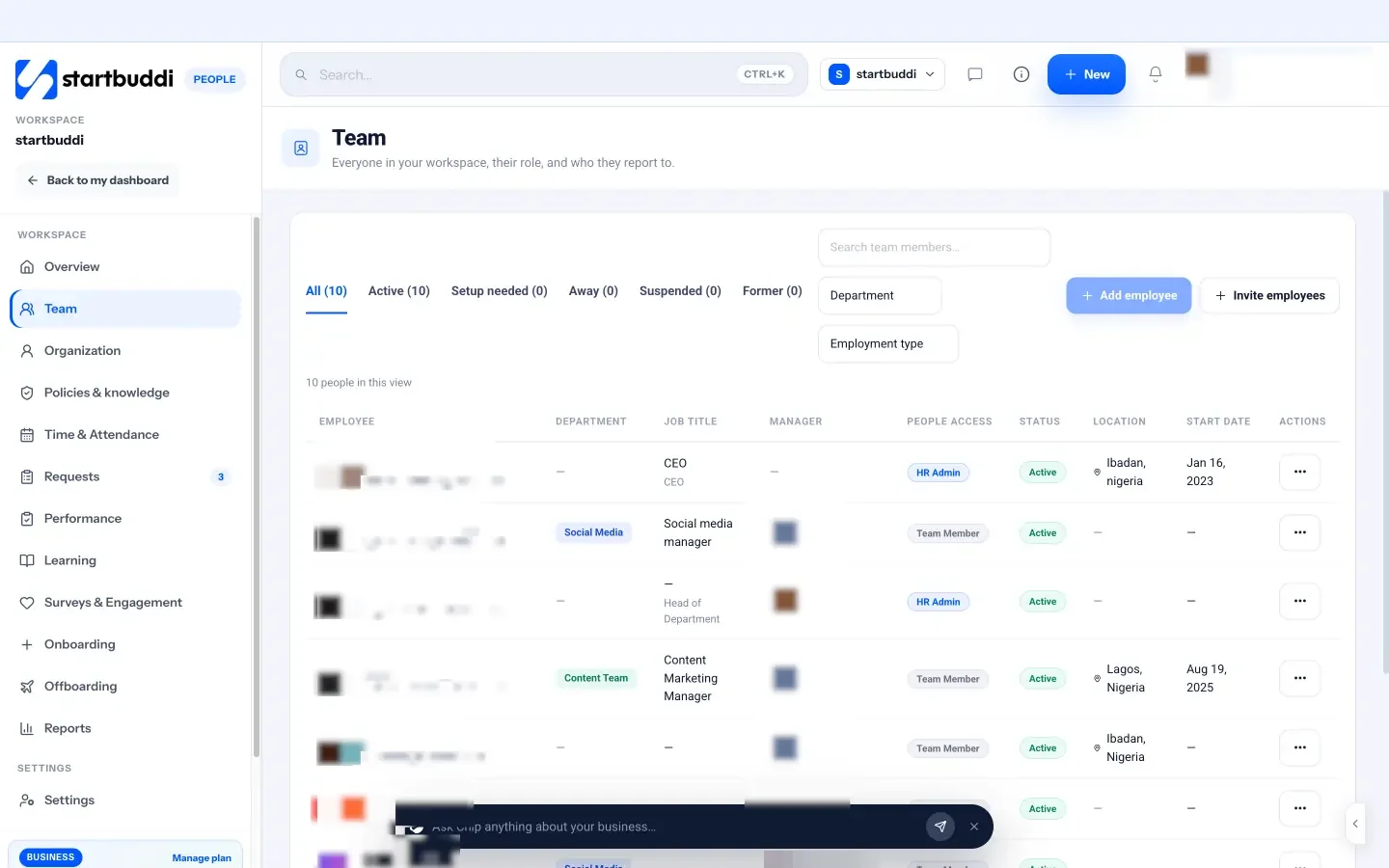
- A proper record for each person. Under People, then Team, add an employee with their job title, department, manager, employment type and start date. Each profile holds contact details, leave, reviews, documents and equipment.
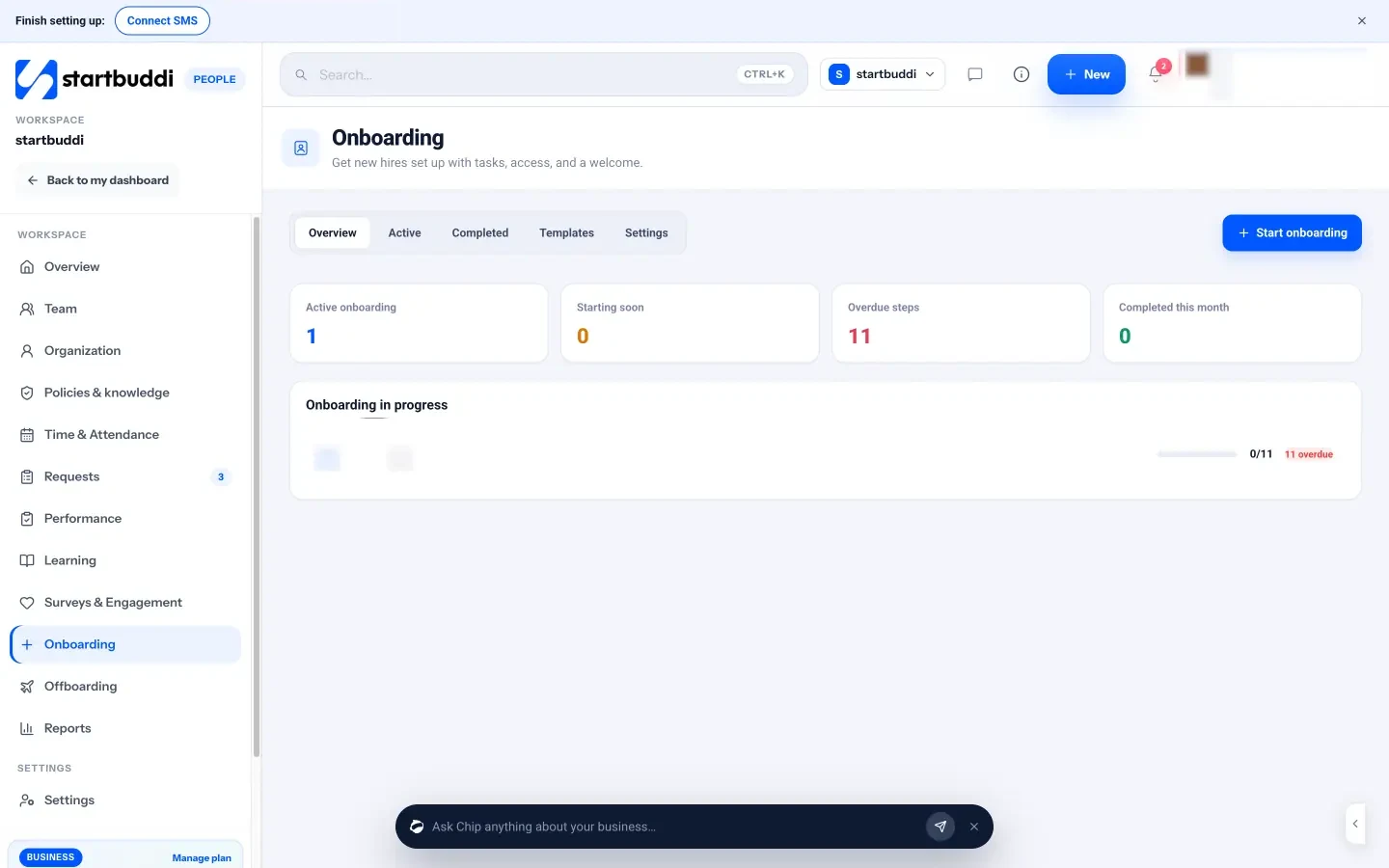
- Onboarding with a checklist. The onboarding wizard walks you through who’s joining, their employment details and a checklist, then notifies everyone who owns a step: the new hire, the manager, HR or IT. The built-in Company onboarding template covers equipment and accounts before day one, introductions on day one, and training and goals in the first fortnight.
- A handbook people actually read. Write your policies in Policies and knowledge, starting from templates, and ask employees to acknowledge the ones that need a sign-off.
- Time off without the back-and-forth. Staff request leave, see their balance, and requests go to the right approver.
- Chip HR. Ask Chip HR to draft a 30/60/90 plan for your new hire, which it saves as a draft in Documents, or to check what’s left on their onboarding. You confirm every change.
- Offer letters and contracts. Write them in Documents and send them for e-signature.
Two things to know. Inviting a teammate into your startbuddi workspace needs a paid plan with a seat for them. Starter includes 2 seats (yours and one more), Growth 5 and Scale 15. Every paid plan has a 30-day trial. And startbuddi doesn’t run payroll or file taxes, so you’ll still pay salaries and handle PAYE and pension remittances through your bank, accountant or a payroll provider.
Your next step
Write the one-page job description and the first 90 days of work for your first hire this week. If you can’t fill the 90 days, wait. If you can, check the official sources below for your legal steps, then start looking. When your new hire is ready to start, you can set up their onboarding in startbuddi; see the plans and pricing to choose the right number of seats.
Sources
- Labour Act (Cap L1, Laws of the Federation of Nigeria)
- National Pension Commission: Pension Reform Act 2014
- Nigeria Social Insurance Trust Fund: About
- M.J Numa and Partners: National Minimum Wage (Amendment) Act 2024 overview
- Lagos State Internal Revenue Service
- GOV.UK: Employing staff for the first time
- GOV.UK: National Minimum Wage and National Living Wage
- US Small Business Administration: Hire and manage employees
- IRS: Hiring employees
Frequently asked questions
How much money should I have before hiring my first employee?
Aim to cover at least six months of the role's full cost, including salary, employer contributions and equipment, without relying on new sales.
Do I need a written contract for my first employee?
It's strongly recommended everywhere, and often required. In Nigeria, the Labour Act requires written terms within three months for workers it covers.
Should my first hire be full-time?
Not necessarily. Part-time or freelance help is a lower-risk way to test whether there's enough work before committing to a full-time salary.
Does startbuddi handle payroll?
No. startbuddi keeps employee records, onboarding, leave and policies, but salaries, PAYE and pension payments are handled outside it.
Chinedu Kalu is the co-founder and chief operating officer of startbuddi, responsible for how the company runs day to day. Chinedu writes about the operational side of a small business: registering and running the company, money, hiring and the routines that keep a team on track.
Co-founded startbuddi and runs its operations