Withholding Tax (WHT): Definition, Examples and How It Works

Withholding tax (WHT) is income tax that the person paying you deducts from the payment and sends to the tax authority on your behalf. You receive the rest, plus a credit you can set against your own income tax. So what is withholding tax for a small business?
Withholding tax (WHT) is income tax that the person paying you deducts from the payment and sends to the tax authority on your behalf. You receive the rest, plus a credit you can set against your own income tax. So what is withholding tax for a small business? An advance payment of your tax, collected by your client.
Key takeaways
- WHT isn’t an extra tax. For a Nigerian business it’s usually an advance payment of income tax that you claim back against your final bill.
- In Nigeria, the duty to deduct is in section 51 of the Nigeria Tax Administration Act 2025, and the rates are set by regulations on deduction of tax at source.
- The payer deducts at the time of payment and must pay it over by the 21st of the following month, or face penalties.
- Keep every WHT receipt or credit note. Without proof, you can’t claim the credit.
- Plan cash flow for it: a client who withholds tax pays you less than the invoice total.
Why withholding tax matters for a small business
If you sell IT support, software or consulting to companies in Lagos or Abuja, many of your clients will deduct WHT before they pay you. Larger companies and government agencies tend to deduct it as a matter of routine.
That has two effects. First, cash: on a large invoice the amount withheld can be a meaningful sum you won’t see until you file your tax return. Second, paperwork: the credit is only worth something if you can prove it, so you need the client’s receipt for each deduction and a record that matches it to the invoice.
If you also pay suppliers, contractors or landlords, you may be the one who has to deduct and remit. Getting that wrong is expensive.
What is withholding tax under the Nigeria Tax Act 2025?
Nigeria’s tax reform laws were signed on 26 June 2025. The Nigeria Tax Act 2025 sets out what is taxed and applies from 1 January 2026, as the gazetted Act shows. The rules on collecting tax, including withholding, sit in the companion Nigeria Tax Administration Act 2025 (both checked on 1 October 2026).
How it works under those laws:
- The payer deducts. Section 51(1) of the Administration Act says that where a payment is made, the payer deducts tax “at the rate prescribed in regulations relating to deduction of tax at source”, when the payment is made or settled.
- The rate comes from regulations. The rates are in the regulations, not in the Act. Section 146 keeps earlier regulations in force where they don’t conflict with the new law, and the Joint Revenue Board’s Personal Income Tax Guidelines 2026 apply the Deduction of Tax at Source (Withholding) Regulations 2024. Check the current schedule for your type of payment.
- The payer remits and reports. Section 28 requires monthly returns. Under section 107, tax withheld but not paid over by the 21st day of the following month attracts the unpaid amount, a 10% yearly penalty and interest at the Central Bank of Nigeria’s monetary policy rate.
- The recipient claims the credit. The withheld amount counts towards the recipient’s income tax. For non-residents receiving dividends, interest, rent, royalties, directors’ fees or payments as entertainers and sportspersons, section 51(2) makes it the final tax.
A payer who fails to deduct at all faces an administrative penalty of 40% of the amount not deducted (section 105).
Who receives it depends on who is paid. The Nigeria Revenue Service (NRS, formerly FIRS) administers tax on companies and non-residents; tax withheld from payments to individuals and unincorporated businesses generally goes to the state tax authority, such as the Lagos State Internal Revenue Service.
An example with numbers
An IT support company in Lagos sends a bank client an invoice for ₦2,000,000 for installing a new office network. The figures and the rate are illustrative: suppose the rate that applies to this service is 5%.
| Amount | |
|---|---|
| Invoice (before VAT) | ₦2,000,000 |
| WHT deducted by the bank (5%) | ₦100,000 |
| Paid to the IT company | ₦1,900,000 |
| Paid by the bank to NRS, by 21 December if the bank paid in November | ₦100,000 |
At year end, the IT company works out its income tax as ₦300,000. It has receipts for ₦100,000 of WHT from this client and ₦60,000 from others, so it pays ₦140,000 (₦300,000 minus ₦160,000).
On the IT company’s books, the invoice is settled by ₦1,900,000 in cash plus ₦100,000 of tax credit. If it records only the cash, the invoice looks ₦100,000 short and sits in accounts receivable as if the client still owed it.
Common mistakes with withholding tax
- Chasing the client for the “missing” amount. Check whether it’s WHT before you send a reminder.
- Not asking for the receipt. Ask the client for the WHT receipt or credit note each time; it’s your proof.
- Not giving clients your Tax ID. Make sure your Tax ID is on your invoices and supplier forms.
- Forgetting you’re a payer too. Paying a contractor or rent can create a duty to deduct.
Related terms
- Invoice: the document WHT is calculated from.
- Accounts receivable: where an invoice sits until it’s fully settled, cash and credit together.
- Receipt: proof of payment, and the document you need for every deduction.
For how WHT sits alongside VAT and income tax, see our guide to small business taxes for beginners and our explainer on VAT for small businesses in Nigeria.
How startbuddi handles withholding tax
startbuddi isn’t accounting software and doesn’t file or remit tax. It helps you keep the invoice side tidy. When a client pays net of WHT, open the invoice in Money Manager, click Record payment, enter the amount that arrived, and add the WHT amount and the client’s receipt number in the note. The invoice shows as Partially paid, so you can see which balances are tax credits waiting on paperwork rather than real debts.
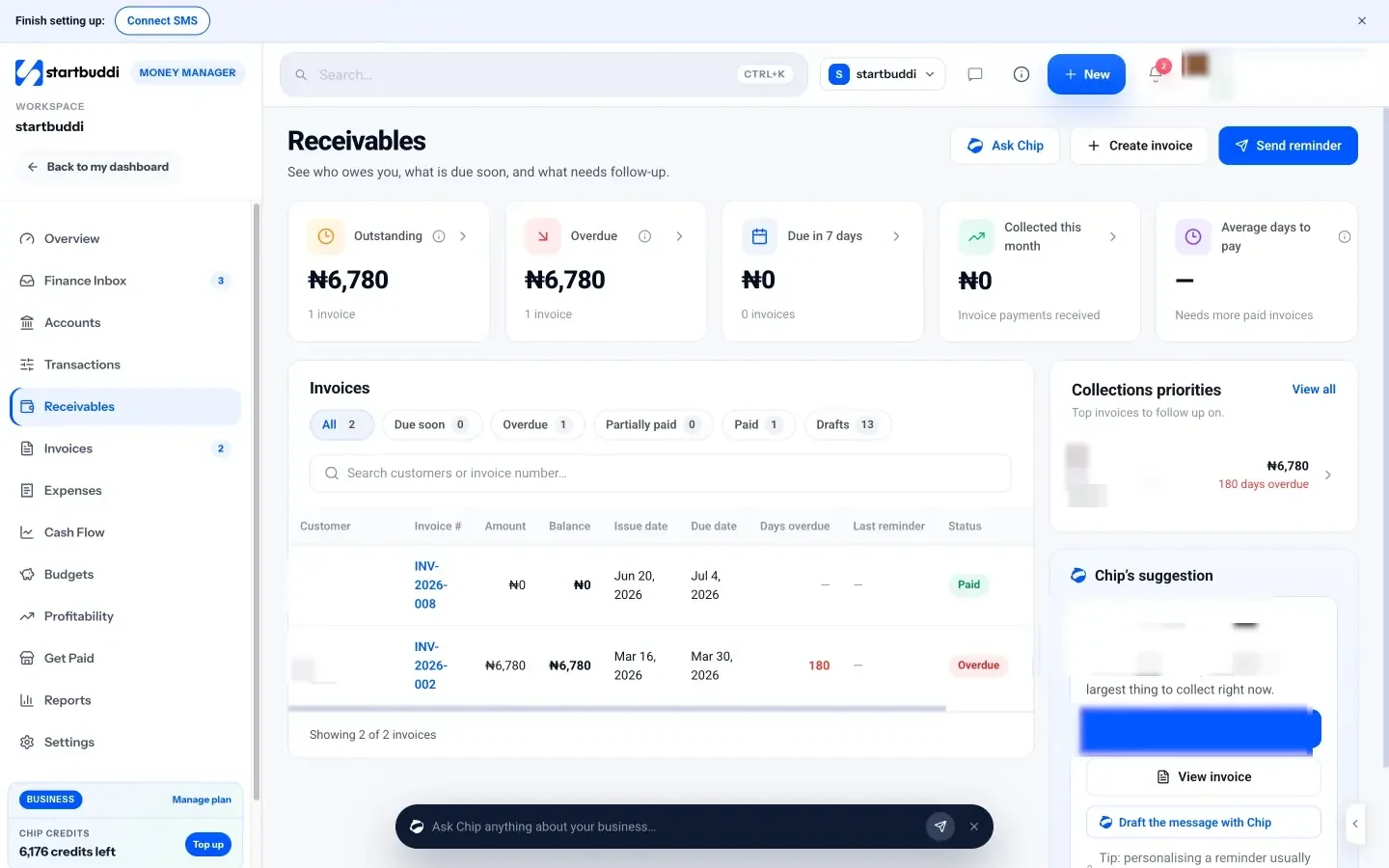
IT firms can see how invoices, projects and support work fit together on startbuddi for IT teams.
Keep your invoices and payments straight
Record what each client actually paid and see every open balance in one place. Start free with startbuddi, no card needed.
Withholding Tax (WHT) is part of Money Manager in startbuddi.
See Money ManagerRelated terms
FAQ
What is withholding tax in simple terms?
Withholding tax is tax your client takes out of a payment to you and sends to the tax authority for you. You receive the rest and a credit for the amount withheld. For most Nigerian businesses it's an advance payment of income tax, not an extra tax.
Who pays withholding tax in Nigeria?
The recipient bears it, but the payer deducts and remits it. Under section 51 of the Nigeria Tax Administration Act 2025, the person making the payment deducts tax at the rate set in the regulations. Companies' WHT goes to the Nigeria Revenue Service; tax withheld from individuals generally goes to their state tax authority.
When must withholding tax be remitted?
The Nigeria Tax Administration Act 2025 sets penalties for WHT not paid over by the 21st day of the month after it was deducted. Late payment attracts the unpaid tax, a 10% yearly penalty and interest at the Central Bank's monetary policy rate. Remitting by the 21st is the safe deadline.
Can I get withholding tax back?
You usually get it back as a credit against your income tax, not as cash from your client. Keep each WHT receipt or credit note and claim them on your tax return. For non-residents receiving certain payments, such as dividends, interest and royalties, the deduction is the final tax.
Is withholding tax the same as VAT?
No. VAT is a tax on what your customer buys, which you charge and pay over. WHT is part of your own income tax, collected early by the person who pays you. The two are separate on an invoice and in your records.
Chinedu Kalu is the co-founder and chief operating officer of startbuddi, responsible for how the company runs day to day. Chinedu writes about the operational side of a small business: registering and running the company, money, hiring and the routines that keep a team on track.
Co-founded startbuddi and runs its operations