VAT: Definition, Examples and How It Works

VAT (value added tax) is a tax on the sale of goods and services, charged at each step of the supply chain. A VAT-registered business adds VAT to its prices, deducts the VAT it paid on its own business purchases, and pays the difference to the tax authority. The final customer bears the cost.
So what is VAT for a small business day to day? It’s a line on your invoices, a record of the VAT you’ve paid suppliers, and a regular return. The rate, the registration threshold and the filing dates depend on your country.
Key takeaways
- VAT is charged on sales and collected by businesses for the government. It isn’t a tax on your profit.
- Output VAT is what you charge customers; input VAT is what you pay suppliers. You pay the difference.
- Nigeria charges 7.5%, the UK 20% as standard and Kenya 16%. Each has its own threshold and return dates.
- The US has no VAT. Sales tax is set by each state and charged mainly at the final sale.
- Only charge VAT if you’re registered or required to be. Check your country’s rules with the tax authority or an accountant.
Why VAT matters for a small business
VAT affects your prices, your cash and your paperwork. If you’re registered, a ₦1,000,000 job becomes ₦1,075,000 on the invoice in Nigeria, and the extra ₦75,000 isn’t yours: you’re holding it for the tax authority. Spend it and you’ll be short when the return is due.
For an IT services firm, VAT also matters on purchases. Laptops, servers and software licences usually carry VAT, and a registered business can normally deduct that input VAT from what it owes. Keeping the supplier invoices is what makes that possible, which is why VAT and bookkeeping go together.
How VAT works
VAT is collected in small pieces along the chain, so each business pays tax only on the value it adds.
- You buy goods or services and pay VAT to the supplier (input VAT).
- You sell and add VAT to your price (output VAT), shown on your invoice.
- You file a return for the period showing output VAT, input VAT and the difference.
- You pay the difference, or carry forward or claim back any excess where the rules allow.
What is VAT compared with sales tax?
Sales tax, used in the US, is usually charged once, at the final sale to the consumer. VAT is charged at every step, with each business deducting the VAT it paid. The customer ends up paying a similar percentage either way, but the paperwork is different: VAT businesses track input and output tax, while most sales tax sellers only collect at the point of sale.
VAT rates and rules in four countries
| Country | Tax and standard rate | Who must register | Returns |
|---|---|---|---|
| Nigeria | VAT, 7.5% | Businesses outside the small business exemption (see below) | Monthly, by the 21st of the following month |
| United Kingdom | VAT, 20% (5% reduced, 0% zero rate) | Taxable turnover over £90,000 in the last 12 months, or expected to go over it in the next 30 days | Usually every 3 months |
| Kenya | VAT, 16% | Taxable supplies of KSh 5 million or more a year | Monthly, by the 20th of the following month |
| United States | No VAT. State and local sales tax instead | Depends on the state | Depends on the state |
Sources, all checked on 1 October 2026: Nigeria’s Nigeria Tax Act 2025, section 147, sets VAT at 7.5%, and the Nigeria Tax Administration Act 2025 sets the 21st-day return and the small business exemption; the Nigeria Revenue Service (NRS, formerly FIRS) administers it. GOV.UK sets out the UK registration threshold. The Kenya Revenue Authority’s VAT page gives Kenya’s rate, threshold and due date. In the US, Texas, for example, charges a 6.25% state sales tax and lets local areas add up to 2%.
Nigeria’s small business exemption: a business with gross turnover of ₦100 million or less a year and fixed assets of no more than ₦250 million doesn’t have to register, charge VAT or file monthly returns, unless it opts in. Businesses providing professional services don’t count as small businesses, so many IT consultancies may still need to register. Our guide to VAT for small businesses in Nigeria explains the test in detail.
An example with numbers
These figures are illustrative.
Tunde runs a VAT-registered IT firm in Lagos. In October he buys laptops and licences for a client project, then bills the client for the equipment and setup.
| Before VAT | VAT at 7.5% | Total | |
|---|---|---|---|
| Bought from supplier (input VAT) | ₦1,000,000 | ₦75,000 | ₦1,075,000 |
| Sold to client (output VAT) | ₦2,000,000 | ₦150,000 | ₦2,150,000 |
| VAT to pay for October | ₦150,000 − ₦75,000 = ₦75,000 |
Tunde collects ₦150,000 of VAT from his client, deducts the ₦75,000 he paid his supplier, and pays ₦75,000 to the NRS by 21 November. His client, if VAT-registered, can deduct the ₦150,000 in turn. The VAT calculator does the adding and removing for any rate.
Common VAT mistakes
- Charging VAT when you’re not registered. Only registered businesses should add it.
- Spending the VAT you collect. Move it to a separate account when the client pays.
- Losing supplier invoices. No invoice, no input VAT deduction.
- Quoting without saying “plus VAT” or “including VAT”. It leads to arguments over the price.
- Assuming every country works the same. A UK client, a Kenyan client and a US client each need different treatment.
Related terms
- Invoice: where VAT is shown on its own line.
- Receipt: proof of a payment, including the VAT you paid.
- Bookkeeping: the records that make VAT returns possible.
How startbuddi handles VAT
startbuddi isn’t accounting software and doesn’t file VAT returns. In Money Manager you set a default tax rate and label (such as “VAT” at 7.5%) once in invoice settings, and every invoice and estimate shows the tax on its own line, calculated as you type. Reports includes a tax summary: a running total of the tax you’ve added to invoices, as a reference figure for your accountant, not a filing. Export CSV gives them the detail.
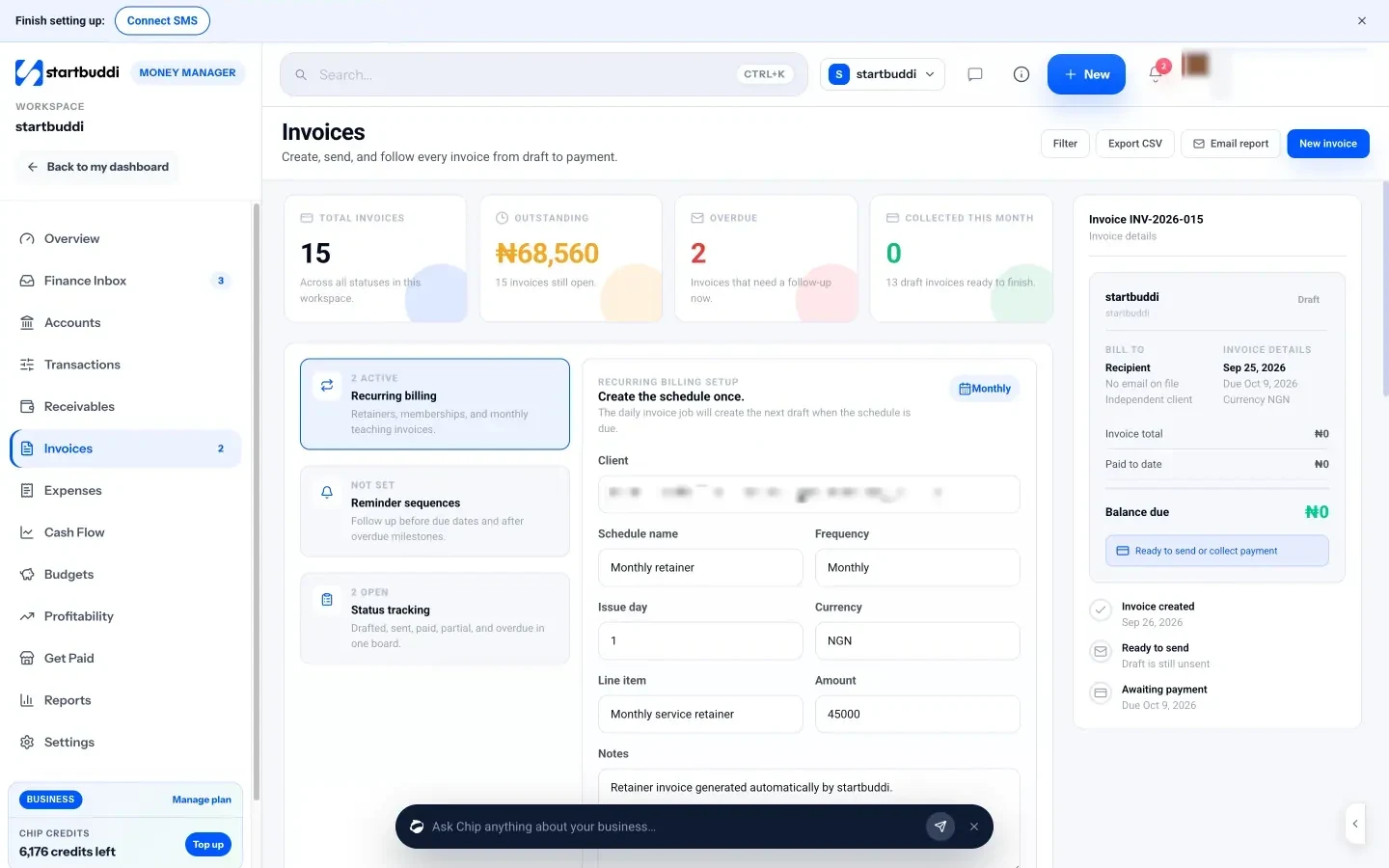
See invoices in Money Manager, our guide to small business taxes for beginners, or how startbuddi works for IT teams.
Put VAT on every invoice automatically
Set your tax rate once and every invoice shows VAT on its own line, with a running total for your accountant. Start free with startbuddi, no card needed.
Related terms
FAQ
What is VAT in simple terms?
VAT is a tax added to the price of most goods and services. Businesses that are registered collect it from customers, deduct the VAT they paid on their own purchases and pay the rest to the tax authority. The final consumer ends up paying it.
What is the VAT rate in Nigeria?
Nigeria's VAT rate is 7.5%, set by the Nigeria Tax Act 2025. Small businesses with turnover of ₦100 million or less and fixed assets of no more than ₦250 million are exempt from charging it, but businesses providing professional services don't qualify for that exemption.
Does the United States have VAT?
No. The US has no VAT. Instead, most states and many local areas charge sales tax, usually at the final sale to the consumer, at rates each state sets. A few states have no statewide sales tax.
What is the difference between input VAT and output VAT?
Output VAT is the VAT you charge your customers on sales. Input VAT is the VAT you pay suppliers on your business purchases. A registered business usually pays the tax authority the output VAT minus the input VAT.
Do I have to register for VAT?
It depends on your country and turnover. In the UK you must register once taxable turnover goes over £90,000 in 12 months; in Kenya at KSh 5 million a year; in Nigeria unless you qualify as a small business. Check with your tax authority or an accountant.
Chinedu Kalu is the co-founder and chief operating officer of startbuddi, responsible for how the company runs day to day. Chinedu writes about the operational side of a small business: registering and running the company, money, hiring and the routines that keep a team on track.
Co-founded startbuddi and runs its operations