Touchpoint: Definition, Examples and How It Works

A touchpoint is any moment when a customer interacts with your business, such as seeing your Instagram post, sending you a WhatsApp message, reading a quote, paying an invoice or getting a follow-up after the job. So what is touchpoint thinking in practice?
A touchpoint is any moment when a customer interacts with your business, such as seeing your Instagram post, sending you a WhatsApp message, reading a quote, paying an invoice or getting a follow-up after the job. So what is touchpoint thinking in practice? It means checking each of those moments, one by one, from the customer’s side.
Key takeaways
- A touchpoint is a specific interaction, not a channel. WhatsApp is a channel; “asking for a price on WhatsApp” is a touchpoint.
- Small businesses have fewer touchpoints than big brands, but each one carries more weight.
- The touchpoints people forget are the dull ones: the booking confirmation, the invoice and the message after the job.
- Map your touchpoints in order and look for where people drop off. That’s where to fix first.
Why touchpoints matter for a small business
Customers don’t judge you on your best moment. They judge you on the whole run of moments, and they remember the bad one. A brilliant haircut doesn’t make up for a booking request that sat unanswered for two days.
Thinking in touchpoints helps in three ways. It shows you where people stop, it tells you which small fix will pay off most, and it makes the experience consistent when a second person starts answering messages or doing jobs.
What is touchpoint vs channel?
Nielsen Norman Group, the user experience research firm, separates the two in its article on channels, devices and touchpoints (checked on 1 October 2026). It defines a channel as “the medium of interaction between a customer and an organization”, and a touchpoint as a specific interaction that includes the device, the channel and the task being done.
In plain terms:
| Term | What it is | Example |
|---|---|---|
| Channel | The route a customer uses to reach you | WhatsApp, email, your website, your shop |
| Device | What they use to get there | Phone, laptop |
| Touchpoint | One interaction, on a channel, to do a task | Asking for a price on WhatsApp from their phone |
The difference matters because one channel holds many touchpoints. Fixing “WhatsApp” is vague. Fixing “replying to price questions on WhatsApp within an hour” is something you can do this week.
How touchpoints work across the customer journey
Touchpoints sit inside the customer journey, the full path from first hearing about you to buying again. The UK government’s Service Manual guide to creating an experience map (checked on 1 October 2026) suggests pulling service touchpoints and channels out of your research at each stage, so you can see what people do, think and feel along the way.
A service business usually has touchpoints like these:
| Stage | Typical touchpoints |
|---|---|
| Discover | Instagram post, Google listing, a friend’s recommendation |
| Enquire | WhatsApp message, website form, phone call |
| Decide | Price list, quote, reviews, a call to talk it through |
| Buy | Booking confirmation, deposit request, invoice, payment |
| Receive | The job itself, reminders, updates on progress |
| After | Thank-you message, review request, check-in, rebooking offer |
Some touchpoints are yours to design (your quote, your reminder). Others you can only influence, such as a review on Google or a friend’s opinion.
An example with numbers
These numbers are illustrative. A cleaning company in Nairobi lists its touchpoints for 100 Instagram enquiries in a month and counts how many people get through each one:
| Touchpoint | People who reach it | Share of enquiries |
|---|---|---|
| Send an Instagram DM asking for a price | 100 | 100% |
| Get a reply within an hour | 70 | 70% |
| Receive a written quote | 50 | 50% |
| Book a clean | 20 | 20% |
| Get a check-in message after the clean | 20 | 20% |
| Leave a review | 6 | 6% |
The biggest drop is between the quote (50) and the booking (20): 30 people received a price and went quiet. The owner adds one touchpoint, a short follow-up two days after every quote. The next month, 28 of 50 quoted customers book, so bookings rise from 20% to 28% of enquiries with no extra marketing spend.
How to find your weakest touchpoints
- List every touchpoint in order, from first contact to after the job.
- For each one, write who handles it and how long it takes.
- Count how many people reach each step, even roughly.
- Read your messages as a customer would: are they clear, quick and friendly?
- Fix the biggest drop first, then measure again a month later.
Asking customers directly helps too. A simple Net Promoter Score question after the job tells you whether the whole run of touchpoints worked.
Related terms
- Customer journey: the full path that touchpoints sit inside.
- Sales funnel: the stages from interest to sale, usually measured by how many people reach each one.
- Net Promoter Score: a one-question survey of how likely customers are to recommend you.
For a deeper look at how customers decide, read our article on the customer decision journey, and for the service side, our guide to customer service for small business.
How startbuddi handles touchpoints
startbuddi keeps a record of the touchpoints that happen inside it, on the customer’s contact page:
- Messages: WhatsApp, email, Instagram, Facebook, SMS and website chat land in one shared Inbox, so a reply on any channel is part of the same history.
- Forms and bookings: a form submission or a booking creates or updates the contact, so you can see how they first got in touch.
- Activity: calls, meetings, notes and tasks your team logs show on the contact’s timeline, alongside deals and invoices.
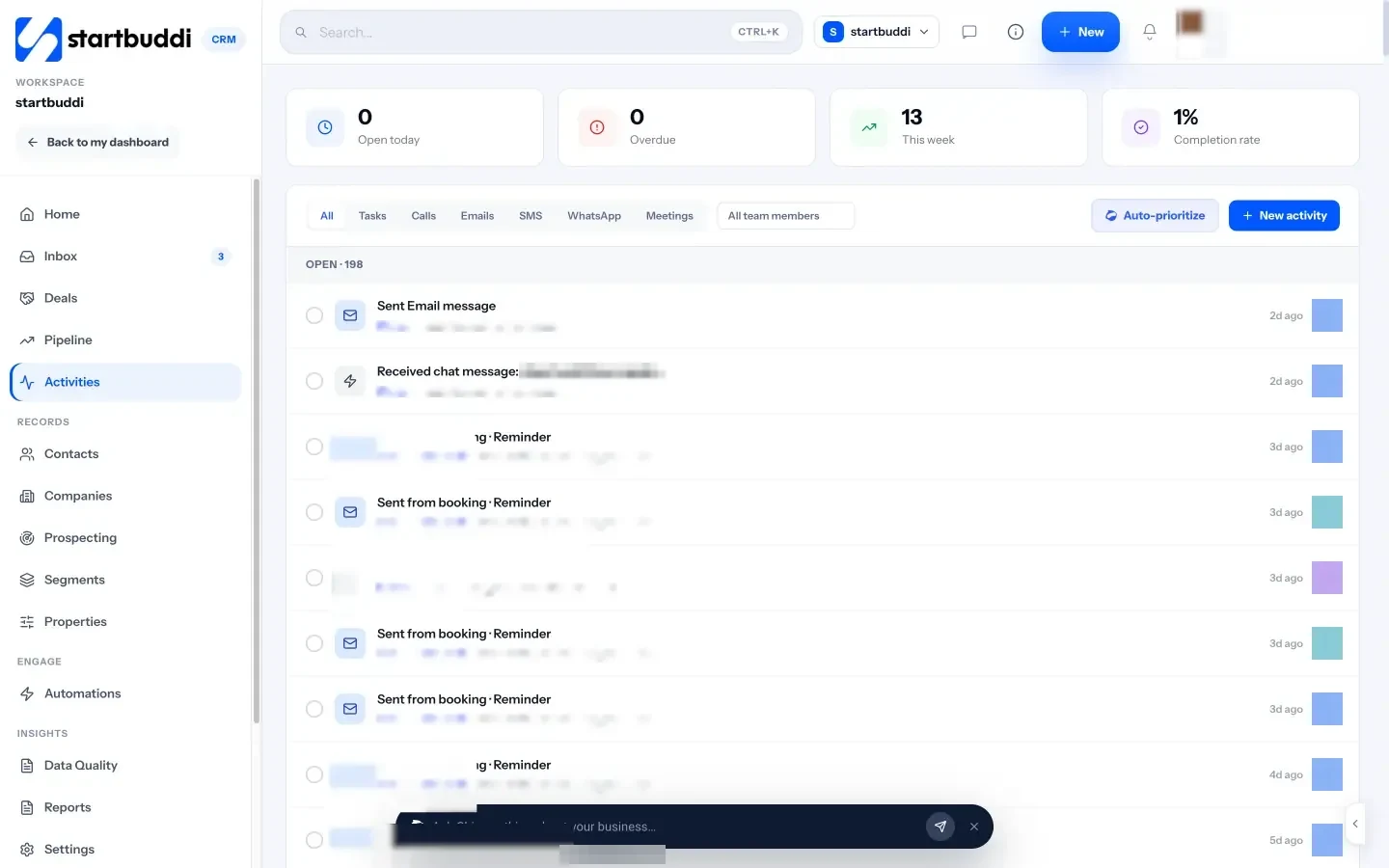
Touchpoints outside the app, such as a chat in your shop, only appear if someone logs them. A free plan is available; see pricing.
Related terms
FAQ
What is a touchpoint in simple words?
A touchpoint is any moment a customer deals with your business, before, during or after buying. It could be a post they see, a message they send, a quote they read or a thank-you they receive. Each one shapes how they feel about you.
What are examples of customer touchpoints?
Common customer touchpoints for a service business are social media posts, Google listings, enquiry messages, quotes, booking confirmations, reminders, the service itself, invoices, receipts and follow-up messages. Word of mouth and online reviews are touchpoints too, even though you don't control them.
What is the difference between a touchpoint and a channel?
A channel is the route a customer uses, such as WhatsApp or email. A touchpoint is one specific interaction on that route, such as asking for a price on WhatsApp. One channel usually carries many touchpoints, and each can be good or bad on its own.
How many touchpoints does it take to make a sale?
There's no fixed number; it depends on the price and how well the customer already knows you. A repeat customer may book after a single message, while a new client for a large job may need several conversations, a quote and reviews before deciding. Count your own by looking at recent sales.
Tiwalade Joanna Okedara-Kalu is the founder, CEO and CTO of startbuddi, the business system that brings clients, bookings, invoices, projects, marketing and the Chip AI assistant into one place. Tiwalade builds software around how service businesses really work day to day, and writes about client management, getting paid on time and why small businesses outgrow the tools they start with.
Founded startbuddi and leads its product and engineering