Recurring Appointment: Definition, Examples and How It Works

A recurring appointment is an appointment that repeats on a fixed pattern, such as every Tuesday at 10:00 or the first Monday of each month, so the client keeps the same slot without booking each time. So what is recurring appointment scheduling worth to a small business?
A recurring appointment is an appointment that repeats on a fixed pattern, such as every Tuesday at 10:00 or the first Monday of each month, so the client keeps the same slot without booking each time. So what is recurring appointment scheduling worth to a small business? Predictable work, steadier income and clients who are less likely to drift away.
Key takeaways
- A recurring appointment has two parts: a pattern (how often) and a range (when it ends, or how many times it repeats).
- Weekly, fortnightly and monthly patterns cover most service businesses.
- Each occurrence can usually be moved or cancelled on its own without breaking the rest of the series.
- Regular slots fill your calendar in advance but also take slots away from new clients, so cap how many you offer.
- Pair recurring appointments with recurring billing, so the money is as regular as the work.
Why recurring appointments matter for a small business
Most service businesses earn more from repeat clients than from one-off visits. A physiotherapist’s patient comes weekly for six weeks. A cleaner visits every Friday. An IT support company checks a client’s backups and updates on the first Monday of every month. Each of these is a recurring appointment, whether or not anyone calls it that.
Fixing the slot in advance means the client doesn’t have to remember to book, and you can see income coming. Regular slots also turn one-off clients into recurring revenue, which is easier to plan around than whatever this week’s enquiries bring.
What is recurring appointment scheduling and how does it work?
Pattern and range
Calendar software describes a repeat in two parts. Microsoft’s developer guide to scheduling recurring events in Outlook (checked on 1 October 2026) calls them the recurrence pattern, meaning how often it repeats, and the recurrence range, meaning for how long. “Every Thursday” is a pattern; “until 31 March” or “for 10 sessions” is a range.
Common patterns
| Pattern | Typical use |
|---|---|
| Every week, same day and time | Physiotherapy, tutoring, cleaning, coaching |
| Every two weeks | Hair maintenance, therapy, account reviews |
| Same date or weekday each month | IT maintenance visits, bookkeeping catch-ups, retainer check-ins |
| Every few months | Equipment servicing, dental hygiene, HVAC checks |
Changing one occurrence or the whole series
Clients go on holiday and public holidays fall on Mondays. Most calendars let you move or cancel one occurrence and leave the rest alone, or change every future one at once. Google Calendar’s help on repeating events (checked on 1 October 2026) asks which events in the series a change applies to, and notes a limit of 730 occurrences for a repeating event.
Ending a series
Open-ended series cause problems: a client stops coming but their slot stays blocked for months. Give each series an end date or a set number of sessions, then renew it when you review the client.
Example: recurring appointments with real numbers
An IT support company in Lagos offers small offices a monthly on-site check: backups, updates and a security review, two hours each. It has one engineer working 20 days a month with room for three two-hour visits a day. These figures are illustrative.
| Item | Figure |
|---|---|
| Slots available a month | 20 days × 3 = 60 |
| Monthly clients on a recurring visit | 25 |
| Slots used by recurring visits | 25 (42% of capacity) |
| Price per visit | ₦60,000 |
| Recurring revenue a month | 25 × ₦60,000 = ₦1,500,000 |
| Slots left for one-off call-outs | 35 |
Recurring visits bring in ₦1,500,000 a month before the first emergency call-out. The company still keeps 35 slots for new clients and urgent jobs. If recurring visits grew past about two thirds of capacity, it would struggle to respond to emergencies, which is usually the point to hire a second engineer.
Common mistakes with recurring appointments
- No end date. Series keep running after a client has stopped coming. Review them every quarter.
- Not confirming each occurrence. Regular clients forget too. A reminder before every visit cuts the risk of a no-show appointment.
- Giving away every prime slot. If all your Saturday mornings are recurring, new clients can’t get in.
- Forgetting public holidays. Move those occurrences in advance, not on the morning.
- Clashes after a change. Moving one session into a slot that’s already taken creates a double booking. Check before you move.
How startbuddi handles recurring appointments
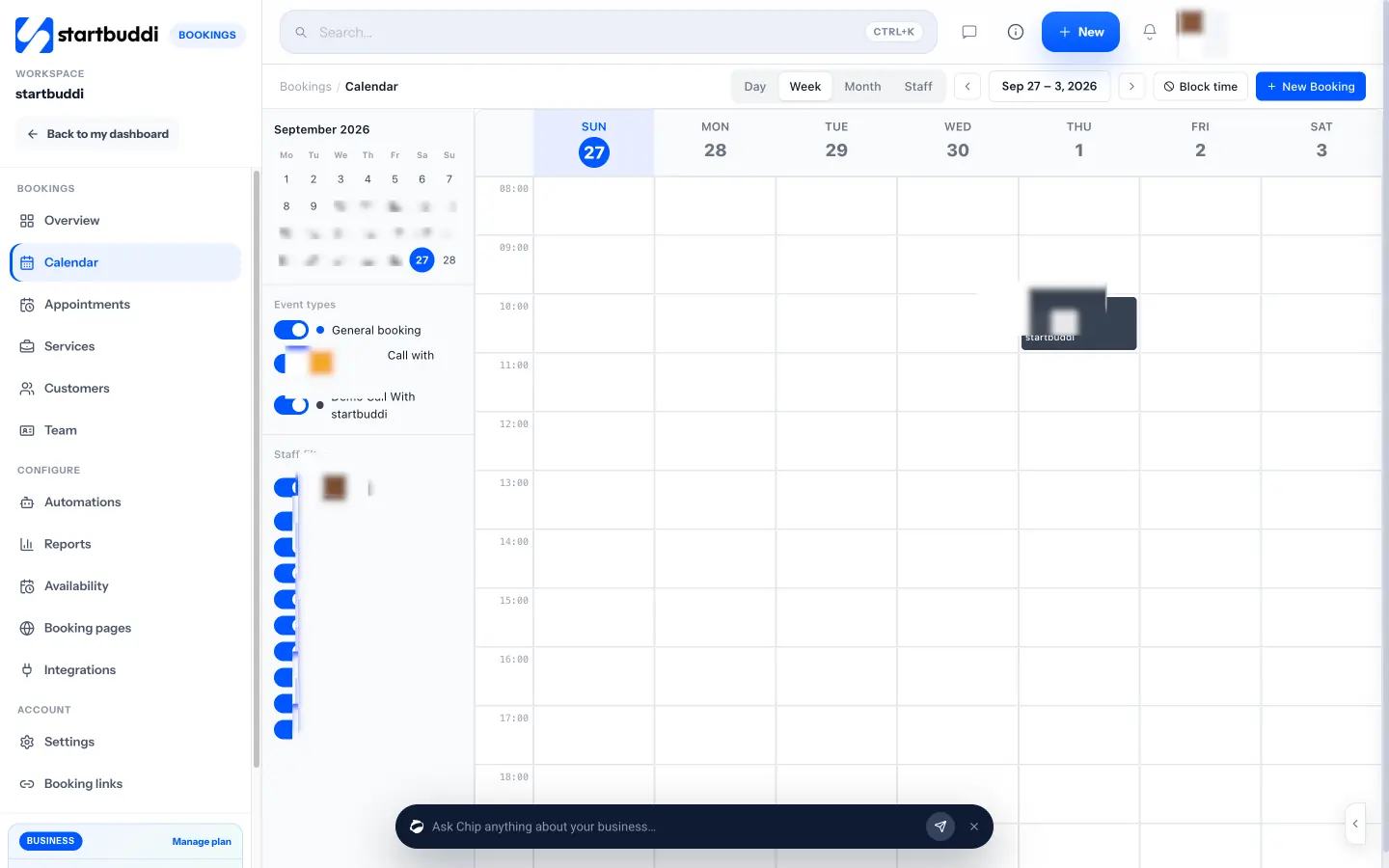
startbuddi Bookings doesn’t create a repeating series automatically today. Each session is its own booking, which keeps reminders, payments, no-show tracking and notes separate for every visit. For regular clients, these steps keep things simple:
- Book the next session before the client leaves. Open Bookings and click New Booking, pick the client, service, staff member, date and time, and click Create booking. The client gets an email with the details and a calendar invite. startbuddi checks the slot against your other bookings and blocked time.
- Let clients book their own next slot. After booking online, clients see a Book another time option, and your booking page is always there for the next visit. Our guide on how to create a booking page covers the setup.
- Bill regularly. In Money Manager, set up recurring invoicing for clients you invoice on a schedule, or use Subscriptions in Get Paid to charge a plan monthly or yearly. See subscriptions in startbuddi.
- Keep the visit checklist on repeat. In Work, create the task for the visit with its checklist as subtasks and set it to repeat, so the same steps come back every month.
A free plan is available. See pricing, how startbuddi Bookings works, or startbuddi for IT teams.
Related terms
FAQ
What is a recurring appointment?
A recurring appointment is one that repeats on a set pattern, such as weekly, every two weeks or monthly, at the same time. The client keeps a regular slot instead of booking each visit separately. Each repeat is called an occurrence.
What is the difference between a recurring appointment and a follow-up appointment?
A recurring appointment repeats on a fixed pattern decided in advance. A follow-up appointment is booked once, usually after the first visit, to check progress or finish work. Several follow-ups in a row can become a recurring series if they settle into a pattern.
Can I change one recurring appointment without changing the rest?
In most calendars, yes. When you edit or cancel an occurrence, you're asked whether the change applies to that one event, to that and all following events, or to the whole series. Choose carefully, especially when changing the time.
How do I stop a recurring appointment?
Edit the series and set an end date, or delete the remaining occurrences. Tell the client first, and cancel any linked recurring invoice or subscription so they aren't charged for visits that won't happen.
Are recurring appointments good for small businesses?
Yes, for services clients need regularly. They make income more predictable and reduce the time spent arranging bookings. Keep some slots free for new clients and urgent work, and review recurring series regularly so inactive clients don't block your calendar.
Tiwalade Joanna Okedara-Kalu is the founder, CEO and CTO of startbuddi, the business system that brings clients, bookings, invoices, projects, marketing and the Chip AI assistant into one place. Tiwalade builds software around how service businesses really work day to day, and writes about client management, getting paid on time and why small businesses outgrow the tools they start with.
Founded startbuddi and leads its product and engineering