Double Booking: Definition, Examples and How It Works

Double booking is when two appointments are accepted for the same person, room or piece of equipment at overlapping times, so one of them can't happen as promised. So what is double booking in a small business?
Double booking is when two appointments are accepted for the same person, room or piece of equipment at overlapping times, so one of them can’t happen as promised. So what is double booking in a small business? Usually an accident: two diaries, two people taking bookings, or an online booking for a slot you just agreed by phone.
Key takeaways
- Double booking almost always comes from having more than one place where bookings are taken or recorded.
- It’s different from deliberate overbooking, where a business accepts more bookings than capacity on purpose because it expects some no-shows.
- The cost isn’t just one rescheduled client: it’s the time spent apologising and the trust lost.
- One shared booking calendar that checks every new booking against existing ones is the main fix.
- Buffers and blocked time stop “near misses” where bookings don’t overlap but still can’t both be kept.
Why double booking matters for a small business
For a one-person business, a double booking means letting someone down. For a team, it means two clients expecting the same engineer, or two engineers turning up at one client while another waits. Either way, somebody gave up their time for a slot that didn’t exist.
The person who gets moved remembers it, and some won’t rebook. That’s a lost client, not a lost hour.
What is double booking usually caused by?
Several places to book
The most common cause. Bookings arrive by WhatsApp, phone, email, Instagram and a website, and each is written down somewhere different. If you’ve relied on manual scheduling, you’ve probably seen this happen.
Calendars that don’t talk to each other
A personal calendar, a work calendar and a booking tool can each look free while another is full. Google’s help page on appointment schedules (checked on 1 October 2026) has a “check calendars for availability” option for this reason, and notes that by default it doesn’t check co-hosts’ availability.
Several people taking bookings
Two receptionists, or an owner and an assistant, can each accept the 10:00 slot within minutes of each other if they work from separate lists.
Ignoring travel and wrap-up time
Bookings at 10:00 to 11:00 and 11:00 to 12:00 don’t overlap on paper. If the second is across town, they clash in practice. Buffer time exists to prevent this.
Double booking vs overbooking
| Double booking | Overbooking | |
|---|---|---|
| Intentional? | No, it’s a mistake | Yes, a deliberate policy |
| Why it happens | Separate calendars, manual entry, no checks | Expecting some customers not to turn up |
| Typical setting | Service businesses, consultants, clinics | Airlines, hotels, some clinics with high no-show rates |
| Result when it goes wrong | Two clients for one slot | More customers turn up than there is room for |
Small service businesses should almost never overbook on purpose. Dealing with a no-show appointment through deposits, reminders and a clear policy is safer than gambling on one.
Example: what double booking costs, with numbers
An IT support company in Accra runs on-site visits at GH₵ 600 each. Bookings come in by WhatsApp to the owner and by phone to an office assistant, written in two diaries. These figures are illustrative.
| Item | Per clash |
|---|---|
| Time spent calling, apologising and rearranging | about 30 minutes of the owner’s time |
| Engineer time lost if both clients are visited late | about 1 hour |
| Chance the moved client never rebooks | 1 in 4, say |
| Expected lost revenue from that client (GH₵ 600 × 4 visits a year × 1 in 4) | GH₵ 600 |
At one clash a week, that’s about 26 hours of the owner’s time a year (52 × 30 minutes) and around GH₵ 31,200 a year of expected lost repeat business (52 × GH₵ 600), before counting the engineer’s lost hours. Even if your real numbers are half of that, one shared calendar is cheap by comparison.
How to avoid double booking
- Take every booking in one calendar. Phone and WhatsApp bookings should be entered into the same system clients book online.
- Let the system check, not people. A booking tool should refuse a slot that overlaps another booking.
- Add buffers for travel and wrap-up, so back-to-back slots don’t clash in practice.
- Block your own time (lunch, school runs, holidays) so it isn’t offered.
- Share bookings across a team automatically. Round robin scheduling assigns each booking to an available person, rather than two people grabbing the same one.
Microsoft’s guide to service availability in Microsoft Bookings (checked on 1 October 2026) describes the same principle: making a service bookable only when its staff are free helps avoid double-booking.
How startbuddi handles double booking
startbuddi Bookings gives you one calendar for bookings from your booking page and the ones you add yourself. Before a booking is saved, startbuddi checks the slot against your other startbuddi bookings and blocked time, including any buffer after events, and only offers free times on your booking page. If you add a booking with New Booking and it overlaps, you’re told that time is already booked, as the help article on creating a booking for a client explains.
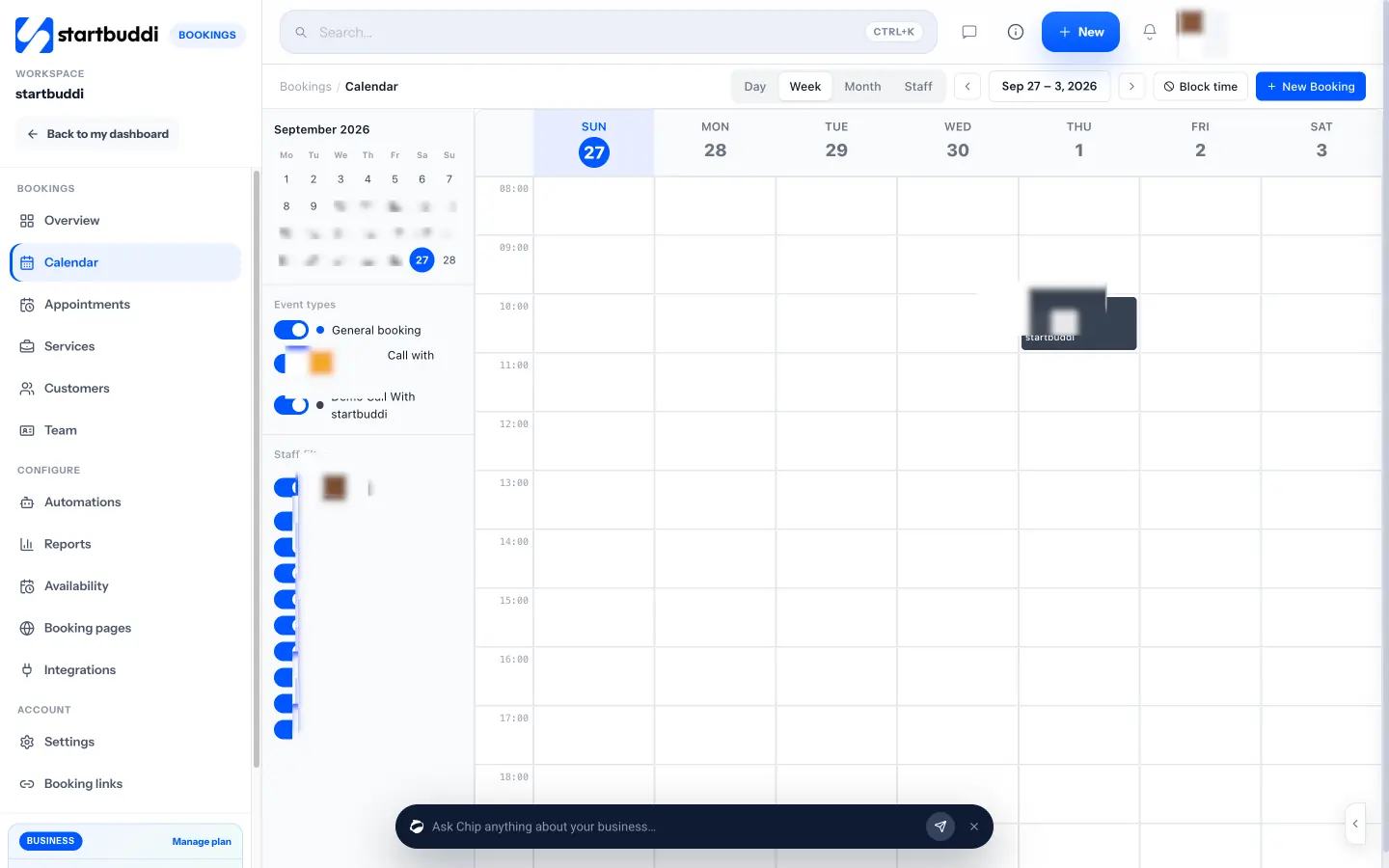
Use Block time on the Calendar for lunch, team meetings, holidays or training, either for everyone or for one person. While a client pays a deposit, their slot is held for 30 minutes so nobody else can take it.
One honest limit: calendar sync is one way. startbuddi adds your bookings to Google Calendar, but it doesn’t read other events from it, so personal appointments in Google Calendar won’t block slots. Block that time in Bookings instead.
A free plan is available. See pricing, how startbuddi Bookings works, or startbuddi for IT teams.
Related terms
FAQ
What does double booked mean?
Double booked means two appointments have been accepted for the same person, room or resource at overlapping times. One of them can't go ahead as planned, so someone has to be moved or kept waiting. It's usually a mistake caused by separate calendars or several people taking bookings.
Is double booking the same as overbooking?
No. Double booking is an accident, while overbooking is a deliberate choice to accept more bookings than capacity, usually because some customers are expected not to show up. Airlines and hotels overbook on purpose; most small service businesses shouldn't.
How do I stop double bookings in my business?
Take every booking, including phone and WhatsApp ones, in one booking calendar that checks for overlaps automatically. Add buffer time for travel and wrap-up, block your personal time, and let the system assign team bookings. Then stop keeping a second diary.
Can Google Calendar prevent double booking?
Google Calendar's appointment schedules can check your calendar for conflicts before offering times, though some features need a paid Google Workspace or Google One plan. It works best if every booking ends up in that same calendar. If you take bookings elsewhere, those still need to be added or blocked.
Tiwalade Joanna Okedara-Kalu is the founder, CEO and CTO of startbuddi, the business system that brings clients, bookings, invoices, projects, marketing and the Chip AI assistant into one place. Tiwalade builds software around how service businesses really work day to day, and writes about client management, getting paid on time and why small businesses outgrow the tools they start with.
Founded startbuddi and leads its product and engineering