Omnichannel: Definition, Examples and How It Works

What is omnichannel? Omnichannel means giving customers one connected experience across WhatsApp, email, phone, your website and your shop, so their history carries over when they switch. They deal with one business instead of five separate inboxes, and never have to repeat themselves.
Key takeaways
- Multichannel means you’re on several channels. Omnichannel means those channels share one customer record and one conversation history.
- For a small business, the practical version is one shared inbox plus one contact record per customer.
- The test is simple: can whoever replies see what the customer already said on another channel?
- Each channel keeps its own rules, such as WhatsApp’s 24-hour window, so an omnichannel setup has to respect them.
What is omnichannel in plain terms?
The word started in retail. Cambridge Dictionary defines omnichannel as a way of selling that is the same and equally good whether the customer buys online, in an app or in a physical shop (checked on 1 October 2026). Service businesses use it more broadly: every way a customer can contact you, ask a question, book or pay should feel like one relationship.
Picture a client of an IT support firm in Accra. She emails on Monday about a slow server, sends a WhatsApp voice note on Tuesday asking for an update, and calls on Wednesday. In a multichannel business, three different people see three fragments. In an omnichannel business, whoever picks up the call sees the email and the voice note on her record and says, “We replaced the drive yesterday; is it faster now?”
Omnichannel vs multichannel
| Multichannel | Omnichannel | |
|---|---|---|
| Channels | Several, run separately | Several, connected |
| Customer history | Split across apps and phones | One record per customer |
| Who replies | Whoever owns that channel | Anyone on the team, with full context |
| Switching channels | Customer repeats themselves | Conversation continues |
| Typical tools | WhatsApp on one phone, Gmail, Instagram app | Shared inbox linked to a contact list |
Most small businesses start multichannel by accident: a WhatsApp Business number on the owner’s phone, a Gmail address, an Instagram page. Omnichannel is the step of pulling those into one place.
How omnichannel works
Three pieces have to be in place.
- One inbox. Messages from every channel land in one list your team can see and assign.
- One customer record. Each message is matched to a contact, so their past emails, chats, bookings and invoices sit together. This is what lets you follow the whole customer journey rather than a single chat.
- Channel rules respected. Channels behave differently. Meta’s WhatsApp Cloud API documentation explains that a 24-hour customer service window opens when a customer messages you, and once it closes you can only send pre-approved template messages (checked on 1 October 2026). An omnichannel setup should show you when that window has closed and let you reply by email instead. The WhatsApp Business API entry covers those rules in more detail.
Example: an omnichannel inbox in numbers
A four-person IT services firm in Lagos counts its enquiries for one month. The figures are illustrative.
| Channel | Enquiries |
|---|---|
| 70 | |
| Instagram DMs | 25 |
| 15 | |
| Website chat | 10 |
| Total | 120 |
When the team matches enquiries to contacts, it finds 18 of the 120 came from customers who had already written on another channel, which is 15%. Before the change, each of those 18 risked two people replying, or nobody replying because each assumed the other had. With one inbox and one record per customer, those 18 become 18 single threads, and the owner stops checking four apps on four devices.
If the firm also tracks customer satisfaction score after each resolved enquiry, it can compare CSAT before and after the switch to see whether customers noticed.
Common mistakes with omnichannel
- Adding channels before connecting them. A TikTok inbox nobody checks is worse than no TikTok inbox.
- Keeping WhatsApp on one person’s phone. When that person is off, the most-used channel goes dark.
- No owner per conversation. Shared visibility without assignment means everyone reads and nobody replies.
- Forgetting the customer’s preferred channel. Reply where they wrote unless there’s a reason not to, such as a closed WhatsApp window.
For how channels feed your lead list, see how CRMs handle multi-channel lead tracking, and for adding chat to your site, our guide to live chat for small business.
How startbuddi handles omnichannel
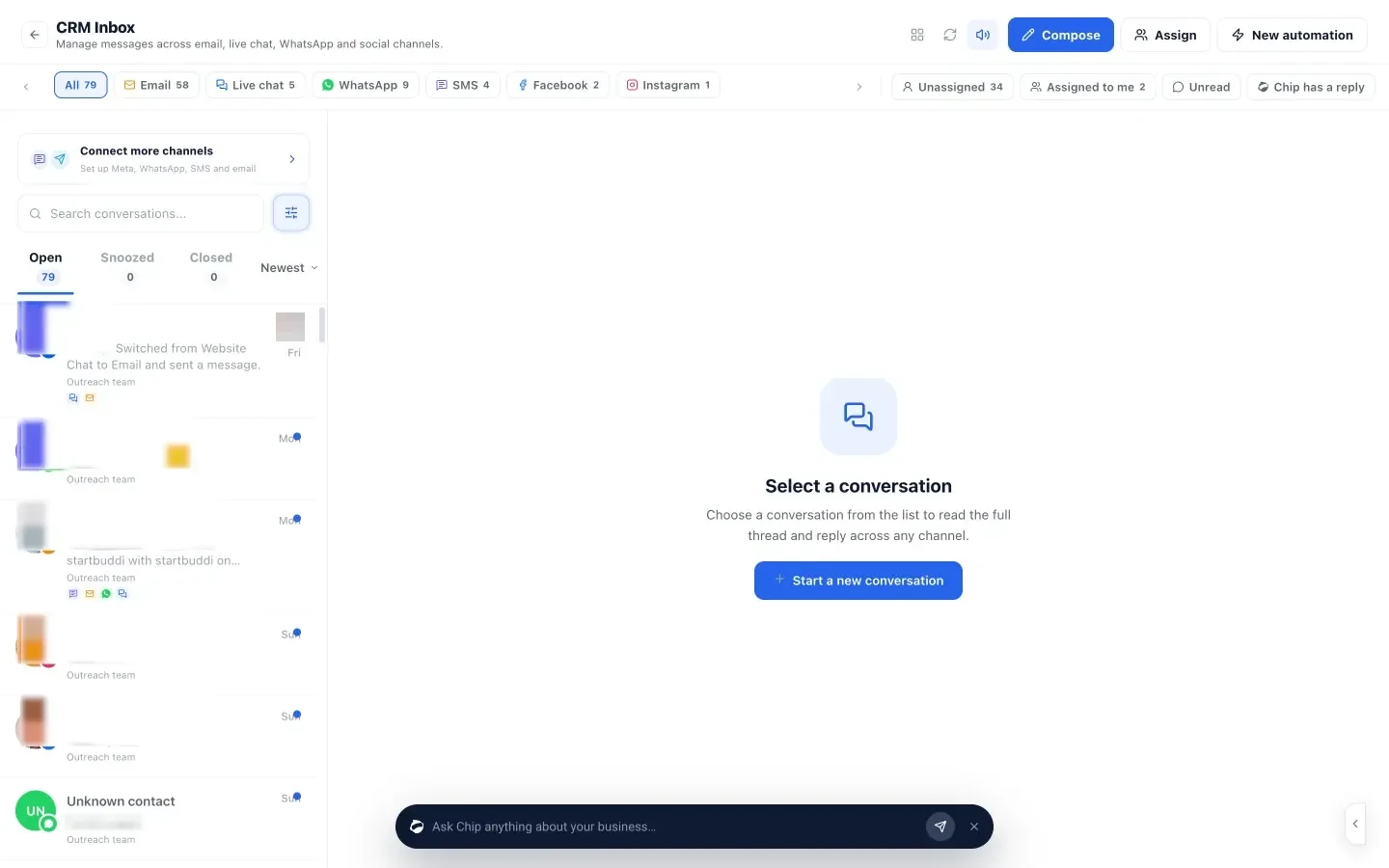
In startbuddi, omnichannel lives in the Inbox inside Customers.
- Channels in one list. Connect WhatsApp, email (Gmail or SMTP), SMS, website chat, Instagram, Facebook Messenger and Telegram, and filter by channel or see all of them together.
- Switch channel in the same thread. Reply on a different channel from the one the message came in on; if a channel isn’t available, the inbox says why.
- One contact panel. Each conversation shows the contact’s details, notes, bookings and form submissions, so whoever replies has the history.
- Assign and share. Assign a conversation to a person or a team inbox, leave internal notes, and let Chip draft replies.
WhatsApp and SMS need a paid plan, and Chip replying on its own needs Growth or above. A free plan is available; see pricing for what each plan includes.
Bring your channels into one place
List every channel customers use to reach you, then connect them to one inbox this week. Start startbuddi free and see every conversation, and every customer’s history, in one list.
Related terms
FAQ
What does omnichannel mean in simple terms?
Omnichannel means your customers get one connected experience whichever channel they use, whether that's WhatsApp, email, phone, your website or your shop. Their history follows them, so they never have to repeat themselves. It is about connecting channels, not just having many of them.
What is the difference between omnichannel and multichannel?
Multichannel means a business is present on several channels that run separately. Omnichannel means those channels are connected through one inbox and one customer record. In a multichannel setup customers repeat themselves; in an omnichannel setup the conversation continues.
Does a small business need omnichannel?
A small business needs it once customers contact you on more than one channel and more than one person replies. That point usually comes early, when WhatsApp, email and Instagram are all active. Start by connecting the channels you already use rather than adding new ones.
What is an omnichannel inbox?
An omnichannel inbox is one shared inbox that collects messages from several channels, such as WhatsApp, email, SMS and website chat. Each conversation is linked to a customer record, and the team can assign, reply and add notes from one screen.
Tiwalade Joanna Okedara-Kalu is the founder, CEO and CTO of startbuddi, the business system that brings clients, bookings, invoices, projects, marketing and the Chip AI assistant into one place. Tiwalade builds software around how service businesses really work day to day, and writes about client management, getting paid on time and why small businesses outgrow the tools they start with.
Founded startbuddi and leads its product and engineering