Customer satisfaction score (CSAT): Definition, Examples and How It Works

What is customer satisfaction score? Customer satisfaction score (CSAT) is the percentage of customers who say they were satisfied with one interaction, usually by rating it 4 or 5 out of 5. You ask it right after a job or support call, so it shows how that moment went.
Key takeaways
- CSAT = satisfied responses ÷ total responses × 100. On a 1 to 5 scale, “satisfied” normally means a 4 or a 5.
- Ask it straight after the moment you want to measure: a resolved ticket, a delivered project, a completed appointment.
- CSAT tells you how a single experience went; Net Promoter Score tells you how loyal customers feel overall.
- The score only helps if someone reads the low ratings and calls those customers back.
What is customer satisfaction score used for in a small business?
A small firm can’t afford to lose customers quietly. Plenty of unhappy customers never complain; they just don’t book again, and you find out months later when your churn rate creeps up. A one-question survey after each job surfaces problems while you can still fix them.
It also gives you a number to manage. If your IT support team’s CSAT drops from 90% to 75% in the month you hired a new technician, you know where to look. And satisfied customers stay longer, which protects customer retention and the lifetime value of every account.
How customer satisfaction score works
You ask one question at a defined moment, for example: “How satisfied were you with the support you received today?” Customers answer on a scale, most often 1 (very unsatisfied) to 5 (very satisfied). Then you count only the top answers as satisfied.
CSAT formula: CSAT (%) = (number of 4 and 5 ratings ÷ total ratings) × 100
Tools differ slightly. Zendesk’s help centre explains that on a 1 to 5 scale, ratings of 1 to 3 count as bad and 4 to 5 as good (checked on 1 October 2026). HubSpot’s customer satisfaction surveys sort answers into happy, neutral or unhappy and show the share of each (checked on 1 October 2026). Pick one method and stick to it, or your month-on-month numbers won’t compare.
Choosing a CSAT scale
A 1 to 5 scale is the most common because it is quick to answer and leaves room between “fine” and “great”. A 1 to 3 scale or a thumbs up and down is even quicker to answer on a phone, but gives you less detail. Whichever you choose, label both ends in words (“very unsatisfied”, “very satisfied”) so a 5 means the same to everyone.
CSAT vs NPS
| CSAT | NPS | |
|---|---|---|
| Question | How satisfied were you with this? | How likely are you to recommend us? |
| Scale | Usually 1 to 5 | 0 to 10 |
| Measures | One interaction | Overall loyalty |
| When to ask | Right after the moment | Every few months |
| Result | A percentage, 0% to 100% | A score from -100 to +100 |
Example: calculating CSAT for an IT support firm
A five-person IT support firm in Nairobi sends a one-question survey every time it closes a support ticket. In September it closed 80 tickets and got 52 replies. The figures are illustrative.
| Rating | Responses |
|---|---|
| 5 (very satisfied) | 25 |
| 4 | 16 |
| 3 | 6 |
| 2 | 3 |
| 1 (very unsatisfied) | 2 |
| Total | 52 |
Satisfied responses are 25 + 16 = 41. CSAT = 41 ÷ 52 × 100 = 78.8%, which you’d report as 79%. The response rate is 52 ÷ 80 = 65%.
The owner then reads the 11 ratings of 3 or below. If six of them mention slow first replies on WhatsApp, the fix is a staffing or routing change, not a new survey. Next month’s CSAT shows whether it worked.
Some teams also report the average rating: (25×5 + 16×4 + 6×3 + 3×2 + 2×1) ÷ 52 = 215 ÷ 52 = 4.13 out of 5. The average hides more than the percentage does, so use it alongside, not instead.
Common mistakes with CSAT
- Asking too late. A survey a fortnight after the job measures memory, not the experience.
- Asking too much. Every extra question cuts replies. One rating plus an optional “What could we have done better?” is enough.
- Comparing different scales. A 1 to 3 survey and a 1 to 5 survey produce different numbers. Change the scale and you restart the trend.
- Ignoring low response rates. Ten replies from 200 customers is a guess, not a score.
For the wider habits that keep scores high, from response times to handling complaints, see our guide to customer service for small business.
How startbuddi handles customer satisfaction surveys
startbuddi doesn’t calculate a CSAT score for you, but it gives you the pieces to collect ratings and act on them.
- Build the survey in Forms. Create a form with a Rating field and an optional Long text field. The Create form screen includes a Client feedback starting point, and Chip can draft a form from a sentence. Every response is saved against the contact, so you can see who rated you low and call them.
- Send it at the right moment. In Bookings, the “After a completed booking” follow-up email can carry the link to your form, so the question arrives just after the appointment.
- Read the results. Form responses list every rating; divide the 4s and 5s by the total to get your CSAT.
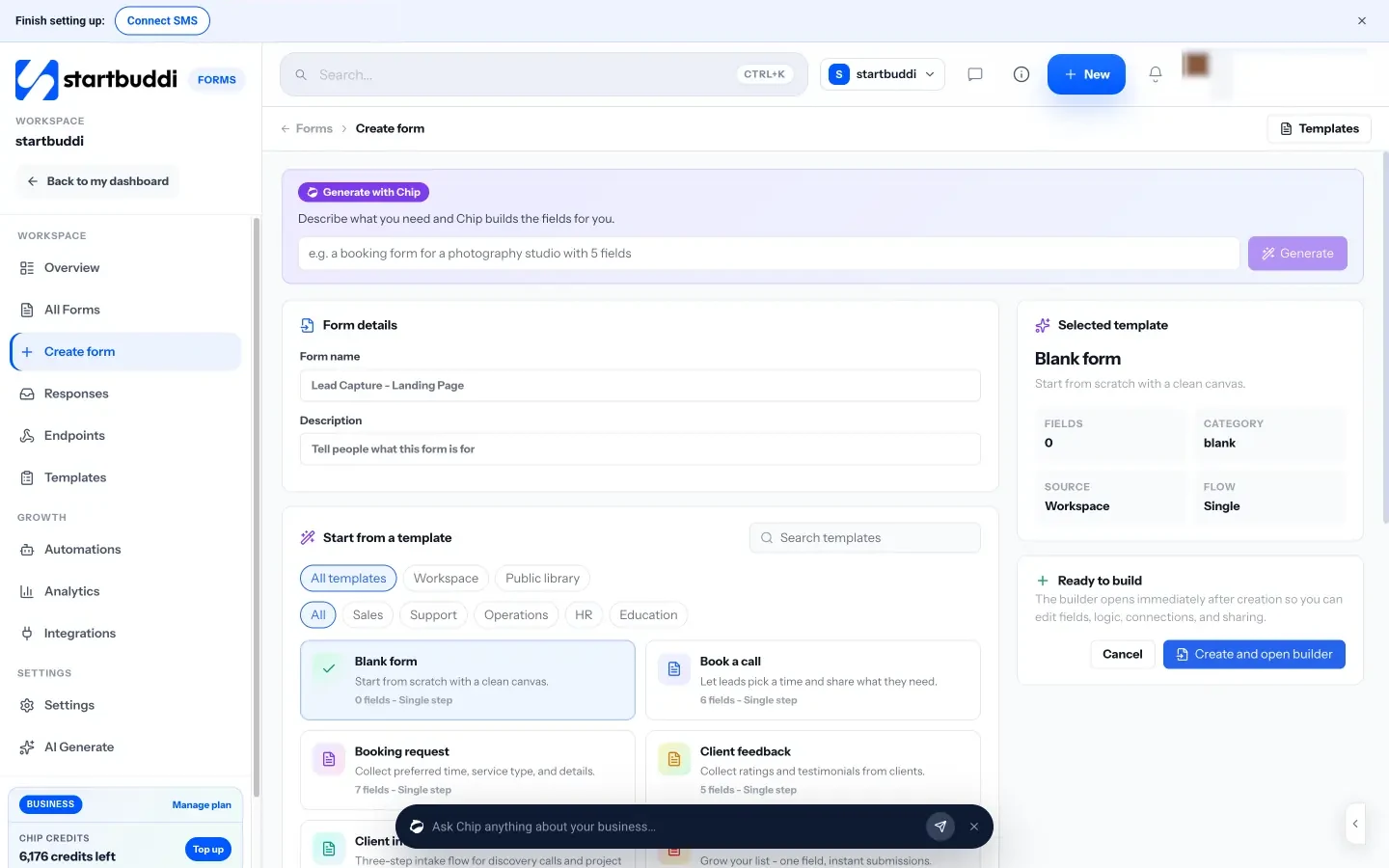
See Forms for what the form builder can do. A free plan is available; see pricing for what each plan includes.
Start measuring customer satisfaction
Write your one question, add it to a form and send it after your next completed job. Start startbuddi free to collect ratings against each customer’s record and follow up on the low ones.
Customer satisfaction score (CSAT) is part of Customers in startbuddi.
See CustomersRelated terms
FAQ
What is a good customer satisfaction score?
A good CSAT depends on your industry and scale, so the most useful benchmark is your own score last month. Track the trend and read the low ratings. A falling score is a warning even if the number still looks high.
How do you calculate CSAT?
Divide the number of satisfied responses by the total number of responses and multiply by 100. On a 1 to 5 scale, satisfied usually means a rating of 4 or 5. For example, 41 satisfied answers out of 52 replies gives a CSAT of 79%.
What is the difference between CSAT and NPS?
CSAT measures satisfaction with one interaction, such as a support ticket, on a short scale. NPS asks how likely customers are to recommend you on a 0 to 10 scale and measures overall loyalty. Many businesses use CSAT after every job and NPS a few times a year.
When should you send a CSAT survey?
Send it straight after the moment you want to measure, such as when a ticket is closed, a project is delivered or an appointment ends. The same day is best. Waiting a week or more makes answers vaguer and replies fewer.
Tiwalade Joanna Okedara-Kalu is the founder, CEO and CTO of startbuddi, the business system that brings clients, bookings, invoices, projects, marketing and the Chip AI assistant into one place. Tiwalade builds software around how service businesses really work day to day, and writes about client management, getting paid on time and why small businesses outgrow the tools they start with.
Founded startbuddi and leads its product and engineering