NFC payment: Definition, Examples and How It Works

An NFC payment is a card, phone or watch payment made by holding the device a few centimetres from a reader, so the two exchange payment data over near-field communication (NFC), a short-range radio.
An NFC payment is a card, phone or watch payment made by holding the device a few centimetres from a reader, so the two exchange payment data over near-field communication (NFC), a short-range radio. The device acts like a contactless bank card, and every payment carries a one-time security code instead of reusable card details.
Key takeaways
- NFC is the radio technology; “contactless payment” is what the customer experiences. Most people use the two terms for the same tap.
- NFC works only over a couple of centimetres, which is part of what makes it hard to intercept by accident.
- To take NFC payments you need an NFC reader or a phone approved for tap to pay by your payment provider, and that depends on the country.
- Where tap to pay isn’t offered, QR codes and payment links do the same job: the customer pays on their own phone.
Why NFC payment matters for a small business
A tap takes seconds. For a barber, a café or a salon front desk, that means shorter queues and no waiting for change.
The bigger shift is on the seller’s side. In a growing list of countries, a business no longer needs a separate card terminal: a compatible phone can read a tap directly. That helps mobile workers, such as cleaners and mobile hairdressers, get paid where the job is done.
How NFC payment works
The NFC Forum, the industry body behind the standard, describes NFC (checked on 1 October 2026) as radio communication on a base frequency of 13.56 MHz with “a typical range of up to 2cm”. In card emulation mode, a phone or watch can “emulate contactless banking cards for payment”, so the reader treats it exactly like a card.
The payment itself follows the EMV chip rules. EMVCo, which manages those standards, says EMV contactless (checked on 1 October 2026) generates “a one-time use security code” for every transaction.
A tap goes like this:
- The seller enters the amount on a reader, a till or a phone set up for tap to pay.
- The customer holds a card, phone or watch near the reader’s tap zone.
- The device sends a one-time code. Phone wallets first ask for a face, fingerprint or passcode.
- The payment provider asks the customer’s bank to approve the payment.
- The reader shows approved or declined, and the money settles to the seller’s bank account later.
Above a set amount, the bank may also ask for a PIN. Limits are set by banks and regulators in each country, so check with your provider rather than assuming the UK or US limit applies to you.
NFC payment apps: customer side and seller side
“NFC payment apps” means two different things, depending on who is holding the phone.
| Side | What the app does | What you need |
|---|---|---|
| Customer (paying) | A phone wallet stores a card and pays by tap | An NFC phone, a supported bank card and a wallet available in your country |
| Seller (accepting) | A tap to pay app turns the seller’s phone into a card reader | A supported phone, a payment provider that offers tap to pay, and a country where it is live |
The seller side is where availability varies most. Stripe’s documentation for Tap to Pay on Android (checked on 1 October 2026) lists countries including the UK, US, Canada, Ireland and Australia, and requires Android 13 or later with a working NFC sensor. Nigeria, Kenya and Ghana are not on that list, so businesses there usually rely on bank or fintech card terminals for taps, plus transfers, QR codes and payment links.
NFC payment examples with numbers
A mobile hairdresser in London
A home visit costs £45. The hairdresser types £45 into a tap to pay app on their phone, the client taps a debit card, and the payment is approved. Over a week of 14 visits that is £630 taken without carrying a card reader. The figures are illustrative.
A nail technician in Nairobi
A gel set costs KSh 2,500. The studio has no tap to pay option on its phone, so it shows a printed QR code at the desk. The client scans it and pays by card on their own phone. For the client the experience is still touch-free; it just isn’t NFC. The figures are illustrative.
When NFC isn’t the right tool
NFC needs both people in the same room. For deposits taken when someone books, invoices sent after a job, or customers who order on WhatsApp, a link is simpler: the customer pays wherever they are. Many service businesses use both, NFC or a terminal at the counter and links for everything else.
Related terms
- Contactless payment: the customer-facing name for tap to pay, including card limits and safety.
- Payment gateway: the service that carries an online card payment to the banks.
- Payment links: a link that opens a checkout page for a set amount.
- Chargeback: when a bank reverses a card payment after a dispute.
How startbuddi handles NFC payment
startbuddi is not a card terminal or point-of-sale system, so it doesn’t read NFC taps. It covers the remote and touch-free ways a service business gets paid:
- Scan to pay: Money Manager’s Get Paid hub has printable QR codes for your pay me page and each payment link.
- Payment links and invoices: with Stripe connected, customers pay by card; with Paystack connected, by card, bank transfer, USSD or mobile money.
- Deposits at booking: a service can require full payment or a deposit before the booking is confirmed.
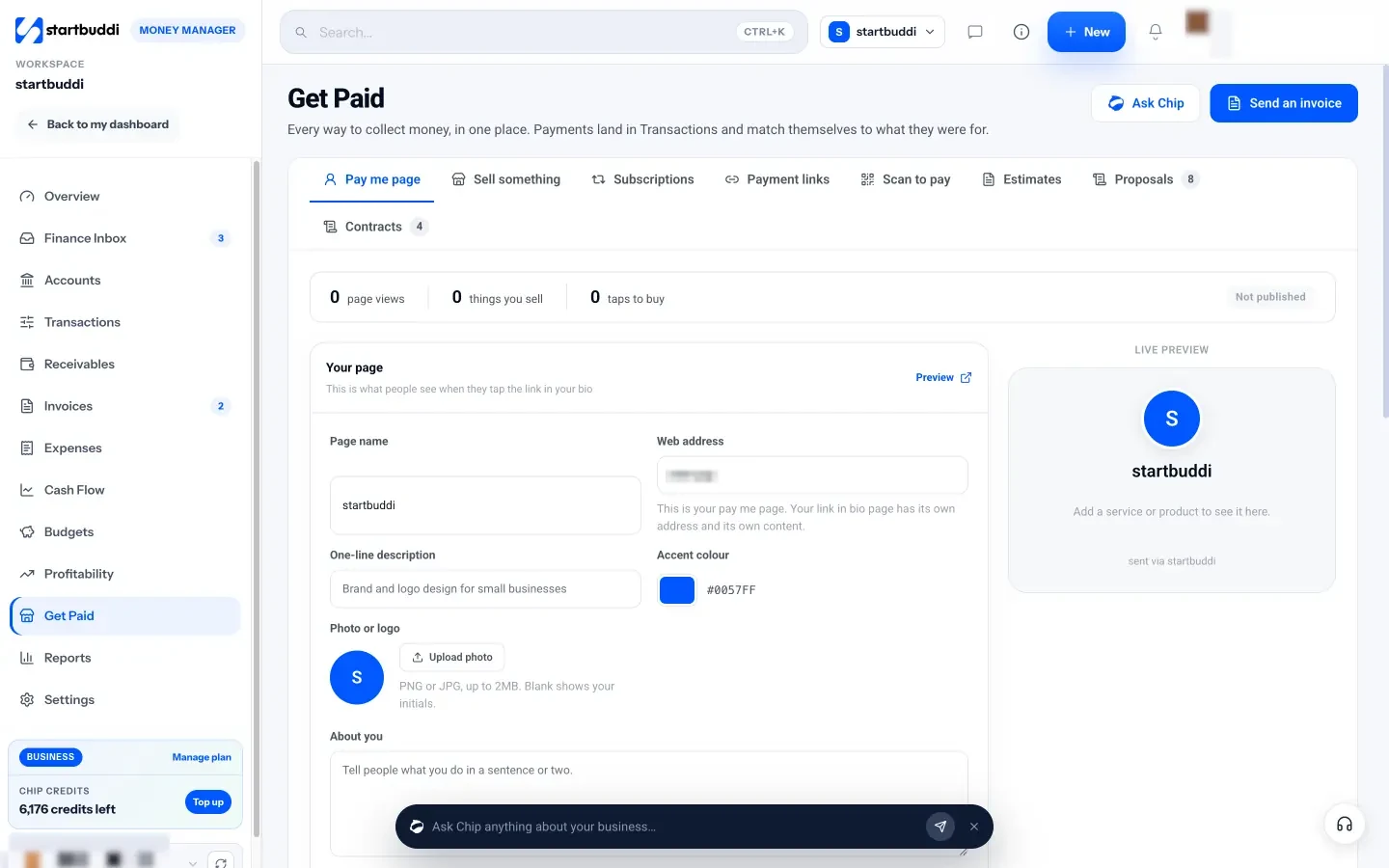
Payments land in Transactions and match to the invoice, link or sale they were for. Here is how to create a payment link for your business in Nigeria, or see the Get Paid features. A free plan is available; see pricing.
NFC payment is part of Money Manager in startbuddi.
See Money ManagerRelated terms
FAQ
Is NFC payment the same as contactless payment?
Mostly, yes. NFC is the short-range radio technology, and contactless payment is the tap a customer makes with it. QR code payments are also called contactless sometimes, but they use the phone's camera, not NFC.
Is NFC payment safe?
NFC payment is generally safe. The range is about 2 cm, each payment uses a one-time security code, and phone wallets check a face, fingerprint or passcode before paying. Report a lost card or phone to your bank straight away.
Can I accept NFC payments on my phone?
You can if your payment provider offers tap to pay in your country and your phone meets its requirements. Stripe, for example, lists supported countries and needs Android 13 or later for Tap to Pay on Android. If it isn't available where you trade, use a card terminal, QR codes or payment links.
Do I need the internet to take an NFC payment?
Usually yes. Phone-based tap to pay needs a stable internet connection to approve the payment, and most card terminals need a mobile data or Wi-Fi connection too. Ask your provider how its device behaves when the network drops.
Tiwalade Joanna Okedara-Kalu is the founder, CEO and CTO of startbuddi, the business system that brings clients, bookings, invoices, projects, marketing and the Chip AI assistant into one place. Tiwalade builds software around how service businesses really work day to day, and writes about client management, getting paid on time and why small businesses outgrow the tools they start with.
Founded startbuddi and leads its product and engineering