First response time: Definition, Examples and How It Works

What is first response time? First response time (FRT) is how long a customer waits between sending a message and getting the first reply from a real person on your team.
What is first response time? First response time (FRT) is how long a customer waits between sending a message and getting the first reply from a real person on your team. It is measured per conversation and usually reported as a median or average over a week or month, often split by channel and by business hours.
Key takeaways
- FRT measures the wait for the first human reply, not how long it takes to solve the problem.
- Automatic “we got your message” replies shouldn’t count, or the number flatters you.
- Use the median as well as the average, because a few weekend messages can skew an average badly.
- Decide whether the clock runs in business hours or around the clock, then stick to it.
Why first response time matters for a small business
For a customer, the first reply is the moment they find out whether anyone is there. A Lagos office whose network has gone down doesn’t need the fix in five minutes, but it does need to hear “we’re on it” quickly. Without that reply, they ring three times, message on WhatsApp and start looking for another IT firm.
For the business, FRT is the simplest health check on a support or sales inbox. If it creeps up, something has changed: more messages, fewer people, or conversations falling between colleagues. It is also usually the first target written into a service level agreement, so you need to measure it before you promise it.
Platforms track it too. Meta’s very responsive badge (checked on 1 October 2026) appears on a Facebook Page with a Messenger response rate of 90% or higher and a response time under 15 minutes.
How first response time works
The clock starts when the customer’s message arrives and stops at the first reply from a person on your team. Help desks define it in a similar way. Zendesk’s explanation of first reply time (checked on 1 October 2026) measures from ticket creation to the first public agent comment, and stores the result in both calendar hours and business hours.
Four choices change the number, so agree them up front:
| Choice | Option A | Option B |
|---|---|---|
| Hours | Calendar hours (the clock never stops) | Business hours (paused overnight and at weekends) |
| What counts as a reply | Only a person’s reply | Any reply, including automatic ones |
| Summary | Average (mean) | Median (the middle value) |
| Scope | All channels together | Each channel separately |
For most small teams, the honest set is business hours, human replies only, median, by channel.
The formula: for each conversation, first response time = time of first human reply minus time the customer’s message arrived. Then take the median (or the average) across all conversations in the period.
Example: an IT support firm’s week
These figures are illustrative. A three-person IT support firm in Accra receives seven new conversations on Monday. Their first response times are 4, 6, 8, 10, 15, 22 and 180 minutes. The last one arrived during a site visit when nobody was watching the inbox.
| Measure | Working | Result |
|---|---|---|
| Average | (4 + 6 + 8 + 10 + 15 + 22 + 180) ÷ 7 = 245 ÷ 7 | 35 minutes |
| Median | Middle of the seven sorted values | 10 minutes |
| Within a 30-minute target | 6 of 7 conversations | 86% |
The median says the team usually replies in 10 minutes. The average says 35, because of one slow reply. Both are true, and the gap points at the real fix: someone needs to cover the inbox during site visits.
How to bring first response time down
- Name an owner for every hour. A shared inbox with assignment means “someone will reply” becomes “Kofi will reply”.
- Write saved answers for repeat questions. Canned responses cut a six-minute reply to two.
- Set notifications on the channels customers actually use, including WhatsApp and live chat.
- Tell customers your hours. An away message that says when you’ll reply sets expectations, even though it shouldn’t count as a first response.
- Don’t trade quality for speed. A fast, wrong first reply hurts customer satisfaction more than a slightly slower good one.
Our customer service guide suggests response time standards by channel, and our walkthrough on WhatsApp Business for customer service covers setting up a WhatsApp number for support.
How startbuddi handles first response time
In startbuddi, Customers Reports has a Lead response time figure in Sales performance. It is the median time from a customer’s first message in a conversation to your team’s first reply, and it counts team replies only, so Chip’s automatic replies don’t flatter the number. Messages from every channel you connect to the Inbox feed into it.
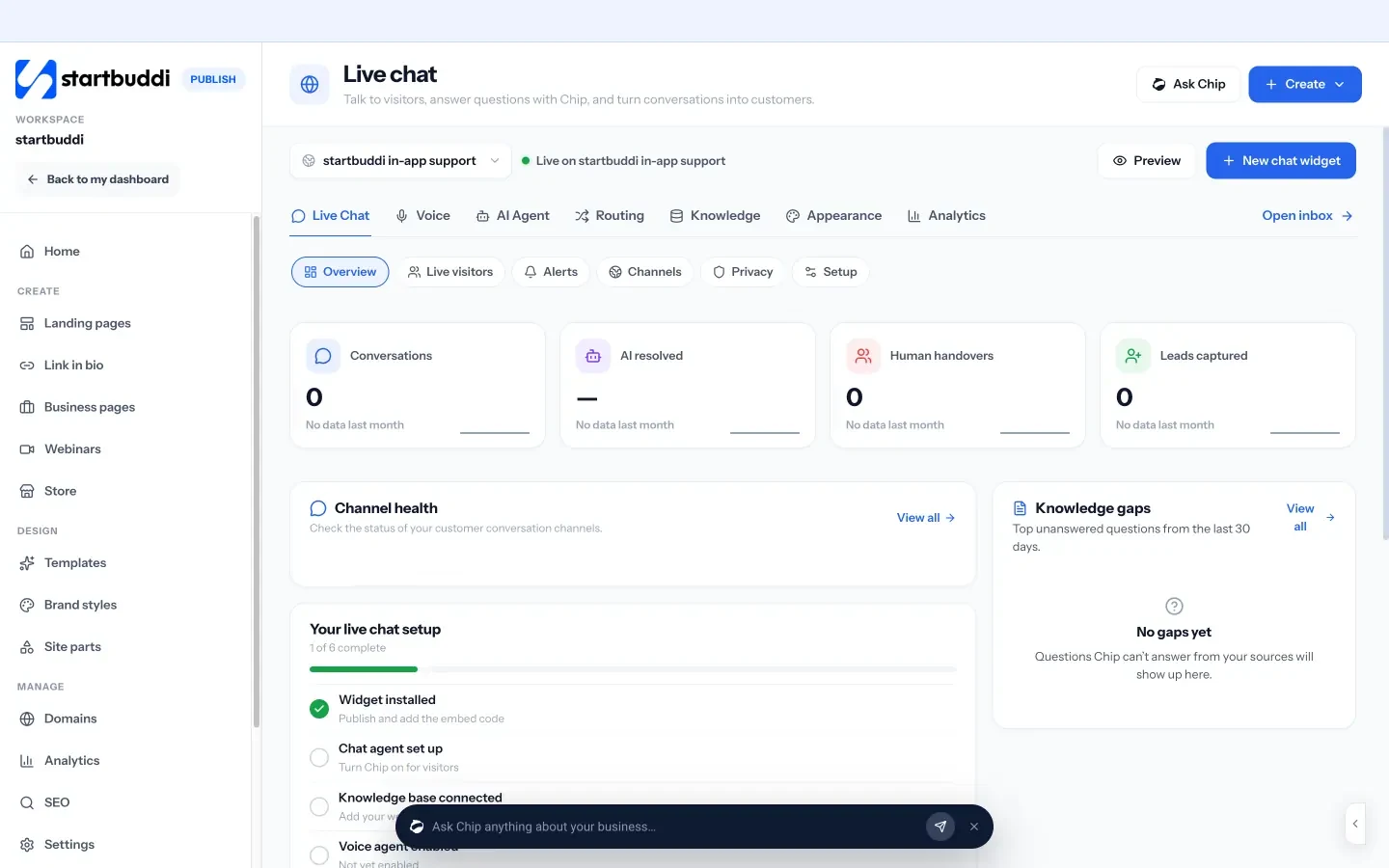
For website chat, you set a maximum wait in the handoff settings. When a visitor is still waiting for a person, the team gets a “Visitor still waiting” alert, and past the maximum a “Response time missed” alert, with a follow-up task so the visitor isn’t lost. Chip can also answer on its own while your team is busy, on paid plans; see pricing. A free plan is available.
Related terms
FAQ
What is a good first response time?
It depends on the channel. Chat and WhatsApp users expect minutes, while email customers usually accept a few business hours. Set a target you can meet on a busy week and publish your hours so customers know what to expect.
What is the difference between first response time and resolution time?
First response time measures the wait for the first human reply. Resolution time measures how long it takes to fix the problem or close the conversation. A team can reply fast and still take days to resolve, so track both.
Do automatic replies count towards first response time?
They shouldn't. An automatic acknowledgement doesn't answer anything, so counting it makes your first response time look better than the customer's experience. Most teams measure the first reply written or sent by a person.
Should I use the average or the median?
Use the median for a fair picture of a typical wait, and keep an eye on the average and the slowest replies. The median isn't pulled up by one weekend message, while the average shows when a few customers waited a very long time.
Tiwalade Joanna Okedara-Kalu is the founder, CEO and CTO of startbuddi, the business system that brings clients, bookings, invoices, projects, marketing and the Chip AI assistant into one place. Tiwalade builds software around how service businesses really work day to day, and writes about client management, getting paid on time and why small businesses outgrow the tools they start with.
Founded startbuddi and leads its product and engineering