Service level agreement (SLA): Definition, Examples and How It Works

What is a service level agreement?
What is a service level agreement? A service level agreement (SLA) is the part of a contract where a service provider commits to measurable standards, such as how fast it will respond, how quickly it will fix problems or how much uptime it guarantees, and says what the customer gets if those standards are missed.
Key takeaways
- An SLA sets targets you can measure: response time, fix time, uptime, hours of cover.
- It also says how those targets are measured and what happens when they are missed, usually service credits.
- Small businesses meet SLAs from both sides: the ones in their suppliers’ terms, and the ones they offer their own clients.
- Only promise what you can hit on your worst week, not your best.
Why a service level agreement matters for a small business
Picture a three-person IT support firm in Lagos looking after twelve small offices. Without an SLA, every client has a different idea of “urgent”. One expects a technician within the hour for a broken printer; another waits two days to mention the server is down.
An SLA settles this before work starts. The client knows what a “critical” problem is and how fast you will act on it. You know what you have promised, so you can staff for it and price it.
You are also on the receiving end of SLAs. Google’s Workspace SLA (checked on 1 October 2026) commits to at least 99.9% monthly uptime and adds 3, 7 or 15 days of free service when uptime falls below set levels. Knowing how your email, hosting and payment providers word theirs tells you what you can safely promise your own clients.
How a service level agreement works
NIST’s glossary entry for service level agreement (checked on 1 October 2026) describes it as a commitment between a provider and its customers covering responsibilities, the type of service, expected performance such as reliability and response times, and how reporting, resolution and termination work. In practice, most SLAs have the same building blocks:
| Part | What it says | Example for an IT support firm |
|---|---|---|
| Scope | Which services the SLA covers | Help desk, laptops, office network |
| Hours of cover | When the clock runs | Monday to Friday, 8am to 6pm WAT |
| Priority levels | How problems are graded | Critical, high, normal |
| Response time | Time to first human reply | Critical: 30 minutes |
| Resolution target | Time to fix or a workaround | Critical: 4 business hours |
| Measurement | How it is counted and reported | Monthly report from the ticket log |
| Remedies | What happens if targets are missed | Service credit of 5% of the monthly fee |
| Exclusions | What the SLA doesn’t cover | Outages caused by the client’s power or ISP |
The SLA usually sits inside a wider service agreement or alongside a statement of work, which lists the deliverables themselves. Our service agreement template covers the rest of the contract around it.
Example: an IT support SLA with numbers
These figures are illustrative. The Lagos firm charges an office ₦400,000 a month for managed support and offers this SLA during business hours:
| Priority | Example | First response | Fix or workaround |
|---|---|---|---|
| Critical | Whole office offline | 30 minutes | 4 business hours |
| High | One person can’t work | 2 business hours | 1 business day |
| Normal | Request or minor fault | 1 business day | 5 business days |
In March, the office logs 40 tickets. 38 get a first response within target, so the response target is met 95% of the time. The contract promises 95% or better, so no credit is due. If only 34 had been on time (85%), a 5% service credit would take ₦20,000 off April’s invoice.
That is why the measurement row matters as much as the targets.
Common mistakes with service level agreements
- Promising 24/7 when you are a small team. Say business hours, and offer out-of-hours cover as a paid extra.
- Vague words. “Prompt” and “as soon as possible” can’t be measured. Use minutes and hours.
- No priority levels. If every ticket is urgent, none is.
- No exclusions. You can’t control the client’s power supply or internet provider, so say so.
- Not measuring. If you can’t produce the monthly numbers, the SLA is just a hope. Check your tools can track first responses before you sign.
This is general information, not legal advice. Have a lawyer check any contract you sign.
Related terms
A statement of work describes what will be delivered; the SLA describes how well and how fast. Deliverables are the outputs the client receives. Canned responses help a team hit response targets on repeat questions without cutting quality. Our customer service guide sets out response time standards by channel if you want a starting point.
How startbuddi handles service level agreements
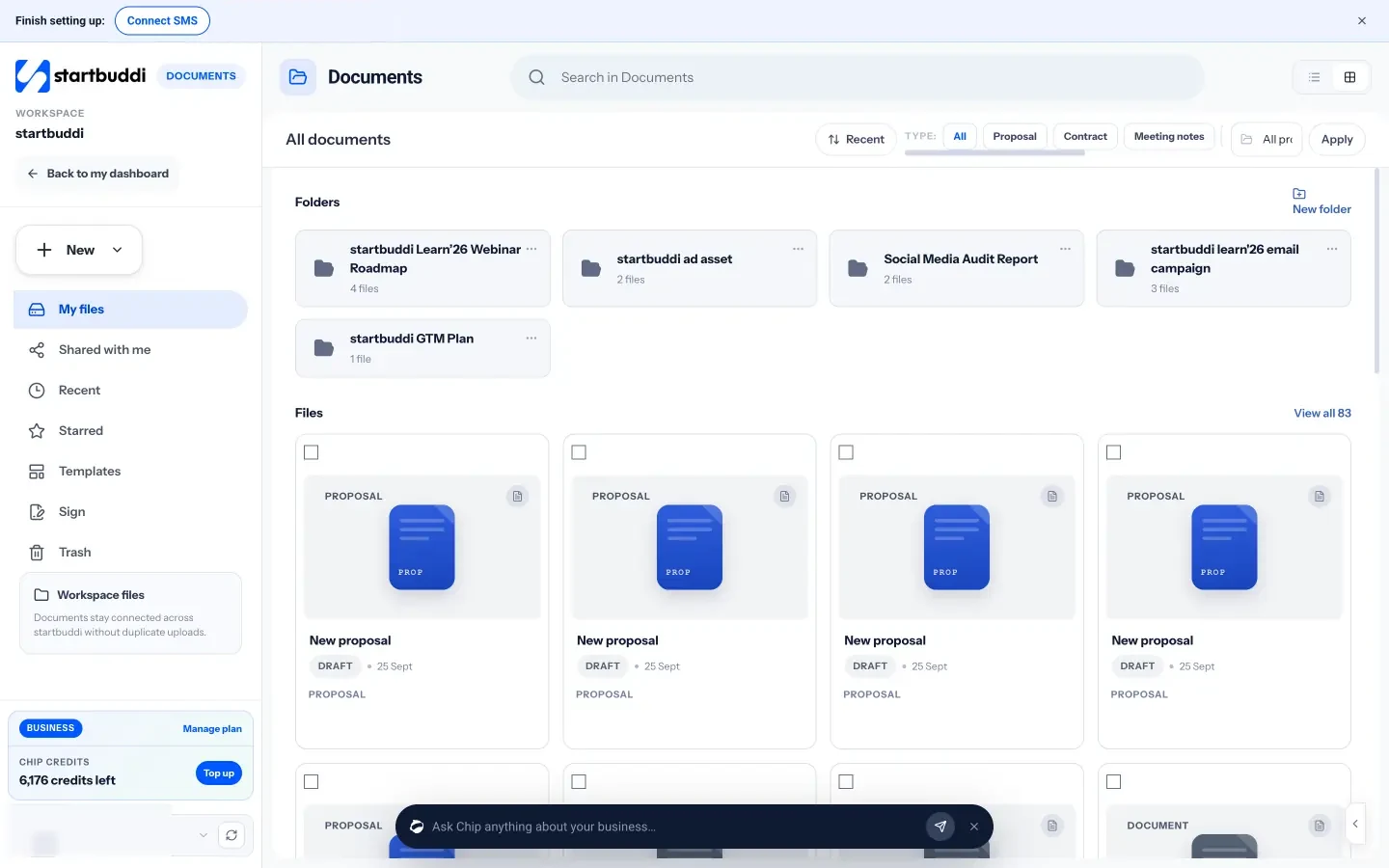
You can write the SLA in Documents: start from a contract template such as Service Agreement or Monthly Retainer Agreement, add the SLA table, and use variables for the client’s name and fee. Send it for signature with startbuddi eSign, and the signed copy stays linked to the client and the project.
For the measuring side, Customers Reports includes a Lead response time figure: the median time between a customer’s first message and your team’s first reply, counting team replies only. Website chat lets you set a maximum wait and alerts the team when a visitor is still waiting or the response time is missed. startbuddi doesn’t run per-client SLA timers or calculate service credits, so keep that report in a sheet. See pricing for plans; a free plan is available.
Related terms
FAQ
What is the difference between an SLA and a contract?
An SLA is usually one part of a contract, or a schedule attached to it. The contract covers the whole deal, such as price, term, liability and ending the agreement. The SLA covers the measurable service levels and what happens when they are missed.
What are the three types of SLA?
A customer SLA covers one client, a service SLA applies the same terms to every client of a service, and a multi-level SLA combines both, for example company-wide terms with extras for one client. Small businesses mostly use a service SLA with paid extras for larger clients.
What is a good response time in an SLA?
It depends on the priority and the team. Many small IT firms promise 30 to 60 minutes for critical issues during business hours and one business day for routine requests. Pick targets you can meet on your busiest week.
What happens if an SLA is breached?
The SLA should say. The usual remedy is a service credit, a discount on the next invoice or extra days of service. Repeated breaches often give the client the right to end the contract early.
Tiwalade Joanna Okedara-Kalu is the founder, CEO and CTO of startbuddi, the business system that brings clients, bookings, invoices, projects, marketing and the Chip AI assistant into one place. Tiwalade builds software around how service businesses really work day to day, and writes about client management, getting paid on time and why small businesses outgrow the tools they start with.
Founded startbuddi and leads its product and engineering