Capacity Planning: Definition, Examples and How It Works

Capacity planning is working out how much work your team can deliver over the coming months, comparing it with the work you expect to have, and deciding in advance how to close any gap. So what is capacity planning for a small service business?
Capacity planning is working out how much work your team can deliver over the coming months, comparing it with the work you expect to have, and deciding in advance how to close any gap. So what is capacity planning for a small service business? Turning “are we too busy to take this on?” into a sum in hours.
Key takeaways
- Capacity planning looks one to six months ahead. It leads to decisions such as hiring, subcontracting, raising prices or turning work away.
- Supply is available hours × a realistic utilisation target. Demand is signed work plus a fair share of what might land.
- Plan for the likely case and know your plan for the busy case.
- Hiring is slow, so the decision has to be made before the crunch, not during it.
Why capacity planning matters for a small business
Without it, small firms tend to swing between two bad months: one where the team is idle and you’re still paying salaries, and one where three projects start together and every deadline slips. An IT support company in Lagos that wins a large office fit-out in March but only starts recruiting in March will still be short-staffed in May.
It also protects your prices: if you know next quarter is nearly full, you quote new work at your full rate or push its start date.
What is capacity planning, and how does it work?
It’s a supply-and-demand sum, usually done per quarter.
- Work out supply. For each person, take contracted hours, subtract leave and public holidays, then multiply by a realistic utilisation rate for their role. That’s how many billable hours you can expect from them.
- Work out demand. Add up the hours in retainers and contracts you already have, plus signed projects. For deals still in your pipeline, count only a share, based on how likely they are to land.
- Compare. Demand below supply means spare capacity to sell. Demand above supply means a gap.
- Decide how to close a gap. Subcontract, move start dates, raise prices, stop selling a service, or hire.
- Repeat monthly. The plan changes every time a contract is signed or ends.
Capacity planning vs workload management
Workload management shares out the work you already have, week by week, so nobody is overloaded. Capacity planning asks whether the team is the right size for the work ahead. Resource scheduling then books named people to specific jobs and times. Think of them as months, weeks and days.
An example with numbers
An IT support firm in Manchester has four engineers on 40-hour weeks. The owner plans the next quarter of 13 weeks. These figures are illustrative.
Supply
- Contracted hours per engineer: 13 × 40 = 520 hours.
- Leave and bank holidays: UK workers on a five-day week are entitled to at least 28 days’ paid annual leave, which can include bank holidays (checked on 1 October 2026). That’s 7 days, or 56 hours, a quarter on average.
- Available hours per engineer: 520 − 56 = 464.
- Billable target of 75%: 464 × 75% = 348 billable hours each, or 1,392 for the team.
Demand
| Work | Hours | Chance it happens | Hours to plan for |
|---|---|---|---|
| Managed support contracts | 900 | Signed | 900 |
| Signed network refresh project | 300 | Signed | 300 |
| Office move for a new client (in the pipeline) | 400 | 50% | 200 |
| Total | 1,600 | 1,400 |
The likely case is 1,400 hours against 1,392 available: full, with almost no slack. If the office move is won, demand is 1,600 hours, a gap of 208.
The owner’s options for that gap:
- Subcontract it. 208 hours from a trusted contractor at an illustrative £45 an hour costs £9,360. Price the office move with that cost in mind.
- Move the start date. Ask the new client to start in the following quarter.
- Hire. A fifth engineer adds about 348 billable hours a quarter once settled in, but recruiting and training take time, so it only helps if the extra work will last.
Asking the four engineers to absorb 208 extra hours is not on the list. That’s about 16 hours a week across the team for 13 weeks, and in the UK workers can’t be made to work more than 48 hours a week on average unless they opt out (checked on 1 October 2026).
Common mistakes with capacity planning
- Using 100% of contracted hours as supply. Leave, training, admin and sales take real time.
- Counting every pipeline deal at full value. You’ll plan for work that never comes.
- Planning once a year. One lost contract changes the whole picture.
- Hiring for a peak. If the extra work lasts one quarter, a contractor is usually cheaper than a permanent salary. Our guide to building your first team covers that choice.
Related terms
- Utilisation rate: the share of available hours spent on billable work, which sets realistic supply.
- Workload management: the weekly job of sharing out work you already have.
- Resource scheduling: booking specific people and equipment to specific times.
For the wider numbers behind hiring decisions, read our post on workforce planning analytics.
How startbuddi helps with capacity planning
startbuddi gives you the inputs; the quarterly sum is still yours. The Time page shows logged and billable hours per week, which tells you what utilisation your team really achieves. The Workload page in Work shows each person’s estimated hours against their weekly capacity for the coming weeks, with approved leave and public holidays taken off.
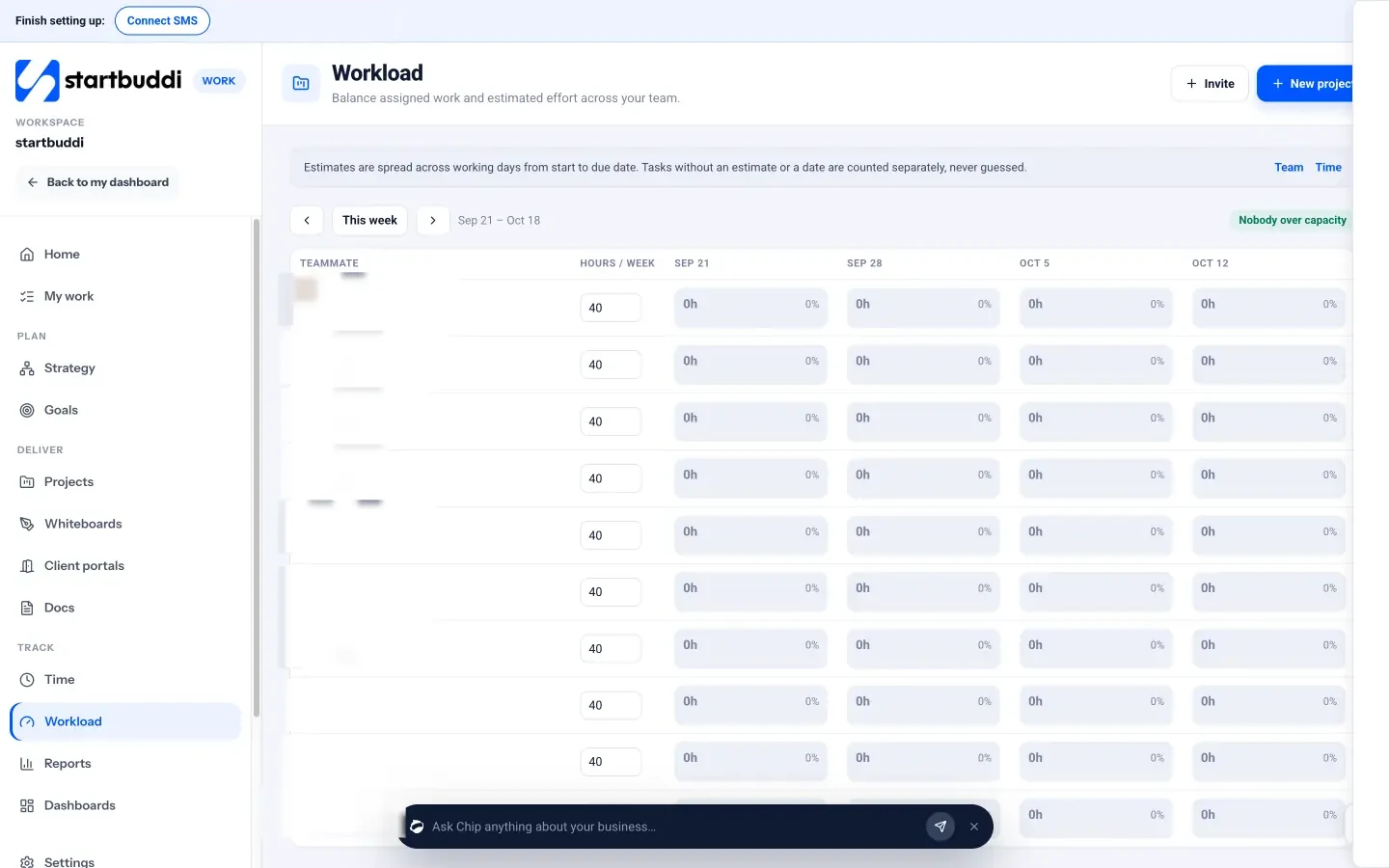
For demand, each deal in the Pipeline can carry a value, an expected close date and a probability. Workload covers the next few weeks rather than a full quarter, so for a longer view, copy the numbers into a simple sheet like the one above. See how it fits together for an IT business on startbuddi for IT teams.
Know if you can take the next job
Log time, track estimates and see each person’s load against their hours. Start free with startbuddi, no card needed.
Related terms
FAQ
What is capacity planning in simple terms?
Capacity planning is checking whether your team will have enough time for the work you expect over the next few months. You compare available hours with expected work, then decide early whether to hire, subcontract or say no. It turns a gut feeling about being busy into a number.
How do you calculate team capacity?
For each person, take contracted hours for the period, subtract leave and public holidays, and multiply by a realistic utilisation target. Add the results for the team. For example, 464 available hours at 75% gives 348 billable hours per person per quarter.
How often should a small business do capacity planning?
Do a full plan each quarter and update it monthly, or whenever a large contract is won or lost. Weekly balancing of tasks between people is a separate job, workload management. Looking further than six months ahead is usually guesswork for a small team.
What is the difference between capacity planning and resource planning?
The terms overlap and are often used interchangeably. Capacity planning usually means comparing total available hours with expected demand. Resource planning can also cover which skills, equipment and roles you need, not just how many hours.
Tiwalade Joanna Okedara-Kalu is the founder, CEO and CTO of startbuddi, the business system that brings clients, bookings, invoices, projects, marketing and the Chip AI assistant into one place. Tiwalade builds software around how service businesses really work day to day, and writes about client management, getting paid on time and why small businesses outgrow the tools they start with.
Founded startbuddi and leads its product and engineering