What is a sales funnel? A plain-English guide for small businesses
What a sales funnel is, the stages from stranger to repeat customer, a worked example for a service business, the numbers to track and how to build a simple one.


Chinonye wrote this while on the startbuddi team. The product has changed since, so the team updated it on .
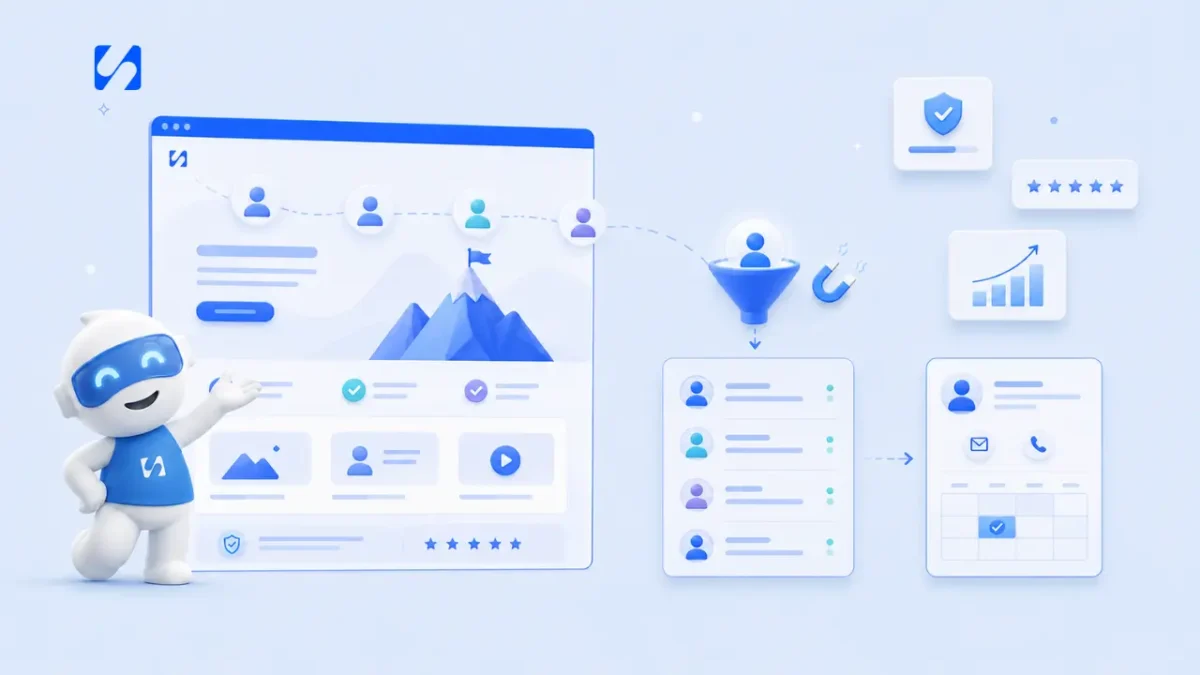
- A sales funnel is the path people take from first hearing about you to paying you and coming back. It narrows at each stage: awareness, interest, decision, purchase and repeat. Map each stage, give people one clear next step at every point, follow up quickly, and measure where most people drop out.
What is a sales funnel? It is the path people take from first hearing about your business to paying you, and ideally coming back. It’s called a funnel because it narrows: lots of people notice you, fewer show interest, fewer still get in touch, and a smaller group buys. A sales funnel isn’t a piece of software. It is a way of seeing that path clearly, so you can give people a good next step at every stage and spot where most of them drift away.
This guide explains the stages in plain words, walks through an example for a small service business, shows which numbers to watch, and gives you a simple way to build your own funnel with tools you may already have.
A sales funnel in simple terms
Think about the last time you hired someone new, maybe a plumber, a hairdresser or an accountant. You probably saw them somewhere first: a search result, a friend’s recommendation, a post. You looked at their website or profile. Maybe you sent a message or booked a call. They replied, you compared them with someone else, and eventually you chose. If they did a good job, you went back.
That journey is a sales funnel. Every business has one, whether they’ve designed it or not. The difference between businesses that grow steadily and those that rely on luck is usually that the first group has thought about each step and made it easy to move to the next.
Funnel, pipeline and customer journey
These terms overlap:
- Customer journey describes the whole experience from the customer’s point of view.
- Sales funnel describes the same path from your point of view, counting how many people reach each stage.
- Sales pipeline tracks individual deals that are already in play, such as quotes sent and proposals being negotiated. Our glossary entry on what a sales pipeline is explains the difference in detail.
In short, the funnel shows the flow of people, and the pipeline shows the deals you are actively working on.
The stages of a sales funnel
Different models use different names, but most describe the same five stages.
| Stage | What the person is thinking | What they need from you |
|---|---|---|
| 1. Awareness | “I have a problem” or “Who are these people?” | To notice you and understand what you do |
| 2. Interest | “This might help me” | Useful information and a reason to stay in touch |
| 3. Decision | “Are they the right choice?” | Proof, clear prices, answers to their doubts |
| 4. Purchase | “Let’s do it” | An easy way to book, sign and pay |
| 5. Repeat and referral | “That was good” | A reason to come back and to tell others |
1. Awareness
People first come across you through search, social media, referrals, local directories, events or ads. The goal here isn’t to sell. It is to be found by the right people and to make it obvious, in a few seconds, who you help and what you do.
2. Interest
They visit your page or profile and want to know more. This is where many small businesses lose people, because there is nothing to hold on to. A simple way to stay in touch, such as an enquiry form, a booking link for a free consultation or a useful guide in exchange for an email address, turns a passing visitor into someone you can talk to.
3. Decision
Now they’re comparing options. They want examples of your work, prices or at least a price range, what happens next and reassurance that you’re reliable. Fast, personal follow-up matters most here. A study published in Harvard Business Review found that firms contacting web leads within an hour were nearly seven times as likely to have a meaningful conversation with a decision maker as firms that waited longer.
4. Purchase
They’ve decided. Now anything that slows them down is a risk: a confusing booking process, an invoice that takes three days to arrive, no way to pay online. Make the last step short and clear.
5. Repeat and referral
Many funnel diagrams stop at the purchase. For a small business, the stage after is often the most profitable. A check-in after the job, a reminder when the next service is due and a polite request for a review or referral bring people back to the top of the funnel at no cost. Research by Frederick Reichheld of Bain & Company, summarised in Harvard Business Review, found that increasing customer retention rates by 5% increases profits by 25% to 95%.
A sales funnel example for a service business
Here is how a simple funnel might look for a small interior design studio in Toronto:
- Awareness: before-and-after posts on Instagram, a Google Business Profile and referrals from past clients.
- Interest: the Instagram bio links to a one-page site with the studio’s services, price ranges and a short “Tell us about your room” form.
- Decision: every form gets an automatic thank-you message with a link to book a free 20-minute call, plus a personal reply the same day. After the call, the designer sends a proposal with two package options.
- Purchase: the client signs the agreement online and pays a deposit by card from the invoice.
- Repeat and referral: two weeks after the project ends, the studio checks in, asks for a review, and six months later sends a note about refreshing another room.
Nothing here is complicated. The strength is that every stage has a next step, and nothing depends on the owner remembering to do it. For a step-by-step build, see our guide to a simple sales funnel.
How funnels differ between businesses
The five stages are the same everywhere, but what happens inside them changes with what you sell.
Online shops
The funnel is short and mostly self-service: an ad or post, a product page, the checkout. The biggest gains usually come from a smoother checkout, reminders to people who started but didn’t finish, and emails that bring buyers back for a second order.
Coaches and consultants
Trust is the main hurdle, so the middle of the funnel is longer. Free content, a discovery call and a clear proposal do most of the work. Referrals from happy clients often feed the top of the funnel more than any ad.
Trades and home services
People often search when they need help soon, so speed wins. A clear phone number, a quick quote form, fast replies and online booking matter more than long content. Reviews carry a lot of weight at the decision stage.
Agencies and B2B services
Decisions often involve several people and take weeks. Case studies, proposals, a well-run pipeline and patient follow-up matter most, and the repeat stage, turning a project into a retainer, is where much of the profit sits.
What to measure at each stage
You don’t need a marketing dashboard. Five numbers, checked monthly, show where your funnel leaks:
- Visitors or reach: how many people saw your page or profile.
- Enquiries: how many got in touch or booked a call. Divide by visitors for your enquiry rate.
- Proposals or quotes: how many enquiries became a real conversation about price.
- Customers: how many paid. Divide by enquiries for your conversion rate.
- Repeat customers: how many came back or referred someone.
Look for the biggest drop. If 500 people visit and only two get in touch, your page or offer needs work. If 30 get in touch but only two buy, look at your follow-up, your prices and how you handle the call. If people buy once and never return, your funnel needs a proper last stage.
Here is an illustration. Imagine a web studio in Nairobi with 800 visitors in a month, 24 enquiries (3%), 10 proposals and 3 new clients. The weakest step is enquiries to proposals: more than half of the people who got in touch never reached a real conversation about price. If the cause is slow replies, answering every enquiry the same day is the obvious first fix, and it costs nothing extra in marketing.
How to build a simple sales funnel
You can build a working funnel in a weekend with a few basic pieces.
1. Pick one offer and one audience
A funnel for “everyone who needs anything” doesn’t work. Choose one service and one type of customer to start, such as “bathroom renovations for homeowners in Leeds” or “monthly bookkeeping for small online shops”.
2. Build one page with one job
A landing page that explains the offer, shows proof and asks for one action: book a call, request a quote or sign up. Our explainer on sales funnels vs websites covers why a focused page often outperforms a general homepage.
3. Capture details with a short form
Ask only what you need to reply well. Make sure each enquiry lands somewhere you check every day, ideally straight into your contact list.
4. Follow up automatically, then personally
Send an instant confirmation with a clear next step, then reply personally the same day. For people who aren’t ready yet, a short series of helpful emails keeps you in mind. Our guide on building a sales funnel email sequence shows what to write.
5. Make buying easy
Offer online booking, an agreement you can sign online and a way to pay by card or bank transfer from the invoice.
6. Close the loop
Plan the after-sale steps: a check-in, a review request and a reminder when the customer might need you again.
Common sales funnel mistakes
- Too many steps. Every extra click, form field or page loses people. Remove anything that doesn’t help the customer decide.
- No follow-up. Most enquiries don’t buy on the first contact. Without follow-up, your funnel is a sieve.
- Talking to everyone. Vague pages attract vague enquiries. Be specific about who you help.
- Hiding prices completely. You don’t have to publish an exact price, but a range helps people decide whether to get in touch. It also filters out enquiries that were never going to fit, which our guide on how to pre-qualify leads covers in more depth.
- Stopping at the sale. The cheapest customer to win is the one you already have.
- Too many disconnected tools. When the page, form, email tool, calendar and invoices don’t share information, people fall through the gaps between them.
How startbuddi covers each stage of the funnel
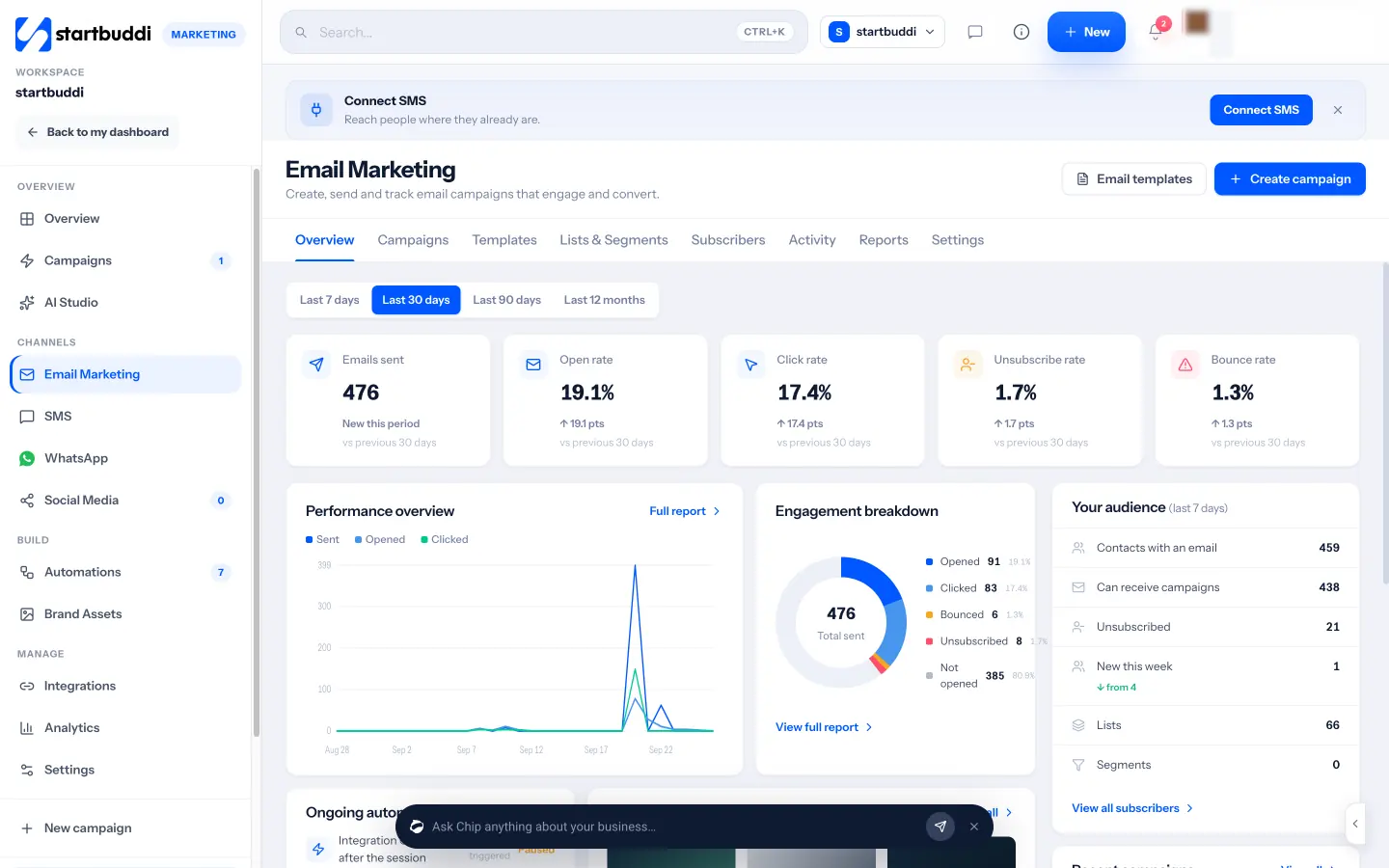
There is no separate funnel builder in startbuddi. Instead, the tools you need for each stage sit in one system and share the same contact list, so a person’s journey from first visit to repeat customer stays on one record.
| Funnel stage | Tools in startbuddi |
|---|---|
| Awareness | Landing pages, link in bio and business pages in Publish, social media scheduling (Starter and above) |
| Interest | Forms on your pages, with every submission creating or updating a contact; booking pages for free calls |
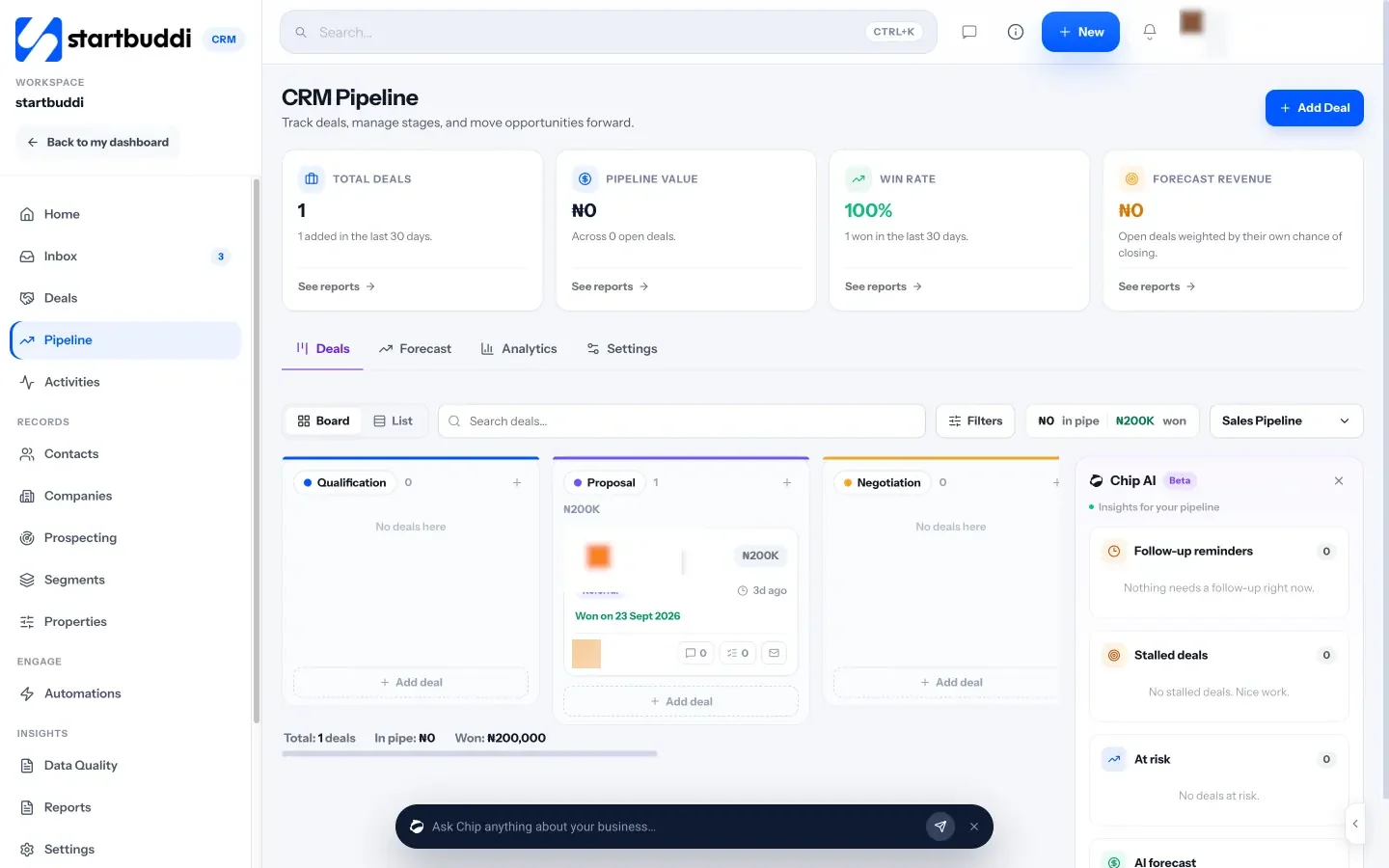
| Decision | Shared inbox for fast replies, automated welcome messages and email sequences, the sales pipeline to track each deal |
| Purchase | Estimates, contracts with e-signature, invoices and payment links with online payment |
| Repeat and referral | Segments of past customers, email campaigns, automations such as a cancellation win-back or a reactivation message |
A landing page can also link on to follow-on pages, such as a thank-you page, and show which follow-up emails it sends. Once someone becomes a lead, the sales pipeline shows every deal by stage, and it updates when a contact replies or an invoice on a deal is paid.
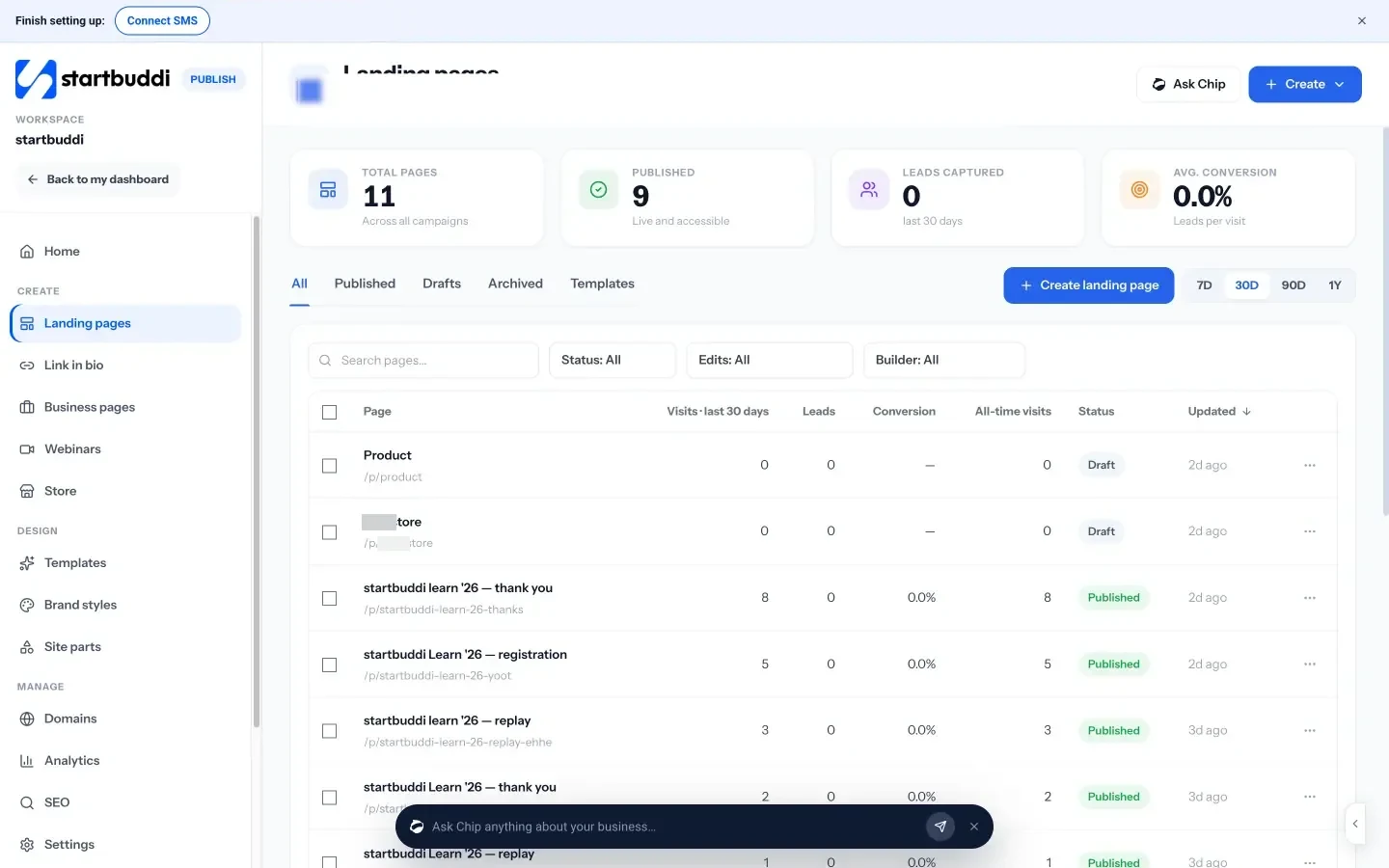
Email marketing and the rest of the Marketing module are available on Starter and above (see pricing), and every paid plan comes with a 30-day trial. Pages, forms, bookings, contacts and invoices are available on the Free plan, with limits.
Your next step
Draw your current funnel on paper: the five stages, what happens at each one today, and roughly how many people reach each stage each month. Circle the stage with the biggest drop and fix that first. When you want the pieces to work together, compare plans on our pricing page.
Sources
- Oldroyd, McElheran and Elkington, “The Short Life of Online Sales Leads”, Harvard Business Review, March 2011
- Amy Gallo, “The Value of Keeping the Right Customers”, Harvard Business Review, October 2014
Frequently asked questions
What is a sales funnel in simple terms?
The path people take from first hearing about you to becoming a paying, returning customer. It narrows at each stage because not everyone moves on to the next.
Do service businesses need a sales funnel?
Every business already has one, even if it isn't planned. Designing it means each stage has a clear next step, so fewer enquiries are lost.
What is the difference between a sales funnel and a sales pipeline?
A funnel counts how many people move through each stage overall. A pipeline tracks individual deals you're actively working on, such as quotes and proposals.
What tools do I need to build a sales funnel?
At minimum, a page, a form or booking link, a way to follow up by email or message, and a way to take payment. Keeping them connected matters more than having many tools.
SEO Copywriter| Email growth Specialist| I help businesses increase revenue with strategic SEO content & high-converting email funnels.