Chatbot: Definition, Examples and How It Works

A chatbot is software that holds a text or voice conversation with people automatically, answering questions or completing simple tasks without a person typing each reply. So what is chatbot software in a small business?
A chatbot is software that holds a text or voice conversation with people automatically, answering questions or completing simple tasks without a person typing each reply. So what is chatbot software in a small business? Usually it’s the assistant on your website or WhatsApp that answers the same twenty questions at any hour.
Key takeaways
- Chatbots come in two main types: rule-based bots that follow fixed menus and paths, and AI chatbots that understand free text and write their own replies.
- They work best on repeat questions (hours, prices, areas covered, booking) and worst on complaints or anything needing judgement.
- A good chatbot hands over to a person quickly and says plainly that it’s a bot.
- You’re responsible for what your chatbot tells customers, so it should only answer from information you’ve approved.
- A chatbot is not the same as live chat: live chat is the channel, a chatbot is one way to answer it.
Why chatbots matter for a small business
Small teams answer the same questions over and over. An IT support company gets “Do you support Mac?”, “What’s your call-out fee?” and “Can you come today?” dozens of times a week, often after hours. A chatbot answers those instantly, collects the details your team needs, and leaves your people free for the work that pays.
It also catches enquiries you’d otherwise lose. Someone who messages at 11pm and hears nothing until 10am may have booked a competitor by breakfast. A bot that replies straight away, takes their details and books a call keeps them.
What is chatbot software and how does it work?
Rule-based chatbots
A rule-based bot follows a script you draw: a greeting, buttons such as “Book a visit” or “Pricing”, and a fixed reply for each choice. It can’t understand a question it wasn’t built for, but it never goes off script. These suit simple flows like booking or collecting a quote request, and they’re a form of workflow automation.
AI chatbots
An AI chatbot uses a large language model to read whatever the customer types and write a reply. A well-run one is limited to your own knowledge: your FAQs, price list, policies and hours. It can handle questions phrased a hundred different ways, but it needs guard rails so it doesn’t invent prices or promises.
Where chatbots run
| Channel | Typical use | Notes |
|---|---|---|
| Website chat widget | Pre-sales questions, lead capture | Often paired with live chat for handover |
| Bookings, order updates, FAQs | Needs the WhatsApp Business API, not the phone app | |
| Facebook Messenger and Instagram | Replies to DMs and ad enquiries | Needs a connected business page |
| Voice | Answering calls | A voice agent is a chatbot that speaks |
A chatbot example with numbers
These figures are illustrative. A managed IT services firm in Lagos gets about 400 website and WhatsApp enquiries a month. Its team spends roughly four minutes on each first reply.
| Before the chatbot | After the chatbot | |
|---|---|---|
| Enquiries a month | 400 | 400 |
| Answered fully by the bot | 0 | 220 (routine questions) |
| Handed to a person | 400 | 180 |
| Team time on first replies | 400 x 4 min = 26.7 hours | 180 x 4 min = 12 hours |
| Enquiries after hours with no reply until morning | about 120 | 0 (bot replies, books calls or takes details) |
That’s nearly 15 hours a month back for the team, before counting the after-hours leads that no longer wait overnight. The figures to watch in your own business are the share the bot resolves and how often customers ask for a person.
Risks to manage
- Wrong answers. In Moffatt v. Air Canada, a Canadian tribunal held the airline responsible for incorrect refund information its chatbot gave a customer, and rejected the idea that the bot was a separate entity, according to McCarthy Tétrault’s summary (checked on 1 October 2026). Limit the bot to approved information.
- Hiding that it’s a bot. In the EU, Article 50 of the AI Act (checked on 1 October 2026) requires AI systems that interact with people to be designed so people know it’s an AI, unless that’s obvious, from 2 August 2026.
- No way out. A customer stuck in a loop gets angry fast. Always offer “talk to a person”.
- Collecting data carelessly. Ask only for what you need, and say why.
For a deeper look at choosing and running one, read what to know before adding an AI chatbot to your website.
Related terms
- Live chat: the real-time chat channel a chatbot often answers first.
- WhatsApp Business API: what a business needs to run a chatbot on WhatsApp.
- Workflow automation: the rule-based “when this, do that” logic behind scripted bots.
How startbuddi handles chatbots
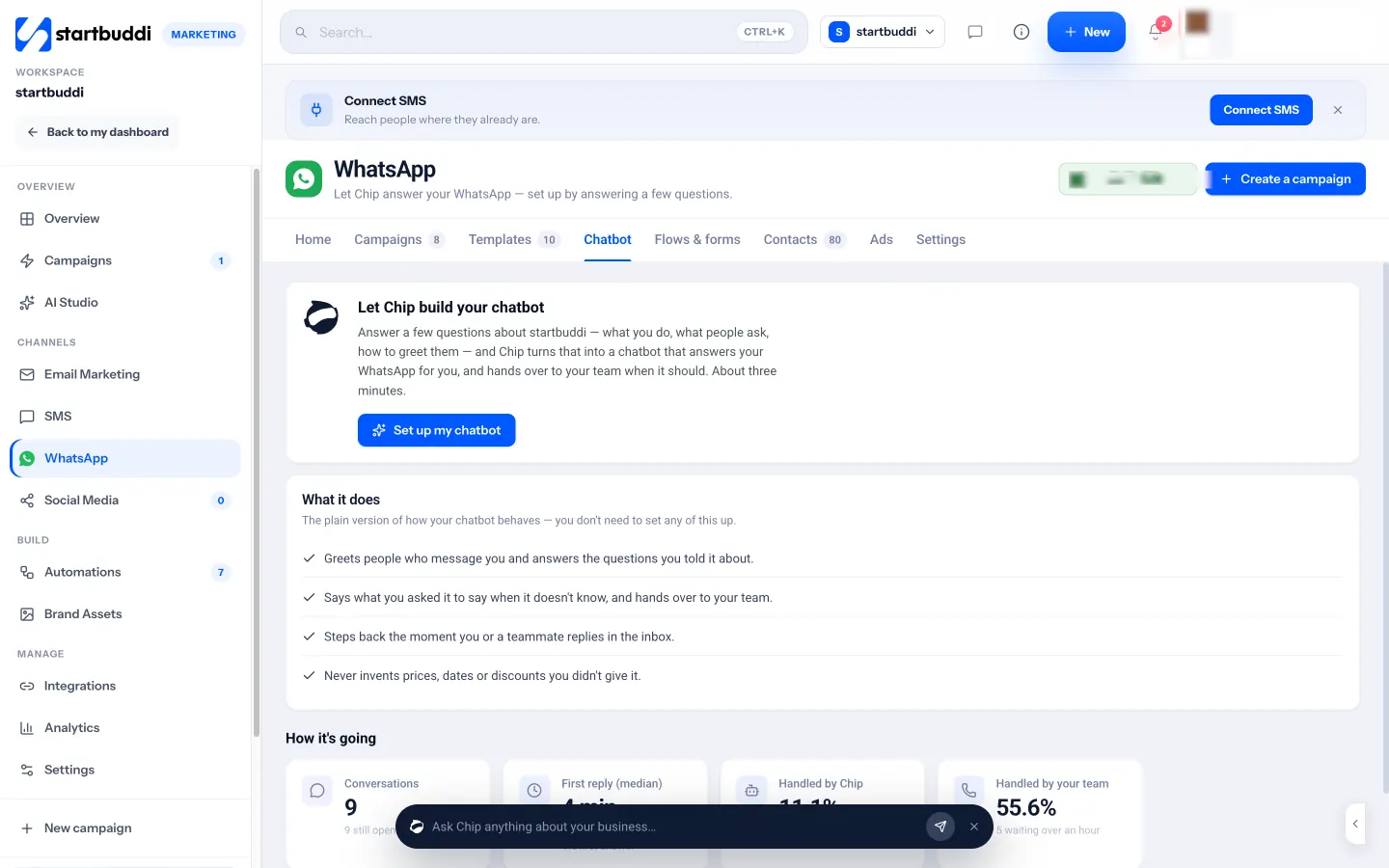
In startbuddi, the chatbot is Chip. On your website, Chip answers in the chat widget from the knowledge sources you approve, and hands the conversation to your team with the full context when it can’t help. On WhatsApp, you set up a chatbot by answering a few questions from Chip (what you do, the top questions, what never to promise); the setup says it takes about three minutes. The bot steps back the moment a teammate replies, and it’s instructed never to promise prices, dates or discounts you didn’t give it. For fixed paths, WhatsApp step-by-step replies follow exactly the route you draw.
Chip’s replies use Chip credits, and switching a chatbot on to answer by itself needs a paid plan; see pricing. Read more about website chat, or how it suits IT teams.
Let Chip answer the routine questions
Give Chip your FAQs and prices, and let it answer website chat and WhatsApp while you work. Start free with startbuddi.
Chatbot is part of Chip & AI agents in startbuddi.
See Chip & AI agentsRelated terms
FAQ
What is a chatbot in simple words?
A chatbot is a computer program that chats with people. You type or say something, and it replies automatically. Businesses use them to answer common questions, take bookings and collect contact details.
What is the difference between a chatbot and AI?
AI is the wider technology; a chatbot is one use of it. Some chatbots use no AI at all and just follow buttons and scripts. AI chatbots use language models to understand free text and write replies.
Are chatbots good for small businesses?
They're good for businesses that get the same questions repeatedly or receive enquiries outside working hours. They're less useful if most conversations need judgement, such as complaints or custom quotes. Start with your top ten questions and a clear handover to a person.
Can a chatbot replace customer service staff?
Not entirely. A chatbot can handle routine questions and collect details, which frees staff for harder problems. Customers still need a person for complaints, unusual requests and anything sensitive.
Do I have to tell customers they are talking to a chatbot?
It's good practice everywhere, and in some places it's a legal duty. The EU AI Act requires AI systems that talk with people to make clear they're AI, unless it's obvious, from 2 August 2026. A short line such as "I'm the virtual assistant" is enough.
Tiwalade Joanna Okedara-Kalu is the founder, CEO and CTO of startbuddi, the business system that brings clients, bookings, invoices, projects, marketing and the Chip AI assistant into one place. Tiwalade builds software around how service businesses really work day to day, and writes about client management, getting paid on time and why small businesses outgrow the tools they start with.
Founded startbuddi and leads its product and engineering