AI Receptionist: Definition, Examples and How It Works

An AI receptionist is software that answers a business's incoming calls or voice enquiries in a natural-sounding voice, then handles routine requests: answering questions, booking appointments, taking messages and passing callers to a person. So what is AI receptionist software in practice?
An AI receptionist is software that answers a business’s incoming calls or voice enquiries in a natural-sounding voice, then handles routine requests: answering questions, booking appointments, taking messages and passing callers to a person. So what is AI receptionist software in practice? It’s a voice chatbot doing the front-desk work.
Key takeaways
- An AI receptionist listens, understands the request and replies by voice, usually from a set of approved answers about your business.
- Its main jobs are answering common questions, booking or changing appointments, capturing caller details and handing over to a person.
- It’s most useful when calls arrive while you’re busy, after hours or in bursts you can’t staff for.
- It shouldn’t pretend to be human. Tell callers they’re speaking with an AI and offer a way to reach a person.
- Calls are usually billed by the minute, so check the cost per minute against the value of the calls it answers.
Why an AI receptionist matters for a small business
A small IT services firm can’t keep someone by the phone all day. The engineer who answers is the same engineer fixing a server, and a missed call from a new prospect often goes to the next firm on the list. A human receptionist solves that, but it’s a salary most five-person businesses can’t justify.
An AI receptionist sits in between. It picks up every time, answers the questions that come up daily (“Do you support small offices in Ikeja?”, “What are your hours?”), books a callback or a visit, and sends your team a summary. Your people only step in when the caller needs them.
What is AI receptionist software and how does it work?
- The caller connects. Depending on the product, that’s a phone number that forwards to the AI or a voice button on a website.
- Speech becomes text. The system turns what the caller says into text it can understand.
- It decides what to do. Using your instructions and approved knowledge (services, prices, hours, policies), it picks an answer or an action, such as checking your calendar.
- It replies by voice. The answer is turned back into speech, in short spoken sentences.
- It hands off and records. For anything outside its brief, it takes details or passes the call on, then logs a summary, the caller’s details and any booking it made.
AI receptionist vs other options
| AI receptionist | Human receptionist | Answering service | Voicemail | |
|---|---|---|---|---|
| Availability | Any hour | Office hours | Usually extended hours | Any hour |
| Answers questions | Yes, from approved info | Yes | Limited script | No |
| Books appointments | Yes, if connected to your calendar | Yes | Sometimes | No |
| Handles complaints and judgement calls | Poorly; should hand over | Well | Takes a message | No |
| Typical cost basis | Per minute or per call | Salary | Monthly fee or per call | Usually free |
An example with numbers
These figures are illustrative. A managed IT firm in Abuja gets about 300 inbound voice enquiries a month. Before using an AI receptionist, roughly 1 in 4 went unanswered because the team was on site.
| Without AI | With AI receptionist | |
|---|---|---|
| Enquiries a month | 300 | 300 |
| Unanswered | 75 | 0 |
| Fully handled by the AI (questions, bookings) | 0 | 170 |
| Passed to the team with a summary | 225 | 130 |
| Average call length | 3 minutes | 3 minutes |
| AI minutes used | 0 | 300 x 3 = 900 |
If even 5 of those 75 previously missed callers become clients on a monthly support contract, the AI pays for itself many times over. The number to watch is cost per minute against the value of what it catches. Check your provider’s per-minute rate and do the sum for your own call volume.
Rules and good practice
- Say it’s an AI. In the EU, Article 50 of the AI Act (checked on 1 October 2026) requires AI systems that interact with people to be designed so people know they’re dealing with an AI, unless that’s obvious, from 2 August 2026.
- Answering is not cold calling. In the US, the FCC ruled in February 2024 (checked on 1 October 2026) that AI-generated voices count as “artificial” under the Telephone Consumer Protection Act, so outbound robocalls using them need the called person’s prior consent. An AI receptionist that answers calls people make to you is a different use, but don’t repurpose it for outbound calling without checking the rules.
- Get consent to record. If calls are recorded, tell the caller at the start and check the rules where you and your callers are.
- Limit what it can say. Give it approved prices and policies only, and tell it to hand over rather than guess.
Our guide to customer service for small business covers how phone, chat and email fit together.
Related terms
- Chatbot: the text version of the same idea; an AI receptionist is a chatbot that speaks.
- Live chat: real-time website messaging, often run alongside voice.
- Appointment booking: the task an AI receptionist most often completes.
How startbuddi handles AI receptionist calls
startbuddi’s version is Chip on voice, and it’s honest to be precise about where it works. Chip answers voice calls that visitors start from your website chat widget, as a browser call (currently in Beta). It isn’t connected to your business phone number, so calls to your landline or mobile don’t reach it.
On a call, Chip answers from the public knowledge sources you approve, such as pricing, services and hours, and can book an appointment, capture contact details, promise a follow-up or create a task for your team, depending on the actions you switch on. When a caller asks for a person, your team is alerted. After the call, your team gets a summary, the caller’s details and the actions taken, plus the recording and transcript if recording is on (Chip announces it at the start).
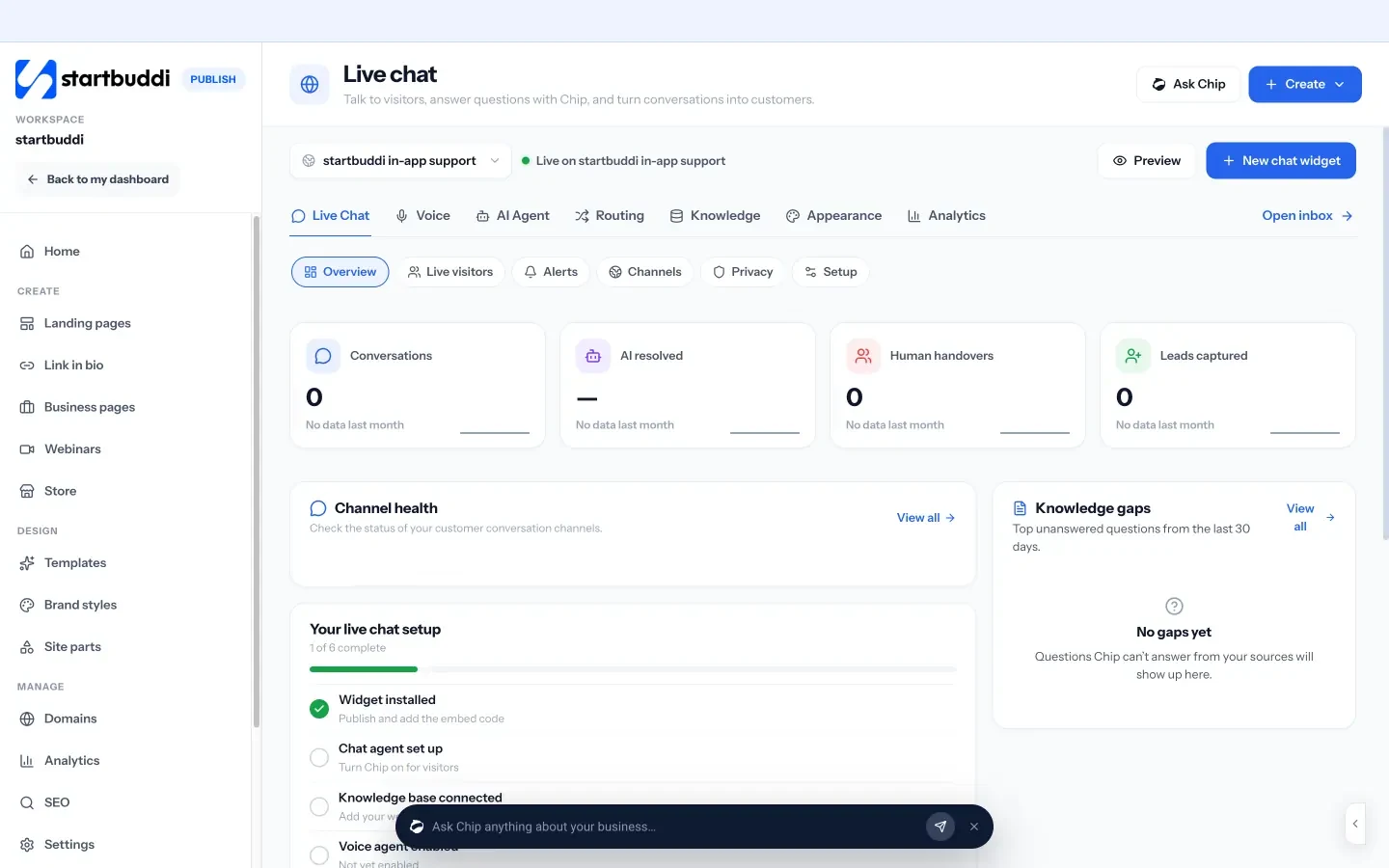
Voice calls use Chip credits by the minute, after any voice minutes your plan includes; your first three test calls are free. See pricing, read more on the website chat and voice page, or see how it fits IT teams.
Answer more enquiries without hiring a receptionist
Set Chip up to answer voice and chat questions from your website and pass the rest to your team. Start free with startbuddi.
AI Receptionist is part of Chip & AI agents in startbuddi.
See Chip & AI agentsRelated terms
FAQ
What does an AI receptionist do?
An AI receptionist answers calls or voice enquiries, responds to common questions, books appointments, takes messages and passes callers to a person when needed. It then sends the team a summary. It works best on routine, repeated requests.
Is an AI receptionist the same as a virtual receptionist?
Not quite. "Virtual receptionist" often means a remote human team answering your calls, while an AI receptionist is software. Some services blend both, with AI answering first and people taking over.
How much does an AI receptionist cost?
Most are priced per minute, per call or as a monthly plan with a minute allowance. The right comparison is the cost of the minutes against the value of calls you'd otherwise miss. Check each provider's current pricing page.
Can an AI receptionist book appointments?
Yes, if it's connected to your calendar or booking system. It checks available times, offers them to the caller and confirms the booking. Make sure the booking also sends the caller a confirmation.
Do callers know they are talking to an AI?
They should. Good practice, and in the EU a legal duty from 2 August 2026 unless it's obvious, is to make clear the caller is speaking with an AI. A short introduction such as "I'm the AI assistant for Kora IT" does the job.
Tiwalade Joanna Okedara-Kalu is the founder, CEO and CTO of startbuddi, the business system that brings clients, bookings, invoices, projects, marketing and the Chip AI assistant into one place. Tiwalade builds software around how service businesses really work day to day, and writes about client management, getting paid on time and why small businesses outgrow the tools they start with.
Founded startbuddi and leads its product and engineering