Best Booking App for Yoga Studios: 13 Options for 2026
The best booking app for yoga studios: 13 apps compared on class passes, waitlists, waivers, livestreams and branded apps, with prices checked 14 Oct 2026.



The best booking app for yoga studios that are small and independent is Punchpass: passes, waitlists, online waivers and Zoom classes from $59 a month. Solo teachers should look at OfferingTree, which includes a website from $35 a month. Established studios that want a marketplace and a full front desk system should compare Mindbody and WellnessLiving.
startbuddi is our product. It doesn’t run group classes, so it’s only on this list for teachers who sell private one-to-one sessions, and we say so in its entry. Prices were checked on each vendor’s own site on 14 October 2026.
Key takeaways
- A yoga studio needs class booking with capacity, a waitlist, class passes and memberships, and waivers. Most general appointment apps don’t do classes well.
- The biggest cost differences come from add-ons: a branded app runs from $99 a month (TeamUp) to $149 a month plus a $500 build fee (Walla), and livestream or on-demand video is often extra.
- Marketplaces (Mindbody, Vagaro, Glofox, Eversports) can bring new students, usually for a commission on their first purchase. Momence, Walla and Punchpass have none.
- Check how price grows: per location, per active member, per booking or per staff member.
Yoga studio booking apps compared
| App | Best for | Starting price (checked 14 Oct 2026) | Free plan | Standout feature |
|---|---|---|---|---|
| Punchpass | Small independent studios | $59/month (Grow) | No (14-day trial) | Waitlists, waivers and Zoom classes on the cheapest plan |
| OfferingTree | Solo teachers and small studios | $35/month, or $26 billed annually | No (14-day trial) | A website builder in every plan |
| Arketa | Solo teachers who stream classes | $49/month billed annually (Individual) | No (free trial) | Livestream and on-demand library |
| WellnessLiving | Growing studios wanting a full system | $69/month (Starter, one staff member) | No | Free setup and data migration |
| Mindbody | Established studios wanting the marketplace | From $79/month (US); £89 per location (UK) | No | Listing in the Mindbody consumer app |
| TeamUp | Studios that prefer no contract | $119/month (under 100 active customers) | No | No setup fee and no contract |
| Vagaro | Studios that also offer massage or beauty | $23.99/month for 6 months, then $30 (US) | No (30-day trial) | Classes, packages and memberships in every plan |
| Eversports | Studios in Austria, Germany and Switzerland | €59/month (Light, up to 49 bookings) | No | Aggregator connections and a marketplace |
| Momence | Hybrid studios with workshops and video | Pricing on request | No (free trial offered) | Automatic waitlist promotion, no marketplace |
| Glofox | Boutique studios with a bigger budget | $275/month (Essential, plus taxes) | No | Waivers, waitlists and spot booking included |
| Walla | Established studios in the US and Canada | $299/month per location (Core) | No | No fees on first-time bookings |
| bsport | European studios wanting a member app | Pricing on request | No | Branded member app from the Engage tier |
| startbuddi | Private one-to-one yoga sessions only | See pricing | Yes | Deposits through Paystack or Stripe |
Prices are in each vendor’s own currency, before tax, billed monthly unless stated. Several vendors offer annual discounts or promotions, so check the page for your country and size.
How we chose
We judged each app on what a yoga studio actually runs every week:
- Classes: a timetable with capacity, waitlists and spot booking.
- Selling: drop-ins, class passes, memberships and intro offers.
- Admin: online waivers, check-in and reminders.
- Online yoga: livestream and on-demand video.
- Students’ phones: a booking app, a branded app, or just a web page.
- True cost: the plan you’d need, plus the add-ons and how the price grows.
Every price and feature comes from the vendor’s own pricing or feature pages, checked on 14 October 2026. We didn’t run hands-on tests and don’t quote review scores.
1. Punchpass
Punchpass is class and pass software for independent studios.
Best for: small yoga studios and teachers running a timetable from one room.
Key features:
- Unlimited classes, passes and instructors, sold online.
- “Waitlists for full classes”, “Collect online waivers” and live online classes through Zoom, all on Grow.
- A video library (10,000 minutes on Grow) and recurring memberships from Flow.
Pricing: Punchpass pricing lists Grow at $59 a month, Flow at $99 and Pro at $149, with about 12% off annual billing. There’s a 14-day trial with no card, and it’s month to month. When we checked, new clients got 50% off the first two months.
Pros:
- Clear pricing and no contract.
- Waivers and waitlists on the cheapest plan.
Cons:
- Recurring memberships need Flow.
- No custom branded app.
- No marketplace to find new students.
Who should skip it: a multi-location studio.
2. OfferingTree
OfferingTree is booking, payments and a website for wellness teachers and small studios.
Best for: solo yoga teachers and small studios who don’t yet have a proper website.
Key features:
- Classes, private sessions and workshops, in person or online.
- Unlimited memberships and packages, digital waivers and an on-demand library.
- A website builder in every plan and a ClassPass connection.
Pricing: OfferingTree’s pricing page lists Essentials at “$35 /mo billed monthly” or $26 billed annually for one person, Pro at $59 ($49) and Pro Plus at $99 ($83). Studio plans start at $120 a month ($100 annually) for three team members. There’s a 14-day trial.
Pros:
- One bill for booking and your website.
- Free migration on studio plans.
Cons:
- Waitlists start at Pro for individuals.
- A branded app is $100 to $120 a month extra.
- The cheapest individual plan adds a platform fee on each transaction.
Who should skip it: a franchise; OfferingTree says it isn’t a fit for franchisors.
3. Arketa
Arketa is booking and video software for yoga, pilates and wellness teachers.
Best for: solo teachers who teach in person and stream classes.
Key features:
- Unlimited group classes, class packages and memberships, and waitlists.
- Livestream class management and an unlimited on-demand library.
- Workshops and events, and a booking app; a branded app on Studio Suite or as an add-on.
Pricing: Arketa’s pricing page lists Individual at “$49/mo” billed annually, for one team member, with a per-transaction platform fee. Studio Core, Growth and Suite are priced on request. There’s a free trial, and plans renew month to month unless you choose annual.
Pros:
- Strong livestream and video tools for one person.
Cons:
- Studio prices aren’t published.
- The Individual plan carries a platform fee on each transaction.
Who should skip it: studios that want to compare prices without a demo.
4. WellnessLiving
WellnessLiving is studio software with classes, appointments, memberships and a client app.
Best for: studios growing beyond a handful of teachers.
Key features:
- Class and appointment booking with flexible waitlist settings.
- Digital waivers and contracts, passes and memberships.
- The Achieve client app, Reserve with Google and ClassPass connections.
Pricing: WellnessLiving’s pricing page lists Starter at $69 a month for one staff member, Business at $199 and BusinessPro at $349, with 10% off annual billing. Setup and data migration are free. When we checked, Business and BusinessPro carried 80% off for two months.
Pros:
- A full system with published prices.
- Free migration.
Cons:
- Starter covers one staff member.
- Livestream and on-demand video are add-ons with no published price.
- The branded app needs BusinessPro or an add-on.
Who should skip it: a solo teacher.
5. Mindbody
Mindbody is the best-known platform for fitness and wellness businesses, with a large consumer app.
Best for: established studios that want students to find them in the Mindbody app.
Key features:
- Memberships with automatic renewals, and automatic late-cancel and no-show fees.
- Pick-a-Spot and room management from the Accelerate tier.
- Livestreaming “starting at $49/month” and on-demand video at $99 a month.
Pricing: Mindbody’s pricing page says “Starting at $79 USD/month” in the US and “£89/month per location” in the UK. Its Starter, Accelerate and Ultimate tiers are priced after a call. Listing in the app is free; a client new to your studio pays you through it, and Mindbody takes 20% of that first purchase, capped at $30.
Pros:
- A marketplace that can fill classes.
- Room to grow to several locations.
Cons:
- Tier prices aren’t published.
- A branded app isn’t available on Starter and is an add-on above it.
- Video costs extra.
Who should skip it: a new or one-room studio. Our Mindbody alternatives list goes into the reasons studios switch.
6. TeamUp
TeamUp is studio software priced by the number of customers who book or buy each month.
Best for: studios that want month-to-month terms and price that follows their size.
Key features:
- Memberships, packs, courses and on-demand content.
- Waivers and forms, family accounts and a penalty system for late cancellations.
Pricing: TeamUp’s pricing page starts at $119 a month for under 100 active customers (£99 in the UK), with “no setup fee” and “no contract or long-term commitment”. A custom branded app is $99 a month.
Pros:
- No contract.
- You don’t pay for members who didn’t book that month.
Cons:
- Expensive for a very small studio.
- The price rises as you grow.
Who should skip it: teachers with a few dozen students.
7. Vagaro
Vagaro is salon, spa and fitness software with a consumer marketplace.
Best for: yoga studios that also offer massage or beauty treatments.
Key features:
- Classes, a customer waitlist, and “Memberships, packages, & gift certificates” in every plan.
- Unlimited reminders and a marketplace listing.
Pricing: Vagaro’s US pricing page shows “$23.99 / mo.” for six months, then $30, plus $10 a month per extra bookable calendar. Live Stream and the Check-In App are $10 a month each, and selling memberships online in the US needs the $10 Online Shopping Cart. The UK page shows £20 a month. There’s a 30-day trial.
Pros:
- Low starting price.
- Classes and treatments on one calendar.
Cons:
- The add-ons add up.
- Sold in the US, UK, Canada and Australia only.
Who should skip it: a classes-only studio that wants everything in one price. See our Vagaro alternatives for others.
8. Eversports
Eversports Manager is studio software from Austria, with a consumer marketplace.
Best for: studios in Austria, Germany and Switzerland.
Key features:
- Drop-ins, class passes, memberships and spot booking.
- Online live classes and video on demand.
- Connections to ClassPass, Wellhub, USC, EGYM Wellpass and other aggregators.
Pricing: Eversports’ pricing page lists Light at €59 a month (€49 billed annually) for up to 49 bookings a month, Starter at €89 (€79) for up to 199, and Accelerate at €134 (€119) for up to 599, all excluding VAT, plus a one-off €99 setup fee. Appearing in its marketplace is optional; its help centre describes a commission on new customers who first book through it.
Pros:
- Strong in German-speaking countries.
- Many aggregator connections.
Cons:
- A setup fee, and the price rises with bookings.
- No self-serve trial.
Who should skip it: studios outside Europe.
9. Momence
Momence (Xplor Momence) runs classes, courses, workshops and video from one calendar.
Best for: hybrid studios with workshops, teacher trainings and video.
Key features:
- Capacity matched to the room, with waitlists that promote the next person automatically.
- Memberships in any format and payment plans.
- An on-demand library, courses and an optional branded app.
Pricing: Momence’s pricing page doesn’t publish prices. A free trial is offered, length not stated.
Pros:
- Good for teacher trainings and retreats alongside classes.
- No marketplace showing your students other studios.
Cons:
- Quote-only pricing.
Who should skip it: anyone who wants a price before a sales call.
10. Glofox
Glofox, part of ABC Fitness, is software for boutique gyms and studios.
Best for: boutique studios with a bigger budget.
Key features:
- Classes, courses and events, dynamic waitlists, digital waivers and spot scheduling on every plan.
- Membership pauses, family accounts and ClassPass integration.
Pricing: Glofox’s 2026 price page lists Essential at $275 a month, Boost at $375 and Elite at $625 (£185, £290 and £500), plus taxes. On-demand video starts at Boost.
Pros:
- A lot included at entry level.
Cons:
- The highest published entry price on this list.
- A branded app is an add-on below Elite.
Who should skip it: small and new studios.
11. Walla
Walla is boutique fitness software for the US and Canada.
Best for: established studios that want a polished app for members.
Key features:
- Classes, book-a-spot and waitlists, electronic waivers, intro offers and guest passes.
- A video library and built-in Zoom.
Pricing: Walla’s pricing page lists Core at “$299 /mo per location, billed monthly” and Pro at $599. A branded app on Core is $149 a month plus a $500 build fee. It says it doesn’t charge extra for first-time bookings.
Pros:
- No first-booking fees.
Cons:
- A high starting price per location.
- Term lengths vary and change your price.
Who should skip it: new studios.
12. bsport
bsport is studio software from France, sold across Europe.
Best for: European studios that want a branded member app.
Key features:
- Unlimited bookings, a website widget and online payments from Start.
- On-demand classes from Build, a branded member app from Engage and spot booking from Elevate.
Pricing: bsport’s pricing page is quote-only across five tiers. It says it doesn’t offer a free version or standard free trials; new studios get a free period at the start of their contract.
Pros:
- Setup help at no extra charge.
Cons:
- Contract required and no published prices.
Who should skip it: studios that want month-to-month terms.
13. startbuddi
startbuddi is an all-in-one workspace for service businesses: bookings, client records, an inbox for WhatsApp, Instagram and email, invoices and payments together. It doesn’t run group classes, so it’s not a studio timetable tool.
Best for: yoga teachers who sell private one-to-one sessions, corporate sessions or home visits, especially in Nigeria and across Africa.
Key features:
- A booking page for each session type, with prices in NGN, USD, GBP, EUR, KES, ZAR or GHS.
- Require full payment or a deposit to confirm: through Paystack (card, bank transfer, USSD or mobile money) or Stripe (card).
- Private online sessions in startbuddi’s own video room from the Starter plan, or by Google Meet or your own link.
- Subscriptions in Money for a monthly fee that renews by card.
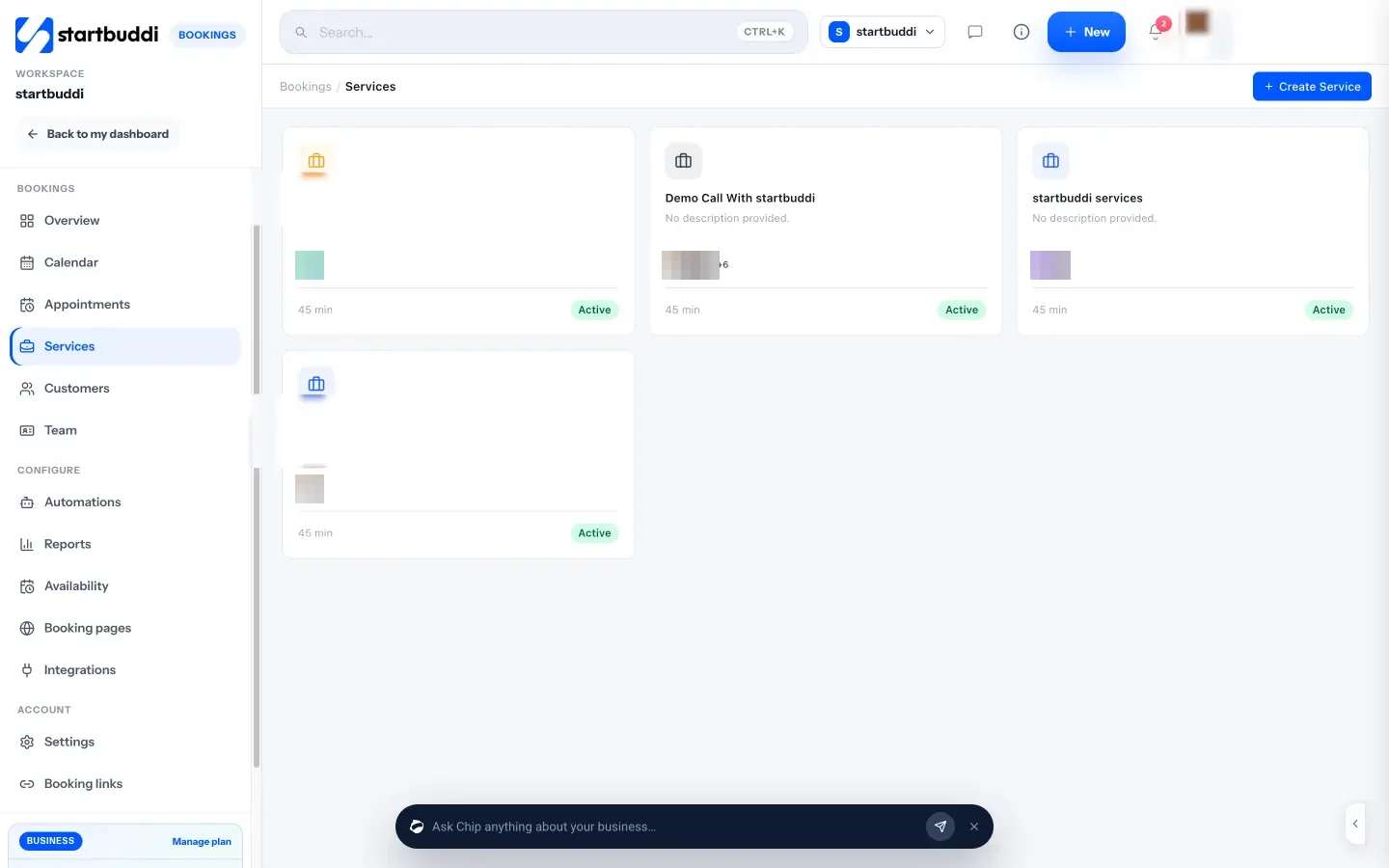
Pricing: free plan available; see pricing. The Free plan allows one live service.
Pros:
- Payment methods Nigerian students use.
- Private sessions, WhatsApp chats and invoices in one place.
Cons:
- No classes, class capacity, class passes, waitlists or waivers.
- No recurring bookings.
- No livestream classes to a group.
Who should skip it: any studio with a class timetable. Pick one of the twelve above.
How to choose the best booking app for yoga studios
Answer these in order.
- How many teachers and rooms? A solo teacher needs OfferingTree, Arketa or Punchpass. A one-room studio with a few teachers can stay on Punchpass or move to TeamUp or WellnessLiving. Several rooms or locations point to Mindbody, Glofox, Walla or Momence.
- Do students need your own app? A branded app looks professional but costs extra almost everywhere: $99 a month on TeamUp, $100 to $120 on OfferingTree, and $149 a month plus a $500 build fee on Walla. Many studios do fine with a web booking page and email.
- Do you teach online? If you stream or sell recordings, check whether video is included (Punchpass, Arketa, OfferingTree) or an add-on (Mindbody, WellnessLiving, Vagaro).
- Do you want a marketplace? Marketplaces bring new students but charge on the first purchase. If your classes fill from Instagram and word of mouth, skip it.
- How will you handle late cancellations? Most of these apps can charge a late-cancel fee on a pass or card. Our explainer on the no-show fee covers how to set one fairly.
Here’s an illustrative monthly cost for a one-room studio with three teachers and about 150 active students, at list prices billed monthly, checked on 14 October 2026, before card payments:
| App and plan | Plan | Recurring memberships | Branded app | Total |
|---|---|---|---|---|
| Punchpass Flow | $99 | Included | Not available | $99 |
| TeamUp (101 to 200 active customers) | $189 | Included | $99 | $189, or $288 with the app |
| WellnessLiving Business (after the promotion) | $199 | Included | Add-on | $199 plus any add-ons |
| Glofox Essential | $275 | Included | Add-on | $275 plus taxes |
The figures are illustrative: your country, size and promotions will change them. If you’re building a studio website too, our fitness website templates include a class timetable layout, and our best booking software list covers appointment-based businesses.
Is there a free app to book yoga classes?
Not among the studio apps checked here: they offer trials instead, from 14 days (Punchpass, OfferingTree) to 30 days (Vagaro). General booking apps with free plans, such as Setmore or Square Appointments, can book a class in a pinch, but you lose passes, memberships and waivers. startbuddi’s free plan works for private sessions only.
Try startbuddi for private sessions
If you teach private yoga in Lagos, Nairobi or London and want clients to pay before they book, start free with startbuddi Bookings. See the Bookings features first, and if you also coach one to one, our list of booking software for personal trainers covers lighter tools.
Frequently asked questions
What is the best booking app for a yoga studio?
For small independent studios, Punchpass offers passes, waitlists, waivers and Zoom classes from $59 a month. Solo teachers should look at OfferingTree or Arketa. Established studios that want a marketplace and a full system should compare Mindbody and WellnessLiving.
How much does yoga studio booking software cost?
From about $35 to $60 a month for a solo teacher or small studio (OfferingTree, Arketa, Punchpass), $100 to $200 for a growing studio (Punchpass Flow, TeamUp, WellnessLiving Business), and $275 or more for platforms such as Glofox and Walla. Mindbody, Momence and bsport quote prices after a call.
Do yoga booking apps take waivers?
Most do. Punchpass, OfferingTree, WellnessLiving, TeamUp, Glofox and Walla all list digital waivers. Vagaro handles them through its Forms add-on.
Can I livestream yoga classes through my booking app?
Yes, on several. Punchpass and OfferingTree connect to Zoom, Arketa has livestream management built in, and Mindbody charges from $49 a month for livestreaming. Vagaro's Live Stream add-on is $10 a month.
Do I need a branded app for my yoga studio?
No. A web booking page works for most small studios, and a branded app costs extra on almost every platform here. It's worth it once you have enough regular students that a home-screen icon makes booking noticeably easier.
Which yoga booking apps charge commission on new students?
Mindbody takes 20% of a new client's first purchase through its app, capped at $30. Eversports describes a commission on new customers from its marketplace. Walla says it doesn't charge for first-time bookings, and Punchpass and Momence have no marketplace.
Olabimpe Salami is the email and outreach specialist at startbuddi. Olabimpe writes about the messages that bring customers in and back: email, WhatsApp and SMS campaigns, follow-ups, and turning enquiries into paying clients.
Runs email and outreach at startbuddi