10 Mindbody Alternatives for Small Studios and Service Businesses
Mindbody alternatives compared: 10 tools for studios and appointment businesses, with prices checked 14 October 2026, free trials and the honest limits.


Photo: Clearcut Derby / Unsplash
The best Mindbody alternatives for a small studio are Vagaro, for classes, memberships and appointments at a low published price; WellnessLiving, the closest like-for-like swap with published plans; and Punchpass, for a simple class studio that wants passes, waitlists and waivers from $59 a month. People leave Mindbody mostly over quote-only plan prices, paid add-ons and contract terms.
startbuddi is our product. It is on this list for appointment-based businesses only, because it doesn’t run group classes, and its limits are listed as plainly as everyone else’s. Prices were checked on each vendor’s own site on 14 October 2026.
Key takeaways
- Mindbody publishes a starting price ($79 a month in the US, £89 per location in the UK) but its Starter, Accelerate and Ultimate tiers are all “Let’s talk”. You only learn the real price from a sales call.
- If you run group classes with capacity, waitlists and class packs, pick a studio tool: Vagaro, WellnessLiving, Punchpass, OfferingTree, TeamUp, Glofox, Momence, Walla or Zen Planner.
- If you mainly sell one-to-one appointments (massage, personal training, beauty, consultations), a lighter booking tool with deposits may be all you need, and costs less.
- Compare the add-ons, not just the base plan: branded apps, livestreaming, text reminders and website tools are extras on most of these.
Why look for a Mindbody alternative?
Mindbody is a big, capable platform for fitness, wellness and beauty businesses. Its pricing page (checked on 14 October 2026) lists integrated payments, booking widgets for your website, a listing in the Mindbody consumer app, reporting, memberships with automatic renewals and automatic late-cancel and no-show fees. The reasons small businesses look elsewhere are specific, and most of them come from Mindbody’s own pages.
You can’t see the full price before a sales call
The US page says “Starting at $79 USD/month” and calls it the “entry-level plan”. The UK page says “Starting at £89/month per location”. Every tier underneath, Starter, Accelerate and Ultimate, shows “Let’s talk” rather than a number, and the page says subscription prices increase with each new location. If you like to compare costs on a spreadsheet before you speak to anyone, that’s a hurdle.
Useful features sit higher up or cost extra
Text confirmations and reminders, room and resource management and promo codes start on Accelerate. Automated email and SMS marketing is on Ultimate. A branded app isn’t available on Starter and is an add-on above it. Mindbody’s virtual classes page prices livestreaming “starting at $49/month” and on-demand video at $99 a month. A small yoga or pilates studio can end up a long way from the headline $79.
Contract terms depend on your agreement
The pricing FAQ says “Your Mindbody contract depends on the specific plan and billing terms” and that cancelling may require advance notice. Read your agreement before you plan a switch date, so you don’t pay twice.
The marketplace fee on new clients
Listing in the Mindbody app is free on all plans, and Mindbody says it reaches over 3 million consumers a month. When a client new to your business makes their first purchase through it, the fee is 20%, capped at $30 (or 30 in local currency). Later bookings from that client are commission-free. For many studios that trade is worth it. If most of your clients come from Instagram and word of mouth, it’s money you may not need to spend.
It isn’t built for one-person businesses
Mindbody’s own FAQ says it “may not be a fit for independent, one-person operators who rent time at a shared location”. A solo massage therapist or a personal trainer renting gym space is better served by something smaller.
Mindbody alternatives compared
| Tool | Best for | Starting price (checked 14 Oct 2026) | Free plan | Standout feature |
|---|---|---|---|---|
| Vagaro | Studios and salons in the US, UK, Canada and Australia | $23.99/month for 6 months, then $30 (US); £20/month (UK) | No (30-day trial) | Classes, memberships and packages in every plan |
| WellnessLiving | Studios wanting a close Mindbody swap with published prices | $69/month (Starter, one staff member) | No | Free setup and data migration |
| Punchpass | Small class studios and solo teachers | $59/month (Grow) | No (14-day trial) | Passes, waitlists and waivers on the cheapest plan |
| startbuddi | Appointment-only businesses, especially in Nigeria and Africa | See pricing | Yes | Deposits through Paystack or Stripe, with clients and invoices in one place |
| OfferingTree | Solo teachers and small studios that want a website included | $35/month, or $26 billed annually (Essentials) | No (14-day trial) | Website builder in every plan |
| TeamUp | Growing studios that prefer month-to-month terms | $119/month (under 100 active customers) | No | No setup fee and no contract |
| Glofox | Boutique gyms and studios with bigger budgets | $275/month (Essential, plus taxes) | No | Waivers, waitlists and spot booking on every plan |
| Momence | Studios selling classes, courses and on-demand video | Pricing on request | No (free trial offered) | No marketplace commission because there is no marketplace |
| Walla | Established boutique studios in the US and Canada | $299/month per location (Core) | No | No fees for first-time bookings |
| Zen Planner | Gyms and martial arts schools | From $99/month (Studio) | No | Month-to-month, with free onboarding |
Prices are in the vendor’s own currency, before tax, as shown on its site. Several vendors raise prices with locations, staff, bookings or active members, so check the page for your size and country.
1. Vagaro
Vagaro is booking and business software for salons, spas and fitness studios, with a consumer marketplace.
Best for: small studios and salons in the US, UK, Canada or Australia that want classes and appointments on one calendar at a low starting price.
Key features:
- Classes, a customer waitlist, and “Memberships, packages, & gift certificates” in every plan.
- Free listing on the Vagaro Marketplace, plus booking from Instagram, Facebook and Apple Maps.
- 1,000 free emails a month.
Pricing: Vagaro’s US pricing page shows $30 crossed out and “$23.99 / mo.” as an “Exclusive rate for the first 6 months”, with exclusions. Each extra bookable calendar costs $10 a month, up to seven. The UK page shows £20 a month against £30. There’s a 30-day trial.
Pros:
- A published price you can work out yourself.
- Classes, packages and memberships aren’t locked behind a higher tier.
Cons:
- Many studio extras are add-ons: in the US, selling memberships and packages online needs the Online Shopping Cart ($10 a month), and Forms, Live Stream and the Check-In App are $10 a month each. A branded app is $100 a month.
- The US headline price is introductory.
- Its own site leads with beauty, so some fitness tools feel secondary.
Who should skip it: studios outside Vagaro’s four countries. If you’re weighing it up, our Vagaro alternatives list covers the other direction.
2. WellnessLiving
WellnessLiving is studio and wellness software that competes head-on with Mindbody, with classes, appointments, memberships and a client app.
Best for: studios that want most of what Mindbody does but with prices on the page.
Key features:
- Class and appointment booking, flexible waitlist settings, and digital waivers and contracts.
- The Achieve client app, plus Reserve with Google, ClassPass and Wellhub connections.
- “FREE Setup and Data Migration”, with free training.
Pricing: WellnessLiving’s pricing page lists Starter at “$69 /mo” for one staff member, Business at $199 a month and BusinessPro at $349 a month, with 10% off for annual billing. When we checked, Business and BusinessPro carried a promotion of 80% off for two months.
Pros:
- Free migration lowers the cost of switching.
- Unlimited staff from the Business plan.
Cons:
- Starter covers one staff member, so most studios with several teachers will be on Business.
- The branded (white label) app is on BusinessPro or an add-on.
- Livestream and on-demand video are add-ons with no published price.
Who should skip it: a solo teacher who doesn’t need a full studio system.
3. Punchpass
Punchpass is simple class and pass software for independent studios.
Best for: small yoga, pilates, dance and martial arts studios, and solo teachers who sell passes.
Key features:
- Unlimited classes, passes and instructors from the first plan.
- Waitlists for full classes, online waivers and live online classes through Zoom on Grow.
- Recurring memberships from the Flow plan.
Pricing: Punchpass pricing lists Grow at $59 a month, Flow at $99 and Pro at $149, with about 12% off for annual billing. There’s a 14-day trial with no card, and a promotion of 50% off the first two months for new clients when we checked. It is month to month, and the page says “The only fee you pay to Punchpass is our monthly subscription.”
Pros:
- Clear, low pricing with no contract.
- Waivers and waitlists on the cheapest plan.
Cons:
- Recurring memberships need Flow or above.
- No custom branded app.
- Built for classes, so appointment-heavy businesses will find it thin.
Who should skip it: spas and wellness centres whose income is mostly one-to-one treatments.
4. startbuddi
startbuddi is an all-in-one workspace for service businesses: bookings, client records, an inbox for WhatsApp, Instagram and email, invoices and payments in one account. It does not run group classes, so it’s an alternative only for businesses that use Mindbody mainly for appointments.
Best for: massage therapists, personal trainers, beauty businesses and consultants who sell one-to-one sessions, especially in Nigeria and across Africa where clients pay by transfer, USSD or mobile money.
Key features:
- A booking page for your services, with prices in NGN, USD, GBP, EUR, KES, ZAR or GHS.
- Require full payment or a booking deposit before a booking is confirmed: through Paystack (card, bank transfer, USSD or mobile money) or Stripe (card). The slot is held for 30 minutes while the client pays.
- One automatic reminder per confirmed booking at the time you choose (1 to 48 hours before; 24 by default), by email, or by WhatsApp or SMS once those channels are set up.
- Every booking creates or updates the client’s record, and you can generate an invoice from a booking.
- Subscriptions in Money, for a monthly plan a client pays by card that renews automatically through Stripe or Paystack.
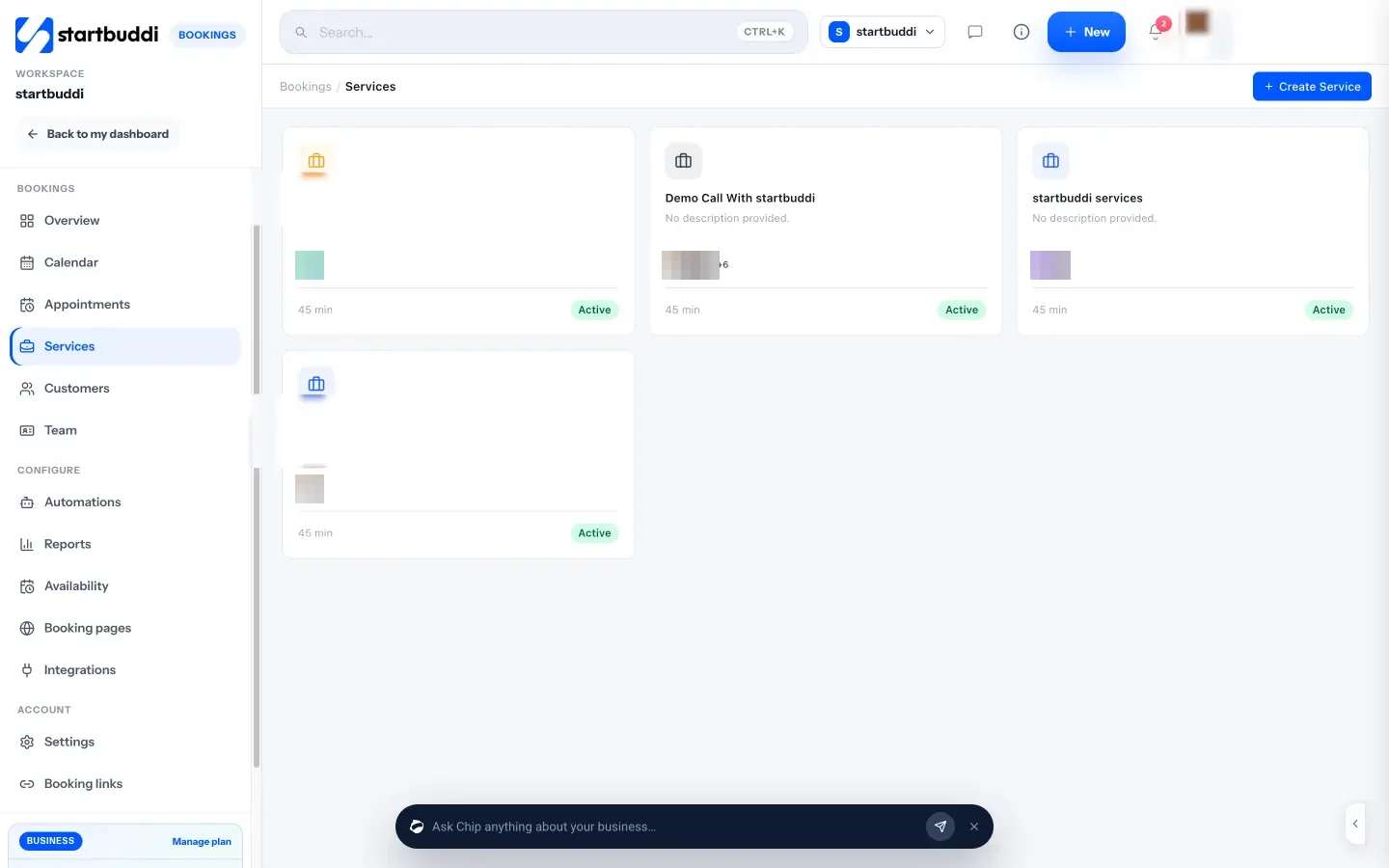
Pricing: free plan available; see pricing. The Free plan allows one live service and one team member.
Pros:
- Local payment methods through Paystack: card, bank transfer, USSD and mobile money.
- Bookings, client history, WhatsApp conversations and invoices in one place.
- No marketplace, so no commission on new clients.
Cons:
- No group classes, class capacity, class packs or session credits.
- No recurring bookings: each appointment is booked on its own.
- No waitlist and no consumer marketplace.
- Calendar sync is one way: bookings go to Google Calendar, but your Google events don’t block slots.
Who should skip it: any studio that runs a class timetable. For the client-management side of training, see our guide to a CRM for personal trainers.
5. OfferingTree
OfferingTree combines booking, payments and a website for wellness teachers and small studios.
Best for: solo teachers and studios with a few staff who want their website included in the price.
Key features:
- Classes, appointments and events, online or in person.
- Unlimited memberships and packages, digital waivers and an on-demand library.
- A website builder in every plan, plus a ClassPass connection.
Pricing: OfferingTree’s pricing page lists Essentials for individuals at “$35 /mo billed monthly” or $26 billed annually, Pro at $59 ($49 annually) and Pro Plus at $99 ($83 annually). Studio plans start at $120 a month ($100 annually) for three team members. There’s a 14-day trial and free migration on studio plans.
Pros:
- One bill covers booking and the website.
- Waitlists on studio plans and on Pro and above for individuals.
Cons:
- The branded mobile app is $100 to $120 a month extra.
- Team seats are capped by tier.
- The cheapest individual plan adds a platform fee on each transaction.
Who should skip it: a franchise. OfferingTree says it is “not a fit for franchisors”.
6. TeamUp
TeamUp is studio and gym software priced by the number of customers who book or buy each month.
Best for: growing studios that want month-to-month terms and price that tracks their size.
Key features:
- Memberships, packs, appointments, courses and on-demand content.
- Waivers and forms, family accounts and a penalty system for late cancellations.
- Unlimited locations.
Pricing: TeamUp’s pricing page starts at $119 a month for under 100 active customers and $189 for 101 to 200 (£99 and £139 in the UK). It says “There is no setup fee” and “There is no contract or long-term commitment”. A custom branded app is $99 a month.
Pros:
- No contract and no setup fee.
- You don’t pay for clients who didn’t book that month.
Cons:
- The price rises as you grow.
- The branded app is extra.
- Trial length isn’t stated on its site.
Who should skip it: very small studios, where $119 is a lot for under 100 clients.
7. Glofox
Glofox, part of ABC Fitness, is software for boutique gyms and studios.
Best for: boutique studios with a bigger budget that want waivers, waitlists, spot booking and a consumer app included.
Key features:
- Class, course and event scheduling, dynamic waitlists and digital sign-up with waivers.
- Membership pauses, family accounts and ClassPass integration on every plan.
- On-demand video from the Boost plan.
Pricing: Glofox’s main pricing page is a quote form, but its 2026 price page lists Essential at $275 a month, Boost at $375 and Elite at $625 (£185, £290 and £500 in the UK), “plus applicable taxes”.
Pros:
- A lot included on the entry plan.
- Prices published in many currencies.
Cons:
- The most expensive entry price on this list.
- A branded app is an add-on below Elite.
- No on-demand video on Essential.
Who should skip it: solo teachers and new studios.
8. Momence
Momence (Xplor Momence) runs classes, courses, workshops and an on-demand library from one calendar.
Best for: studios that sell a mix of live classes, workshops and video.
Key features:
- Capacity that matches the room or equipment, with waitlists that promote the next person automatically.
- Memberships in any format, with payment plans.
- An on-demand video library and courses, and an optional branded app.
Pricing: Momence’s pricing page doesn’t publish prices; it puts together pricing after a conversation. A free trial is offered, length not stated.
Pros:
- Strong for hybrid studios with video.
- Its site says customers can’t search for other businesses on the Momence app, so your clients aren’t shown competitors.
Cons:
- Quote-only pricing.
- No marketplace to bring new clients.
Who should skip it: anyone who wants a published price before talking to sales.
9. Walla
Walla is studio management software for boutique fitness, sold in the US and Canada.
Best for: established boutique studios that want a polished member app and are ready to pay for it.
Key features:
- Classes, appointments and enrolments, with book-a-spot and waitlists.
- Electronic waiver management, intro offers and guest passes.
- A video library and built-in Zoom on all plans.
Pricing: Walla’s pricing page lists Core at “$299 /mo per location, billed monthly” and Pro at $599. Guided onboarding with migration is a one-off $429. It says “we don’t charge extra for first-time bookings”.
Pros:
- No fees on first-time bookings.
- A lot of studio features on every plan.
Cons:
- A high entry price per location.
- On Core, the branded app is $149 a month plus a $500 build fee.
- Term lengths vary, and your price reflects the one you choose.
Who should skip it: new studios and anyone outside North America.
10. Zen Planner
Zen Planner is membership and billing software for gyms, CrossFit boxes and martial arts schools.
Best for: membership-based gyms that bill monthly and track attendance.
Key features:
- Membership management, automated billing, class scheduling and attendance.
- Staff and member apps.
- Free onboarding sessions and done-for-you data migration.
Pricing: Zen Planner’s pricing page lists Studio “Starting at $99 /mo”, Essentials from $198 (adds a website) and Ultimate from $348 (adds marketing automation). Prices scale with active members. It says “Zen Planner runs month-to-month”.
Pros:
- Month-to-month terms.
- Branded app is a modest $39 a month add-on.
Cons:
- “Starting at” prices rise with your member count.
- A website needs Essentials or above.
Who should skip it: spas, salons and appointment-led wellness businesses.
How to choose your Mindbody alternative
Start with what you actually sell.
- Mostly group classes? You need class capacity, waitlists, packs and memberships. Look at Punchpass or OfferingTree if you’re small, Vagaro or WellnessLiving if you also take appointments, and TeamUp, Glofox, Momence or Walla as you grow.
- Mostly one-to-one appointments? You need booking, deposits, reminders and client records. A studio platform is more than you need. startbuddi, Vagaro or a general tool from our best booking software list will do it for less.
- Do you rely on a marketplace for new clients? Mindbody, Vagaro and Glofox have consumer apps. Momence, Walla, Punchpass and startbuddi don’t, so you’d bring clients from your own channels.
Then price your real month. Here’s an illustrative comparison for a small studio with three teachers, using list prices checked on 14 October 2026 and leaving out card payments:
| Cost | Punchpass (Flow) | WellnessLiving (Business, after the promotion) | Vagaro (US, after the intro rate) |
|---|---|---|---|
| Base plan | $99 | $199 | $30 |
| Extra staff or calendars | Included | Included | 2 × $10 = $20 |
| Selling memberships online | Included | Included | $10 (Online Shopping Cart) |
| Livestream classes | Included (Zoom) | Add-on, price not published | $10 (Live Stream) |
| Total before card payments | $99 | $199 plus any video add-on | $70 |
The figures are illustrative and change with your size: check each vendor’s page for your country. The point is that a low headline price plus add-ons can still be the cheapest, and a high one can include almost everything.
Finally, think about no-shows. Late-cancel fees and deposits protect a full class and a one-to-one slot alike; our explainer on the no-show appointment covers how to handle the ones that still happen.
Migrating from Mindbody
Plan a few weeks, not a weekend, because memberships and pre-paid passes need care.
- Check your contract. Find your notice period and renewal date, and pick a switch date after it.
- List what you use: class types, appointment types, pricing options, memberships, intro offers and automations.
- Export your data. Get your client list, active memberships and remaining pass balances out of Mindbody before you cancel. Ask Mindbody support if a report you need isn’t available to you.
- Ask the new vendor about migration. WellnessLiving and OfferingTree studio plans offer free migration, and Zen Planner offers done-for-you migration; Walla charges for guided onboarding.
- Rebuild your timetable and pricing, then honour remaining class credits by hand or as a custom pass.
- Move clients’ payment details. Recurring memberships usually need clients to re-enter a card in the new system, so warn them early.
- Switch your links on your website, Instagram and Google profile, and run both systems for a short overlap.
If you’re moving to startbuddi for appointments, import contacts from a CSV file in Customers, then Contacts, then Import (up to 10,000 at a time; contacts only). Set up each service with its price and deposit, then share the booking link. Our let clients book you page shows the booking side in more detail.
Try startbuddi for appointments
If you sell one-to-one sessions rather than classes and want deposits, reminders, client records and invoices in one place, start free with startbuddi Bookings. Set up one service, take a deposit and see if it fits before you pay for anything. Compare plans on the pricing page.
Frequently asked questions
What is the best alternative to Mindbody?
For a small studio, Vagaro is the cheapest all-rounder with classes, memberships and appointments, and WellnessLiving is the closest like-for-like swap with published prices. Punchpass suits small class studios that want something simple. Appointment-only businesses can use a lighter booking tool such as startbuddi.
Is there a cheaper alternative to Mindbody?
Yes. Punchpass starts at $59 a month and Vagaro at $23.99 a month for six months in the US (then $30), against Mindbody's "Starting at $79 USD/month" with higher tiers quoted on request. Add the add-ons you need before you compare, because they change the answer.
Does Mindbody charge a fee for new clients from its app?
Yes, on the first purchase by a client new to your business who finds you through the Mindbody app. Mindbody's pricing page puts the fee at 20%, capped at $30 or 30 in local currency, and says every booking after the first is commission-free. Existing clients and tracked referral links carry no fee.
Which Mindbody alternatives have no contract?
TeamUp says there is no contract or long-term commitment, Punchpass is month to month, and Zen Planner runs month to month. Vagaro says you can cancel any time with no cancellation fees, with exclusions. Walla offers several term lengths that change your price.
Is there a Mindbody alternative with a free plan?
Not among the class studio tools on this list: they offer trials instead. startbuddi has a free plan for one-to-one bookings, with one live service, but it doesn't run group classes.
Can I move my clients from Mindbody to another system?
Yes. Export your client list and membership details before you cancel, and ask your new vendor about migration, since several offer it free. Clients on recurring memberships usually need to re-enter their card details in the new system.
Omolola Akiyode is the operations and project manager at startbuddi, leading cross-functional projects and the content that helps founders get set up. Omolola writes about projects, websites and getting found online, and turns complex ideas into clear, practical steps.
Runs operations and projects at startbuddi