Goal setting for small business: how to set goals your team will actually hit
A four-part guide to goal setting for small business: structure your goals, write SMART goals with examples, use OKRs and KPIs, and keep goals alive with check-ins.


This guide is about goal setting for small business owners who are tired of new-year resolutions that are forgotten by March. It is for founders, freelancers and small teams who want a handful of clear goals, a simple way to track them and a weekly habit that keeps them moving.
The short answer: pick three to five goals for the year, each tied to a real number, break each one into quarterly targets and the actions that drive them, give every goal one owner, and check progress for ten minutes every week. Everything else in this guide is detail on how to do those five things well.
There are four chapters. First, why goal setting works and how to structure goals from your big themes down to weekly work. Second, business goals examples you can copy, written with the SMART method, plus a worked example that turns a revenue goal into daily activity. Third, OKRs and KPIs: what they are, which you need, and how to write them. Fourth, the habits that make goals stick: check-ins, reviews and resets. Each chapter explains the idea first and then shows how to do it in startbuddi.
Why goal setting for small business works, and how to structure it
- Why goal setting works
- When goals backfire
- Goals, plans and tasks: know the difference
- Build your goal structure from the top down
- Worked example: a cleaning company's goal structure
- A two-hour goal-setting session
- Goal setting when you are just starting out
- How many goals should a small business have?
- Cover the whole business, not just sales
- Involve the team
- Five questions to ask before you commit to a goal
- Common goal-setting mistakes
- Set up your strategy in startbuddi
Most small businesses have goals. They are just not written down, not measured and not shared. "Grow the business" and "get more clients" feel like goals, but they cannot tell you on a Tuesday afternoon whether you are winning, or what to do next. Good goal setting for small business turns those wishes into a few specific targets that guide what you do each week.
This chapter explains why goals work (and when they backfire), the difference between goals, plans and tasks, how to build a simple goal structure from your big themes down to weekly actions, and how many goals a small business should have. At the end you will set up your strategy in startbuddi.
Why goal setting works
Goal setting is one of the most studied ideas in workplace psychology. Edwin Locke and Gary Latham reviewed 35 years of research and found that specific, difficult goals led to higher performance than vague goals or simply being told to "do your best", as long as people were committed to the goal, had the ability to reach it and received feedback on their progress (Locke and Latham, 2002, American Psychologist).
Look closely at those conditions, because they are the whole recipe:
- Specific: everyone knows exactly what success looks like.
- Difficult but possible: it stretches you without being fantasy.
- Committed: the people doing the work believe in it and ideally helped set it.
- Able: they have the skills, time and tools.
- Feedback: progress is visible, often.
Most failed goals miss one of these. A goal set by the owner alone lacks commitment. A goal nobody measures lacks feedback. A goal that needs twice the team you have lacks ability.
When goals backfire
Goals are a tool, and like any tool they can hurt. Watch for three problems.
- Tunnel vision. A team chasing "50 new customers" may sign bad-fit customers who leave in a month. Pair growth goals with a quality measure, such as customers still active after 90 days.
- Too many goals. Ten goals means no goal. Energy spreads thin and nothing gets finished.
- Goals as punishment. If missing a stretch goal leads to blame, people will quietly set easy goals next time. Separate ambitious goals from pay and performance ratings, especially in a small team.
Goals, plans and tasks: know the difference
People mix these up constantly, and it causes confusion in meetings.
| Level | Question it answers | Example for a small bakery |
|---|---|---|
| Theme (or pillar) | What are we trying to do as a business? | Become the go-to bakery for office catering in our area |
| Goal | What outcome will show we are getting there? | Grow catering revenue to $6,000 a month by December |
| Key result or target | How will we measure it? | 20 repeat office clients; average order $150 |
| Plan or project | What will we do to get there? | Launch a catering menu page; visit 40 offices; offer a first-order discount |
| Task | What is the next action, by whom, by when? | Tolu drafts the catering menu by Friday |
A goal is an outcome, not an activity. "Post on Instagram every day" is a plan. "Get 30 catering enquiries a month from Instagram" is a goal. The distinction matters because you can do every planned activity and still miss the goal, and that is useful information: it tells you the plan is wrong.
Build your goal structure from the top down
A simple structure keeps everything connected. Work through these steps in order, ideally in a two-hour session once a year with a lighter review every quarter.
- Write your themes. Two to four sentences about what the business is trying to do over the next few years. For example: "Get more customers", "Deliver work people rave about", "Build a team that can run without me".
- Pick three to five annual goals that move those themes. Each is an outcome with a number and a date.
- Split each annual goal into quarterly targets. A year is too long to feel urgent. A quarter is short enough to plan for.
- List the projects and habits that will drive each quarterly target.
- Turn the first few steps into tasks with owners and dates.
- Choose how you will track each goal and when you will check in.
If you do not yet have a business plan, a one-page version is a good place to start your themes. The free business plan template keeps it short.
Worked example: a cleaning company's goal structure
Here is the full structure for a residential cleaning company in Nairobi with an owner, an operations lead and eight cleaners. It shows how a theme becomes a goal, then quarterly targets, then projects and tasks.
- Theme: Build steady, recurring income so we are not starting from zero every month.
- Annual goal: Grow recurring weekly contracts from 25 homes to 60 homes by December, owned by the owner.
- Quarterly targets: 32 homes by March, 40 by June, 50 by September, 60 by December.
- Quality guard: keep complaints under 2% of visits every month.
- Projects: a "switch to weekly" offer for one-off customers; a referral reward for existing clients; a partnership with two estate management companies.
- First tasks: the owner writes the weekly offer by 10 January; the operations lead lists every one-off customer from the last six months by 12 January; the owner books meetings with two estate managers by 20 January.
Look at how each level answers "why?" for the one below it. The task "list every one-off customer" makes sense to anyone who can see the goal it serves. That is the point of a structure: people make better decisions about their own work when they can see how it connects to the bigger picture.
A two-hour goal-setting session
You do not need an away day. For a small team, two focused hours once a year (plus a shorter session each quarter) is enough. Here is an agenda:
- Look back (20 minutes). What went well last year? What did not? What numbers do we actually have?
- Themes (20 minutes). Agree two to four themes. Keep last year's if they still fit.
- Brainstorm goals (30 minutes). Everyone writes possible goals on sticky notes or a shared board. Group similar ones.
- Choose (20 minutes). Vote for the three to five that matter most. Put the rest on the "not this year" list.
- Make them measurable (20 minutes). Add a number, a date and an owner to each.
- First steps (10 minutes). Each owner names the first task they will do this week.
End the session by writing the goals somewhere everyone can see them. A goal that lives in one person's notebook is not a team goal.
Goal setting when you are just starting out
If your business is very new, you may not have much data yet, and that is fine. Early-stage goals are often about learning rather than growth: "Talk to 30 potential customers by March", "Win the first 5 paying customers", "Find out which of our two services people will pay more for". These are still specific, measurable and dated. Once you have a few months of real numbers, switch to growth goals based on what you learned.
How many goals should a small business have?
Fewer than you think. A useful rule of thumb:
- Solo founder or freelancer: two or three goals a year, one of which can be personal (such as working fewer weekends).
- Team of two to ten: three to five company goals, and one or two personal goals per person that link to them.
- Team of ten to fifty: three to five company goals, and each team sets two or three goals that support them.
If you have more ideas than that, good. Put them on a "not this year" list. Saying no to good ideas is what gives the chosen goals room to succeed.
Cover the whole business, not just sales
New founders often set only revenue goals. Revenue matters, but a business can grow sales while running out of cash, burning out its team or losing its best customers. A balanced set covers a few areas. You do not need a goal in every area every year, but check that you are not ignoring one that is quietly getting worse.
- Customers and sales: new customers, revenue, average order value.
- Delivery and quality: on-time delivery, reviews, repeat customers.
- Money: profit margin, cash in the bank, days to get paid.
- Team: hiring, training, engagement, staff turnover.
- Owner: hours worked, time off, the tasks only you can do.
Chapter two has example goals for each of these areas.
Involve the team
If you have a team, set goals with them, not for them. Commitment was one of Locke and Latham's key conditions, and people commit to goals they helped shape. A practical approach for a small team: the owner proposes the themes and a draft of company goals; each person suggests what they could own and what they would need; you agree the final set together. It takes an extra hour and saves months of half-hearted effort.
Five questions to ask before you commit to a goal
- Why does this matter now? If you cannot explain it in one sentence, the goal may be a nice-to-have.
- What will we stop doing to make room for it? Time is fixed. A new goal without a trade-off usually means longer hours.
- Who owns it, and do they want to? A reluctant owner is an early warning sign.
- How will we know in week three whether it is working? If there is no early signal, add a leading measure.
- What could go wrong? Name the biggest risk now, so it does not become an excuse later.
If a goal passes all five, commit to it and tell the team. If it fails two or more, park it on the "not this year" list and revisit it at the next quarterly reset.
Common goal-setting mistakes
- Setting goals and never looking at them again. The fix is a weekly check-in, covered in chapter four.
- Goals with no owner. "We" will increase sales means nobody will. One person owns each goal, even if many people help.
- Goals you cannot measure yet. If you want to grow repeat customers but do not track who comes back, the first goal is to start tracking.
- Copying a big company's framework whole. A five-person business does not need cascading goals across ten levels. Keep it light.
Set up your strategy in startbuddi
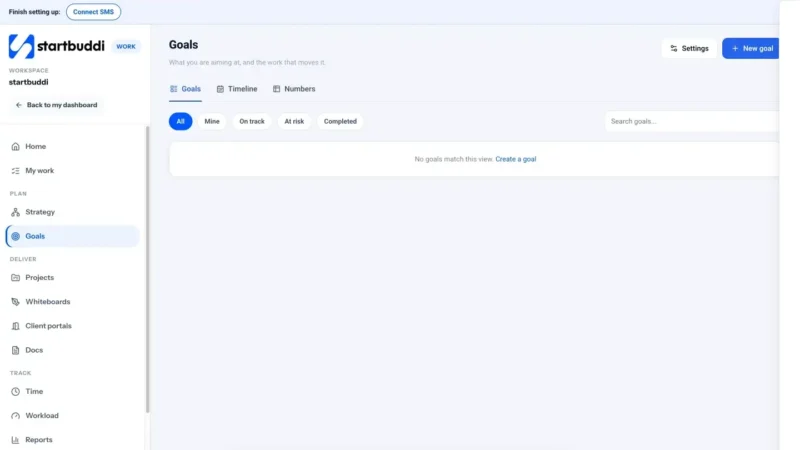
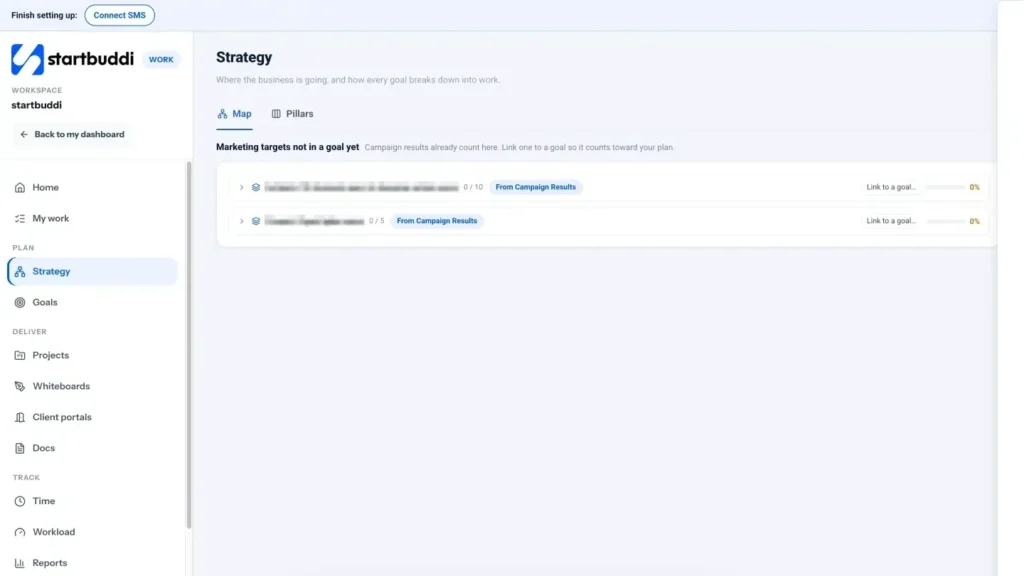
In startbuddi, goals live in Work, alongside the projects and tasks that move them. Start on the Strategy page. Its Pillars tab is where you write your themes: give each one a short name (such as "Get more customers") and a one-sentence meaning. Every goal can then point to the pillar it serves, so you can see at a glance whether your goals cover what matters.
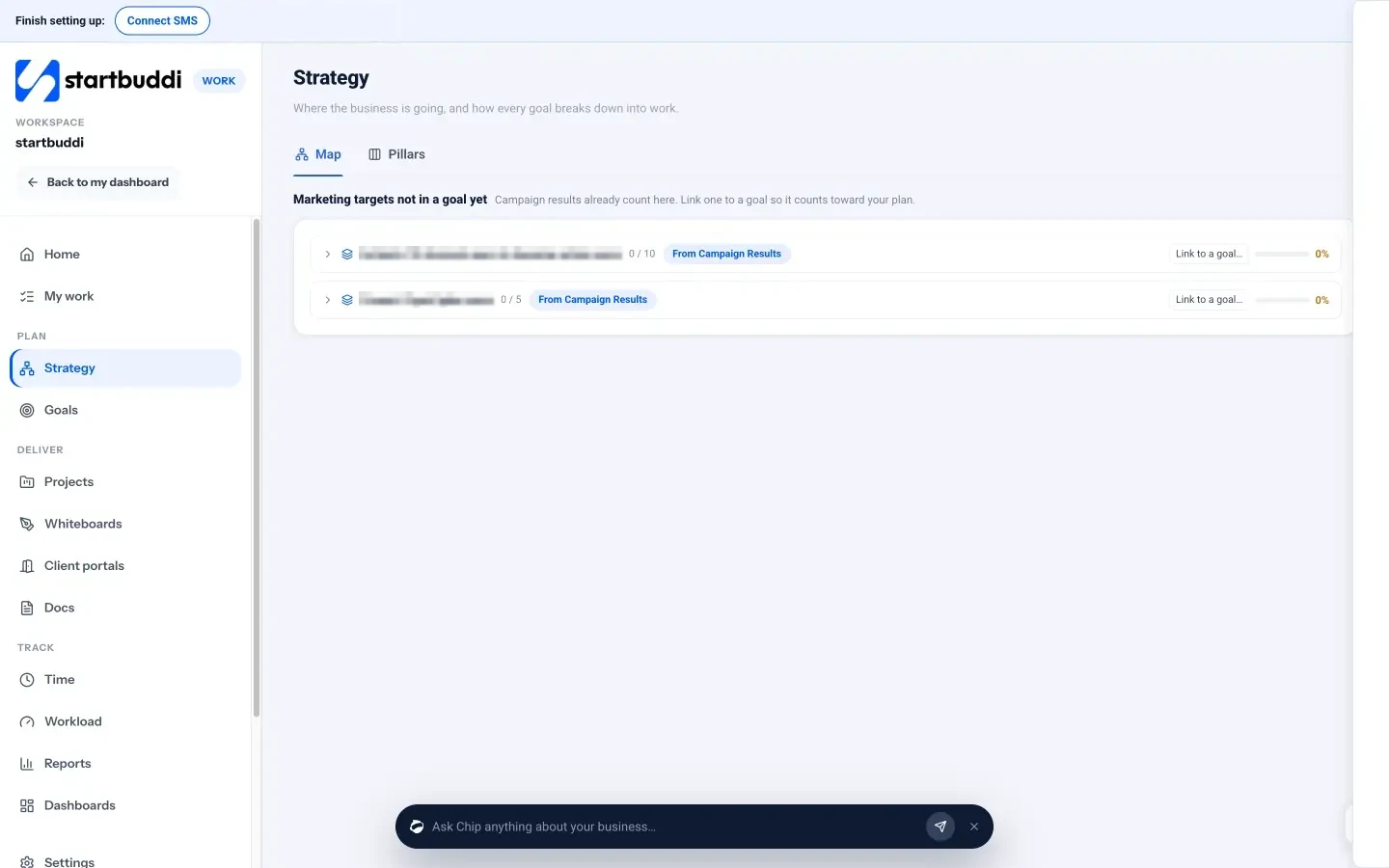
The Map tab shows the whole structure as a tree: goal, sub-goals, key results, initiatives, projects, milestones and tasks, and you can add an objective, key result, initiative or task inline. If you run marketing campaigns in startbuddi, campaign targets appear on the map under "Marketing targets not in a goal yet", with a Link to a goal option, so campaign results can count toward your plan. When Chip spots work that is not attached to any goal, the map can show suggestions, and nothing changes until you say yes.
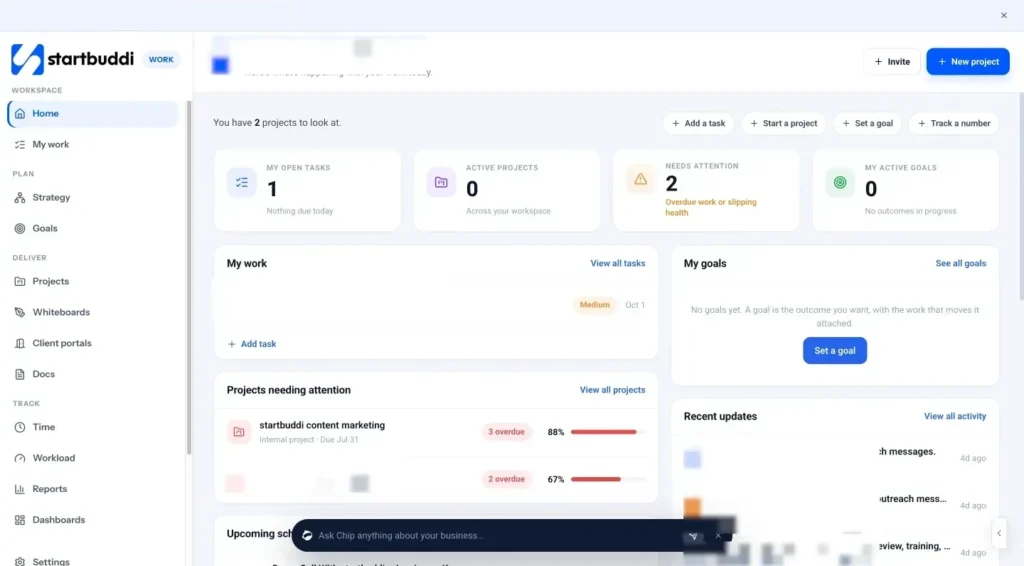
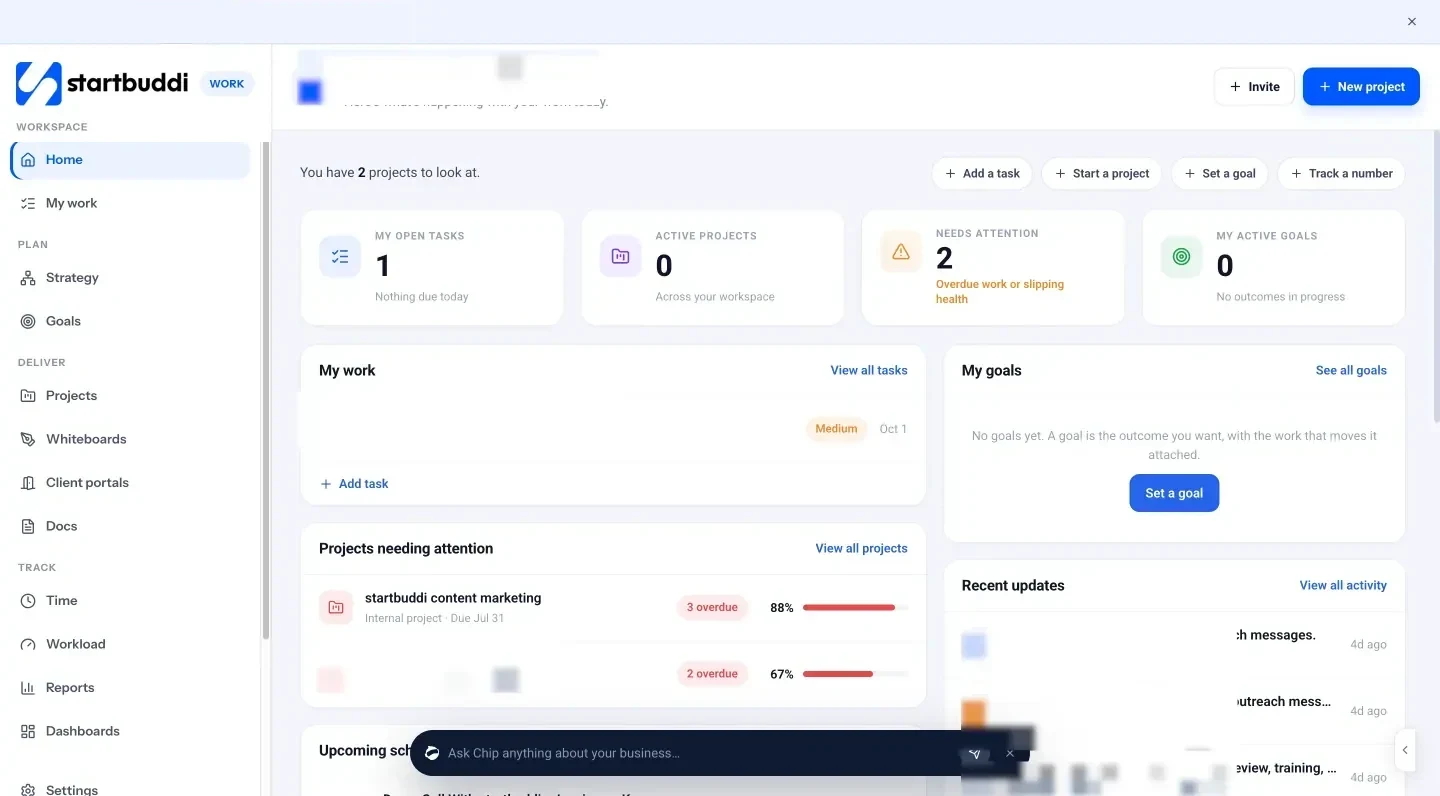
From the Work home page, the quick actions include Set a goal and Track a number, and the My active goals card shows the average progress on your goals every time you open Work. In the next chapter you will write the goals themselves.
Sources for this chapter
- Locke, E. A. and Latham, G. P. (2002). Building a practically useful theory of goal setting and task motivation. American Psychologist.
- Fast Company: If your goal is success, don't consult these gurus
Business goals examples: write SMART goals for every part of the business
- The SMART method, and where it came from
- Business goals examples for every part of the business
- Sales and customers
- Marketing
- Customers and delivery
- Money
- Team and owner
- Examples by type of business
- Worked example: turn a revenue goal into weekly activity
- How to set realistic numbers
- A fill-in-the-blanks goal template
- Examples by stage of business
- Personal goals for team members
- Split an annual goal into quarters
- Service businesses and product businesses
- Mistakes when writing goals
- Create a goal in startbuddi
A well-written goal answers three questions at once: what are we trying to achieve, how will we know, and by when? This chapter gives you a simple method for writing goals (SMART), dozens of business goals examples across every part of a small business, and a worked example that turns a revenue goal into the number of conversations you need each week. Then you will create your first goal in startbuddi.
The SMART method, and where it came from
SMART is the most widely used checklist for writing goals. It was first set out by George Doran in a 1981 article in Management Review, where the letters stood for Specific, Measurable, Assignable, Realistic and Time-related (SMART criteria, with Doran's original article). Today most people say "Achievable" for the A, but Doran's "Assignable" is worth keeping in mind for a small team: every goal needs a named owner.
| Letter | Question to ask | Weak | Strong |
|---|---|---|---|
| Specific | What exactly will change? | Get more clients | Win new monthly retainer clients |
| Measurable | What number shows success? | Lots of clients | 6 new retainer clients |
| Assignable | Who owns it? | The team | Owned by Amina |
| Realistic | Can we do it with our time and money? | 50 new clients with one salesperson | 6 clients, based on last year's 4 |
| Time-related | By when? | Eventually | By 31 March |
Put together: "Amina will win 6 new monthly retainer clients by 31 March." Anyone reading it knows what success looks like and who to ask about it.
Business goals examples for every part of the business
Here are business goals examples you can adapt. Change the numbers to fit your size and your history: a realistic goal usually starts from what you achieved last year.
Sales and customers
- Increase monthly revenue from $8,000 to $12,000 by December.
- Win 10 new customers a month from referrals by the end of Q2.
- Raise the average order value from $45 to $60 by June by adding bundles.
- Convert 30% of quotes into paid jobs, up from 20%, by September.
Marketing
- Grow the email list from 400 to 1,500 subscribers by the end of the year.
- Get 40 enquiries a month through the website contact form by Q3.
- Collect 50 new Google reviews with an average of 4.7 stars or more this year.
- Publish two helpful articles a month and reach 2,000 monthly website visitors by December.
Customers and delivery
- Reply to every customer message within 2 working hours by the end of Q1.
- Deliver 95% of projects on or before the agreed date this year.
- Keep 80% of this year's customers buying again next year.
- Cut refund requests from 5% of orders to 2% by June.
Money
- Get the average time to be paid down from 35 days to 14 days by April.
- Build a cash reserve equal to three months of fixed costs by December.
- Raise gross profit margin from 40% to 50% by reviewing prices and suppliers by Q3.
- Cut software spending by $150 a month by combining tools by the end of Q1.
Team and owner
- Hire and fully onboard a part-time operations assistant by May.
- Write step-by-step processes for the 10 most common jobs by September.
- Complete a performance review with every team member twice this year.
- Get the owner's working week down from 60 hours to 45 hours by December.
Notice that each example has an owner-ready outcome, a number and a date. For more on choosing which numbers to watch, see our guide to OKRs vs KPIs and the glossary entry on goal-tracking systems.
Examples by type of business
The same principles look different in different businesses. A few examples:
- Freelance designer in Manchester: earn £5,000 a month from three retainer clients by June, so fewer one-off jobs are needed.
- Cleaning company in Nairobi: grow recurring weekly contracts from 25 homes to 60 homes by December, while keeping complaints under 2% of visits.
- Online skincare store in Johannesburg: reach 35% of orders from repeat customers by Q4.
- Consultancy in Toronto: sell 4 strategy workshops a quarter at CA$6,000 each.
- Salon in Lagos: grow monthly revenue from ₦2,500,000 to ₦4,000,000 by December by filling weekday afternoon slots.
Worked example: turn a revenue goal into weekly activity
A goal becomes real when you can see what it means for this week. Here is how a small marketing agency turns an annual revenue goal into a weekly number of conversations.
- The goal: add $60,000 of new revenue next year.
- Average value of a new client: from last year's records, a new client spends about $5,000 in their first year.
- New clients needed: $60,000 divided by $5,000 is 12 new clients, or 1 a month.
- Proposal win rate: the agency wins about 1 in 3 proposals, so it needs 36 proposals in the year, or 3 a month.
- Call to proposal rate: about half of first calls lead to a proposal, so it needs 72 first calls a year, or 6 a month.
- Enquiry to call rate: about half of enquiries book a call, so it needs 144 enquiries a year, or 12 a month, roughly 3 a week.
Now the goal is concrete. Three enquiries a week is something the team can plan around: which channels will bring them, who follows up, and what happens if a week comes in at one. It also shows where improvement pays off most. If the win rate improves from 1 in 3 to 1 in 2, the agency needs only 24 proposals, and the whole chain shrinks by a third.
How to set realistic numbers
The hardest part of writing a goal is choosing the number. Too low and nobody is stretched; too high and people give up. Start from your baseline, which is where you are today, and look at your recent growth.
Here is an example. An online shop made $4,000 in January, $4,300 in February and $4,600 in March: roughly $300 more each month, or about 7% growth a month. If nothing changes, June will be around $5,500. That is the "business as usual" number. A realistic stretch goal might be $6,500 by June, which needs something new (a campaign, a new product, a better website) on top of normal growth. A goal of $20,000 by June would need the business to more than quadruple in three months, which is fantasy without a major change.
Three quick tests for any number:
- The baseline test: how far is it from where we are now, and from what we achieved last year?
- The maths test: work backwards like the example above. Is the weekly activity possible with our team and time?
- The gut test: ask the owner "out of 10, how confident are you?" Around 5 to 7 is a healthy stretch. A 10 is too easy. A 2 is too hard.
A fill-in-the-blanks goal template
If you get stuck, use this sentence and fill the gaps:
[Owner] will [increase / reduce / reach] [measure] from [baseline] to [target] by [date], so that [reason it matters].
For example: "Ngozi will reduce the average time to get paid from 35 days to 14 days by 30 April, so that we can pay suppliers without dipping into savings." The "so that" part is optional, but it helps a lot with motivation because it tells people why the goal exists.
Examples by stage of business
- Idea stage: interview 30 potential customers by the end of next month; get 100 people onto a waiting list.
- First year: win 10 paying customers; reach $3,000 in monthly revenue; get the first 10 reviews.
- Growing (years two to five): hire the first employee; grow repeat revenue to 40% of the total; build three months of cash reserves.
- Established: open a second location; cut the owner's hours to 40 a week; launch one new service line.
Personal goals for team members
Each person in a small team can have one or two goals that link to the company goals. Keep them within the person's control. "Grow company revenue by 20%" is not a fair personal goal for a designer. "Deliver every client project within the agreed two rounds of changes" is. Personal goals also feed directly into performance reviews, which our performance review guide covers in detail.
Write the baseline next to every goal when you publish it. Six months from now, nobody will remember whether "40 enquiries a month" was a big jump or a small one, and the baseline is what lets you judge the result fairly at the end of the year.
Split an annual goal into quarters
Annual goals rarely grow in a straight line. Seasonality, holidays and the time it takes a new idea to work all affect the shape. When you split an annual goal into quarters, think about when the growth will realistically come. Here is an example for a gift shop aiming to grow annual online sales from $40,000 to $60,000.
| Quarter | Last year | Target | Why this shape |
|---|---|---|---|
| Q1 | $7,000 | $8,500 | Quiet after the holidays; new website launches in February |
| Q2 | $9,000 | $12,000 | Mother's Day and graduations; first email campaigns |
| Q3 | $8,000 | $11,500 | Summer lull; loyalty list starts paying off |
| Q4 | $16,000 | $28,000 | Holiday season; the biggest push of the year |
| Total | $40,000 | $60,000 |
A straight split of $15,000 a quarter would have made Q1 look like a disaster and Q4 look easy. Shaping targets around your real year keeps check-ins honest and stops the team losing heart in a slow quarter.
Service businesses and product businesses
The type of business changes which goals matter most. A service business (agency, consultant, cleaner, coach) sells time and skill, so its goals often focus on price, utilisation and repeat clients: how many hours are billed, at what rate, to how many returning customers. A product business (shop, bakery, online store) sells items, so its goals often focus on volume, margin and repeat purchases: how many orders, at what profit, from how many returning buyers. Both need cash goals. Many service businesses also have a capacity limit: if everyone is fully booked, the next goal may be a price rise or a hire rather than more marketing.
Mistakes when writing goals
- Activity dressed up as a goal. "Send 100 emails" is a plan. Ask "so that what happens?" until you reach the outcome.
- No starting point. "Increase repeat customers by 20%" means nothing if you do not know today's number. Record the baseline.
- Round numbers with no logic. Doubling revenue sounds good, but work backwards like the example above to check it is possible.
- Dates that are all 31 December. Spread deadlines across the year so everything does not land at once.
One last check before you publish your goals: read them aloud to someone outside the business, such as a friend or mentor. If they cannot tell what success looks like, or they ask "why does that matter?", rewrite the goal until they can. Clear goals survive being explained to a stranger.
Create a goal in startbuddi
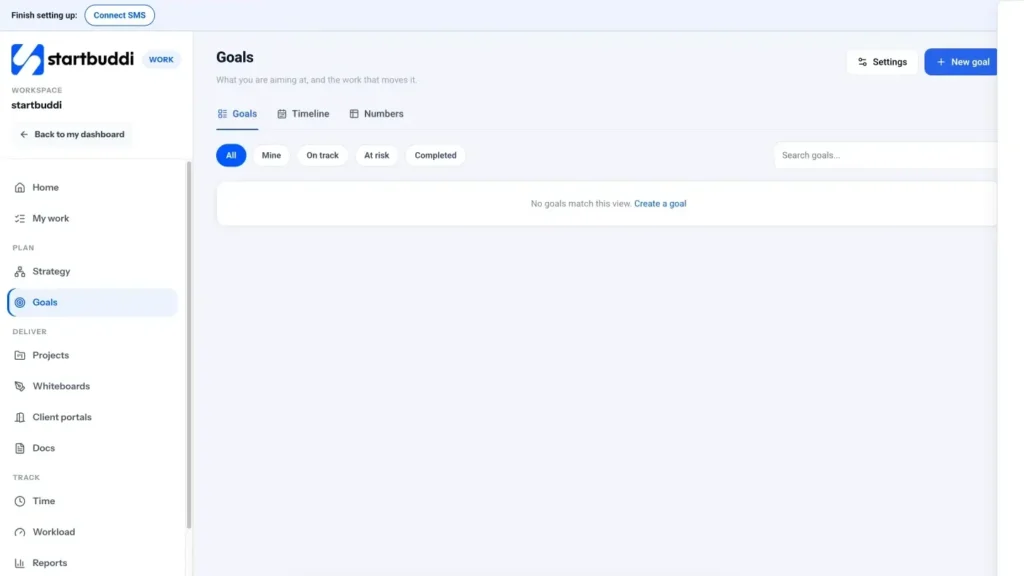
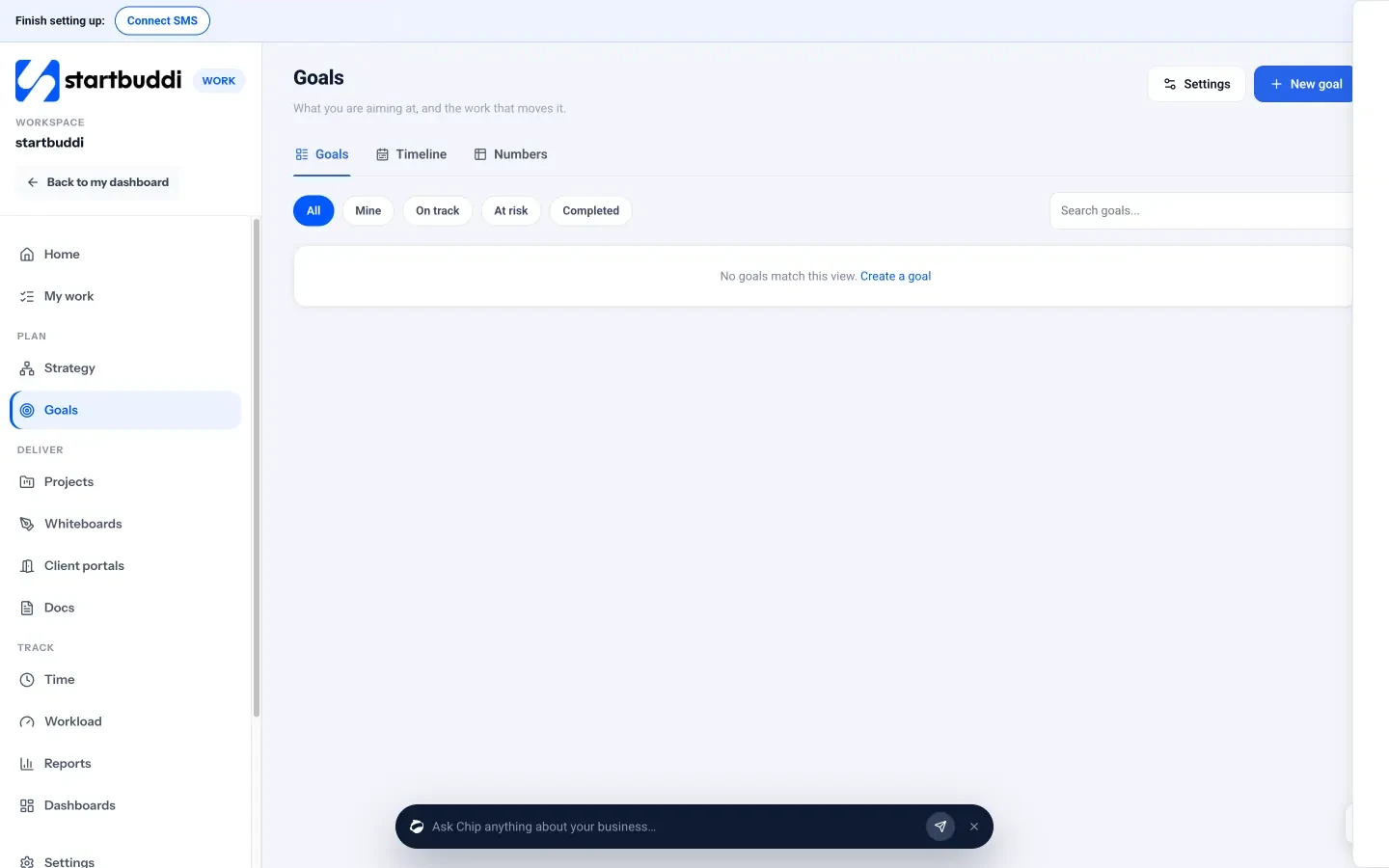
Open Work, go to Goals and click New goal. The drawer asks for the goal itself (the placeholder suggests something like "Increase qualified leads by 30%"), an optional description, an Owner and Team, and Visibility: visible to everyone in the workspace, the team only, or private. You can pick a Parent goal if this goal supports a bigger one, choose which pillar it is for, and set the Goal period (weekly, monthly, quarterly or custom), dates, a reporting cadence and a check-in day.
Then add Key results, the measurable targets that show progress. Each key result can be a number, a percentage, a currency amount or a simple yes/no, with a target, a unit and its own owner. For the agency example above, the goal "Add $60,000 of new revenue" might have key results "12 new clients" (number), "$60,000 new revenue" (currency) and "Proposal win rate 33%" (percentage).
The Goals list shows every goal with its key results, linked projects, linked tasks and due date, and you can filter to see only yours, only those on track or only those at risk. The Timeline view shows what lands when, with the filled part of each bar showing progress. If you would like a walkthrough, our help article on setting up OKRs in startbuddi goes step by step.
Sources for this chapter
OKRs and KPIs: which you need and how to write them
- KPIs: the health numbers you always watch
- Leading and lagging indicators
- OKRs: goals for change
- OKRs vs KPIs: which do you need?
- How to write good key results
- Worked example: a KPI dashboard for a service business
- OKR examples for different businesses
- How to choose your KPIs in five steps
- If you have no data yet
- Mistakes with OKRs and KPIs
- A quarterly OKR routine for a small team
- Where to find your numbers
- Track OKRs and KPIs in startbuddi
Once you have a few clear goals, two acronyms start to appear: OKRs and KPIs. They are often presented as rival systems, and small business owners worry about choosing the wrong one. In practice, most small businesses benefit from both, used for different jobs. This chapter explains what each one is, how to write them, the mistakes to avoid, and how to track both in startbuddi.
KPIs: the health numbers you always watch
A KPI (key performance indicator) is a number you watch continuously because it tells you whether the business is healthy. Think of the dashboard in a car: speed, fuel, engine temperature. You do not set a new goal for your fuel gauge every quarter; you just keep an eye on it and act when it moves the wrong way.
Good KPIs for a small business are few, simple and updated often. Examples:
- Money coming in this month, and money going out.
- Cash in the bank, and how many months of costs it covers.
- New enquiries or leads per week.
- Quote or proposal win rate.
- Average time to get paid.
- Repeat customer rate.
- Customer rating or reviews.
Pick five to seven. If you watch 30 numbers, you watch none of them. Our glossary entry on the difference between OKRs and KPIs has more examples.
Leading and lagging indicators
Some numbers tell you what already happened; others warn you about what is coming. Revenue is a lagging indicator: by the time it drops, the cause happened weeks ago. Enquiries, booked calls and proposals sent are leading indicators: when they fall, revenue will follow. A good small business dashboard has both. The worked example in chapter two is really a chain of leading indicators (enquiries, calls, proposals) feeding a lagging one (revenue).
OKRs: goals for change
OKR stands for objectives and key results. An objective is a clear, inspiring statement of what you want to achieve. Key results are two to five measurable outcomes that prove you got there. Where KPIs watch the health of the business as it is, OKRs describe a change you want to make, usually over a quarter.
Google, which popularised OKRs, suggests setting ambitious objectives and treating a score of around 0.6 to 0.7 (60 to 70% of the target) as a good result for stretch goals. Scoring much higher may mean the goals were not ambitious enough. It also distinguishes committed OKRs, which must be fully met, from aspirational ones (Google re:Work, set goals with OKRs).
A simple OKR template:
Objective: Become the first choice for office catering in our neighbourhood.
Key result 1: Sign 20 repeat office clients (from 6).
Key result 2: Reach $6,000 a month in catering revenue (from $2,200).
Key result 3: Keep an average catering rating of 4.8 or higher.
Initiatives: catering menu page, office visits, first-order offer, follow-up call after every order.
Notice that the initiatives (the things you will do) are listed separately from the key results (the outcomes). Mixing them is the most common OKR mistake. Our posts on OKR implementation for small businesses and setting OKRs for an agency go deeper, and the glossary explains what OKRs are in brief.
OKRs vs KPIs: which do you need?
| KPIs | OKRs | |
|---|---|---|
| Purpose | Monitor health | Drive a specific change |
| Time frame | Ongoing | Usually a quarter |
| Target | A normal range | An ambitious target |
| Number | 5 to 7 for the business | 1 to 3 objectives a quarter |
| Question | Is anything going wrong? | Are we making progress on what matters most? |
For most small businesses the answer is: watch a handful of KPIs all the time, and use one to three OKRs a quarter for the changes you most want to make. When a KPI goes badly wrong (for example, days to get paid jumps from 14 to 40), that problem can become next quarter's objective.
Solo founders can keep it even lighter: one objective a quarter and a few numbers on a single screen. A team of 15 might have three company objectives and let each team add one of its own.
A simple way to decide: if the question is "should we worry?", you need a KPI. If the question is "what are we trying to change this quarter?", you need an OKR. Many owners find that writing KPIs first makes OKRs easier, because the weak numbers point straight at what to fix.
How to write good key results
- Outcomes, not tasks. "Launch the new website" is a task. "Get 40 enquiries a month through the new website" is a key result.
- A start and an end number. "From 6 to 20 office clients" tells everyone the size of the jump.
- Two to four per objective. Enough to describe success, few enough to remember.
- Balance quantity with quality. If one key result pushes volume, add another that protects quality, such as ratings or refunds.
- Measurable from data you already have, or can collect easily. A key result you cannot check is a wish.
Worked example: a KPI dashboard for a service business
Here is a simple KPI set for a small accounting and bookkeeping practice with four staff. For each number, the owner wrote down how it is measured, what "normal" looks like, and what happens when it moves outside that range. That last column is what turns a number into a management tool.
| KPI | How it is measured | Normal range | If outside the range |
|---|---|---|---|
| New enquiries | Contact form and calls, weekly | 4 to 8 a week | Below 4 for two weeks: review marketing in the Monday meeting |
| Proposal win rate | Proposals won divided by sent, monthly | 40% to 60% | Below 40%: review pricing and proposal wording |
| Money coming in | Payments received, monthly | $18,000 to $24,000 | Below $18,000: check overdue invoices first |
| Days to get paid | Average from invoice to payment | Under 21 days | Over 21: send reminders, review payment terms |
| Client retention | Clients renewing their annual contract | Over 85% | Below 85%: call every client who left |
| Staff hours | Average hours per person per week | 35 to 42 | Over 42 for a month: rebalance work or hire |
Six numbers, one screen, a clear action for each. That is enough to run a small business well, and it takes the owner about fifteen minutes a week to check once the numbers update themselves or are entered on a fixed day. Our guide to OKRs and KPIs has more ideas for choosing yours.
OKR examples for different businesses
Online store (quarterly):
- Objective: Turn first-time buyers into regulars.
- KR1: Repeat purchase rate from 18% to 28%.
- KR2: 500 customers join the loyalty email list.
- KR3: Average rating stays at 4.6 or above.
Freelance developer (quarterly):
- Objective: Move from one-off projects to steady monthly income.
- KR1: Sign 3 monthly support retainers.
- KR2: Retainer income reaches 50% of total income.
- KR3: Working hours stay under 40 a week.
Restaurant (quarterly):
- Objective: Fill the quiet weekday lunches.
- KR1: Weekday lunch covers from 30 to 55 a day.
- KR2: 20 local businesses on the lunch delivery list.
- KR3: Food cost stays under 32% of sales.
How to choose your KPIs in five steps
- List what could sink the business. Running out of cash, losing a big client, a drop in enquiries, overworked staff. Each risk suggests a number to watch.
- List what drives growth. For most small businesses: enquiries, conversion, average sale and repeat customers.
- Pick one number for each and cut the list to five to seven.
- Decide how often each is checked. Weekly for fast-moving numbers like enquiries; monthly for revenue and margin; quarterly for retention.
- Write the normal range and the action for each, as in the dashboard example above.
Review your KPI list once a year. As the business changes, so do the numbers that matter. A new business watches enquiries and cash; a larger one may add staff turnover and profit per client.
If you have no data yet
Many small businesses discover when they start this process that they do not actually know their numbers. That is common and fixable. For the first quarter, make "start measuring" the goal: record every enquiry, every quote and every payment in one place. After a month or two, you will have baselines, and you can set real targets. Tools that record this as a side effect of normal work (sending an invoice, adding a contact, receiving a form) save a lot of effort compared with a separate spreadsheet.
Mistakes with OKRs and KPIs
- Too many OKRs. A five-person team with twelve objectives will finish none of them.
- Tying OKR scores to pay. People sandbag: they set easy targets they know they will hit. Keep stretch goals separate from reviews and bonuses.
- Setting OKRs and forgetting them. Without weekly check-ins, OKRs are just a nicer-looking to-do list.
- KPIs nobody updates. If updating a number means an hour in a spreadsheet, it will not happen. Automate where you can.
- Copying someone else's KPIs. A salon and a software start-up need different numbers. Choose the ones that predict success in your business.
A quarterly OKR routine for a small team
- Two weeks before the quarter: review how the last quarter went and what the KPIs are saying.
- One week before: draft one to three objectives and their key results with the team.
- First day of the quarter: publish them where everyone can see, with owners.
- Every week: a ten-minute check-in on each objective (chapter four).
- Last week of the quarter: score each key result, write down what you learned, and decide what carries over.
Where to find your numbers
You probably have more data than you think. Most small businesses can pull their core KPIs from a few places:
- Money: your invoices, payment provider and bank statements give you money in, money out, and days to get paid.
- Customers: your contact list or CRM shows new contacts, where they came from and who bought again.
- Marketing: your website forms, email tool and social accounts show enquiries, sign-ups and engagement.
- Delivery: your project or booking tool shows on-time delivery, no-shows and workload.
- Team: leave records, hours and pulse surveys show how the team is coping.
The more of these live in one system, the less time you spend copying numbers into a spreadsheet, and the more likely you are to keep looking at them. Whatever tools you use, pick one place where the KPIs are brought together, and one person who makes sure they are up to date before the monthly review.
Track OKRs and KPIs in startbuddi
In startbuddi, a goal with key results is an OKR. The objective is the goal, and each key result has its own target and owner. On the Strategy map, each key result can take its progress from one of three sources: Updated by hand, From tasks or From milestones. Linking a key result to tasks or milestones means progress moves as the work gets done, with no manual updates.
For KPIs, use the Numbers view in Goals, which is a month-by-month board of the numbers you track. Click Add a number to track and answer four questions: what you are tracking (for example "Money coming in"), where the number comes from, which part of the strategy it belongs to, and who watches it. You can then set a target.
Several numbers can fill themselves in from the rest of startbuddi, marked "auto" on the board: Money coming in and Money going out from Money Manager, New contacts from Customers, Form submissions from Forms, Posts published from Social media and Emails opened from Email. Anything else you can enter yourself each month. Because the numbers and the goals sit in the same place as your projects and tasks, you can see both "is the business healthy?" and "are we making the change we planned?" on one screen.
If you want to compare dedicated goal tools before deciding, our list of the best OKR software sets out the options.
Sources for this chapter
Make goals stick: weekly check-ins, reviews and resets
- Why feedback keeps goals alive
- The weekly check-in (10 minutes per goal)
- The monthly review (30 to 60 minutes)
- The quarterly reset (half a day)
- What to do when a goal goes off track
- Link goals to the work
- Run a 15-minute weekly goals meeting
- Example: one quarter of check-ins
- Goals for solo founders: accountability without a team
- When is it right to change a goal mid-quarter?
- Celebrate progress
- Your yearly goal calendar
- Common mistakes keeping goals on track
- Check in, review and report in startbuddi
Setting goals takes an afternoon. Keeping them alive takes a habit. Most goals die quietly in February, not because they were bad goals, but because nobody looked at them again until the end of the year. This chapter gives you a simple rhythm that keeps goals moving: a weekly check-in, a monthly review and a quarterly reset, with templates for each, plus what to do when a goal goes off track. Then you will set up check-ins, reminders and reports in startbuddi.
Why feedback keeps goals alive
Remember Locke and Latham's conditions from chapter one: goals work when people get feedback on their progress (Locke and Latham, 2002). A goal checked weekly gets fifty chances a year to be corrected. A goal checked annually gets one, when it is too late. The rhythm below is designed to take very little time while giving you that feedback often.
The weekly check-in (10 minutes per goal)
Once a week, on the same day, the owner of each goal writes a short update. Keep it short enough that it never feels like a chore. Four questions are enough:
Progress: 9 of 20 office clients signed (up from 7 last week).
Health: On track / At risk / Off track.
Confidence: how likely are we to hit it? (for example 7 out of 10)
What changed and any blockers: Two new clients from the office visits. Our catering menu page is still not live; waiting on photos.
Health and confidence are different on purpose. A goal can be on track today but low in confidence because a big risk is coming. Asking both gets honest answers. If you have a team, share check-ins where everyone can see them, and spend five minutes of your weekly meeting on the ones marked at risk.
The monthly review (30 to 60 minutes)
Once a month, step back from individual goals and look at the whole picture. A simple agenda:
- KPIs: are any numbers outside their normal range? Why?
- Goals: which are on track, which are at risk, which are stuck?
- For each stuck goal: is the problem effort, the plan, or the goal itself?
- What will we stop, start or change next month?
- Wins to celebrate.
Write the decisions down and turn them into tasks with owners. A review without actions is just a conversation.
The quarterly reset (half a day)
At the end of each quarter, score every goal and key result, even roughly. A 0 to 1 scale works well: 1.0 means fully achieved, 0.7 means most of the way, 0.3 means some progress. Then ask three questions for each goal:
- What did we learn? About customers, the market, our process, ourselves.
- Keep, change or drop? Some goals carry into the next quarter, some need a new approach, some turn out not to matter.
- What is next quarter's focus? One to three objectives, as in chapter three.
This is also the moment to update the annual picture. If the first quarter shows the revenue goal was far too optimistic, adjust it rather than pretending. A realistic goal people believe in beats an impressive one everyone has given up on.
What to do when a goal goes off track
Every business misses goals. What matters is how quickly you notice and what you do next. Work through these questions in order:
- Is the measure right? Sometimes progress is happening but the number does not show it, for example sales closed in person but never recorded.
- Is it effort? Did the planned work actually happen? If the office visits never took place, the plan was not tested.
- Is it the plan? If the work happened and the number did not move, try a different approach. Talk to customers about why.
- Is it the goal? If circumstances changed (a big client left, costs jumped), the goal may need to change too. Say so openly and write down why.
- Does the owner need help? More time, a budget, a decision from you, or someone to take other work off their plate.
Avoid blame. If people fear missing goals, they will stop setting ambitious ones and stop reporting problems early. The best signal in a check-in is an honest "at risk" in week three, not a surprise "missed" at the end of the quarter.
Link goals to the work
Goals stay alive when they are connected to what people do every day. If the tasks on someone's list have nothing to do with the goals, the goals will lose every time, because tasks feel urgent and goals feel distant. Three simple habits help:
- When you plan a project, ask which goal it moves. If the answer is "none", ask whether it should happen now.
- In the weekly meeting, review the goals first and the task list second.
- Give each goal owner a small, regular block of time for goal work, protected from daily firefighting.
Run a 15-minute weekly goals meeting
If you have a team, turn the check-ins into a short standing meeting, ideally the first item of your weekly team call. Keep it tight:
- Numbers (3 minutes). A quick look at the KPIs. Anything outside its normal range?
- Goals at risk (8 minutes). Only discuss goals marked at risk or off track. Owners of on-track goals just say "on track".
- Decisions and help (4 minutes). What does each at-risk goal need: a decision, a person, a budget? Agree who does what.
Everything else goes into the written check-ins. The meeting is for decisions, not updates.
Example: one quarter of check-ins
Here is how a quarter might play out for the bakery's catering objective from chapter three.
- Week 2: 7 of 20 office clients. On track, confidence 7. The catering page is being written.
- Week 5: 8 of 20. At risk, confidence 5. The page went live but office visits keep being cancelled because the shop is busy.
- Week 6 decision: the owner covers the shop two mornings a week so Tolu can do visits.
- Week 9: 14 of 20. On track, confidence 7. Visits are working; most new clients came from them.
- Week 13, final score: 18 of 20 clients (0.9), catering revenue $5,400 of $6,000 (0.9), rating 4.9 (1.0). Lesson: in-person visits beat online ads for office catering. Next quarter: keep visiting, and add a referral offer for existing clients.
The week-five "at risk" was the most valuable check-in of the quarter. Without it, the owner would have found out about the cancelled visits in week thirteen.
Goals for solo founders: accountability without a team
If you work alone, nobody will ask about your goals unless you arrange it. A few ways to create accountability:
- Put the weekly check-in in your calendar as a meeting with yourself, and treat it as seriously as a client call.
- Find a goal partner: another founder you swap check-ins with every Friday by message.
- Share goals with an adviser, mentor or accountant and ask them to check in monthly.
- Keep goals visible where you work: on the first screen you open each morning.
When is it right to change a goal mid-quarter?
Changing goals too often destroys trust in them, but refusing to change a goal that no longer makes sense is just as bad. A useful rule: change a goal mid-quarter only if something outside your control has changed the situation in a big way. Examples include losing a client that made up a large share of revenue, a supplier doubling prices, a new regulation, or a team member leaving unexpectedly. "It is harder than we thought" is not a reason to change a goal mid-quarter; it is a lesson for the next reset. When you do change one, write down the old target, the new target and the reason, and tell everyone affected. That record matters when you look back at the end of the year.
Celebrate progress
Small businesses rarely stop to celebrate, and they should. Marking progress keeps energy up through the long middle of a goal. It can be simple: a note in the team channel when a key result crosses the halfway mark, lunch when a quarterly goal is hit, a sentence in the monthly review about who made it happen. Celebrate learning as well as winning. A well-run experiment that proved an idea does not work saves you months of wasted effort.
Your yearly goal calendar
| When | What | Time |
|---|---|---|
| December or January | Set themes and annual goals | 2 to 3 hours |
| Start of each quarter | Set quarterly objectives and key results | Half a day |
| Every week | Check-ins on each goal | 10 minutes per goal |
| Every month | Review KPIs and goals together | 30 to 60 minutes |
| End of each quarter | Score, learn, reset | Half a day |
| Twice a year | Personal goals in performance reviews | 1 hour per person |
If you are just starting, do not try to do everything at once. Begin with three goals and a weekly check-in. Add the monthly review after a month and the quarterly reset at the end of the first quarter.
Common mistakes keeping goals on track
- Check-ins that turn into essays. Four short answers are enough. Long updates get skipped.
- Only the owner looks at goals. Share them. Visibility creates gentle accountability and invites help.
- Changing goals every week. Adjust at the quarterly reset unless something big changes. Constant changes make people stop taking goals seriously.
- Never scoring. Without a score at the end of the quarter, you cannot learn how good you are at setting goals.
Finally, remember that the rhythm matters more than the tool. A notebook and a weekly calendar reminder beat the best software if the software is never opened. Choose the simplest setup your team will actually use every week, and improve it once the habit is in place.
Check in, review and report in startbuddi
Each goal in startbuddi has its own page with tabs for Overview, Key results, Linked work, Activity, Check-ins and Settings. Click Check in and answer the questions from the template above: how the goal is going, its health (on track, at risk or off track), whether you will hit it, and what changed or is blocking you. If you are short of time, Draft it for me asks Chip to draft the check-in from what changed since the last one; you review and edit before saving, and it uses Chip credits. The goal page also has a feedback thread where the team can cheer on progress or ask a question.
Under Linked work, attach the projects and tasks that move the goal, so progress on key results can come straight from tasks or milestones. When a goal is overdue, startbuddi shows an escalation card with an option to ask Chip for help. Goal settings in Work let you set a default reporting cadence, a default check-in day and reminders, plus approval rules if you want company and team goals approved before they count.
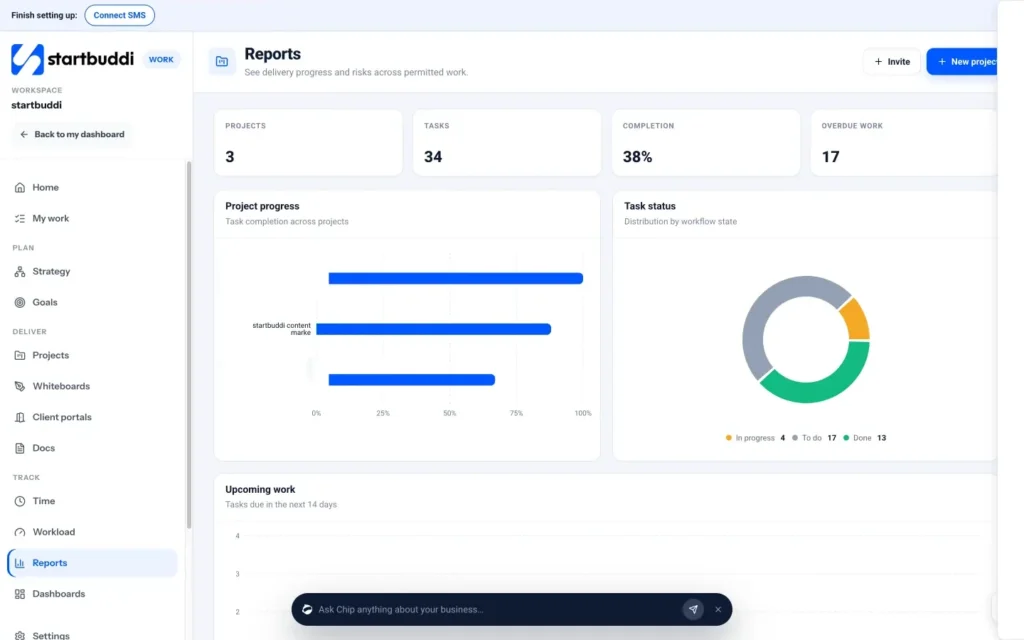
For the monthly review, Reports in Work shows project progress, task status, upcoming and overdue work, and team workload in one place, and you can filter it to a single project. Pair it with the Numbers board for your KPIs, and you have the full agenda for a monthly review on two screens.
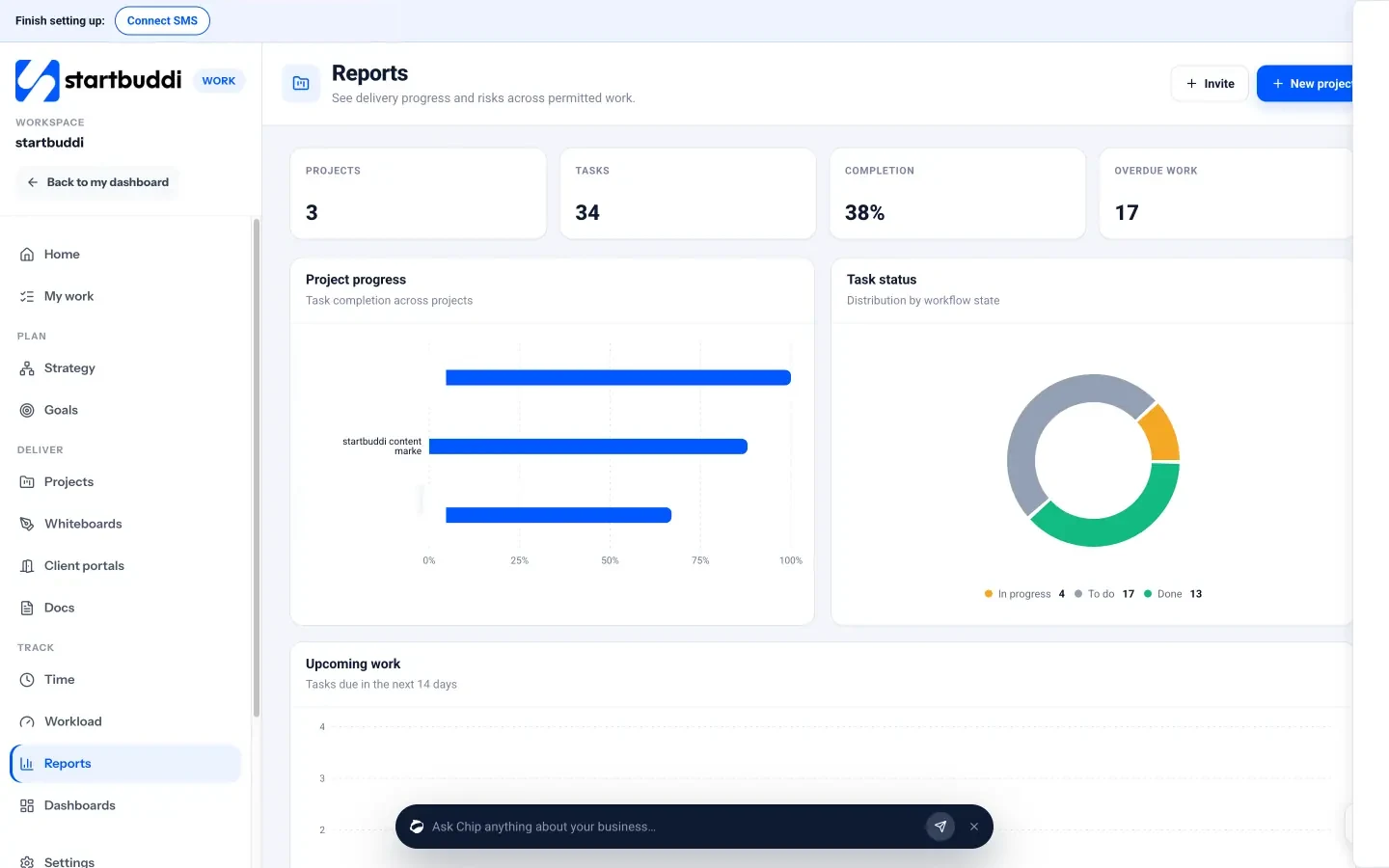
Our help article on tracking goal progress week over week shows the check-in flow step by step.
Your next step: this week, write down three goals for the next quarter, each with a number, a date and an owner, and put a ten-minute check-in in your calendar for the same time every week. If you want your goals, projects and numbers in one place, see how Goals, OKRs and KPIs in startbuddi work, or compare plans on the pricing page. Every paid plan has a 30-day trial.
Sources for this chapter
- Locke, E. A. and Latham, G. P. (2002). Building a practically useful theory of goal setting and task motivation.
- Google re:Work: Set goals with OKRs
Tiwalade Joanna Okedara-Kalu is the founder, CEO and CTO of startbuddi, the business system that brings clients, bookings, invoices, projects, marketing and the Chip AI assistant into one place. Tiwalade builds software around how service businesses really work day to day, and writes about client management, getting paid on time and why small businesses outgrow the tools they start with.
Founded startbuddi and leads its product and engineering