
How to do performance reviews: a simple process, template and scripts for small teams
A four-part guide to performance reviews for small businesses: a fair process, a review template and rating scale, conversation scripts, and ongoing feedback.


This guide shows you how to do performance reviews in a small business, even if you have never run one and dread the idea. It is for owners and first-time managers with a handful of people, who want reviews that are fair, quick to prepare and actually help people improve.
The short answer: agree clear goals at the start of the period, keep short notes on real examples as you go, ask the employee for a self review, write your own view with a simple rating scale, then hold a conversation that looks forward more than back and ends with two or three agreed actions. Do it twice a year, with regular 1:1s and feedback in between so nothing in the review is a surprise.
There are four chapters. First, why many reviews fail and how to design a process that works for a small team. Second, preparation: goals, evidence, a performance review template and a rating scale. Third, the conversation itself, with scripts for praise, problems and pay. Fourth, what happens after: ongoing employee feedback, development and the next cycle. Each chapter covers the thinking first, then shows how to do it in startbuddi.
How to do performance reviews that help, and why most do not
- Why many performance reviews fail
- What a performance review is for
- How often should a small business do reviews?
- What to review: four areas
- Reviews look different in different businesses
- Introducing reviews to a team that has never had them
- Separate the performance review from pay
- Principles for fair reviews
- Designing a process for a small team
- How much time reviews really take
- Part-time staff, contractors and seasonal workers
- Who reviews the owner?
- Common mistakes when setting up reviews
- Set up reviews in startbuddi
Most people have had at least one bad performance review: a rushed meeting, a form full of vague ratings, feedback about something that happened eleven months ago, and a sense that the decision was made before they walked in. It is no surprise that many owners of small businesses skip reviews entirely. But skipping them has a cost too. People do not know where they stand, good work goes unnoticed, problems grow quietly, and the best people leave for employers who take their growth seriously.
This chapter explains why reviews so often fail, what a good review is for, how often to run them in a small team, and the principles that make them fair. At the end you will see how startbuddi sets up a simple review cycle.
The good news is that small businesses have an advantage here. You know your people, you see their work up close, and you can change your process in an afternoon without asking a committee.
Why many performance reviews fail
The evidence is not flattering. Gallup found that only 14% of employees strongly agree that the performance reviews they receive inspire them to improve (Gallup). When Deloitte looked at its own process, it counted close to 2 million hours a year spent on performance management and concluded the system was out of step with what it needed (Harvard Business Review, Reinventing Performance Management).
The common causes are the same in a five-person business as in a global firm:
- Surprises. The review is the first time the person hears about a problem.
- No agreed goals. The person is judged against expectations nobody wrote down.
- Memory instead of evidence. The manager remembers last month clearly and the rest of the year vaguely.
- Looking only backwards. The meeting is a verdict on the past, with nothing about what to do next.
- Mixing everything together. Development, pay and discipline all squeezed into one tense hour.
- Too much form, too little conversation. Twenty rating boxes and five minutes of talking.
What a performance review is for
A good review has three jobs, and it helps to be clear which one you are doing:
- Look back fairly: recognise what went well, name what did not, based on evidence.
- Look forward: agree goals and priorities for the next period.
- Grow the person: talk about skills, support, training and where they want to go.
Gallup recommends treating reviews as "progress reviews" that are achievement-oriented, fair and accurate, and developmental, and holding them at least twice a year (Gallup). The UK's Acas advises reviewing employees at least once a year, discussing strengths, areas to improve, support and training needs and career goals, and keeping a written record that is shared with the employee afterwards (Acas, reviews and appraisals).
How often should a small business do reviews?
For most small businesses, a light rhythm works best:
| What | How often | Length |
|---|---|---|
| Quick feedback | Whenever something good or bad happens | A minute or two |
| 1:1 check-in | Every one or two weeks | 20 to 30 minutes |
| Performance review | Twice a year | 45 to 60 minutes, plus preparation |
| Pay review | Once a year, separate from the performance review | 30 minutes |
| Probation review | At the end of probation, often 3 to 6 months | 30 to 45 minutes |
Twice a year is frequent enough that goals stay current and memories are fresh, and rare enough that preparation is not a burden. If you have only one or two employees, you might hold one formal review a year and a lighter mid-year conversation. What matters most is the regular 1:1 in between, because that is where feedback actually happens.
What to review: four areas
A useful review looks at more than whether targets were hit. Four areas give a rounded picture without making the form long:
- Results: progress against the goals agreed at the start of the period.
- How the work was done: reliability, teamwork, communication, care for customers, and how well the person lives your values.
- Skills: what they have learned, and which skills would make the biggest difference next.
- Growth and wellbeing: what they want to do next, and whether anything is getting in the way.
The "how" matters as much as the "what". Someone who hits every sales target by upsetting colleagues and overpromising to customers is creating problems a results-only review will miss.
Reviews look different in different businesses
- A salon: goals might cover rebooking rate, product sales, client reviews and learning a new technique. Evidence comes from the booking system and client feedback.
- An agency: goals might cover on-time delivery, client satisfaction, billable hours and mentoring a junior colleague.
- A shop: goals might cover sales per shift, stock accuracy, customer service and opening and closing procedures.
- A trades business: goals might cover jobs completed right first time, safety, customer feedback and completing a qualification.
The process is the same; the goals and evidence change. Pick measures people can see and influence day to day.
Introducing reviews to a team that has never had them
If your team has never had reviews, announcing them can cause worry. People may assume someone is about to be let go. Explain the purpose clearly and early. A message like this works:
"From this year we are starting twice-yearly reviews for everyone, including me. They are about looking back at what went well, agreeing what to focus on next, and talking about what you want to learn. There will be no surprises: anything important we will already have talked about in our 1:1s. You will get the questions two weeks ahead, and your own view is a big part of it."
Consider asking the team to review you first, or at the same time. It shows the process is about improvement, not judgement from above, and it is one of the fastest ways to build trust in it.
Separate the performance review from pay
When pay is discussed in the same meeting, people stop listening to feedback and start negotiating. Many small businesses get better conversations by holding the performance review first and the pay review a few weeks later. The pay decision can take the review into account, but the review itself stays focused on growth. Explain this separation to the team in advance so nobody feels something is being hidden.
Principles for fair reviews
- Same process for everyone. Same questions, same scale, same timing. Consistency is the heart of fairness.
- Judge against agreed goals and the job, not against the manager's mood or against colleagues.
- Use evidence. Specific examples with dates, not general impressions.
- Two voices. The employee's self review carries real weight.
- Written record, shared. Both people see the final notes and can add comments.
- A way to disagree. If someone thinks their review is unfair, they should know who else they can talk to.
Designing a process for a small team
You do not need a complex system. Here is a whole review process on one page:
- Four weeks before: tell the team the review dates and share the template.
- Two weeks before: each person writes a self review.
- One week before: the manager writes their review, using notes and goal progress.
- The meeting: a conversation of 45 to 60 minutes (chapter three).
- Within three days: the manager finalises the written review; the employee reads it and adds comments.
- Within two weeks: new goals and development actions are set up and tracked.
If you have several managers, agree the rating scale and a couple of examples together before anyone writes a review, so a "4" means the same thing in every team.
How much time reviews really take
Owners often avoid reviews because they fear the time. Here is a realistic budget for a manager with five people, twice a year:
- Preparation: about 1 to 1.5 hours per person, if you have kept running notes (much longer if you have not).
- The meeting: about 1 hour per person.
- Write-up and setting new goals: about 30 minutes per person.
That is roughly 12 to 15 hours per cycle for five people, or around a day and a half twice a year. Spread over two or three weeks, it is very manageable, and it is small compared with the cost of losing a good employee or letting a performance problem run for a year.
Part-time staff, contractors and seasonal workers
Part-time employees should get the same review process as everyone else, scaled to their role; leaving them out sends the message that they matter less. Contractors and freelancers are different. They are usually not employees, so a formal performance review can blur the line between the two (see our HR for small business guide on employment status). Instead, hold a short project debrief at the end of each piece of work: what went well, what to change next time, and whether you will work together again. For seasonal workers, a brief end-of-season conversation helps you decide who to invite back.
Who reviews the owner?
In a small business, the owner is usually the manager everyone depends on, and nobody reviews them. That is a blind spot. Ask your team for feedback on you at least once a year, ideally anonymously through a short survey, with questions such as: what should I keep doing, what should I stop doing, and what do you need from me that you are not getting? You can also ask a mentor, adviser or board member to hold a yearly review with you against your own goals. Sharing what you learned, and one thing you will change, shows the team that reviews are about growth for everyone, and it makes your own requests for honest feedback far more credible.
Common mistakes when setting up reviews
- Buying a complex tool before agreeing a simple process. Decide the steps first; then pick a tool that fits them.
- Skipping reviews for your best people. They need recognition and growth most, and are the most likely to be hired away.
- Reviewing everyone in the same week as year-end accounts. Pick a quieter period.
- Forgetting remote team members. Remote reviews need a video call, not an email. Our guide to managing a remote team covers remote 1:1s.
Whatever process you choose, write it down in a few lines in your handbook: how often reviews happen, who reviews whom, the rating scale and how pay reviews relate to them. When the process is written and shared, people trust it more, and new managers can run it the same way you do.
Set up reviews in startbuddi
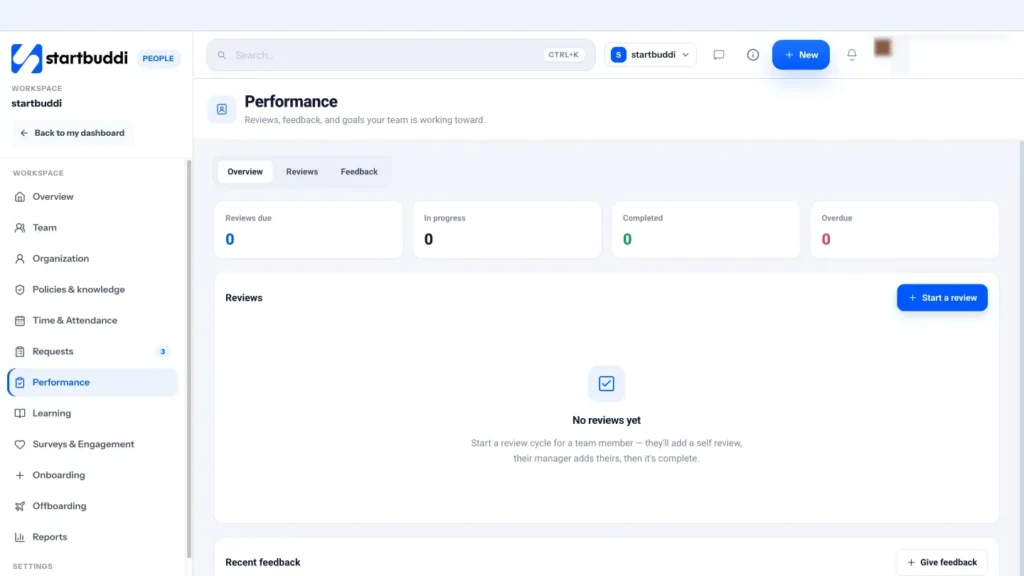
Performance in People keeps reviews simple enough that a small team will actually finish them. The page has three tabs: Overview, Reviews and Feedback. Stat cards show reviews due, in progress, completed and overdue, so you can see at a glance where the cycle stands.
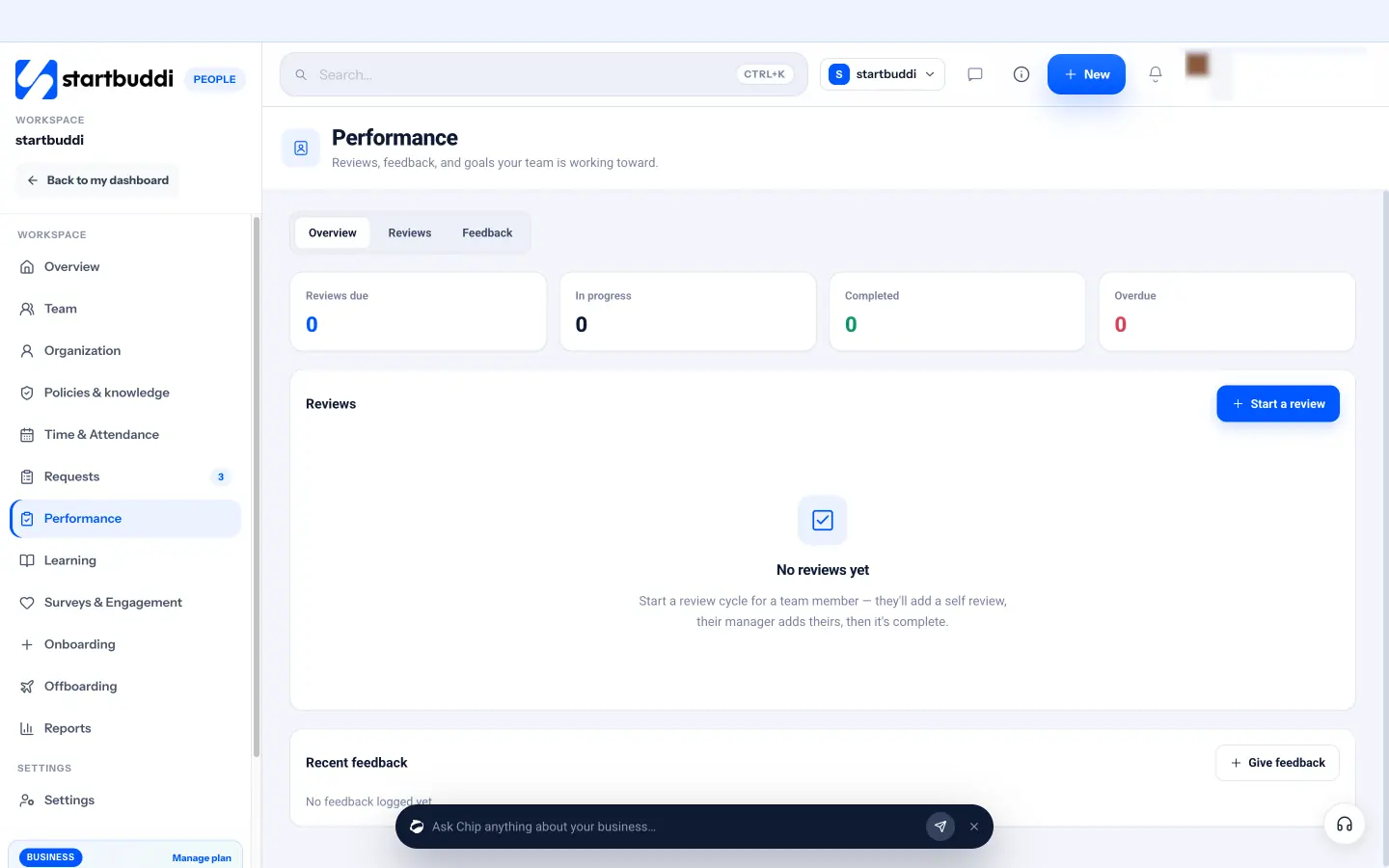
To start a cycle, click Start a review, choose the team member, name the cycle (for example "H1 2026") and set a due date. Repeat for each person; there is no bulk launcher, which for a small team is rarely a problem. The employee then writes a self review, the manager adds theirs with a rating from 1 to 5, and the manager marks it complete. Completion rates appear on the owner overview and in People reports.
The process is deliberately light. There is no 360 or peer-review workflow, no calibration step and no separate one-on-one module; review cycles are a name you give each review. For most teams under fifty that is enough, and it keeps the focus on the conversation rather than the form. Performance is part of People, which has no plan gate of its own. Seats are the limit: the Free plan includes only the owner, so reviewing teammates needs a paid plan with seats for them (see pricing).
Sources for this chapter
- Gallup: Give performance reviews that actually inspire employees
- Harvard Business Review: Reinventing Performance Management (Buckingham and Goodall, 2015)
- Acas: Reviews and appraisals
Prepare: goals, evidence and a performance review template
- Start with goals set months earlier
- Write a one-page role scorecard
- Collect evidence all year, not the night before
- A performance review template you can copy
- Self review questions
- Set expectations for the self review
- Gather customer and colleague input
- A simple rating scale
- Watch for common biases
- Describe behaviour at each level
- Preparing when you rarely see someone work
- Worked example: preparing a review
- Common preparation mistakes
- Prepare reviews in startbuddi
The quality of a performance review is decided before the meeting starts. A manager who arrives with clear goals, real examples and a thoughtful self review from the employee can have a useful conversation in 45 minutes. A manager who arrives with a blank form and a vague impression cannot, however good their intentions. This chapter covers the preparation: goals, evidence, the performance review template, a rating scale, the self review, and the biases to watch for. Then it shows how startbuddi helps you gather it all.
Start with goals set months earlier
A review is only fair if the person knew what they were aiming for. At the start of each review period, agree two to four goals with each person, plus the core expectations of their role. Goals should be specific and measurable where possible, and within the person's control. Acas suggests objectives should be fair, match the person's normal tasks and workload, and can be written using the SMART approach (Acas).
Examples of good individual goals:
- Customer support: keep first reply time under 2 working hours and customer rating at 4.6 or above.
- Sales: send 12 proposals a quarter and win at least 4.
- Designer: deliver client projects within the agreed two rounds of changes, 90% of the time.
- Operations: write step-by-step processes for the 5 most common tasks by the end of June.
- Development goal: complete a bookkeeping course and take over monthly expense reports by September.
For how individual goals link to company goals, see our goal setting for small business guide. One warning: keep stretch goals and OKRs separate from ratings. Google's own OKR guidance says OKRs are not a performance management tool, because tying them to reviews encourages people to set easy targets (Google re:Work).
Write a one-page role scorecard
Goals change each period; the role itself stays more stable. A short role scorecard describes what doing the job well looks like, so reviews are not only about this period's goals. Keep it to one page:
Role: Customer support lead
Purpose: Make sure every customer gets a fast, friendly and correct answer, and that problems reach the right person the same day.
Key outcomes: first reply within 2 working hours; customer rating 4.5 or above; urgent issues escalated the same day; the FAQ kept up to date.
How we expect it done: calm and polite under pressure; honest with customers about what we can and cannot do; shares what customers are saying with the team every week.
Skills that matter: clear writing, product knowledge, prioritising, using our support tools well.
Share the scorecard when someone joins and revisit it once a year. It also makes hiring easier, because it tells candidates exactly what the job involves.
Collect evidence all year, not the night before
The single most useful habit for fair reviews is a running note for each person. Every week or two, write one or two lines: something they did well, something that did not go to plan, feedback from a customer or colleague. Include dates. By review time you have twenty or thirty real examples, not a hazy memory of the last month.
Good sources of evidence:
- Progress on their goals and key results.
- Completed projects and tasks, and whether they were on time.
- Customer feedback, reviews and complaints.
- Feedback from colleagues (ask a couple of people a few simple questions).
- Your notes from 1:1s.
- Training completed and new skills used.
A performance review template you can copy
Keep the template short. Five sections are enough for most small businesses. The free performance review template follows the same structure if you want a ready-made version.
1. Goals from last period. For each goal: what was agreed, what happened, evidence.
2. Strengths. Two or three things the person does especially well, with examples.
3. Areas to improve. One or two things that would make the biggest difference, with examples.
4. Overall rating. One rating on the agreed scale, with a sentence explaining it.
5. Next period. Two to four goals, development actions and any support needed.
Resist adding more. Every extra section is more writing for the manager and less time for the conversation.
Self review questions
The self review gives the employee a voice and often surfaces things the manager did not know. Send these questions two weeks before the meeting:
- How do you think this period went overall?
- What are you most proud of? Give an example.
- What did not go as well as you hoped, and why?
- What got in your way? What would have helped?
- What do you want to learn or take on next?
- How can your manager support you better?
Read the self review before writing your own. Where you agree, say so. Where you disagree, that is the most important part of the conversation.
Set expectations for the self review
Some people write a single line in their self review; others write three pages. Tell people what you are looking for: about a page, honest, with examples, covering each question. Explain that a self review is not a test of modesty or confidence, and that you will not simply copy their rating. If someone struggles with writing, offer to talk it through instead and take notes for them. The aim is to hear their view, not to judge their writing.
Gather customer and colleague input
For customer-facing roles, pull in what customers said: reviews, compliments, complaints and survey comments that mention the person. For roles that work closely with others, ask two or three colleagues the three short questions described in chapter four. Always look for patterns rather than single comments, and never let one complaint or one glowing review decide a rating.
A simple rating scale
Ratings are useful when they are clearly defined and used consistently. A five-point scale with plain descriptions works well:
| Rating | Label | What it means |
|---|---|---|
| 5 | Exceptional | Far beyond the goals and the role; others learn from them |
| 4 | Strong | Met all goals and exceeded some; consistently reliable |
| 3 | Solid | Met the goals and expectations of the role |
| 2 | Developing | Met some goals; clear areas to improve, with support |
| 1 | Not meeting expectations | Missed most goals; needs a clear improvement plan |
Make "3" a good score. If people feel anything below 4 is a failure, the scale stops meaning anything. Most people in a healthy team will sit at 3 or 4 most of the time.
If you manage several people, write all the reviews in the same sitting or the same week, and read them side by side before you finalise any ratings. It is the easiest way to spot whether you have been harder on one person than another for similar results.
Watch for common biases
Everyone has biases, and reviews bring them out. Knowing the common ones helps you catch them (Dartmouth, common rater errors):
- Recency: the last month outweighs the rest of the period. Fix: use your running notes.
- Halo or horns: one strong trait (good or bad) colours everything. Fix: rate each goal separately first.
- Central tendency: everyone gets a 3 to avoid difficult conversations. Fix: tie each rating to evidence.
- Leniency or strictness: one manager rates everyone high, another low. Fix: agree examples of each rating across managers.
- Similarity: favouring people who remind you of yourself. Fix: ask "what is the evidence?" for every judgement.
Describe behaviour at each level
Ratings for how someone works (communication, teamwork, reliability) are the hardest to make fair, because they are easy to base on feelings. Writing a short description of each level for your most important behaviours helps. Here is an example for communication:
| Level | Communication looks like |
|---|---|
| Strong (4 to 5) | Updates people before they ask; writes clearly; raises problems early with a suggested fix; adapts to different customers and colleagues |
| Solid (3) | Keeps people informed on request; messages are usually clear; raises problems when they arise |
| Developing (1 to 2) | People often have to chase for updates; messages cause confusion; problems surface late |
Pick two or three behaviours that matter most in your business, write a table like this for each, and share them with the team at the start of the period, not at review time.
Preparing when you rarely see someone work
Owners of trades, cleaning and delivery businesses often manage people who work on customers' premises or on the road. You cannot watch the work, so evidence has to come from elsewhere: customer feedback and reviews, jobs completed on time, call-backs and complaints, photos of finished work, safety checklists, and short conversations with customers after a job. Spot checks, where a supervisor visits a job now and then with the worker's knowledge, can add useful first-hand evidence without feeling like surveillance.
Worked example: preparing a review
Kemi is a customer support lead in a small online business in Nairobi. Her goals for the half year were: first reply under 2 hours, a customer rating of 4.6 or more, and a written FAQ for the ten most common questions.
- Evidence: first reply averaged 1.5 hours; rating 4.7; FAQ written but only 6 of 10 questions covered. Running notes show two customers praising her by name, and one missed escalation in March.
- Self review: Kemi rates herself 4, is proud of the rating, frustrated that the FAQ stalled because of a busy March, and wants to learn about email marketing.
- Manager's draft: rating 4 (Strong), with the reply times and rating as strengths, the FAQ and the escalation process as areas to improve, and a development goal around email marketing.
With this preparation, the conversation can spend most of its time on the future: finishing the FAQ, fixing escalations, and planning her first email campaign.
Notice what the preparation did: it replaced opinions with facts, gave Kemi's own view a real place, and left most of the meeting free for the future. That is the whole purpose of preparing well. It also means the rating is easy to explain, because every part of it points back to something that happened.
Finally, before the meeting, read your draft once as if you were the employee. Would anything come as a surprise? Is every criticism backed by an example? Is there more about the future than the past? If not, fix it now.
Common preparation mistakes
- Writing the review in the hour before the meeting. It shows, and it is unfair to the person.
- Adjectives without examples. "Great attitude" means little. "Stayed calm and kept the client when the delivery was late in May" means a lot.
- Too many improvement areas. Pick the one or two that matter most.
- Sharing the rating by email before the meeting. Talk first, then share the written version.
Prepare reviews in startbuddi
Goals for each person can live in Goals in Work, with key results and weekly check-ins, and a person's profile in People has a Performance tab showing their reviews, goals and feedback in one place. By review time, the check-ins give you a record of how each goal went, month by month.
When you open a review in Performance, the form has a Self review section ("How do you think this cycle went?"), a Manager review section and a Rating (1 to 5). You can save a draft, and the employee submits their self review before the manager submits theirs and marks it complete.
Chip can help with the writing. Chip HR can gather a person's reviews, feedback, goals, training and onboarding, and draft a short, balanced review summary for you to edit. Suggested prompts include "Prepare a performance review summary for my overdue reviews", and employees can ask "Help me prepare for my performance review". Chip drafts; a person always decides the rating. Chip requests use Chip credits from your plan.
Sources for this chapter
- Acas: Reviews and appraisals
- Google re:Work: Set goals with OKRs
- Dartmouth Human Resources: Common rater errors
Run the conversation: scripts for praise, problems and pay
- Set up the meeting
- A review meeting agenda
- Scripts for praise
- Scripts for areas to improve
- When you disagree with the self review
- Talking about pay
- Underperformance and improvement plans
- Probation reviews
- Remote performance reviews
- End the meeting well
- Handling common reactions
- Write the summary
- Reviews for your best performers
- Reviews when the business is struggling
- Common mistakes in the review meeting
- Use Chip and startbuddi around the meeting
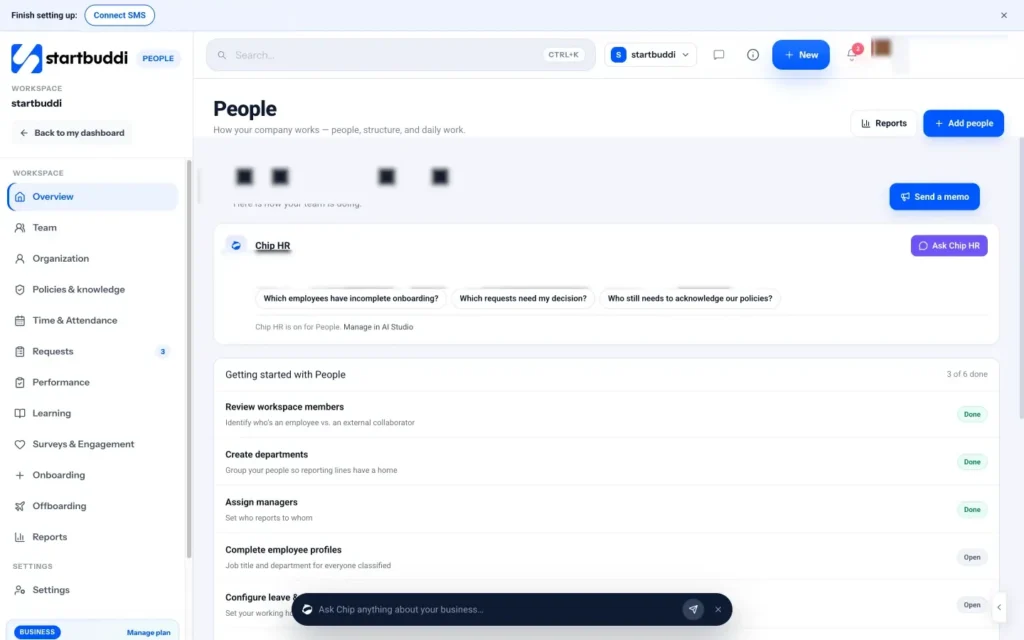
The review meeting is where preparation turns into something useful, or where it all goes wrong. Most people arrive at a review a little nervous, even when the news is good. Your job as the manager is to make it a calm, honest, two-way conversation that ends with both of you clear on what happens next. This chapter gives you an agenda, word-for-word scripts for the moments people find hardest, guidance on underperformance and improvement plans, and tips for remote reviews. Then it shows how Chip and startbuddi help around the meeting.
Set up the meeting
- Book 45 to 60 minutes in a quiet place or on a video call, not squeezed between other meetings.
- Tell them what to expect a week ahead: the agenda and that their self review is part of it.
- Bring your notes, not a script. You want a conversation.
- No surprises. If there is a serious issue they have not heard about, stop and consider whether it should be raised in a separate conversation first.
A review meeting agenda
- Open (5 minutes). Thank them, explain the structure, and say the aim is to look back fairly and plan ahead.
- Their view first (10 minutes). Ask them to talk through their self review. Listen more than you speak.
- Goals and evidence (10 minutes). Go through each goal together: what happened and why.
- Strengths (5 minutes). Be specific and generous.
- Areas to improve (10 minutes). One or two, with examples and a discussion of what would help.
- Rating (5 minutes). Share it and explain it.
- Next period (10 minutes). Agree goals, development and support.
- Close (5 minutes). Summarise the actions, ask how they feel about the review, and agree when you will share the written version.
Notice that most of the time goes on their view and on the future. That balance is what turns a review into a "progress review" rather than a verdict.
Scripts for praise
Praise is often rushed because it feels easy. Specific praise is far more motivating than general praise. Use this pattern: what they did, the effect it had, and why it matters.
"When the Adeyemi order went wrong in May, you called the customer the same day, explained what happened and offered a fix before they asked. They ordered again twice since. That is exactly the kind of care that keeps our customers, and I want you to know I noticed."
"Your reply times averaged an hour and a half against a goal of two hours, and our rating went up to 4.7. That is a real achievement in the busiest half year we have had."
Scripts for areas to improve
The situation, behaviour, impact pattern keeps criticism factual and fair: describe the situation, the specific behaviour, and its impact, then ask for their view.
"In March, the complaint from the hotel client was not passed to me for four days (situation). It stayed in the inbox without an escalation (behaviour). By the time I called them they were ready to cancel, and we had to give a discount to keep them (impact). What happened from your side?"
Then move to the future:
"What would help make sure urgent complaints reach me the same day? Would a simple rule, like tagging anything mentioning a refund, work for you?"
Avoid words like "always" and "never", which invite an argument, and stick to what you saw rather than guessing at motives.
When you disagree with the self review
Sometimes the employee rates themselves much higher or lower than you do. Do not skip over it; it is the most useful part of the meeting.
"You rated yourself a 5 and I have you at a 3. I want to understand how you see it. Can you walk me through what you think went especially well?"
Listen, share your evidence, and look for the gap. Often it is about expectations that were never made clear, which is a lesson for setting next period's goals. If someone rates themselves too low, tell them plainly what you see: people who undersell themselves often need to hear it directly.
Talking about pay
If you keep pay reviews separate (as chapter one suggests), people will still ask. A simple answer works:
"Pay is reviewed for everyone in July, separately from this conversation, so that today can focus on your growth. Today's review will be part of that decision, and I'll talk to you about it then."
Never promise a raise in a review unless the decision is already made and funded. A broken promise damages trust far more than an honest "not yet".
Underperformance and improvement plans
If someone is not meeting expectations, the review should not be the first time they hear it; it should confirm conversations already had. When performance needs a structured fix, use a short, written improvement plan:
- What needs to change: two or three specific, measurable points.
- Why: the evidence and the impact.
- Support: training, more regular check-ins, clearer instructions, fewer competing tasks.
- Timeline: often four to eight weeks, with weekly check-ins.
- What happens next: what happens if things improve, and what happens if they do not.
Many performance problems turn out to have a cause the manager did not know about: unclear expectations, a skills gap, a personal situation, or too much work. Ask before you assume. If a problem continues after a fair, documented process, formal steps may follow, and these are governed by employment law. The UK's Acas guidance on problems with an employee's performance is a clear example of what a fair process looks like.
Whatever the outcome, follow up an improvement plan meeting with a written summary the same day, and hold every weekly check-in you promised. Consistency on your side is what makes the process fair, and it gives the person the best possible chance to turn things around.
Probation reviews
A probation review at the end of a new hire's first months is a shorter version of the same conversation. Look at the goals set when they started, what has gone well, what needs work, and whether you will confirm their role. Be decisive: confirm, extend with clear reasons and a new date, or end the employment fairly. Our post on onboarding a new employee covers the 30, 60 and 90-day check-ins that lead up to it.
Remote performance reviews
- Always use video, never chat or email, for the conversation itself.
- Share the self review and your draft goals in a shared document you both can see.
- Check the connection and time zone in advance, and pick a time that is not at the edge of their working day.
- Pause more often to ask how they are hearing it, because body language is harder to read on screen.
- Send the written summary within a day, while the conversation is fresh.
End the meeting well
The last five minutes shape how the person remembers the whole review. Summarise, check, and close warmly:
"So, to sum up: a strong half year, rated 4, especially on reply times and customer ratings. The two things to work on are finishing the FAQ by the end of August and escalating urgent complaints the same day. Your development goal is the email marketing course, and I'll book it this week. How do you feel about the review overall? Is there anything we haven't covered?"
Things to avoid saying: comparisons with colleagues, promises you cannot keep, anything about someone's personal life, health or family unless they raise it, and vague warnings such as "you need to step up" without saying exactly what that means.
If the conversation runs out of time, do not rush the last sections. Book a follow-up within a few days to agree goals and development properly. A rushed ending undoes much of the good work in the first half, and the next-period goals are the part that actually changes what happens.
Handling common reactions
People react to feedback in different ways. Here is how to respond to the most common reactions:
| Reaction | What it can look like | What helps |
|---|---|---|
| Defensive | "That wasn't my fault", explaining every point away | Acknowledge their view, return to the evidence and the future: "I hear that. What would help it go differently next time?" |
| Silent | Short answers, little eye contact | Ask open questions and allow pauses; offer to follow up in writing or the next day |
| Upset | Tears, shaky voice | Pause, offer a break, and reassure them about what is going well |
| Angry | Raised voice, blaming others | Stay calm, lower your own voice, suggest continuing later if needed |
| Over-agreeable | Agrees to everything quickly | Check understanding: "What will you do differently on Monday?" |
None of these reactions is a failure. They are signs the conversation matters to the person. Your calm, fair response is what they will remember.
Write the summary
Within three days, write a short summary and share it. Keep it factual and brief: the goals and what happened, the main strengths, the one or two areas to improve, the rating, and the agreed goals and actions for next period with dates. Use the same words you used in the meeting, so nothing reads as new. Invite the employee to add their own comments, including disagreements. A summary both people have seen and commented on is far more useful, and fairer, than one only the manager holds.
Reviews for your best performers
Managers often spend review time on struggling employees and rush the strongest. That is backwards. Your best people are the most likely to be approached by other employers and the most expensive to replace. Use their review to ask what would make them stay and grow: bigger responsibilities, a new skill, a clearer path to a senior role, more flexibility. Then act on at least one thing within a month.
Reviews when the business is struggling
When money is tight, owners are tempted to cancel reviews because they cannot offer raises. That is the wrong move. People worry more when times are hard, and silence feeds rumours. Hold the reviews, be honest about the business situation without over-sharing, and focus on what you can offer: recognition, development, more responsibility, flexibility, or a commitment to revisit pay when things improve (only if you mean it). People often accept a difficult year when they feel valued and informed, and leave when they feel ignored.
Common mistakes in the review meeting
- Talking for 45 minutes. Aim for the employee to speak at least half the time.
- The "feedback sandwich". Hiding criticism between two compliments confuses people. Be clear and kind instead.
- Comparing with colleagues. "Ada hits her targets" invites resentment. Compare with goals.
- Ending without actions. Every review ends with agreed goals and next steps, written down.
Use Chip and startbuddi around the meeting
Before the meeting, Chip HR can draft a review summary from the person's feedback, goals and training, and help you prepare a probation check-in: one of its suggested prompts is "Help me prepare a probation check-in" for a named person. Employees can ask Chip to help them prepare for their own review. Chip HR answers from your published policies and handbook and names the page it used, so if your handbook describes the review process, people can ask "how do reviews work here?" and get your own answer. Chip drafts; you decide, and it asks before changing anything.
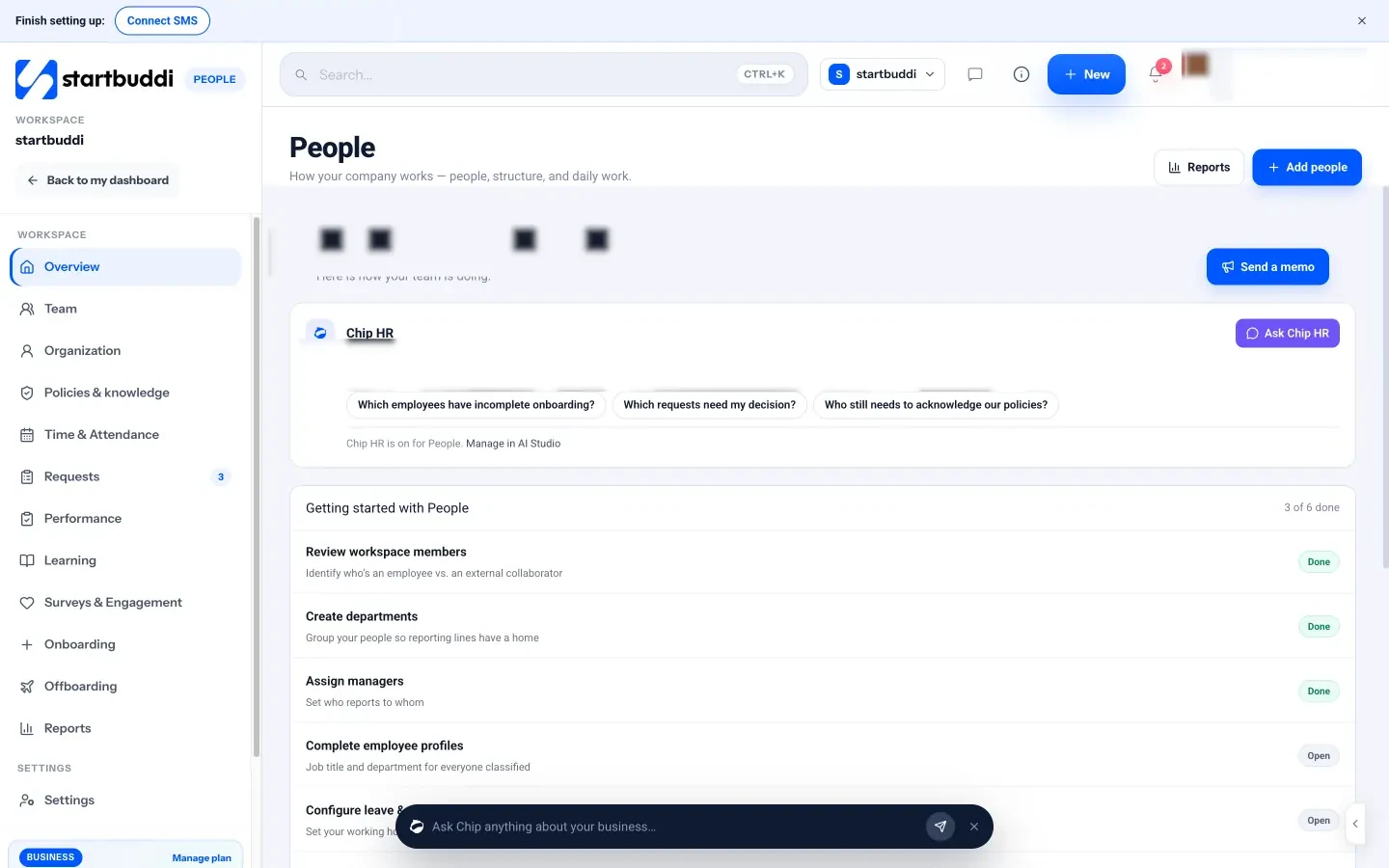
For remote reviews, send the meeting link and the agenda in a direct message in Chat, and keep shared notes in Documents, where you can both edit at the same time and comment on specific lines. After the meeting, the manager completes the Manager review and rating in Performance and marks the review complete, so the record stays with the person's profile.
Sources for this chapter
After the review: employee feedback, development and the next cycle
- In the three days after the review
- Why regular feedback matters more than the review
- How to give employee feedback that helps
- Peer feedback in a small team
- Turn development plans into action
- Measure how people feel
- Improve your review process each cycle
- Career paths in a small business
- When a review shows the role is the wrong fit
- A year of performance management on one page
- A 1:1 template for between reviews
- Recognition that costs little
- Linking reviews to promotions and pay
- Exit interviews as feedback
- Common mistakes after the review
- Feedback, learning and surveys in startbuddi
A review that ends when the meeting ends has done a third of its job. The real value comes afterwards: the goals people work on, the skills they build, and the steady stream of feedback that means the next review holds no surprises. This chapter covers what to do in the days after a review, how to build a habit of regular employee feedback, how to turn development plans into action, how to measure how people feel, and how to improve your review process each cycle. Then it shows how startbuddi supports each step.
In the three days after the review
- Write up the review while it is fresh: the rating, the main points, and the agreed goals and actions.
- Share it with the employee and invite them to add comments, including anything they disagree with.
- Set up the new goals where they will be tracked, with dates.
- Book the support you promised: the course, the mentor, the extra 1:1s.
- Diarise the next review and the regular 1:1s in between.
Acas recommends keeping a written record of what is discussed and sharing it with the employee afterwards (Acas). It protects both of you, and it becomes the starting point for the next review.
Why regular feedback matters more than the review
The formal review happens twice a year; feedback happens every week. Gallup found that 80% of employees who said they had received meaningful feedback in the past week were fully engaged, yet only 16% said their most recent conversation with their manager was extremely meaningful (Gallup, a great manager's most important habit). Gallup's wider research also found that managers account for at least 70% of the variance in team engagement (Gallup). In a small business, the owner or manager's weekly habits shape how people feel about their work more than any policy.
How to give employee feedback that helps
- Soon: within a day or two of what happened.
- Specific: the situation, behaviour and impact pattern from chapter three.
- Balanced over time: far more recognition than correction, but do not hold back correction.
- Private for criticism, public for praise (if the person is comfortable with public praise).
- Two-way: ask for feedback on yourself too, and act on it visibly.
Quick examples:
"The quote you sent Mr Mensah was clear and well laid out. He accepted within the hour. Could you save it as a template for the others?"
"The weekly report came in on Monday afternoon instead of Friday. That meant I went into the client call without the numbers. Can we agree Friday at 16:00 from now on?"
A simple weekly habit helps: on Friday, before you close the laptop, write down one piece of feedback you will give each person next week. It takes five minutes and makes sure nobody goes a month without hearing from you.
Peer feedback in a small team
In a small business, colleagues often see more of someone's work than the manager does. You do not need a formal 360 process to benefit. Before each review, ask two or three colleagues three short questions about the person: what should they keep doing, what could they do more of, and what could they do differently. Collect the answers yourself, look for themes, and share the themes rather than quoting individuals. Keep it light and constructive, and never use it to settle scores.
Turn development plans into action
Development is where many reviews fall down: everyone agrees the person should learn something, and then nothing happens. Make each development goal concrete:
| Vague | Concrete |
|---|---|
| Improve presentation skills | Present the monthly results at two team meetings by September, with feedback from the manager after each |
| Learn marketing | Complete an online email marketing course by August and run one campaign in September |
| Take on more responsibility | Own the supplier relationship for packaging, including the next price negotiation in Q3 |
| Get better with numbers | Shadow the monthly expense report twice, then prepare it with review from October |
Many of the best development activities are free: stretch projects, shadowing, mentoring from a senior colleague, presenting to the team, or taking over a task the owner has been holding on to. Budget for courses when you can, and ask for a short summary of what was learned afterwards so the whole team benefits.
Measure how people feel
Reviews tell you how people are performing. Surveys tell you how they feel about their work, which often predicts performance problems before they appear. Short, regular pulse surveys work well for small teams: three to five questions every few weeks, anonymous where possible, with the results shared back. eNPS (employee net promoter score) asks one question on a 0 to 10 scale: how likely are you to recommend this as a place to work? People who answer 9 or 10 are promoters, 7 or 8 passives and 0 to 6 detractors. The score is the percentage of promoters minus the percentage of detractors. In a very small team, treat the number as a conversation starter rather than a precise measure, and always read the written comments.
Improve your review process each cycle
After each cycle, ask the team two questions: what was useful about the review, and what would make it better? Look at your own numbers too: how many reviews were completed on time, how many people had goals set within two weeks, how many development actions actually happened. Change one thing each cycle. Over two or three cycles, you will have a process that fits your business rather than one copied from a big company.
Career paths in a small business
People in small businesses often worry there is nowhere to grow, because there are few senior roles. You can still offer real progression. Growth can mean more responsibility (owning a client, a supplier or a process), more skill (becoming the go-to person for something), more autonomy (setting their own schedule or budget), or a new role created as the business grows. Talk about these options in reviews, and write down what "next level" looks like for each role, even if it is only a few lines. A clear path, however small, is one of the strongest reasons good people stay.
When a review shows the role is the wrong fit
Sometimes a review reveals that a good person is in the wrong role: a brilliant technician struggling as a manager, or a strong salesperson who dislikes the admin side of account management. Before you treat it as a performance problem, ask whether the role could change. Could you split the job, move them to a role that uses their strengths, or bring in help for the part they find hard? In a small business, reshaping a role around a good person is often cheaper and faster than replacing them, and it keeps the knowledge they have built up.
A year of performance management on one page
| When | What |
|---|---|
| January | Set goals for the first half year with each person |
| Every week or two | 1:1s and quick feedback; update running notes |
| Monthly | Check goal progress; a short pulse survey |
| June | Mid-year performance reviews; set second-half goals |
| July | Pay reviews, separately |
| December | End-of-year reviews; learn from the cycle and adjust the process |
A 1:1 template for between reviews
Regular 1:1s are where feedback and development actually happen. Keep a shared note for each person and use the same simple structure every time:
- How are you? A real check on energy and workload.
- Their topics. Anything they want to raise.
- Goal progress. Quick status on each goal from the last review.
- Feedback both ways. One thing that went well, one thing to try differently, and one thing you could do better as their manager.
- Development. How the agreed learning is going.
- Actions. Who does what by when.
By the next review, these notes give both of you months of evidence, and the review itself becomes a summary of conversations already had.
Recognition that costs little
- A specific thank-you message, the same day.
- A mention in the weekly team meeting or channel.
- Asking them to teach the team something they do well.
- A choice of the next interesting project.
- An afternoon off after a hard push.
- Telling a customer or partner who did the great work.
Linking reviews to promotions and pay
Even if pay is reviewed separately, people want to know how the two connect. A simple, written approach avoids suspicion of favouritism. For example: every role has a pay range; everyone rated 3 or above gets at least the annual adjustment for cost of living when the business can afford it; people consistently rated 4 or 5 move up within their range or are considered for promotion; anyone rated 1 or 2 is on a development or improvement plan first. Share the approach with the team, even if you keep individual pay private.
Exit interviews as feedback
When someone leaves, ask why. A short exit conversation or survey often reveals what reviews missed: a manager who never gave feedback, unclear growth paths, or pay that fell behind the market. Ask what they valued, what would have made them stay, and what they would change. Look for patterns across leavers, and feed them into your next review cycle.
Whatever you choose to change, tell the team before the next cycle starts. People notice when their feedback about the process is acted on, and it makes them far more willing to engage honestly the next time you ask.
Common mistakes after the review
- Filing the review and forgetting it. Goals and actions need a home and a date.
- Promising training that never happens. It teaches people that reviews are just talk.
- Only giving feedback at review time. Weekly feedback is what changes performance.
- Running surveys and ignoring the results. Share what you heard and one thing you will change.
Feedback, learning and surveys in startbuddi
The Feedback tab in Performance lets anyone give feedback: choose who it is about, write what is working and what could be better, and click Send feedback. Managers see recent feedback for their team, and employees see feedback about them, so it builds up as evidence for the next review rather than living in scattered messages.
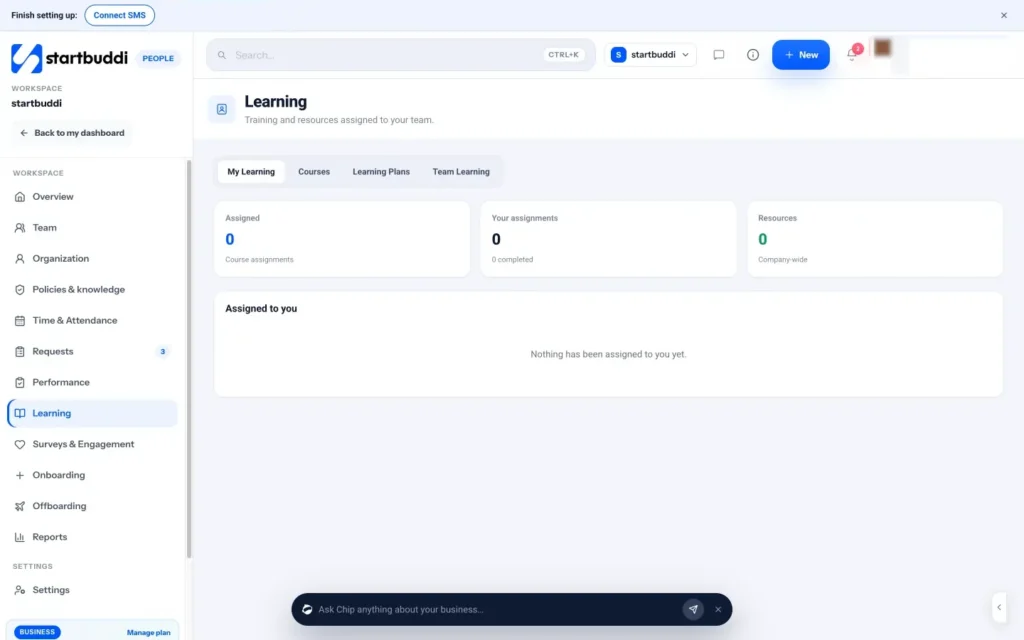
Learning turns development plans into tracked assignments. Add a learning resource (a video, document, link, workshop, webinar or course hosted elsewhere), assign it to a person, team or department, and see who has completed it in Team learning. Learning plans group resources together, such as a role's essentials or a compliance refresher. It is a library with tracking, not a course platform: content is linked by URL, and there are no quizzes or certificates.
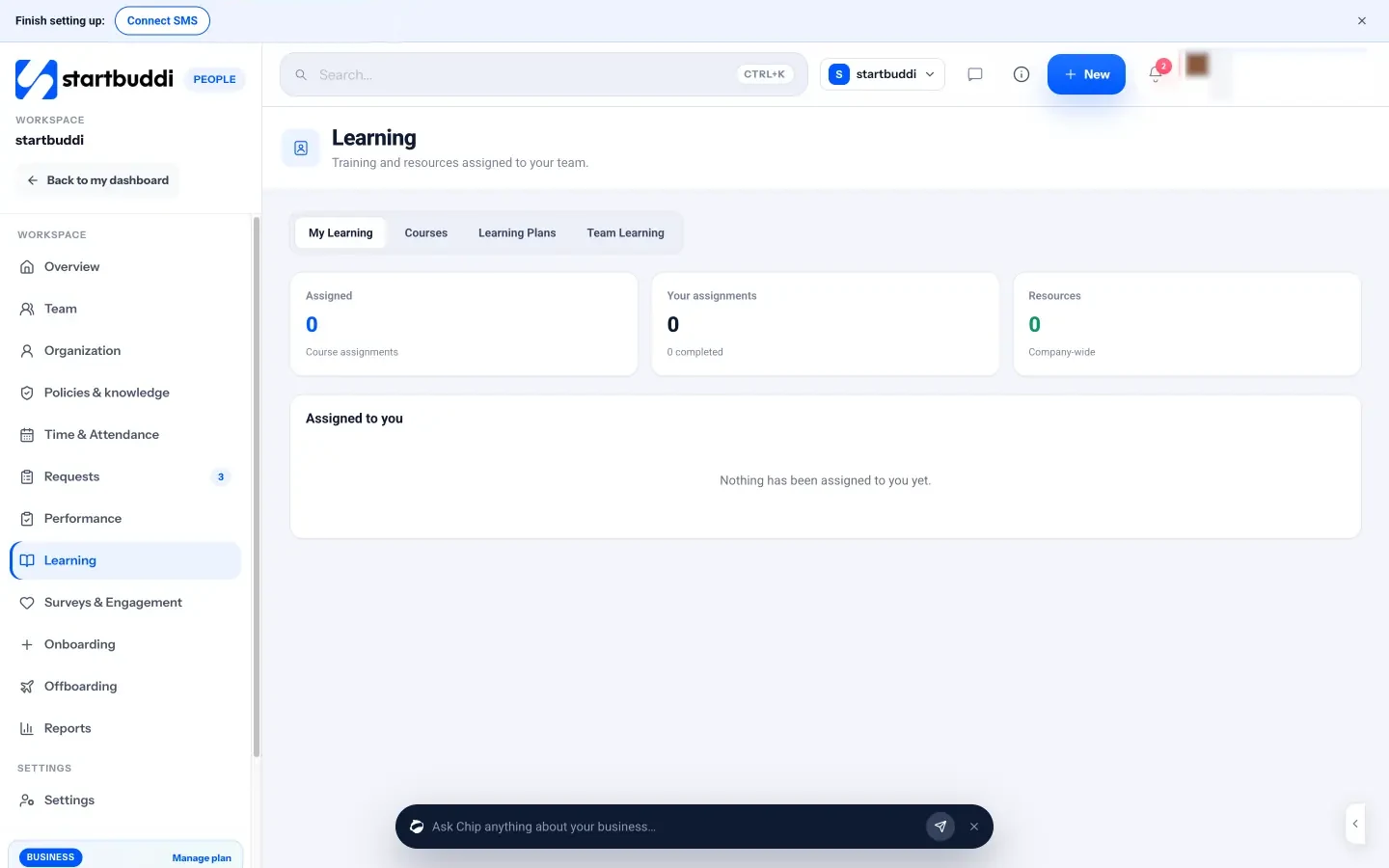
Surveys in People include templates for a weekly pulse check, eNPS, an engagement survey, a new joiner check-in and an exit interview. Questions can use an agreement scale, multiple choice, open text or eNPS. Choose Anonymous and answers are never linked to a person, and results stay hidden until at least 3 people respond. Results show responses, response rate and the eNPS split into promoters, passives and detractors, alongside written answers.
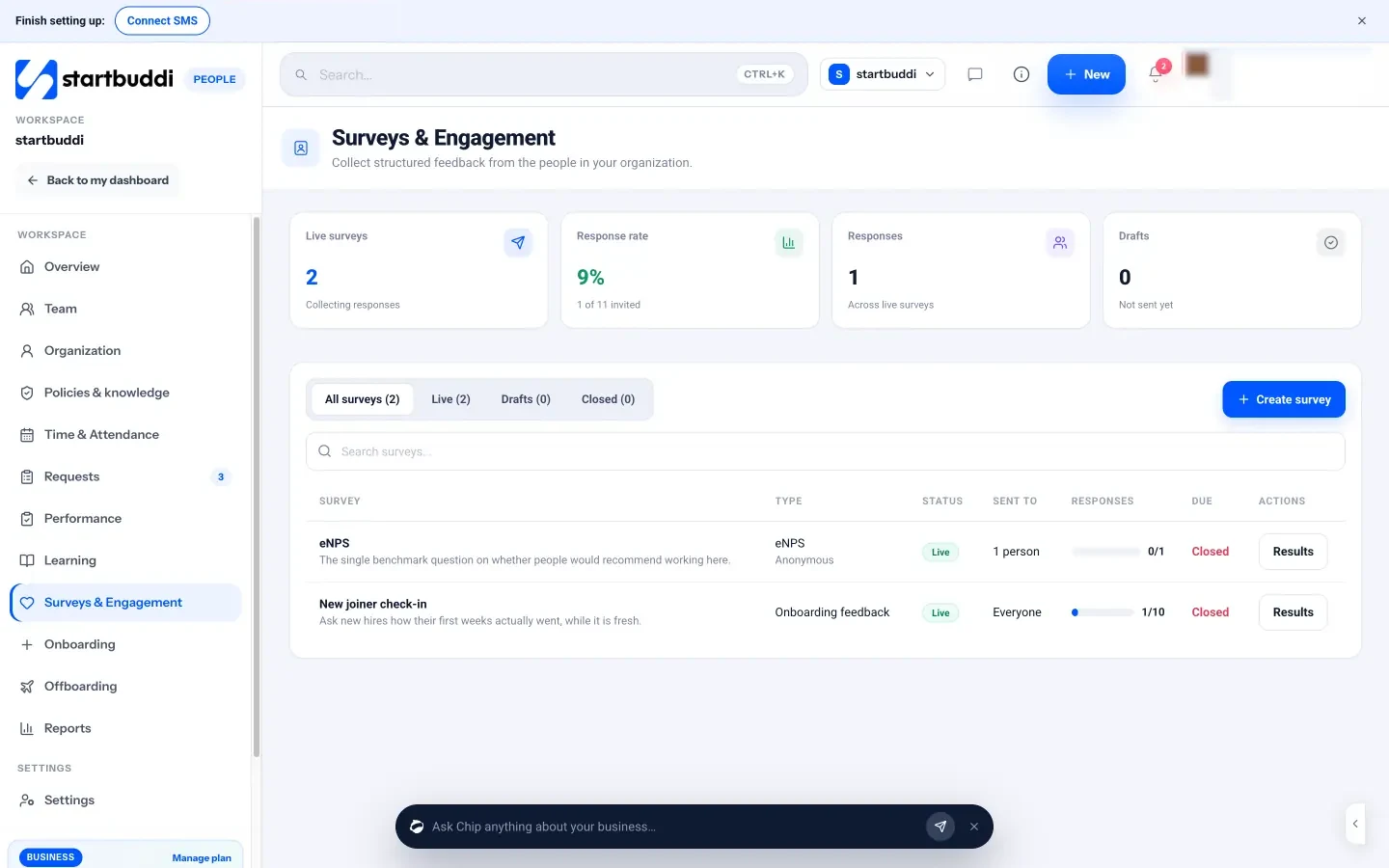
People reports show how many reviews are complete across the team, and the owner overview shows review completion at a glance. Your next step: pick your review dates for this year, share the five-section template with your team, and book the first round of 1:1s. You can see how People in startbuddi handles reviews, feedback, learning and surveys, and compare plans on the pricing page. Every paid plan has a 30-day trial.
Sources for this chapter
- Acas: Reviews and appraisals
- Gallup: A great manager's most important habit
- Gallup: Managers account for 70% of variance in employee engagement
Tiwalade Joanna Okedara-Kalu is the founder, CEO and CTO of startbuddi, the business system that brings clients, bookings, invoices, projects, marketing and the Chip AI assistant into one place. Tiwalade builds software around how service businesses really work day to day, and writes about client management, getting paid on time and why small businesses outgrow the tools they start with.
Founded startbuddi and leads its product and engineering