Leave policy for small businesses: what to include (with a template)
What a small business leave policy should cover, the legal minimums in Nigeria, the UK and South Africa, and a template you can copy and adapt today.



- A leave policy says what time off staff get, how they earn and request it, and who approves it. Start from your country's legal minimum, cover every leave type, set notice, approval, coverage and carry-over rules, and track requests in one system.
A leave policy is a short written rule that says what time off your staff get, how they earn it, how to ask for it and who approves it. For a small business it should cover at least annual leave, sick leave, public holidays, parental leave and unpaid leave, and it must meet the legal minimum in the country where each person works. The rest is your choice: how generous to be, whether leave carries over and how you keep enough people at work during busy weeks.
Below you’ll find the legal starting points for a few common countries, every section a good leave policy needs, a template you can copy and the mistakes that cause arguments later.
This is general information, not legal advice. Employment law changes and depends on the type of worker and contract. Check with your labour ministry or an employment lawyer before you publish your policy.
Why a small business needs a leave policy
Without a written leave policy, every request becomes a negotiation. One person gets a long weekend approved by text, another is told “not this month”, and six months later nobody remembers who has taken what. In a team of five, one person away can halve your capacity on a given day, so planning matters more, not less.
A clear leave policy gives you:
- Fairness. Everyone plays by the same rules, and you can point to them.
- Planning. Notice periods and coverage rules mean you know who’s away before it hurts customers.
- Legal cover. A policy that meets or beats the legal minimum protects you if a dispute comes up.
- Rest. People who actually take their leave do better work. A policy that makes leave easy to book helps.
Start with the legal minimum
Your leave policy can be more generous than the law, never less. Here are the headline minimums in three countries, as examples. Always read the official source, because coverage and conditions matter.
| Country | Annual leave | Sick leave | Maternity |
|---|---|---|---|
| Nigeria (Labour Act) | At least 6 working days with full pay after 12 months’ continuous service (section 18) | Paid up to 12 working days a year for certified temporary illness (section 16) | Six weeks before and six weeks after birth, with at least 50% of wages after six months’ service (section 54) |
| United Kingdom | 5.6 weeks a year, which is 28 days for a five-day week, and bank holidays can be included (GOV.UK) | Statutory Sick Pay rules apply | Statutory maternity leave and pay rules apply |
| South Africa (BCEA) | 21 consecutive days a year, or 15 working days for a five-day week (Basic Conditions of Employment Act) | Up to 30 days in a 36-month cycle for a five-day week | Covered by the Act and unemployment insurance rules |
Two things to note for Nigeria. First, the Labour Act’s minimums are low, and the Act mainly covers workers as it defines them, so many employers choose to offer well above the minimum to attract and keep good people. Second, section 18 allows annual leave to be deferred by agreement, but not beyond 24 months of service, and it doesn’t allow you to pay wages instead of the holiday while someone is still employed. Build both points into your carry-over rule.
What to include in a leave policy
1. Who the policy covers
Full-time, part-time, interns, contractors. Contractors usually aren’t entitled to paid leave, but say so clearly. For part-time staff, explain how leave is worked out (for example, pro rata to the days they work).
2. Leave types and how much
List each type with its entitlement:
- Annual leave: the number of working days per year.
- Sick leave: paid days per year and when you need a doctor’s note.
- Public holidays: whether they’re paid days off on top of annual leave. In Nigeria, the federal government announces holidays, sometimes at short notice, so say how you’ll handle last-minute declarations.
- Maternity and paternity leave: at least the legal minimum. Say whether you top up pay.
- Compassionate or bereavement leave: a set number of days for a death or serious illness in the family.
- Unpaid leave: when it’s allowed and who approves it.
- Optional extras: study leave, a birthday day off, a sabbatical after a number of years.
3. How leave is earned (accrual)
Decide whether leave is given in full at the start of the year or earned month by month. Monthly accrual is fairer for new starters and leavers: 20 days a year is about 1.67 days a month. Also say when the leave year starts (January, or each person’s start date).
4. How to request leave
Say exactly where and how. “Send a request in our HR system” is better than “tell your manager”, because it leaves a record. Include what to put in the request (dates, type, any note).
5. Notice required
A simple rule works well: at least twice as many days’ notice as the number of days requested, or a fixed minimum such as two weeks for anything over three days. Sick and compassionate leave obviously can’t be booked ahead, so explain how to report them instead (for example, message your manager before 9am).
6. Who approves
Name the approver by role, not by person: “your manager”, then “the founder” if the manager is away. For longer leave, you may want two approvers. Say how quickly requests will be answered, such as within two working days.
7. Busy periods and team coverage
If you’re a cleaning company before Christmas or an agency at year-end, you may need to restrict leave during certain weeks. Say which weeks, and how you decide between two people who want the same dates (first come, first served is the easiest to defend).
8. Carry over
Decide how many unused days can roll into next year and when they expire. A cap (for example, five days used by the end of March) stops people banking huge balances and nudges them to rest.
9. Leaving the business
Explain what happens to untaken leave when someone leaves: whether it’s taken during notice or paid out in final pay, following local law.
A leave policy template you can copy
Adapt the numbers to your business and your country’s law.
Leave policy for [Business name]
Who this covers: all employees. Contractors are not covered.
Annual leave: full-time employees get [20] working days a year, earned monthly. The leave year runs from [1 January]. Part-time employees get a pro rata amount.
Public holidays: official public holidays are paid days off and don’t count against annual leave.
Sick leave: you get [12] paid sick days a year. Message your manager before [9am] on the first day. For more than [2] days in a row, we’ll ask for a note from a registered doctor.
Parental leave: [12 weeks] maternity leave on [full] pay and [10] working days paternity leave on full pay, after [6] months’ service.
Compassionate leave: up to [5] paid days for the death or serious illness of a close family member.
Unpaid leave: available by agreement with the founder.
How to request: request leave in [our HR system] at least [two weeks] ahead for more than [3] days. Your manager will reply within [2] working days.
Busy periods: we limit leave in [the first two weeks of December]. Requests for the same dates are approved in the order received.
Carry over: up to [5] unused days carry into the next year and must be used by [31 March].
Leaving: untaken leave will be [taken during notice or paid in your final pay], in line with the law.
Leave for remote and cross-border teams
Small teams often hire across cities or countries. A designer in Accra, a developer in Nairobi and a founder in Lagos can all work together, but their leave rules may differ. A few simple habits keep this manageable:
- Apply the law where the person works. In general, local employment law follows the employee’s location, not yours. Your policy can offer the same generous baseline to everyone, as long as it meets each local minimum.
- List public holidays per location. Different countries, and sometimes different states, close on different days. Keep a holiday list for each place people work.
- Agree overlap hours. When someone is away, the rest of the team needs to know who covers their customers, especially across time zones.
- Use one shared calendar of time off. Remote teams can’t glance across the office to see who’s missing, so make absences visible to everyone.
If you use contractors or an employer of record in another country, check who is responsible for their leave before you promise anything.
How to handle leave requests fairly
- Reply fast. A request left for a week feels like a no. Aim for two working days.
- Give a reason when you decline. “Two others are already off that week” is fair. Silence isn’t.
- Offer an alternative. “Can you do the week after?” keeps goodwill.
- Look at the whole team. Check who’s already away before approving, especially in customer-facing roles.
- Encourage people to use their leave. If someone hasn’t taken a day in six months, ask them to plan some time off.
- Keep records. Balances, approvals and reasons, in one place. You’ll need them for payroll and if anyone ever questions a decision.
Common leave policy mistakes
- Tracking leave in a spreadsheet only one person updates. Balances drift, and staff can’t check their own.
- Counting public holidays as annual leave by accident. Be clear which days are charged.
- No rule for last-minute public holidays. Decide in advance whether a newly declared holiday is a day off for everyone, including people already on leave.
- Informal approvals. A “yes” on WhatsApp is hard to find later. Use one system.
- Changing the rules mid-year without notice. If you change the policy, say when it takes effect and don’t apply it backwards to requests already approved.
- Forgetting about coverage until it’s too late. Two people off in the same week can stall a small team.
How startbuddi runs your leave policy
In startbuddi, leave is part of the People module, and your leave policy isn’t just a document: it’s the set of rules the app actually follows. Read more on the leave and attendance page.
Leave types ready to go. Every workspace starts with Annual leave, Sick leave, Compassionate leave and Unpaid leave, and you can edit them to match your policy. Staff see a balance card for each type showing days used and pending.
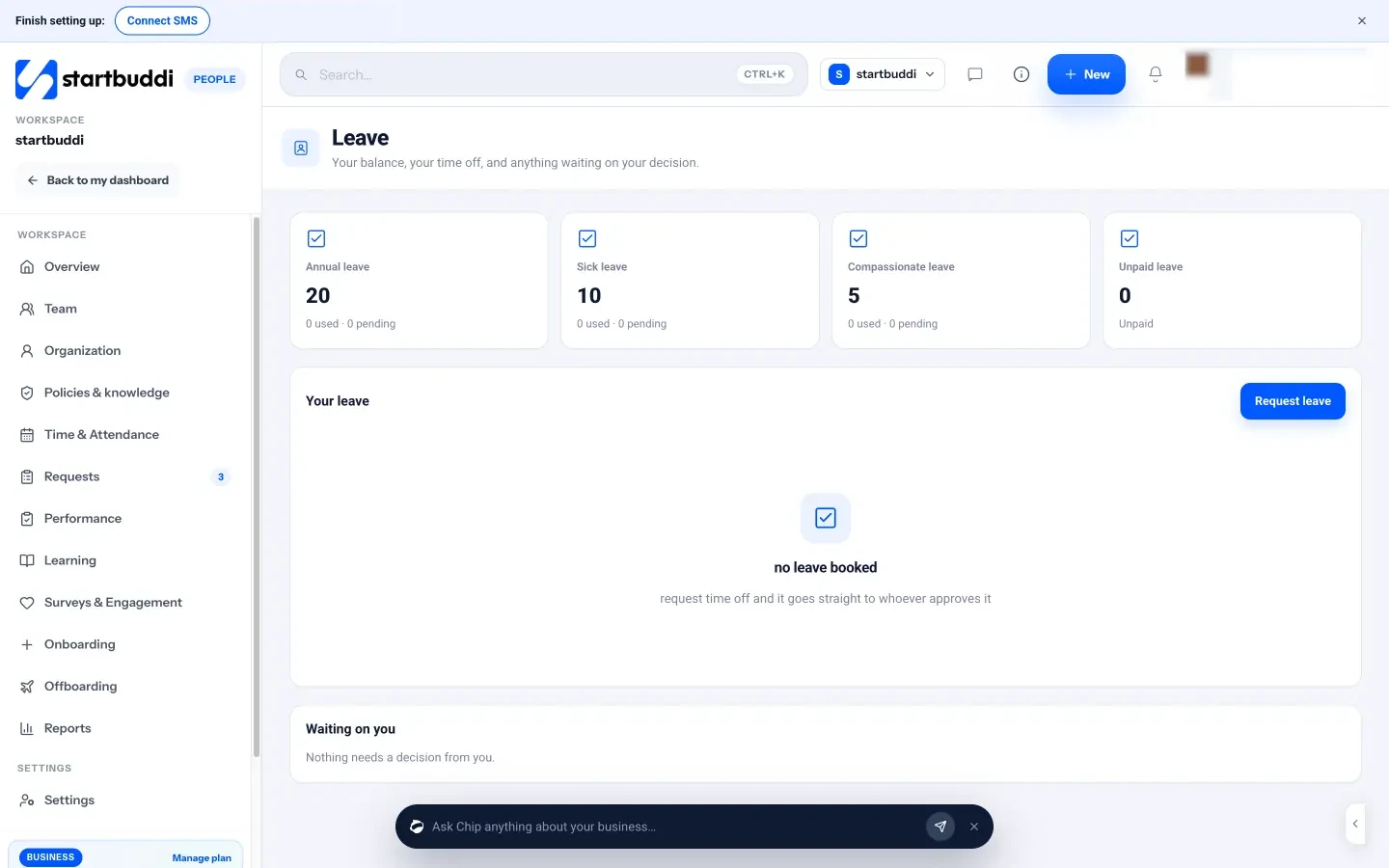
Requests with the checks built in. When someone requests leave, startbuddi counts the working days and checks the request against your policy before it’s sent: not enough leave left, not enough notice, team coverage, restricted periods and policy conflicts. A blocking conflict stops the request from being sent, so problems are caught before they reach you. Public holidays you add under Time & Attendance aren’t charged as leave.
The right approver, in the right order. In the leave policy editor you set who approves leave, as a chain that runs in order: the next person is asked only once the one before approves. Approvers can be the person’s manager, a department head, a People admin, a Finance admin or the workspace owner, and a leave type can have its own chain. Rules for notice, carry over, self-approval and a team coverage guard sit in the same place.
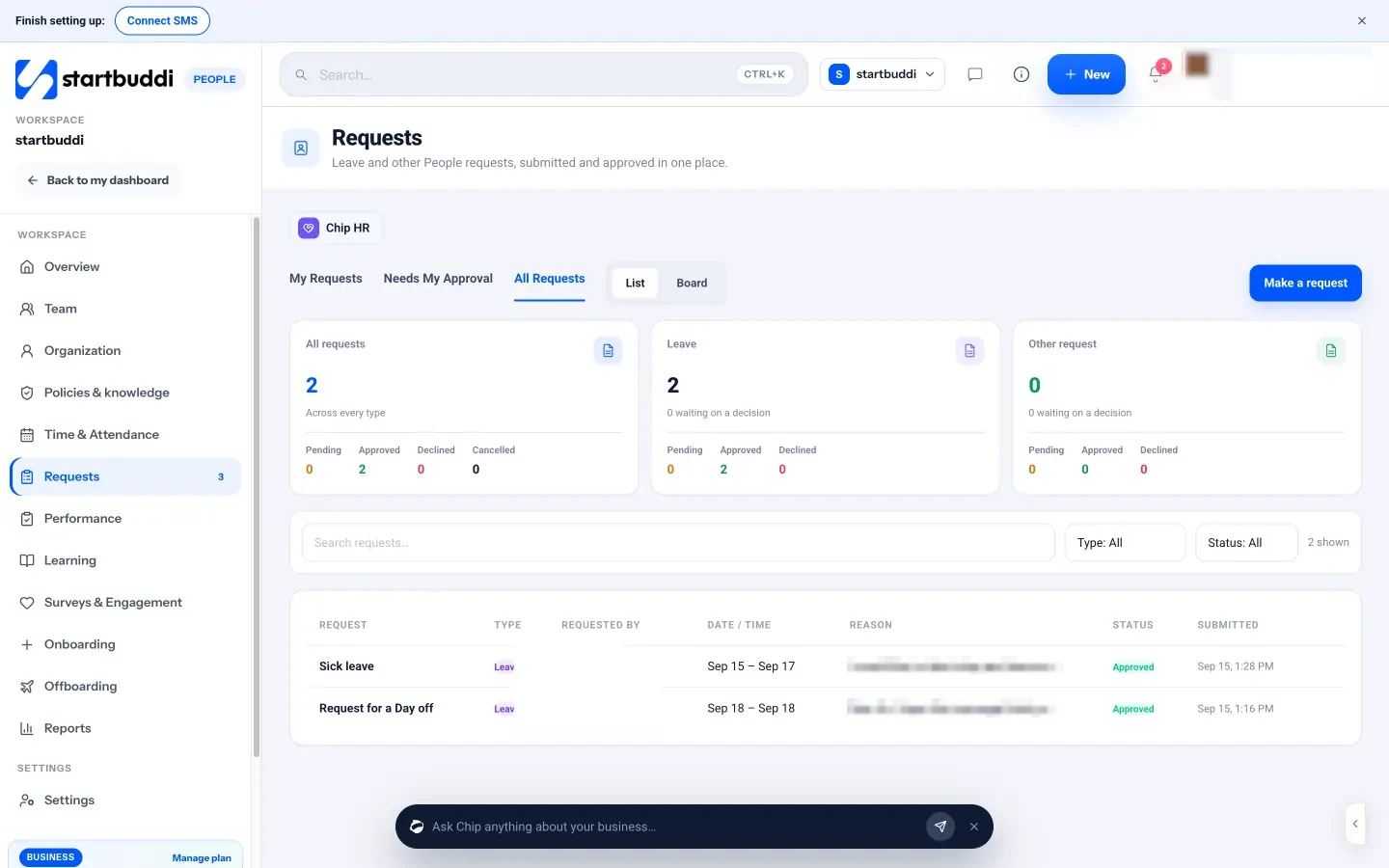
Everyone knows who’s away. Approvers see requests in Requests or on the Leave screen and choose Approve, or Reject with a reason. Once approved, balances update and the time off shows on the overview, on the person’s profile and in “Who’s away today”.
Versions and sign-off. Your leave policy is one of the policies in your handbook. When you publish a change, it applies to new requests from then on, older requests keep the rule version they were made under, and staff can be asked to acknowledge the new version.
Chip HR answers the questions. Staff can ask Chip HR “How much leave do I have left?” or ask about the leave rules, and it answers from their balances and your published policy.
People is available on every plan. For teammates to request their own leave they need a seat in your account: Starter includes 2 seats, Growth 5 and Scale 15, with a 30-day trial on every paid plan. See pricing.
Your next step
Copy the template above, fill in your numbers and check them against your country’s legal minimum. Then put it where your team can use it: add it to your employee handbook, or publish it as a leave policy in startbuddi People so requests, balances and approvals follow the rules automatically.
Sources
- Nigeria Labour Act, section 18: annual holidays with pay
- Nigeria Labour Act, section 16: sick leave
- Nigeria Labour Act, section 54: maternity protection
- GOV.UK: Holiday entitlement
- South Africa: Basic Conditions of Employment Act, No. 75 of 1997
Frequently asked questions
How many leave days should a small business give?
At least the legal minimum in your country. Beyond that, look at what similar businesses offer for the same roles. Ask candidates and peers what's normal in your sector and city.
Can I refuse a leave request?
Usually yes, for a good business reason such as too many people off at once, as long as your policy and local law allow it. Explain why and suggest other dates.
Should unused leave carry over?
It's your choice within the law. A small capped carry-over, used by an agreed date, is a common balance between flexibility and making sure people rest.
Do contractors get paid leave?
Independent contractors usually don't, because they aren't employees. Check how the person is classified under your local law, and state it in the policy.
Chinedu Kalu is the co-founder and chief operating officer of startbuddi, responsible for how the company runs day to day. Chinedu writes about the operational side of a small business: registering and running the company, money, hiring and the routines that keep a team on track.
Co-founded startbuddi and runs its operations