Answering Service: Definition, Examples and How It Works

An answering service is an outside company that answers your business's phone calls when you can't, usually after hours, at busy times or all day, and takes messages or follows a simple script on your behalf. What is answering service cover for, in short?
An answering service is an outside company that answers your business’s phone calls when you can’t, usually after hours, at busy times or all day, and takes messages or follows a simple script on your behalf. What is answering service cover for, in short? Making sure every caller reaches someone, even when your team doesn’t pick up.
Key takeaways
- An answering service catches calls you would otherwise miss and turns them into messages your team can act on.
- Most are staffed by people; some are automated phone menus; newer ones use AI to answer first.
- It’s narrower than a virtual receptionist: the core job is taking accurate messages and escalating urgent calls, not running your front desk.
- Pricing is usually per call, per minute or a monthly bundle, so estimate your call volume before you compare quotes.
- The service will handle your callers’ personal details, so treat it as a data supplier and put the terms in writing.
Why an answering service matters for a small business
A missed call often isn’t just a missed call. For an IT support firm, it might be a client whose network went down at 9 pm and who now thinks you don’t do out-of-hours support. For a plumber in Croydon or an electrician in Accra, it’s a job that goes to whoever picked up.
Voicemail doesn’t solve it, because many callers won’t leave one. An answering service puts a person (or a script) on the line, gets the details and decides, by your rules, whether the call can wait until morning or needs someone now.
What is answering service cover and how does it work?
- You divert your calls. Calls forward to the service all the time, when you don’t answer within a set number of rings, or outside your business hours.
- You set the script. A greeting, the questions to ask (name, number, company, what’s wrong), and what counts as urgent.
- The service answers. The operator or system answers in your business name and follows the script.
- Urgent calls escalate. If the call meets your rules, for example “client server down”, the service rings or texts your on-call person.
- Messages arrive. Everything else comes to you by email, text or an app, ready for the next working day.
Types of answering service
| Type | Who answers | Best for |
|---|---|---|
| Live answering service | Trained operators | Callers who need a human voice and judgement |
| After-hours service | Operators, evenings, nights and weekends only | Firms that handle office hours themselves |
| Automated (phone menu) | Recorded prompts and keypad choices | High volumes of simple, repeat requests |
| AI answering | Software that talks back | Routine questions and bookings, with handover |
| Specialist services | Operators trained for one sector | Clinics, property managers, trades emergencies |
An AI receptionist is the software end of this table. A virtual receptionist sits above it, adding call transfers, booking and front-desk tasks.
An example with numbers
These figures are illustrative. A managed IT firm in Lagos supports 40 business clients and gets about 60 calls a month outside office hours.
| Without a service | With an after-hours service | |
|---|---|---|
| After-hours calls a month | 60 | 60 |
| Reached the on-call engineer directly | 15 | 0 |
| Went to voicemail or rang out | 45 | 0 |
| Messages taken for the next morning | 0 | 48 |
| Urgent calls escalated to on-call | 0 | 12 |
The on-call engineer now gets 12 calls a month instead of 15, but every one is genuinely urgent, and 48 callers get a promise of a call back instead of silence. If the service charges per call, the bill is for 60 calls. Compare that with the value of one client contract you might keep because their outage call was answered.
What to check before you sign up
- Coverage hours match when your callers actually ring.
- Billing is clear: per call or per minute, rounding, and what happens when you go over a bundle.
- Escalation rules are written down and tested with a few practice calls.
- Data protection. The service handles your callers’ personal data for you. Under UK GDPR, the ICO describes this as a controller and processor relationship (checked on 1 October 2026), and its guidance lists the terms the contract must include (checked on 1 October 2026), such as security and what happens to data when the contract ends. In Nigeria, the Nigeria Data Protection Commission (checked on 1 October 2026) oversees both data controllers and data processors under the Nigeria Data Protection Act 2023.
Our guide to customer service for small business explains how to set response times across phone, chat and email.
Related terms
- Virtual receptionist: a remote front desk that also transfers calls and books appointments.
- AI receptionist: software that answers voice enquiries and hands over to people.
- Shared inbox: where the messages from every channel land, so the team can share the follow-up.
How startbuddi handles out-of-hours enquiries
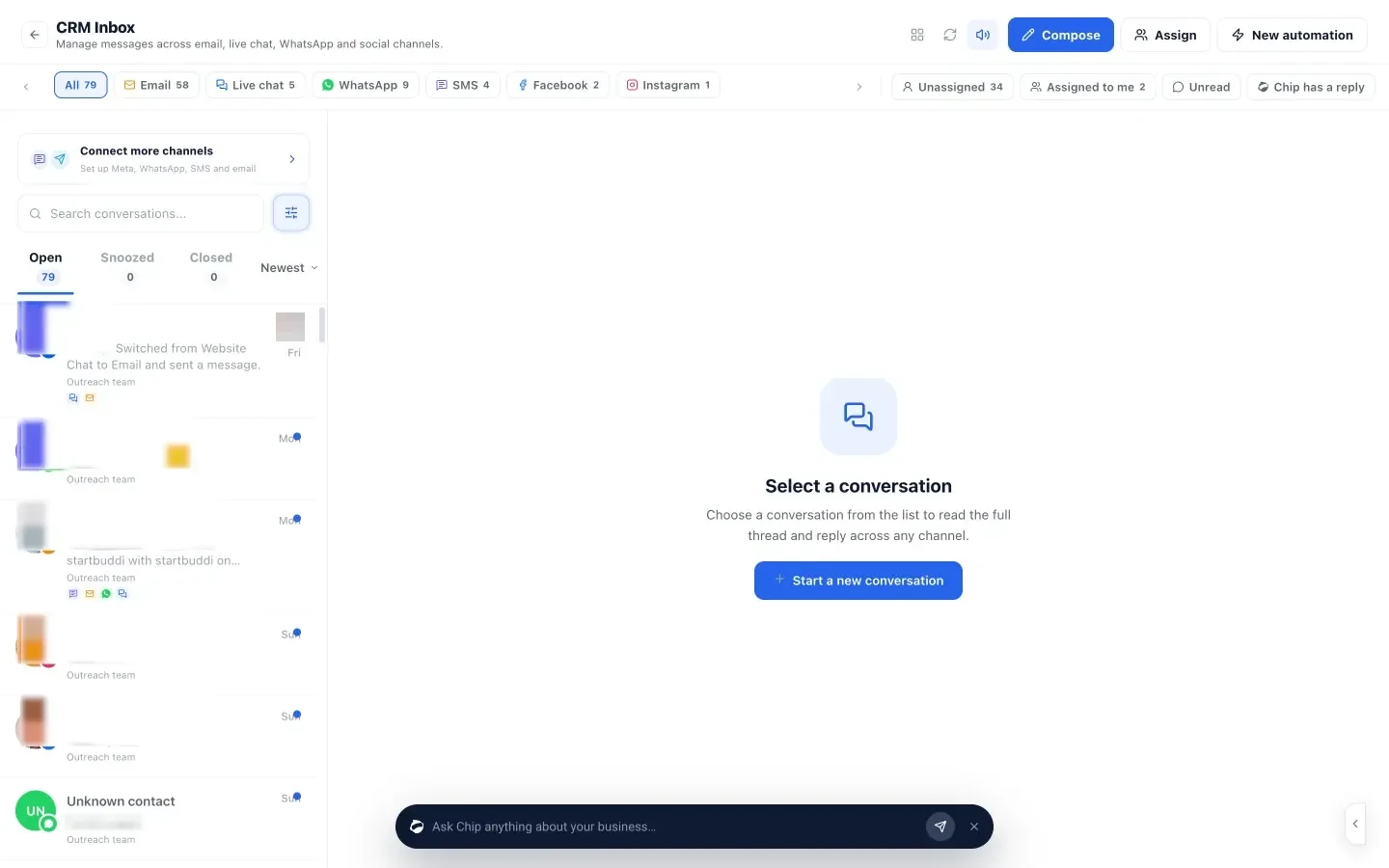
startbuddi isn’t an answering service and doesn’t answer your business phone number. It covers the enquiries that come in through other channels. In the startbuddi Inbox, you can choose, channel by channel, when Chip replies: straight away, when nobody on the team replies within a set time, or outside business hours. Chip can tell customers it’s an AI, and it hands the conversation to your team when a customer asks for a person. Chip auto-reply is on paid plans and uses Chip credits.
On your website, Chip can also take voice calls that visitors start from the website chat widget, as a browser call (currently in Beta). Calls to your phone line still need your team, a phone system or an answering service.
See how this works for IT teams, or check pricing.
Answer every message, not just the calls
Let Chip cover website chat and your inbox channels out of hours, and hand the rest to your team. Start free with startbuddi.
Answering Service is part of Chip & AI agents in startbuddi.
See Chip & AI agentsRelated terms
FAQ
What does an answering service do?
An answering service answers your business calls when you can't, takes messages and passes urgent calls to the right person by your rules. You receive the messages by email, text or app. Some also book appointments or answer simple questions.
What is the difference between an answering service and a call centre?
An answering service mainly takes messages and escalates calls for many small clients. A call centre usually handles larger volumes for one organisation, often with full customer service or sales work. The line between them is blurring as services add more tasks.
How much does an answering service cost?
Most charge per call, per minute or for a monthly bundle, and after-hours-only plans are usually cheaper than all-day cover. Estimate your monthly call count and average call length, then compare quotes on the same numbers. Check each provider's current pricing page.
Is an answering service worth it for a small business?
It's worth it if missed calls cost you work, for example emergency callouts or new clients who won't leave a voicemail. If most enquiries arrive by WhatsApp, email or website chat, those channels may matter more than the phone.
Can an answering service be automated?
Yes. Some services use recorded phone menus, and newer ones use AI that talks to the caller. Automated answering suits simple, repeated requests, but it should always offer a way to reach a person.
Tiwalade Joanna Okedara-Kalu is the founder, CEO and CTO of startbuddi, the business system that brings clients, bookings, invoices, projects, marketing and the Chip AI assistant into one place. Tiwalade builds software around how service businesses really work day to day, and writes about client management, getting paid on time and why small businesses outgrow the tools they start with.
Founded startbuddi and leads its product and engineering