Consultants get hired for their expertise. They lose clients over their process. You can be the best strategist in the room and still damage a relationship because a…
- What Is Project Management for Consultants and Why Is It Different?
- How Do Consultants Define Scope Without Setting Themselves Up to Fail?
- What Does a Reliable Consulting Project Timeline Actually Look Like?
- Why Do Consultants Struggle With Managing Multiple Clients at Once?
- What Are the Most Common Project Management Mistakes Consultants Make?
Consultants get hired for their expertise. They lose clients over their process. You can be the best strategist in the room and still damage a relationship because a deadline slipped, a deliverable was unclear, or a client felt left in the dark for two weeks. Good project management for consultants is what stops that from happening and it is what separates consultants who grow by referral from those who are always chasing the next engagement.
This guide covers how consulting projects are structured, where they typically break down, and the habits that reliable consultants build to deliver on time, every time.
What Is Project Management for Consultants and Why Is It Different?
Project management for consultants is the process of planning, executing, and delivering client engagements in a structured, repeatable way — managing scope, timelines, communication, and results simultaneously.
What separates it from standard project management is external pressure. You are not managing internal teams with fixed priorities. You are working with clients who shift expectations and deadlines that were often set before the full scope was agreed.
Key differences:
- You are accountable to a paying client, not a manager
- Scope is negotiated, not assigned
- Success is measured by client perception, not just task completion
- Communication failures directly damage your reputation and revenue
That is why project management consulting as a discipline has its own practices, tools, and failure points that generic project management advice does not address.
How Do Consultants Define Scope Without Setting Themselves Up to Fail?
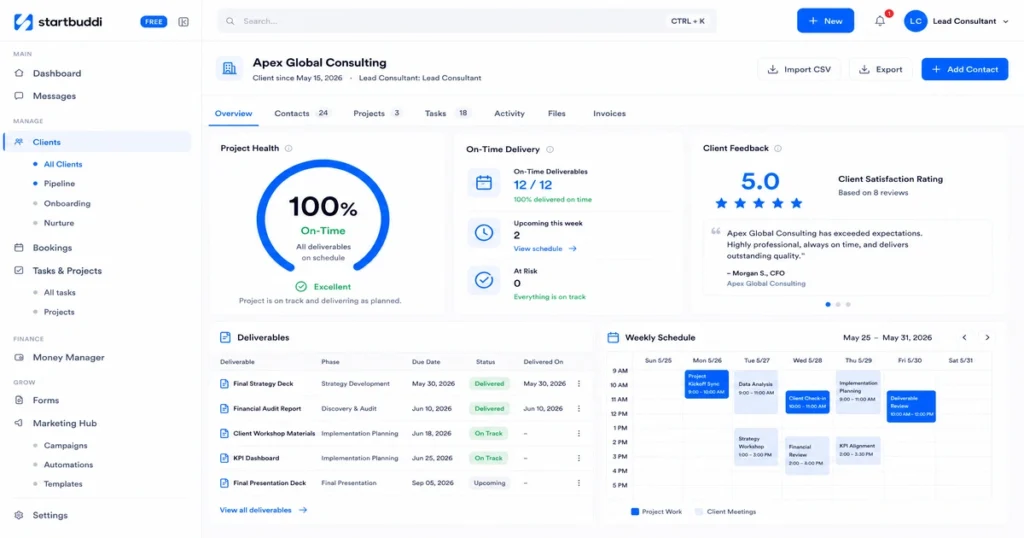
Scope creep is the number one reason consulting projects go over budget and past deadlines. It happens when new requests get absorbed without adjusting the timeline or fee.
A solid scope definition includes:
- Deliverables: Exactly what will be produced — reports, strategies, workshops
- Exclusions: What is explicitly not part of this engagement
- Success criteria: How the client will measure a good outcome
- Change request process: What happens when new requests come in
When a client asks for something outside the agreement, a documented scope makes that conversation straightforward. It protects both sides.
What Does a Reliable Consulting Project Timeline Actually Look Like?
Most consultants underestimate timelines because they plan for best-case scenarios. Reliable client project delivery starts with building a buffer from day one.
A practical timeline follows five phases:
- Discovery — stakeholder interviews, data gathering, understanding the real problem
- Planning — confirming milestones, assigning tasks, agreeing on deliverables
- Execution — core work tracked weekly against the plan
- Review — client feedback cycles with documented approvals
- Closure — final delivery, retrospective, and next-step conversation
Each phase needs a clear output and a sign-off point. Without sign-offs, clients revisit decisions already made, which destroys efficiency and trust.
Why Do Consultants Struggle With Managing Multiple Clients at Once?
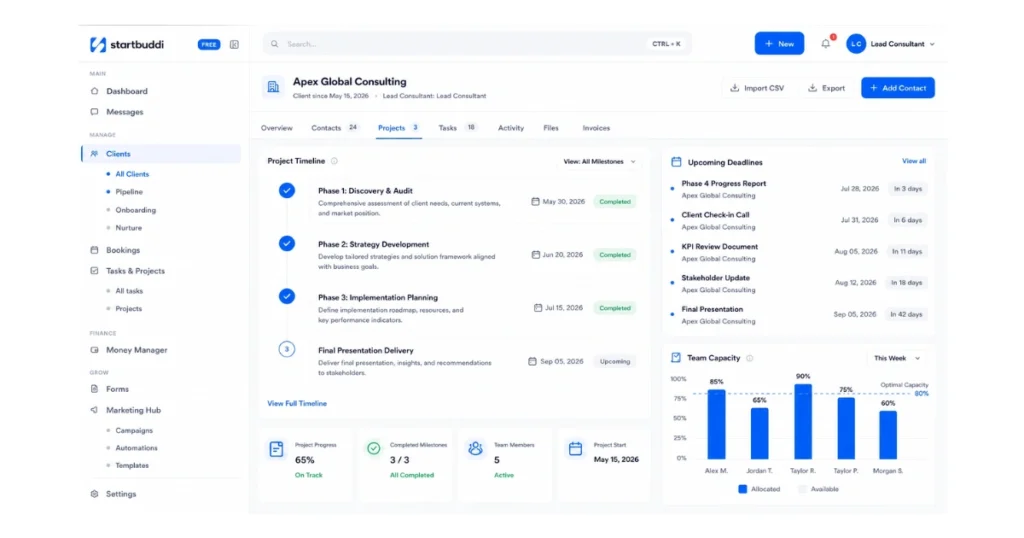
The problem is rarely capacity. It is visibility. When you switch between three projects in the same week, tasks fall through gaps and communication becomes inconsistent.
What separates high-performing consultants from overwhelmed ones:
- Centralised task tracking — every project in one place, not spread across five tools
- Time blocking — dedicated focus hours per client, not reactive switching
- Weekly reviews — 30 minutes every Monday to spot what is at risk
- Client tracking — clients see progress without chasing you for updates
A good system for keeping client information organised is what stops things falling through the cracks as your client list grows.
What Are the Most Common Project Management Mistakes Consultants Make?
- Skipping discovery to start faster — leads to misaligned deliverables
- Verbal scope agreements — impossible to reference or enforce
- Irregular updates — clients fill information gaps with anxiety
- No change request process — scope creep becomes the norm
- Delivering without confirming success criteria — you think it is done, the client does not
These are process problems, not skill problems. Fix the process once and it works across every engagement.
What Is the Best Project Management Software for Consultants?
The best project management software for consultants is the one you will actually use consistently, not the one with the most features.
The categories that matter:
- Task tracking: ClickUp, Asana, or Notion for a visual overview of all active work
- Time tracking: Toggl or Harvest to protect billing accuracy
- Client and project management: Tools that connect your CRM, tasks, invoicing, and communication in one place
The right consulting project management software does not need to be expensive. If you are running a lean consulting practice, startbuddi is worth a look — it combines CRM, task management, invoicing, bookings, and an AI assistant in one workspace built specifically for service businesses and consultants, and you can get started for less than $10.
How Should Consultants Handle Client Communication During a Project?
Poor communication is the most cited reason clients do not rehire consultants, even when the work was strong.
A reliable cadence:
- Kickoff call — align on goals, timeline, and working style
- Weekly written update — what was done, what is next, any blockers
- Milestone reviews — documented approvals tied to major deliverables
- Issue escalation protocol — agree upfront how problems get flagged
Clients do not need every detail. They need to feel informed and confident. Consistent updates do that without consuming your schedule.
Frequently Asked Questions
What is the biggest challenge in project management for consultants?
Scope creep. Without a documented scope and formal change process, clients expand the project over time and consultants absorb the extra work unpaid. Clear scope at the start is the single most effective fix.
Run this from one workspace
Clients, projects, money and marketing — connected, not scattered across five apps.
See how it worksHow many projects can a consultant manage at once?
Two to four active projects is realistic for most independent consultants, but only with a centralised system. Beyond that, delivery quality drops without support or automation.
Do consultants need a project management certification?
Not for most engagements. Certifications like PMP are useful for enterprise project management consulting but practical process habits matter more at the small business level.
How do you stop clients from constantly changing scope?
Use your documented scope. Present every new request as a formal change, show the impact on timeline and cost, and let the client decide. Most clients respect the structure.
Conclusion
Delivering on time, every time, comes down to a clear scope, a structured process, and consistent communication. Project management for consultants is not about rigid methodology or expensive tools, it is about removing the uncertainty that causes projects to slip.
startbuddi gives consultants the infrastructure to actually run this well. CRM, tasks, invoicing, bookings, and AI support in one place, built for service businesses, and accessible for less than $10 to get started. Whether you are taking on your first client or managing ten, startbuddi removes the operational friction that makes consulting harder than it needs to be.
Put this into practice
Everything in this guide is built into startbuddi — free to start.
Start freeWritten by
Chinonye Umezinne
SEO Copywriter| Email growth Specialist| I help businesses increase revenue with strategic SEO content & high-converting email funnels.
Keep reading
Related playbooks
Stop reading. Start doing.
Free to start. No card needed. Your full workspace is ready in five minutes.