
Most ecommerce businesses pour money into getting new customers and almost nothing into keeping the ones they already have. That is a costly mistake. The sale is not…
- What Is a CRM for Ecommerce and Why Do You Need One After the Sale?
- What Should You Look for in the Best CRM for Ecommerce?
- Which Are the Top 5 CRM Tools for Ecommerce Businesses?
- How Does a CRM Improve Post-Sale Customer Relationships in Practice?
- Frequently Asked Questions
Most ecommerce businesses pour money into getting new customers and almost nothing into keeping the ones they already have. That is a costly mistake. The sale is not the finish line.
It is the starting point of the customer relationship. A good CRM for ecommerce helps you manage what happens after the order confirmation so buyers come back instead of disappearing.
This guide covers what to look for in an ecommerce CRM, the top 5 tools worth using in 2025, and how to turn one-time buyers into repeat customers.
What Is a CRM for Ecommerce and Why Do You Need One After the Sale?
A CRM for ecommerce is software that stores and organizes customer data including purchase history, communication logs, and buying behavior so you can manage relationships at scale rather than chasing buyers manually.
Without one, the pattern is always the same. Customers buy. You ship. Then silence. No follow-up, no re-engagement. They forget you and buy from someone else next time.
Research from Bain & Company and Harvard Business School found that a 5% increase in customer retention can boost profits by 25 to 95%.
Repeat buyers already trust you. They spend more, convert faster, and cost far less to win than cold traffic. A CRM for ecommerce business closes the gap between the first purchase and the second one.
What Should You Look for in the Best CRM for Ecommerce?
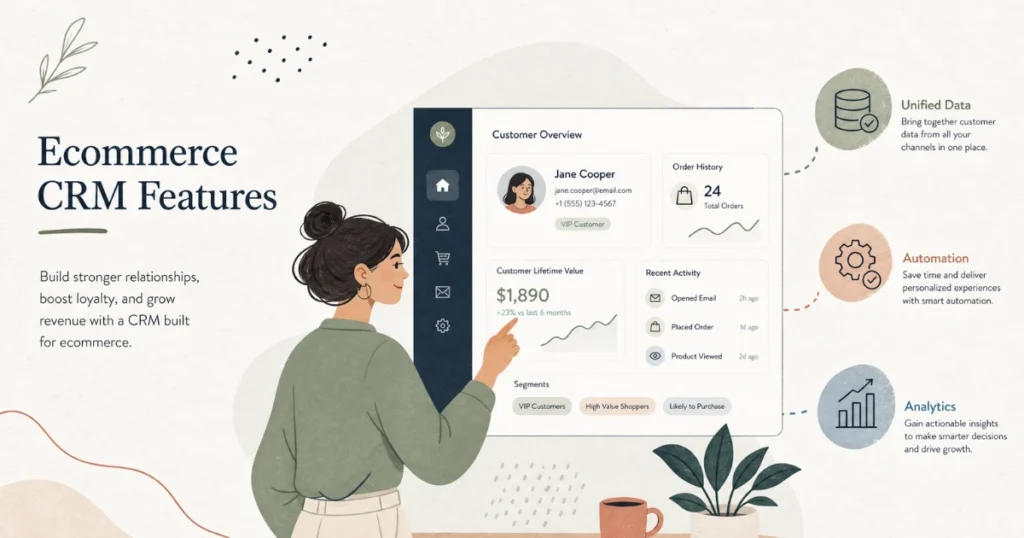
Before picking any crm software for ecommerce, make sure it does these four things:
- Unified customer records. Purchase history, notes, emails, and invoices in one profile. Not spread across tabs.
- Automation triggers. Post-purchase follow-ups, re-engagement sequences, and reminders that run without manual input.
- Behavioral segmentation. Group customers by spend, frequency, or last active date so messages are relevant, not generic.
- Marketing integration. Email, SMS, or WhatsApp campaigns driven by live CRM data, not static exports.
If a tool cannot do all four, it will not retain customers after the sale.
Which Are the Top 5 CRM Tools for Ecommerce Businesses?
| Tool | Best For | Starting Price |
| startbuddi | Service businesses selling online and managing client relationships | From $4.99/mo |
| HubSpot | Free CRM with pipeline and lifecycle workflows | Free plan available |
| Omnisend | Email and SMS automation for ecommerce brands | From $16/mo |
| Freshworks CRM | Omnichannel customer support and engagement | From $11/mo |
| Zoho CRM | Flexible mid-market CRM with ecommerce integrations | From $14/user/mo |
1. startbuddi — Best CRM for Service Businesses That Sell Online
Not every ecommerce business sells physical products through a store. A large and growing number of online businesses sell services — consulting packages, coaching programmes, creative retainers, recurring delivery work. These businesses have real post-sale relationship needs and most traditional ecommerce CRMs are not built for them.
That is exactly where startbuddi fits. It gives service businesses that operate online a single workspace for CRM, invoicing, bookings, payments, and marketing without stitching together five separate tools. Every client record holds a full activity timeline including bookings, invoices, notes, and follow-ups so your team always has full context on every relationship.
Post-sale follow-up is handled through built-in automation. Chip AI monitors outstanding balances and fires payment reminders at Day 3, Day 7, and Day 14. The marketing hub runs email, SMS, and WhatsApp campaigns tied to live CRM segments so re-engagement happens automatically when a client goes quiet. If you run a service-based online business and need your client relationships managed as tightly as any ecommerce store manages its buyers, startbuddi does that cleanly starting at under $10 a month.
Key features:
- Full CRM with complete client timeline and activity history
- Automated follow-up reminders and re-engagement sequences
- Email, SMS, and WhatsApp campaigns from live CRM segments
- Chip AI for payment monitoring and automated invoice reminders
- Bookings, tasks, invoicing, and project management all connected
2. HubSpot — Best Free CRM for Growing Ecommerce Teams
HubSpot’s free CRM covers contact management, deal pipelines, email marketing, and lifecycle automation at no cost. It segments contacts by behavior and lifecycle stage and handles post-sale tracking well. Meaningful automation requires a paid upgrade, but as a free starting point it is hard to beat.
Best for: Early-stage ecommerce businesses that need a solid CRM without upfront cost.
3. Omnisend — Best for Ecommerce Marketing Automation
Omnisend connects to Shopify and WooCommerce and excels at behavior-triggered sequences including abandoned cart emails, post-purchase flows, win-back campaigns, and purchase-based product recommendations. Not a full CRM, but the strongest option if your post-sale strategy runs on email and SMS.
Best for: Ecommerce brands on Shopify or WooCommerce wanting powerful email and SMS automation fast.
4. Freshworks CRM — Best for High-Volume Customer Support
Freshworks manages email, live chat, phone, and social interactions from one inbox. AI chatbots, behavioral analytics, and omnichannel routing are built in. More support-focused than marketing-focused, which suits ecommerce operations where post-sale customer service is the primary touchpoint.
Best for: Ecommerce businesses with a support team handling high volumes of post-sale queries across multiple channels.
5. Zoho CRM — Best for Flexible Mid-Market Ecommerce Teams
Zoho sits between HubSpot’s free tier and enterprise-level tools. It offers pipelines, workflow automation, custom modules, and integrations with Zoho Commerce. The learning curve is real, but for teams that need crm software for ecommerce with room to build custom workflows, Zoho delivers.
Best for: Mid-size ecommerce teams that need a customizable CRM and are open to the Zoho ecosystem.
How Does a CRM Improve Post-Sale Customer Relationships in Practice?
Most churn happens in the silence after delivery. Here is what a properly set-up best crm for ecommerce business does to fill that silence:
Day 1. Automated thank-you email goes out with a feedback request. No manual sending.
Day 7. If no reorder or engagement, a soft re-engagement email fires with a product recommendation.
Day 30. Still no second purchase? A win-back sequence starts with a targeted offer for the right segment.
Ongoing. Every interaction gets logged to the customer profile. Full context, every time.
This is also how best crm software for distributors with built-in ecommerce keeps wholesale accounts from going cold. Every buyer relationship stays organized and no account gets forgotten.
Frequently Asked Questions
Run this from one workspace
Clients, projects, money and marketing — connected, not scattered across five apps.
See how it worksWhat is the difference between a regular CRM and a CRM for ecommerce?
A standard CRM is built for B2B sales pipelines with long deal cycles. A CRM for ecommerce handles high-volume individual transactions, repeat purchase behavior, and post-sale retention connected directly to store data and marketing tools.
What is the best CRM for ecommerce on a tight budget?
startbuddi and HubSpot are the strongest options for cost-conscious businesses. startbuddi starts at under $10 a month and is built specifically for service businesses managing client relationships online. HubSpot has a solid free plan for product-focused ecommerce teams getting started.
How does ecommerce marketing automation connect to a CRM?
Your CRM holds the data including purchase history, tags, and last contact date. Ecommerce marketing automation uses that data to trigger targeted sequences automatically instead of sending one broadcast email to everyone.
Can a CRM reduce customer churn for ecommerce businesses?
Yes. It surfaces at-risk customers early, specifically buyers who went quiet or only purchased once, so you can reach out before they leave. Automated post-sale sequences recover far more buyers than generic emails.
Conclusion
The customer who just bought from you is your biggest revenue opportunity, but only if you stay in contact after the sale. The best CRM for ecommerce keeps post-sale communication running automatically so every transaction builds toward the next one.
If you run a service-based online business, startbuddi gives you a full CRM, invoicing, marketing automation, and client communication in one workspace for less than $10 a month. No tool-stacking, no extra cost. startbuddi is where service businesses that sell online get properly organized without overpaying for software built for someone else.
Pick one tool from this list, set up your first post-sale automation, and build the repeat revenue already sitting in your existing customer base.
Put this into practice
Everything in this guide is built into startbuddi — free to start.
Start freeWritten by
Chinonye Umezinne
SEO Copywriter| Email growth Specialist| I help businesses increase revenue with strategic SEO content & high-converting email funnels.
Keep reading
Related playbooks
Stop reading. Start doing.
Free to start. No card needed. Your full workspace is ready in five minutes.