How to manage agency finances without an accountant
A practical system to manage your agency finances day to day: separate accounts, tax set-asides, profit per client, faster payment and a 60-minute monthly routine.


Chinonye wrote this while on the startbuddi team. The product has changed since, so the team updated it on .

- Keep business money separate, split every payment into tax, buffer, profit and operating pots, record invoices and expenses as they happen, and check profit per client monthly. Use an accountant for returns, VAT, payroll and big decisions, not for knowing whether you made money.
You can manage agency finances without an accountant day to day if you do five things: keep business money in its own account, record every invoice and expense as it happens, set aside tax from every payment, check profit per client each month, and keep enough cash to cover at least a month of costs. That covers the running of the business. You will still want an accountant for tax returns, company accounts and big decisions, but you won’t need one to know whether you made money last month.
This guide is for small creative, marketing and digital agencies, from a solo founder with contractors to a team of ten. It covers the money system, the numbers that matter for an agency, a monthly routine that takes about an hour, and a clear line on when to bring in a professional. Tax and legal points here are general information, not tax or legal advice.
What “managing agency finances” actually means
Managing your agency finances is not the same as doing your accounts. Accounting produces the formal records and returns the tax authority needs. Financial management is the weekly and monthly work of knowing what’s coming in, what’s going out, and whether each client is worth the effort. The first is often worth paying for. The second is yours, because nobody else knows your clients and projects well enough to do it.
Agencies have a few money habits that make this harder than it looks:
- Lumpy income. A big project pays in three instalments, then nothing for six weeks.
- Costs that follow the work. Freelancers, ad spend and stock images are paid before the client pays you.
- Hidden unprofitable clients. A retainer that looks healthy can quietly eat 40 hours a month more than you priced.
- Late payers. One slow client can hold back a month’s wages.
Step 1: Separate business and personal money
Open a business bank account and run every agency payment and cost through it. Mixing the two is one of the most common ways small business owners lose track of their money, and it makes tax time slow and expensive. The U.S. Small Business Administration’s guide to managing your finances treats a business bank account as a standard step, and most tax authorities expect business records you can separate from personal spending.
Then pay yourself on purpose. Move a fixed amount to your personal account on the same day each month, rather than dipping in when you need to. It makes your personal budget calmer and your business figures honest.
Step 2: Split every payment the moment it lands
A simple way to stop tax bills and quiet months from surprising you is to divide each payment as it arrives. Many small business owners use separate savings pots for this. The percentages below are an example to adapt, not advice:
| Pot | Example share of each payment | What it’s for |
|---|---|---|
| Tax | 20% to 30% | Income or company tax and any sales tax or VAT you charged |
| Cash buffer | 5% to 10% | Quiet months and late payers |
| Profit | 5% to 10% | Kept aside, then used for bonuses, investment or your own reward |
| Operating | The rest | Wages, contractors, software, rent |
Why the tax pot matters
Tax often falls due in large amounts, some time after you earned the money. In the US, the IRS says sole proprietors and partners generally need to make estimated tax payments through the year if they expect to owe $1,000 or more. In the UK, many self-employed people make payments on account by 31 January and 31 July, each usually half of the previous year’s bill. In Nigeria, check the current rules with the Nigeria Revenue Service. The rates and dates differ, but the lesson is the same everywhere: the money was never all yours to spend.
How big should the buffer be?
The JPMorgan Chase Institute studied about 600,000 US small businesses and found the median one held enough cash to cover 27 days of typical outflows. A quarter held 13 days or fewer. For an agency with lumpy income and one or two large clients, aim for at least one month of costs, and work towards three.
Step 3: Record invoices and expenses as they happen
You don’t need double-entry bookkeeping to run an agency well. You do need a complete record, kept up to date.
- Every invoice with its client, project, amount, due date and status.
- Every expense with the supplier, amount, category, date and a photo of the receipt. Link it to a client or project where it belongs, such as a freelancer’s fee or ad spend.
- Every payment received, matched to the invoice it pays.
Keep records for as long as your tax authority requires. The IRS says to keep records for 3 years in most cases, and longer in some. HMRC says the self-employed must keep records for at least 5 years after the 31 January deadline for that tax year. Our glossary entry on expense tracking explains the basics, and the expense report template helps if you reimburse your team.
Set a simple spending rule
Most agency money leaks through small, unapproved costs: another software seat, a stock photo pack, a freelancer booked without a budget. Agree one rule, such as “any new cost over $100, or any new subscription, needs the founder’s yes and a client or project to charge it to”. Review every recurring subscription once a quarter and cancel what nobody opened.
Step 4: Know your profit per client
This is where agencies make or lose money, and where an annual set of accounts won’t help you. Each month, for each client, work out:
Client profit = money collected from the client − direct costs for that client. Direct costs are freelancers, ad spend you didn’t pass on, stock assets and tools bought for that job. For a clearer picture, add the hours your own team spent multiplied by an internal hourly cost.
A worked example
A four-person agency bills a retainer client $4,000 a month, around £3,000 or ₦6,000,000. It pays a freelance copywriter $900 for that client. The team logs 45 hours, at an internal cost of $40 an hour, or $1,800. Profit on the client is $4,000 − $900 − $1,800 = $1,300, a 32.5% margin. A second client pays $6,000 but uses 110 hours and $1,200 of freelancers, leaving $400, under 7%. The bigger client is the less profitable one. That’s the conversation to have at the next renewal.
Our profit margin calculator does the sums for you.
Fix the pricing, not just the costs
When a client’s margin is low, the cause is usually one of three things: the price was set too low, the scope has grown without a new price, or the team is slower on that work than you estimated. Tracking hours per client, even on fixed fees, tells you which. Useful checks each quarter:
- Effective hourly rate: fee collected divided by hours spent. Compare it with the rate you meant to charge.
- Utilisation: the share of your team’s paid hours spent on client work. Admin, sales and internal projects are necessary, but if billable time is low, your prices must carry more of the overhead.
- Client concentration: if one client brings in more than a third of revenue, a single email can turn a good year into a hard one. Plan your buffer and your sales pipeline with that in mind.
Retainers help with lumpy income, but only if they are priced for the hours they really take. Review each retainer against actual time every three months, and adjust the fee or the scope before renewing.
Step 5: Get paid faster
For most agencies, the easiest money to find is money already earned. A few habits make a large difference to cash in the bank:
- Take deposits on projects, often 30% to 50% before work starts.
- Bill retainers in advance, on the first working day of the month.
- Invoice milestones the day they are approved, not at month-end.
- Offer easy ways to pay: card, bank transfer and a payment link.
- Chase on a schedule: a reminder before the due date, on the day, then a week after.
Our guide on creating a professional invoice that gets paid faster covers the invoice itself.
A 60-minute monthly routine for agency finances
Put this in your calendar for the first working week of each month.
- Close last month (15 minutes). Check every invoice sent, every payment received and every expense has a receipt and a category.
- Look at profit and loss (10 minutes). Revenue, costs and profit for the month and the year so far. Is it trending the way you expected?
- Review profit per client (15 minutes). Flag any client under your target margin.
- Chase what’s owed (10 minutes). List overdue invoices and send reminders.
- Look ahead (10 minutes). Expected payments and known costs for the next 30 days. Is the buffer enough?
If you want a deeper walkthrough of the profit and loss part, read our guide on tracking profit and loss for a small business.
Which tools to use for your agency finances
There are three common set-ups, and the right one depends on your size and how you work.
- A spreadsheet. Free and flexible, and fine for a solo founder with a few clients. It breaks when several people edit it, when receipts pile up, or when you need to know who has paid without checking the bank.
- Accounting software. Built for bookkeeping, bank feeds, VAT returns and year-end accounts. Often what your accountant prefers. It rarely knows about your projects, hours or sales pipeline.
- A business system with invoicing and expenses built in. Keeps money next to clients and projects, so profit per client is easy to see. Usually paired with an accountant at year-end.
Many agencies combine the last two. Our explainer on business finance manager software compares the options in more depth.
When you do need an accountant
Running your own agency finances doesn’t mean doing everything alone. Bring in a qualified accountant or tax adviser for:
- Year-end accounts and tax returns, especially for a limited company.
- Registering for and filing VAT, GST or sales tax.
- Payroll for employees, which carries its own legal duties.
- Choosing or changing your business structure.
- Raising investment, taking on a partner or selling the business.
- Any letter from the tax authority you don’t fully understand.
Good day-to-day records make every one of these faster and cheaper, because you hand over organised figures instead of a shoebox of receipts.
How startbuddi helps you manage agency finances
Money Manager in startbuddi covers the day-to-day side of this guide: invoices, payments, expenses, cash flow and profit by client or project. It’s available on every plan. The Free plan includes 5 invoices a month, and Starter removes the invoice limit (see pricing).
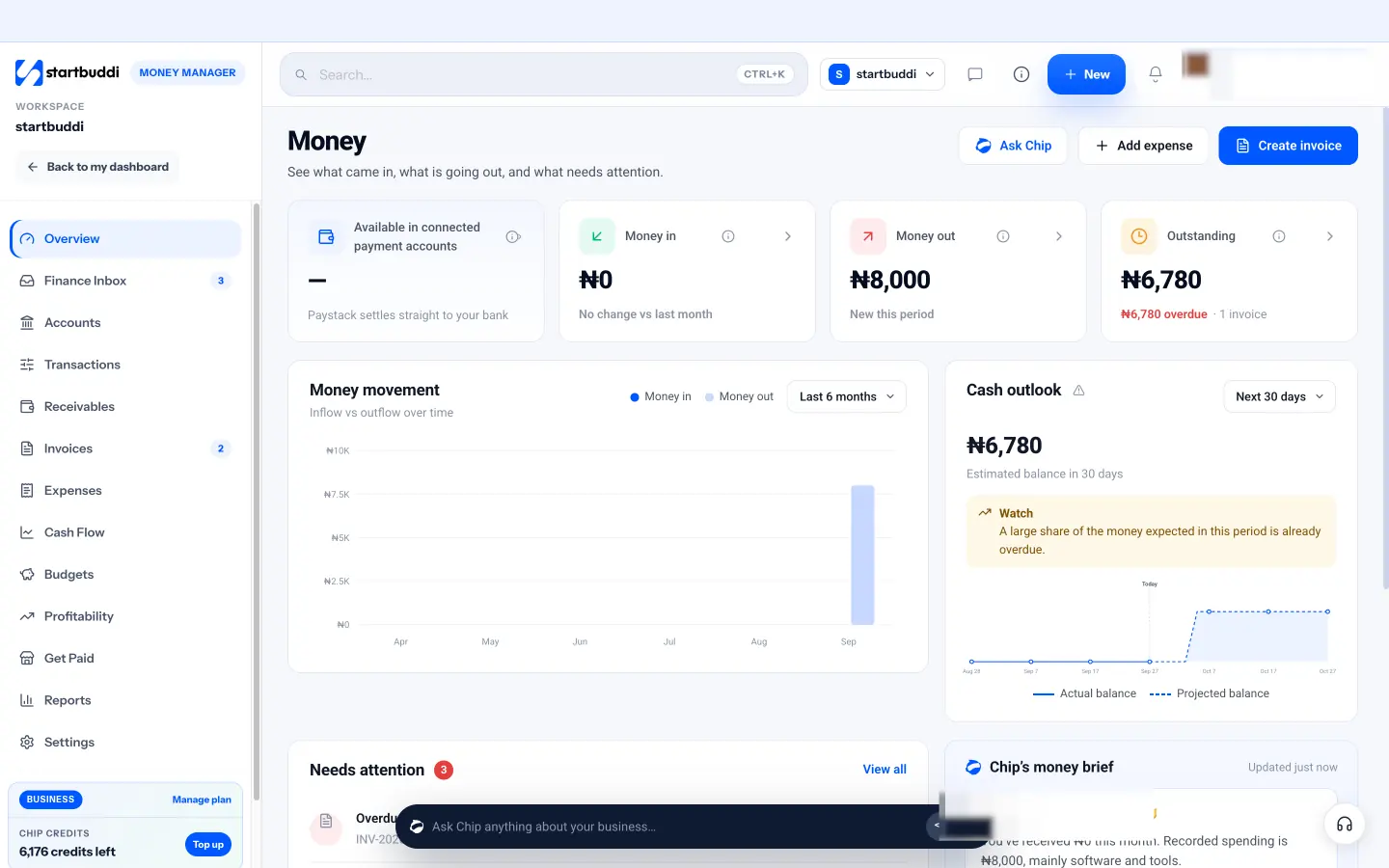
- Invoices and payments. Clients pay online by card through Stripe or Paystack, and those payments are recorded automatically. You can record bank transfers and cash by hand, including part payments. Receivables shows who owes you and has a one-click Remind button.
- Expenses. Log the supplier, amount, category and date, attach a receipt, and link the cost to a project or customer.
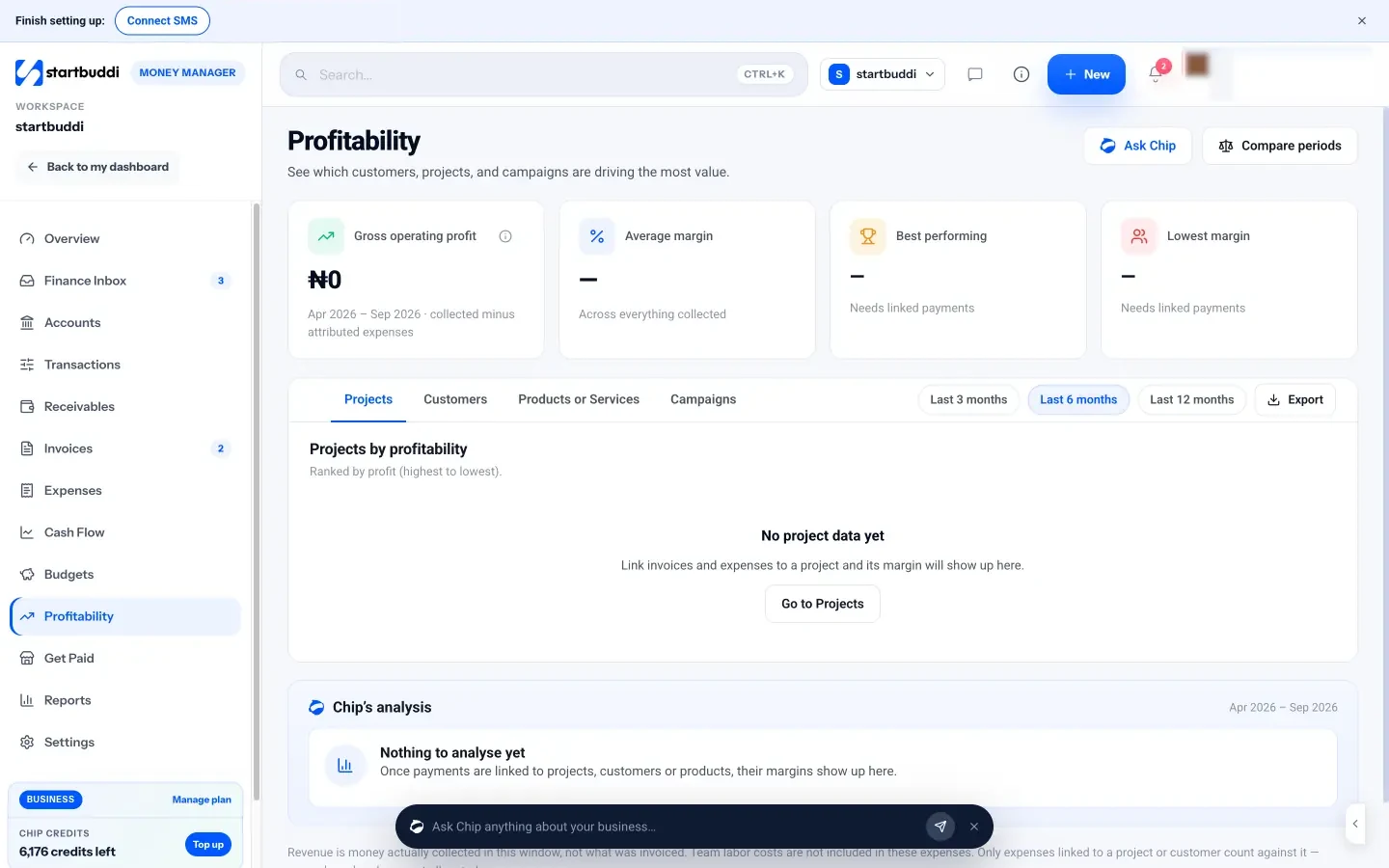
- Profitability. Revenue collected minus linked expenses, ranked by project, customer, product or campaign. Team labour costs are not included, so add your own time separately.
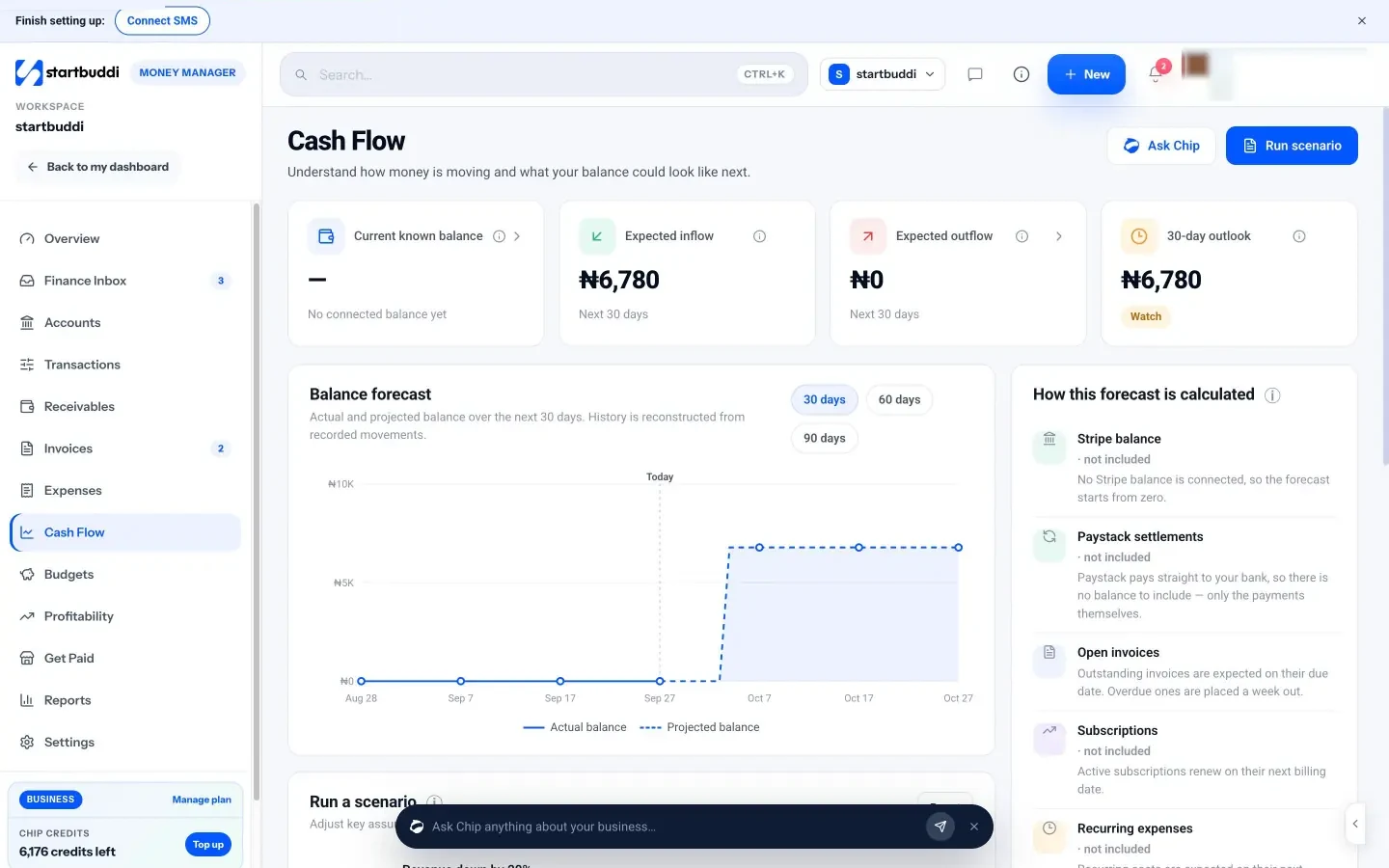
- Cash flow. A forecast built from open invoices, subscriptions and recurring costs, with a scenario tool that changes the forecast’s inputs without touching your records.
- Reports. A cash-basis profit and loss, receivables and payables, expenses by category and a running total of tax added to invoices, with CSV export for your accountant.
Be clear about what it isn’t. startbuddi is not accounting or bookkeeping software. It has no bank feeds, no QuickBooks or Xero sync, no payroll, no general ledger and no tax filing. Its reports are a cash-basis view for running the business, not statutory accounts. Many agencies use it alongside an accountant, exporting the figures at year-end. If you’re weighing it against accounting software, see startbuddi vs QuickBooks Online.
Your next step
This week, open a separate tax pot and move a share of your last payment into it. Then set a 60-minute money review for the first week of next month. If you want your invoices, expenses and client profit in one place, start free and see the plans on our pricing page.
Sources
- U.S. Small Business Administration: Manage your finances
- IRS: Estimated taxes
- IRS: How long should I keep records?
- GOV.UK: Payments on account
- GOV.UK: How long to keep your records (self-employed)
- Nigeria Revenue Service
- JPMorgan Chase Institute: Cash Flows, Balances, and Buffer Days
Frequently asked questions
Can I run my agency without an accountant?
You can handle day-to-day money yourself. Most agencies still use an accountant for year-end accounts, tax returns, VAT and payroll.
How much should an agency set aside for tax?
It depends on your country, structure and profit. Many owners set aside 20% to 30% of each payment and adjust once an accountant has checked their position.
How much cash buffer should an agency keep?
Aim for at least one month of costs and work towards three, especially if one or two clients make up most of your income.
What is the most important number for an agency?
Profit per client. It shows which clients fund the business and which quietly cost you money.
Is startbuddi accounting software?
No. It handles invoices, payments, expenses, cash flow and profit by client, but not bank feeds, payroll, ledgers or tax filing.
SEO Copywriter| Email growth Specialist| I help businesses increase revenue with strategic SEO content & high-converting email funnels.