Starting work without a signed client agreement is one of the fastest ways to lose money, time, and client trust. Scope creep, payment delays, and “that’s not what…
- What Is a Client Agreement and Why Does It Matter Before Work Starts?
- What Should You Include in a Client Agreement Contract?
- What Is the Difference Between a Client Agreement and a Client Service Agreement?
- What Clauses Do Most Business Owners Miss in Their Client Agreement Template?
- Frequently Asked Questions
Starting work without a signed client agreement is one of the fastest ways to lose money, time, and client trust. Scope creep, payment delays, and “that’s not what I asked for” disputes almost always trace back to one thing: nothing was written down before work began.
In this guide, you’ll learn exactly what to include in a client agreement to protect your business at the onboarding stage. You’ll also find the clauses most service providers skip and a comparison of when to use a client service agreement versus a project contract.
What Is a Client Agreement and Why Does It Matter Before Work Starts?
A client agreement is a legally binding document between a service provider and a client that defines the scope of work, payment terms, timelines, and responsibilities before any project begins.
It exists to remove ambiguity. When both parties sign before work starts, there is a shared record to return to when expectations shift, payment stalls, or scope expands without warning.
A 2024 project management survey found that 52% of projects suffer from scope creep when expectations are not clearly defined upfront. A signed client agreement is what prevents that from happening to your business.
Without one, you are operating on assumptions, and assumptions are expensive.
What Should You Include in a Client Agreement Contract?
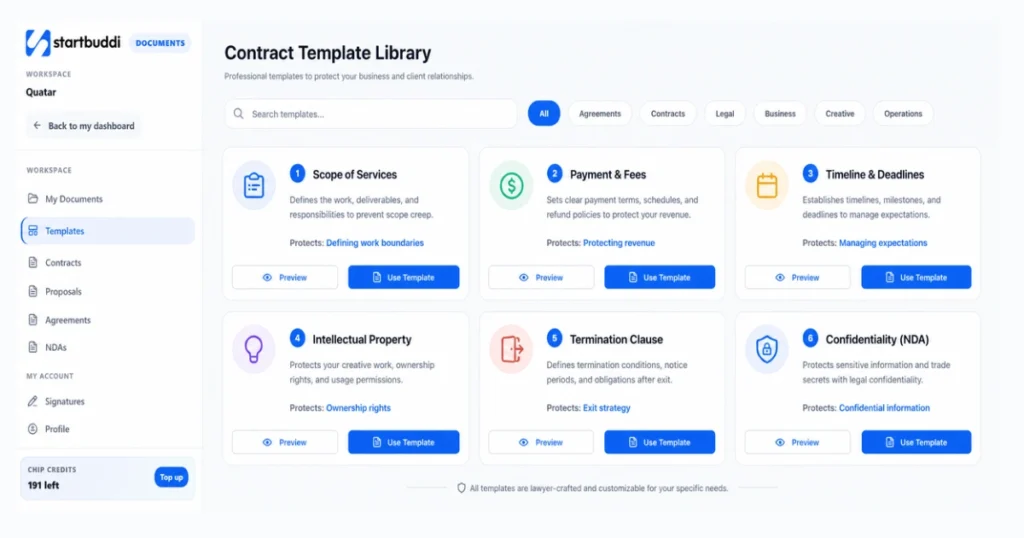
The goal is not a long document. It is a complete one. Every strong client agreement contract needs these sections:
Parties and authorization Full legal names, business names, and confirmation that whoever is signing has the authority to bind the business. Never start work based on approval from someone who cannot actually sign.
Scope of work Define exactly what you will deliver, in what format, and what is explicitly excluded. Vague scope is the single biggest cause of scope creep and this section is your first line of defense.
Payment terms State the total fee, deposit amount, payment schedule, accepted payment methods, and late fee policy. Even if you never charge a late fee, including one sets a professional expectation from day one.
Timeline and client dependencies Include a start date and final delivery date. Tie your deadline to client response time. If a client delays feedback by a week, your delivery date adjusts accordingly. Put this in writing.
Revision policy State how many revision rounds are included and define what counts as a revision versus a new request. This one clause eliminates the most common source of unpaid work.
Intellectual property Ownership transfers to the client only upon receipt of full payment. Until then, you retain the rights. State this clearly.
Confidentiality If the client is sharing sensitive business information, include a basic NDA clause. Even one paragraph signals professionalism and protects both parties.
Termination terms Define how either party exits, how much notice is required, and what the client owes for work already completed if they cancel. This prevents ghost situations and protects your income.
Signatures Both parties must sign, digitally or in writing. An unsigned document is not enforceable.
Many freelancers and consultants in Nigeria use startbuddi to manage client agreements, invoices, and project workflows from one dashboard. Pair that with a solid client tracking system and nothing falls through the cracks.
What Is the Difference Between a Client Agreement and a Client Service Agreement?
A client service agreement is a type of client agreement designed for ongoing relationships rather than one-off projects. Think retainers, monthly content management, bookkeeping, or any recurring engagement.
A well-structured client service agreement also lays the groundwork for retaining clients long term, because both parties have clear, documented terms they can rely on month after month.
Here is how the two differ:
| Project Agreement | Client Service Agreement | Client Agreement |
| Duration | Fixed end date | Ongoing / monthly |
| Scope | Per project | Per service tier |
| Payment | Milestone or lump sum | Monthly retainer |
| Termination | On delivery | 30 to 60 days’ notice |
| Best for | One-off work | Retainer clients |
If you deliver one-off projects, a standard client agreement contract works. If clients pay you monthly, a client service agreement protects both the relationship and your recurring revenue.
What Clauses Do Most Business Owners Miss in Their Client Agreement Template?
Most client agreement templates cover scope and payment. These five sections get left out and they cause the most damage.
Approval and sign-off process Define what counts as client approval. A voice note saying “looks good” is not a sign-off. Require written confirmation, email works, before moving to the next stage.
Communication boundaries state your working hours, response time, and preferred channels. This prevents clients from expecting late-night replies and gives you grounds to enforce boundaries professionally.
Force majeure This clause covers delays caused by circumstances outside your control, such as power outages, illness, or infrastructure failures. Without it, you are liable for delays that had nothing to do with your performance.
Liability cap Limit your liability to the total project fee. Digital service providers especially need this. You should not be held financially responsible for a client’s lost revenue because of a delayed campaign or landing page.
Dispute resolution Include a clause requiring mediation before either party pursues legal action. This keeps small disagreements from becoming expensive legal problems.
A complete client agreement template that covers all five of these clauses protects your business before problems start, not after. For agencies and consultants managing multiple clients, startbuddi simplifies contract tracking so no agreement gets lost or left unsigned.
Frequently Asked Questions
Run this from one workspace
Clients, projects, money and marketing — connected, not scattered across five apps.
See how it worksWhat should be included in a client agreement?
A client agreement should include the parties’ details, scope of work, payment terms, project timeline, revision policy, intellectual property ownership, confidentiality clause, termination terms, and signatures. These sections define expectations for both sides before any work begins.
What happens if a client refuses to sign a client agreement?
Treat it as a red flag. A client unwilling to sign a basic agreement before work starts is unlikely to respect the terms once the project is underway. You are within your rights to decline the engagement until an agreement is in place.
What is the difference between a client agreement and a client contract?
They refer to the same document. “Client agreement” is often used in service industries to sound less formal, while “client contract” carries a more legal tone. Both are binding when properly signed by both parties.
How long should a client service agreement be?
Long enough to cover all key terms and short enough that the client actually reads it. Most effective agreements run between one and four pages. Clarity matters more than length.
Conclusion
A solid client agreement removes ambiguity before a single task starts. Scope, payment, timelines, ownership, and exit terms documented and signed give both you and your client a clear foundation to work from.
The clauses most people skip, including approval processes, liability caps, and communication boundaries, are precisely the ones that prevent the most costly disputes. Start with a proper client agreement template, customize it per engagement, and make signing a non-negotiable step in your onboarding process.
Businesses looking for a simple way to manage contracts, proposals, and client workflows can get started with startbuddi for less than $10 per month.
Put this into practice
Everything in this guide is built into startbuddi — free to start.
Start freeWritten by
Chinonye Umezinne
SEO Copywriter| Email growth Specialist| I help businesses increase revenue with strategic SEO content & high-converting email funnels.
Keep reading
Related playbooks

Stop reading. Start doing.
Free to start. No card needed. Your full workspace is ready in five minutes.