You built something real. A service, a skill, a business you are proud of. But somehow, the clients are not showing up the way you expected. You are…
- What Is a Sales Funnel?
- The Stages of a Sales Funnel and What Happens at Each One
- Why Most Service Businesses Do Not Have a Real Funnel
- How a Sales Funnel Helps You Get Clients Automatically
- Frequently Asked Questions
You built something real. A service, a skill, a business you are proud of. But somehow, the clients are not showing up the way you expected. You are posting, sending emails, following up manually, and it still feels like you are starting from zero every single week.
If you’ve felt this way before, then you are not alone. Most business owners I talk to are not missing talent. They are missing a system. Specifically, they are missing a sales funnel.
And if you just thought “I have no idea what that means,” that is exactly why this post exists.
This guide will walk you through what is a sales funnel, how it works in simple terms, why your business needs one, and how you can start using one without spending months setting it up. By the end of this post, you will know how to stop chasing clients and start attracting them in a way that works even when you are not online.
What Is a Sales Funnel?
Most definitions make this sound complicated. They throw in terms like “pipeline stages” and suddenly you feel like you need a marketing degree just to get a client.
So let me keep this simple.
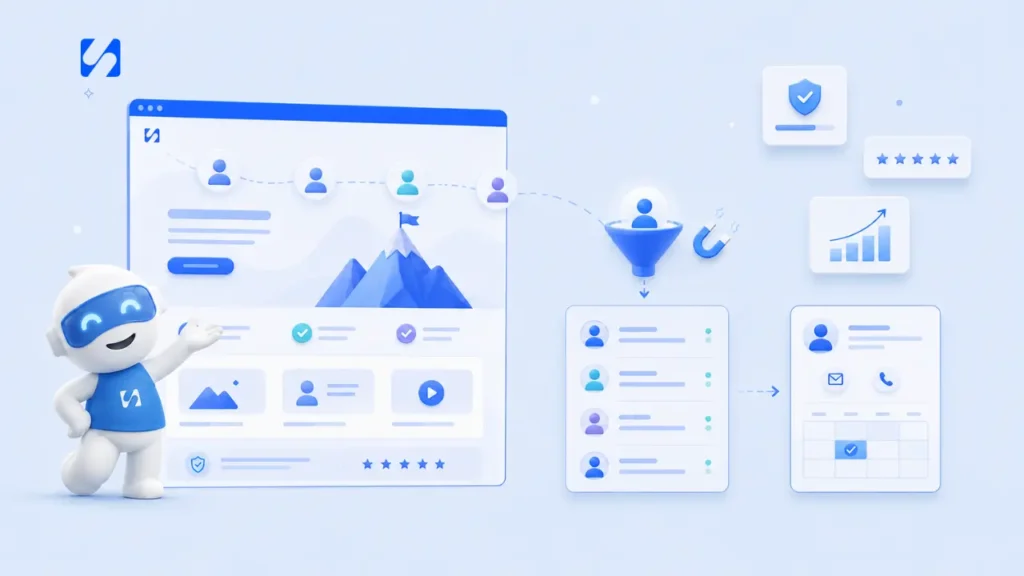
A sales funnel is the path a stranger takes to become your paying client. It is a series of steps that move someone from “I have never heard of you” to “I just paid you.” The word funnel makes sense because at the top you have a lot of people who might be interested, and at the bottom, you have the ones who are actually ready to buy.
Think about the last time you found a new business online. You saw something, clicked around, maybe signed up for something free, got a few emails, and eventually either bought or moved on. That was a sales funnel working on you. Good funnels feel natural, which is the goal for your business too. If you want a closer look at what that structure looks like in practice, this guide will help you see exactly how a simple funnel comes together from start to finish.
The Stages of a Sales Funnel and What Happens at Each One
Understanding what is a sales funnel becomes much easier when you see it broken into stages. Each stage represents where your potential client is in their thinking, and what they need from you at that moment.
Awareness is the top of the funnel. Someone finds you for the first time through a Google search, a social post, or a referral. Your job is simply to show up and make a good first impression.
Interest is where they start paying attention. They read your content or visit your website. They are curious but not ready to buy. This is where most businesses lose people because there is nothing to capture their information and keep them moving forward.
Consideration is when they are actively thinking about whether you can solve their problem. They compare options and look at testimonials. This is where your social proof and clear service pages matter most.
Decision is the moment of action. They are ready. The only question is whether your booking process, payment setup, and follow-up are smooth enough to close the gap. A broken checkout here costs you real money.
According to HubSpot’s marketing funnel guide, building a funnel means mapping your customer journey from initial awareness through conversion, then aligning content and touchpoints to each stage — because without that structure, you are simply hoping people figure out what to do next on their own.
Each stage requires a different message and a different tool, which is exactly why so many founders end up stitching together five platforms and still feel like nothing is working. A connected system like startbuddi bridges all those stages in one place, so your email capture, follow-up, and bookings work together without the usual scramble.
Why Most Service Businesses Do Not Have a Real Funnel
Here is the honest truth. Most founders struggle not because they are doing something wrong, but because nobody ever showed them how a funnel actually connects end to end.
What most people have is not a funnel. It is a collection of disconnected pieces. A website over here. A booking link somewhere else. An email list they set up once and forgot about. A payment processor that does not talk to anything. When a lead comes in, they manually follow up. When a payment fails, nobody notices.
That is not a system. That is a job you gave yourself that nobody hired you for.
A real sales funnel is connected. Someone finds you, lands on a page that speaks to their problem, takes a small action, and moves toward a paid relationship without you babysitting every step. The customer journey should feel seamless for them and for you.
This is where Startbuddi changes things. Instead of connecting ten tools yourself, you get a complete system where your website, bookings, CRM, payments, and follow-up sequences are already working together from day one. No duct tape. No months of setup. Just a funnel that actually functions.
How a Sales Funnel Helps You Get Clients Automatically
Now we get to the part most people actually care about. What is a sales funnel doing for your business when you are not actively working?
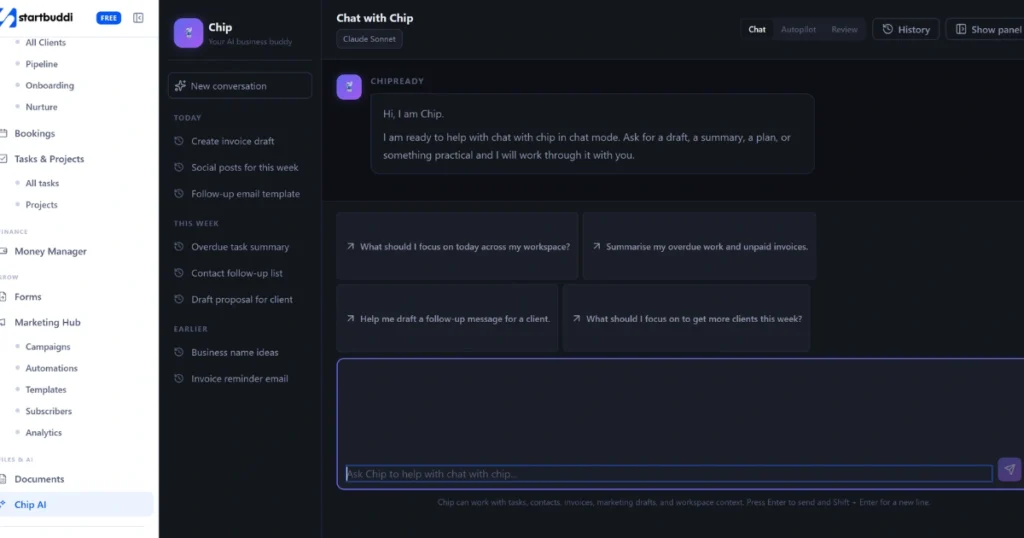
When your funnel is set up properly, it runs in the background around the clock. Someone finds your website at 11pm on a Tuesday, books a discovery call, and gets a confirmation email automatically. You wake up to a scheduled call in your calendar without sending a single message.
That is automated client acquisition. A good funnel includes a lead magnet, something free and useful that earns someone’s email address. It includes a nurture sequence, a series of emails that builds trust over time. And it includes a smooth path from interest to payment with no friction in between. If you want a practical example of what that whole flow looks like when it is running properly, startbuddi walks through exactly how each piece connects so nothing falls between the cracks.
According to Google’s 7-11-4 research on the Think with Google platform, buyers engage with an average of 11 touchpoints across 4 different locations before making a purchase decision. A funnel makes sure those interactions happen automatically instead of depending on you to show up every time.
The difference between founders who are always hustling and those who have predictable client flow is almost always this: one has a funnel, and one does not.
Frequently Asked Questions
Run this from one workspace
Clients, projects, money and marketing — connected, not scattered across five apps.
See how it worksWhat is a sales funnel in simple terms?
A sales funnel is the step-by-step path that takes someone from discovering your business to becoming a paying client. It guides people through awareness, interest, consideration, and decision automatically, so you are not chasing every lead manually.
Do I need a sales funnel if I run a service-based business?
Yes. Without a funnel, you are relying on word of mouth and manual follow-up. A funnel creates a repeatable system for attracting, nurturing, and converting clients without the constant hustle.
What tools do I need to build a sales funnel?
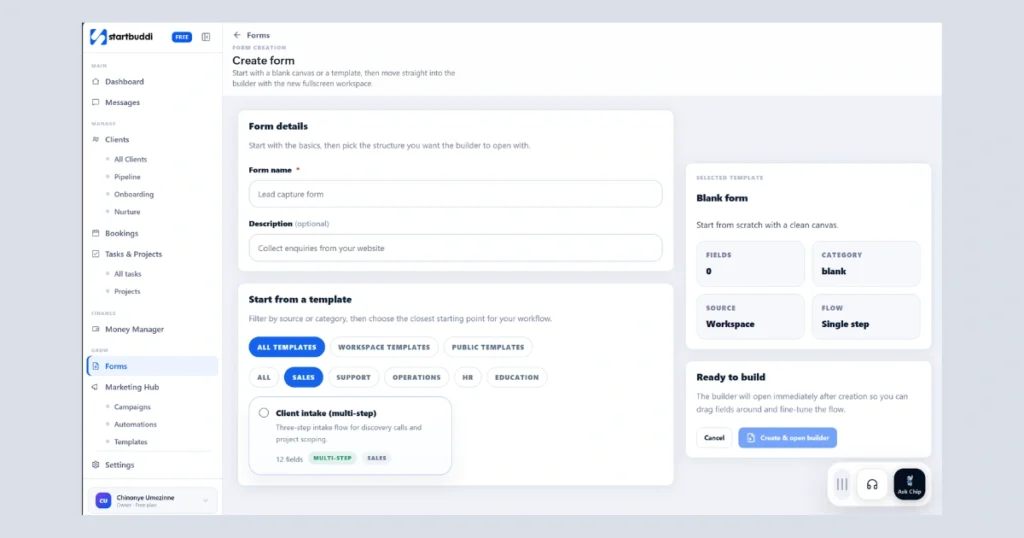
At minimum, you need a landing page, email capture, an automation sequence, a booking system, and a payment processor. The challenge is connecting them. Platforms like Startbuddi bundle all of this into one connected system so nothing falls through the gaps.
How long does it take to build a working sales funnel?
If you are connecting tools yourself, it can take weeks or months. With a done-for-you system, you can have a working funnel live in days.
Conclusion
You do not need to build something complicated. A simple sales funnel for a service business starts with a landing page that explains what you do, a lead magnet to capture emails, an email automation to follow up, a booking system to schedule calls, and a payment setup that works when clients are ready.
The challenge is connecting them. Many founders spend months signing up for ClickFunnels for pages, Mailchimp for emails, Calendly for bookings, and Stripe for payments. Instead of spending money across multiple tools, startbuddi brings all of it into one dashboard so your entire funnel runs from a single place without the cost and chaos of juggling separate platforms.
Put this into practice
Everything in this guide is built into startbuddi — free to start.
Start freeWritten by
Chinonye Umezinne
SEO Copywriter| Email growth Specialist| I help businesses increase revenue with strategic SEO content & high-converting email funnels.
Keep reading
Related playbooks
Stop reading. Start doing.
Free to start. No card needed. Your full workspace is ready in five minutes.