You spent weeks building your website. You picked the colours, wrote the copy. You added a services page, an about page, and a contact form. But visitors still…
- What the Customer Decision Journey Really Means for Your Site
- The Three Stages Every Page Must Speak To
- How to Rebuild Your Pages Around the Customer Decision Journey
- The Conversion Killers That Quietly Cost You Clients
- Frequently Asked Questions
You spent weeks building your website. You picked the colours, wrote the copy. You added a services page, an about page, and a contact form.
But visitors still leave without booking. Without buying. Without doing anything.
Here is what most people do not find out until much later: it is not about how your website looks. It is about how your website thinks. Specifically, it needs to think the way your customers think when they are deciding whether to trust you.
That process has a name. It is called the customer decision journey, and it is the most important framework for building a website that actually converts.
This guide will walk you through what the customer decision journey is, how real buyers move through it, how to structure your pages around it, and what quietly kills conversions even when founders get it mostly right. By the end, you will know exactly how to make your website work harder at every stage.
What the Customer Decision Journey Really Means for Your Site
Before we talk about structure, you need to be clear on what the customer decision journey actually is, because it is not a straight line.
Research from McKinsey’s consumer decision journey study shows that buyers loop back, compare options, revisit content, and only commit when they feel certain enough. Someone might find you on Google, leave, come back three days later, read your FAQ, and then finally book.
Your website needs to work at every point of that loop. When it is built around your services instead of your buyer’s questions, most of those touchpoints fail. Visitors do not feel understood. They leave.
So the starting point is not your homepage. It is your customer. And once you understand that, the way you build every page changes completely.
The Three Stages Every Page Must Speak To
The customer decision process moves through three core stages. Your website needs a clear answer ready at each one, because visitors arrive at different moments in their thinking.
The Awareness Stage is where someone realises they have a problem. They are searching with questions, not looking for a specific product yet. Your blog content, your SEO copy, and your homepage headline all live here. If your content does not speak to the problem they already feel, they scroll away.
The Consideration Stage is where they are actively comparing options. They want to know whether your solution fits their situation specifically. This is where trust signals, process breakdowns, and outcome-based content do the work. Psychologist Daniel Kahneman’s research on decision-making in Thinking, Fast and Slow shows that buyers look for reasons to feel safe, not just reasons to say yes. Testimonials and clear processes reduce that mental friction.
The Decision Stage is the moment they are ready to act. This is where friction kills conversions. If your booking is complicated, your pricing is buried, or your CTA is unclear, you lose people who were already convinced. This stage needs to feel fast, simple, and reassuring.
Most websites only think about the decision stage. A conversion-focused website structure gives equal attention to all three, and that is what separates sites that grow from sites that stagnate.
How to Rebuild Your Pages Around the Customer Decision Journey
Now the customer decision journey becomes practical. Here is how each page type maps to a stage, and what changes you need to make.
Your homepage should lead with the problem your customer already recognises. Not your brand name. Not a feature list. Use intent-based language like “struggling to get consistent clients?” rather than “welcome to our services.” Within three seconds, a visitor should know what you solve and who it is for.
Your services or solutions pages carry the weight of the consideration stage. Break down your process. Answer the objections they are already thinking. Use real outcomes instead of vague benefits. Your trust signals need to be visible here, not locked away on a separate testimonials page.
Your booking or sales page should remove every barrier at the decision stage. Keep it short. One clear action. Remove anything that might cause doubt at the last moment. Even small things like a confusing checkout experience can make someone who was ready walk away without completing.
The problem most founders run into is not understanding individual pages but connecting them into one coherent flow. The homepage does not lead naturally to the services page. The services page does not guide people toward a booking. Everything sits in silos and the journey breaks.
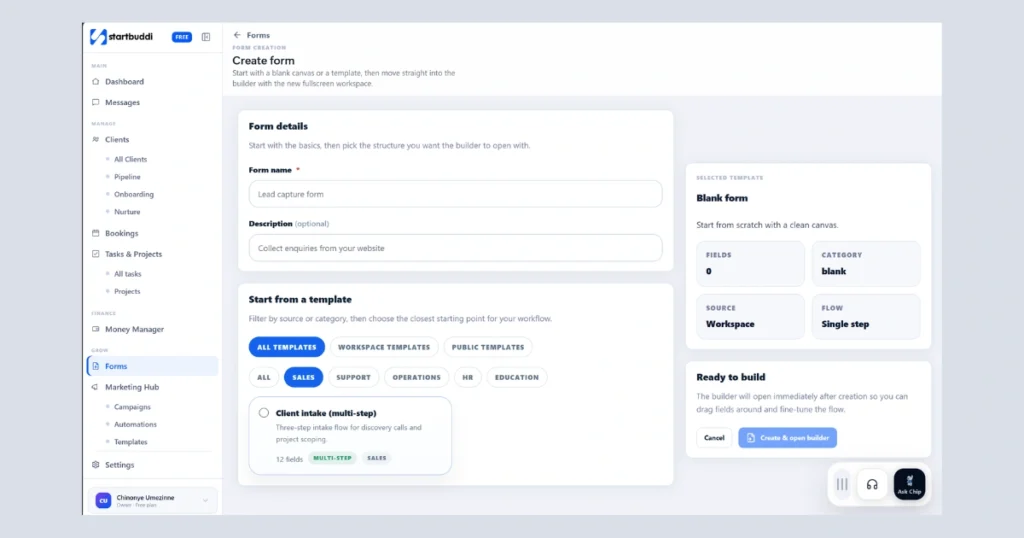
This is exactly where startbuddi changes things. Rather than leaving founders to figure out how pages should connect, what automations should follow a booking, or how a CRM ties into a website, Startbuddi builds the entire connected system for you. Website, bookings, CRM, payments, funnels, and automations, all structured around how your customers actually make decisions. You launch in days, not months.
The Conversion Killers That Quietly Cost You Clients
Even when founders understand the customer decision process stages, there are common gaps that silently kill conversions. This section is about catching them before they cost you.
Unclear next steps. Every page should have one clear action it leads toward. If a visitor has to figure out where to go next, most will not.
Trust signals in the wrong place. Many founders keep testimonials on a reviews page. But someone in the consideration stage needs to see social proof on the same page where they are reading about your service.
Slow or broken booking flow. Research from HubSpot on conversion optimisation shows that reducing form fields and simplifying the path to purchase can meaningfully improve results. People abandon when the process feels like too much work.
Copy that talks about you instead of them. Whether you are running an ecommerce brand or a service business, your language needs to follow the buyer’s thinking. Audit your pages and count how many times you say “we” versus “you.” If most of your copy is about your company, it is not aligned with where your buyer is.
For founders investing in SEO alongside their website structure, this alignment matters even more. Content that matches the right stage pulls in the right leads and keeps them moving forward.
Each of these friction points maps directly back to a stage in the customer decision journey. Fix the friction, and the journey flows.
Frequently Asked Questions
What is the customer decision journey?
It is the process a buyer goes through from first becoming aware of a problem to making a final purchase. It includes the awareness, consideration, and decision stages, and it often involves multiple visits before someone commits.
Run this from one workspace
Clients, projects, money and marketing — connected, not scattered across five apps.
See how it worksHow is the customer decision journey different from a funnel?
A funnel assumes a straight path. The customer decision journey reflects that buyers loop back, compare, and revisit content before deciding. A well-built website accounts for that non-linear behaviour.
What should each stage of my website include?
Awareness needs problem-focused messaging. Consideration needs trust signals and clear outcomes. Decision needs a frictionless, fast path to booking or purchase.
How do I know if my site aligns with the customer decision journey?
Walk through your site as a stranger would. Ask: does my homepage clearly name the problem I solve? Does my services page give someone enough confidence? Can someone book in under two minutes? If you hesitate on any of those, there is a gap to fix.
Conclusion
The customer decision journey gives you a real framework to audit and restructure every page so that visitors have a clear path from first click to final booking.
The hard part is execution. Rebuilding your site to properly map a customer journey means touching your homepage, service pages, booking flow, CRM, and automations all at once. For most founders, that is months of work with tools that never quite connect.
That is why startbuddi is the way. It gives you a complete system — website, bookings, CRM, payments, and automations all connected from day one. You can create a free account, choose only the modules you need, and launch in days. Paid plans start at less than $10, making it one of the easiest decisions you will make for your business.
Put this into practice
Everything in this guide is built into startbuddi — free to start.
Start freeWritten by
Chinonye Umezinne
SEO Copywriter| Email growth Specialist| I help businesses increase revenue with strategic SEO content & high-converting email funnels.
Keep reading
Related playbooks
Stop reading. Start doing.
Free to start. No card needed. Your full workspace is ready in five minutes.